
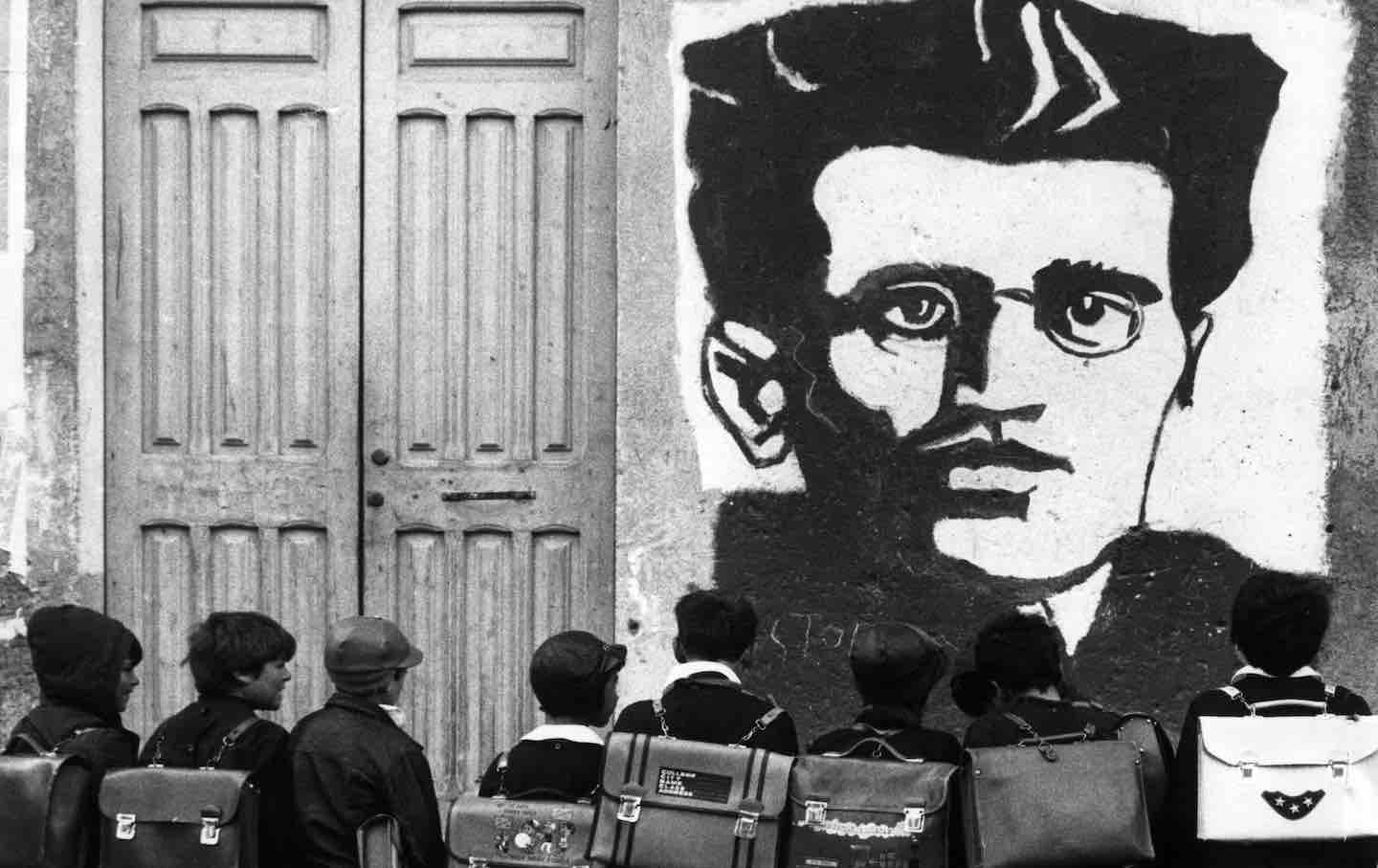
The Ghosts of Antonio Gramsci
Andy Merrifield’s Roses for Gramsci, a highly personal history of the Italian thinker and his work, examines his influence across generations.
Fifty years after Selections From the Prison Notebooks was first published in 1971, the joke remains popular: Antonio Gramsci is a communist you can bring home to your parents. It wouldn’t matter if they were liberals or Maoists, social democrats or anti-imperialists, populists or pacifists—everyone gets along with Antonio.
Books in review
Roses for Gramsci
Buy this bookThe reasons for Gramsci’s popularity, as well as his pliability, lie in the unique form of his oeuvre. His themes, for one, are startlingly capacious: serial novels and popular theater, factory councils and peasant estates, Catholicism and communism, newspaper design and comparative grammar, folklore and opera. There’s something here for everyone. At the same time, Gramsci’s prison writing—over 3,000 pages across 33 notebooks—is peppered with myriad “Aesopian” codes and terms. These ciphers were originally intended to confound Benito Mussolini’s Fascist censors, but their diffuse meanings have since triggered a series of heated polemics. And so, apart from attracting an unusually diverse readership, Gramsci’s work has also spawned diverse, frequently disparate, interpretations.
Is “subaltern” a code for the working classes? Is “hegemony” an economic force or a cultural power? Are “organic intellectuals” inherently more progressive? The answers to such questions depend upon your choice of scholar—whether, say, you’re reading a Foucauldian literary critic or a Marxist sociologist, a subaltern historian or a posthuman anthropologist. Over the years, Gramsci’s writing has been polished by critics of such diverse persuasions that it has now become a mirror: One opens his books only to confirm one’s own beliefs.
It’s no surprise, then, that when the English writer Andy Merrifield arrived in Rome, feeling “washed out intellectually,” Gramsci came to the rescue. In June 2023, Merrifield followed his wife’s new job to Italy. Having written a dozen books—about plagues, cities, donkeys, magic—he wasn’t sure if he had another book left in him. The “practical chores” of moving had left him burned out, prompting fears of an early retirement. A visit to the city’s Non-Catholic Cemetery, however, soon cured his writer’s block.
A brilliant bloom of flowers, cicadas, birds, and cypresses: This “tropical” cemetery looked nothing like the rest of Rome. A 2,000-year-old Egyptian pyramid of Caius Cestius stood in the vicinity. The distant Aurelian city walls, equally ancient, towered above the graves. This “magical kingdom” was an appropriate resting place for the cemetery’s famous denizens: the English Romantic poets John Keats and Percy Shelley. But Gramsci? The lush serenity was at odds with the circumstances of the revolutionary’s life. Gramsci had spent his last decade on the earth rotting, quite literally, in Fascist prisons. He suffered from uremia, angina, gout, tubercular lesions, arteriosclerosis, and Pott’s disease. By the time he died in 1937, at the age of 46, Gramsci’s head was so swollen that it resembled the otherworldly granite stones that have littered the southern landscape of his native Ghilarza since the Neolithic age. In a fitting reversal, however, his grave has since become a totem for Italy’s freedom from Fascist rule.
Merrifield, in recent years, has acquired a reputation for his stylish portraits of Western Marxists: the French Situationist Guy Debord; the English critic, poet, and novelist John Berger; the French philosopher and sociologist Henry Lefebvre; and, most recently, Marx himself. Roses for Gramsci is a welcome, if predictable, addition to this rogue’s gallery. What’s surprising, though, are Merrifield’s unconventional, playful methods. Previously, in The Amateur (2017), Merrifield had sketched out a stern critique of “professional intellectuals,” whose research remains detached from the world outside their campuses and offices. Appropriately enough, Roses for Gramsci isn’t interested in recycling academic exegeses of Gramsci’s texts. Instead, Merrifield seeks a living Gramsci, one no longer entombed in books or museums, much less in a cemetery. His trip to Gramsci’s grave wasn’t followed by a visit to the library. Instead, as befits an amateur, Merrifield instantly took up a new job at the cemetery.
Gramsci is, by the numbers, an incredibly popular thinker: There are over 23,000 references to his work—pamphlets, dissertations, newspaper articles, academic essays, artworks—according to the informal biography maintained by the Fondazione Gramsci. In just the past two years, at least three new biographies have been published as well. Gianni Fresu has written an intellectual biography in broad strokes, while Jean-Yves Frétigné has affixed the revolutionary under a microscope (the appendices include family trees and a list of prison visitors). George Hare and Nathan Sperber, meanwhile, have extended the biographical scope by examining Gramsci’s legacy in a contemporary context of right-wing authoritarianism.
Roses for Gramsci, however, isn’t a biography, at least in any conventional sense. It’s a slim book; one is tempted to describe it as a miniature portrait. Its eight chapters—with carefully curated titles like “Goblin” and “A Rose”—certainly give the impression of a refined belletrist at work. But on a closer look, Merrifield harbors a loftier aspiration: He wants to rewire our canonical, hallowed ideas of intellectual labor. Merrifield’s narrative consists of instinctual jottings of archival study, political analysis, travel, photographs, and personal memories. He takes to Gramsci the way a person might take to cooking or gardening. Not surprisingly, some of these diaristic notes were first posted on his blog.
Merrifield’s prose is informal and, for that reason, inviting. And not just for general readers—even professional Gramscians will welcome the change of scenery. In the cemetery, Merrifield works at the Visitors’ Center. His job as a volunteer also inflects his portrait of Gramsci: Merrifield might be holding the brush, but it’s the visitors who command it. For instance, if the old man sitting on the “Gramsci bench” wants to talk about Antonio’s antagonists—the onetime Hegelians Benedetto Croce, who later became a liberal philosopher, and Giovanni Gentile, who later became a Fascist minister of education—then what choice does the caretaker have? He will have to hold his tongue this morning.
These constraints serve Merrifield nicely. For one, they keep him from writing like a pedant or a preacher, roles otherwise so dear to Marxists of a certain vintage. Always by our elbow, Merrifield never gets in our face. Simultaneously, a circumstantial scatter of strangers enlivens the cemetery setting. Apart from the steady trickle of local devotees, who periodically tidy Gramsci’s grave, we also encounter a much larger, multinational crowd on key festive occasions (Gramsci’s birthday and Liberation Day). These celebrations also betray an unexpected political strife: It turns out that, outside the academy, Gramsci’s legacy is the subject of even more fractious quarrels. The International Gramsci Society and the Fondazione Gramsci, whose members don’t talk to each other, organize separate commemorations in the cemetery.
Merrifield frequently shuttles between the cemetery and the key sites of Gramsci’s life: lodgings, museums, and clinics. There isn’t, however, much hand-wringing about “research methods” here. His narrative turns, as a result, retain their freshness. When he is ready, Merrifield simply announces: “I am standing under the entrance arch of the Hotel Villa Morgagni. A hundred years ago, this was a modest lodging house where Gramsci was arrested by Mussolini’s henchmen; now it’s “a 4-star, 34-room, luxury boutique hotel, equipped with Jacuzzis.” Not long after, Merrifield transports us to New York City, where he’s come to visit David Harvey to discuss the economic theories of Gramsci’s friend Pieroo Sraffa. (Harvey was Sraffa’s student at Cambridge and Merrifield’s doctoral adviser at Oxford.) Other guests in the book—both living and dead—include John Berger (the book is dedicated to him), the painter Renato Guttuso, the translator Maria Nadotti, and the filmmaker Pier Paolo Pasolini, whose long poem “The Ashes of Gramsci” is, in fact, set at the Non-Catholic Cemetery.
But this is Gramsci’s story—and, like most Gramsci scholars, Merrifield also centers his narrative on two key historical figures. Tatiana Schucht, Gramsci’s sister-in-law, supplied him with pens and books, served as an intellectual foil in their letters, and eventually smuggled out his prison notebooks. Sraffa, meanwhile, was Gramsci’s favorite sparring partner in left circles—even after moving to England, he continued to foot Gramsci’s bills for hospitals and bookstores and ran an international campaign for his release. Gramsci’s other relationships, however, proved less fortunate and were permanently ruptured by his imprisonment: his landlady, Clara, in Turin (he never found out about her death); his mother, Giuseppina, in Ghilarza (he never found out about her death either); and his younger son, Guiliano, in Moscow (he never saw him). Seven decades later, Guiliano, who retired as a professor from Moscow’s Music Conservatory, was still wrestling with the personal costs of Italian Fascism:
Dear Papa, I’ve aged, am eighty years old. You are always the same—young, intelligent, sharp, and handsome. I’ve never touched you with my hands, but always caressed you on paper, and embraced you in my dreams.
Even seasoned Gramscians will find new details in Merrifield’s portrait. Most notably, it’s the trivial margins of Gramsci’s oeuvre that gleam with a lively, winking crispness. Consider his favored pseudonym—Raksha—for some early articles in Avanti! and Il Grido del Popolo (The Cry of the People). Why should a revolutionary borrow the guise of a she-wolf from Rudyard Kipling’s The Jungle Book? Gramsci’s peculiar, even problematic, attraction to Kipling can be productively read as a Machiavellian tactic. In his Prison Notebooks, Gramsci explicitly stresses the importance of extracting “images of powerful immediacy,” especially from the works of a reactionary imperialist like Kipling. Even so, Merrifield cautions that the deviant charm of wolves and mongooses in Gramsci’s life cannot simply be tallied like zeros and ones on a political abacus.
The roots of this fascination with animals lie in Gramsci’s Sardinian childhood. Frequently bullied because of his hunchbacked appearance (his spine was deformed after an early accident), Gramsci’s only friends as a child were animals: birds of all kinds (barn owls, finches, crows, magpies), as well as snakes, lizards, weasels, and hedgehogs. Writing to his elder son, Delio, from prison, Gramsci often blended excerpts from The Jungle Book with his own stories of animal friends; for his sister’s children, Gramsci translated the fairy tales of the Brothers Grimm. Although these German fables were 100 years old, Gramsci surmised that they would still resonate with children in southern Italy’s backwaters, where the popular folklore was replete with bandits, witches, and all kinds of magical creatures.
This archaic nature of his native south—Gramsci famously theorized it as the “southern question”—was a historical product of Italy’s “internal colonialism.” The southern peasants were forced to extract raw materials, mainly agricultural produce and minerals, for northern factories, which, protected by import tariffs, enjoyed a ready domestic market. In addition to being exploited, then, the southerners were also forced to buy the more expensive northern goods. But this economic imbalance wasn’t sustained by political repression alone. According to Gramsci, “a social group can, and indeed, must, exercise ‘leadership’ (i.e. be hegemonic) before winning governmental power.” In Italy, the “hegemonic” basis of “internal colonialism” lay in the reactionary formation of its intelligentsia. In the south, “traditional intellectuals” like Benedetto Croce served to legitimize the rule of clergy and landlords, while in the north, trade unionists propagated anti-southern prejudice as an essential lubricant for running factories at a profit.
The southerners periodically lashed out, but the revolts by bandits and war veterans remained “disjointed and episodic,” riddled with all kinds of reactionary, feudal notions. Even so, Gramsci refrained from dismissing subaltern rebellions as mere symptoms of a “false consciousness.” “All men,” he countered, “are intellectuals,” even if the capitalist division of labor permitted only a handful to become “professional intellectuals.” In this context, Gramsci’s penchant for southern folklore was more than just the sentimental fondness of a native son—it was a tactical response to the existing forces of political hegemony. Instead of simply importing a “correct” Marxist line from outside, Gramsci envisioned a “Popular Manual of Marxism,” one that was attuned to popular subaltern cultures and could fertilize the seeds of southern discontent into the organic saplings of critical consciousness.
As has become customary in cultural studies, Merrifield frames Gramsci’s interest in subaltern cultures as an implicit critique of contemporary Soviet dogmas, including the widespread belief in the “primacy of economics.” His arguments are certainly compelling. Nor is there any doubt about Merrifield’s ingenuity as a storyteller. His sketches of Gramsci’s life flow fluently, even if his piety sometimes feels theatrical (at one point, he pontificates about “animality” while stroking “The General,” a feral cemetery cat he has nicknamed after Engels). It’s the clumsy handling of Gramsci’s pre-prison activism, however, that disfigures his otherwise lively portrait. Merrifield posits cultural mindfulness as a sure antidote to economic orthodoxy. But his own fixation on Gramsci’s cultural identity—“a lad from the south”—obscures the systemic workings of the “southern question.”
Like several critical theorists over the years, Merrifield affirms Gramsci’s idea of “organic intellectuals” as a counterpoint to “traditional intellectuals” and “northern communists.” But like most of them, Merrifield, too, renders this opposition in cultural terms, celebrating in particular the ability of organic intellectuals to articulate the “elemental passions” of subaltern classes. For Gramsci, however, an organic intellectual was essentially a political actor, one who performed “organizational functions” organic to his context. None of Gramsci’s own political activities, however, find a mention here. During bienne russo, the “red years” of 1919–20, he actively organized workers’ councils in Turin’s metal factories. Routinely overlooked by critics, these pre-prison episodes hold the key not just to the riddle of the “southern question” but also to the unusually capacious range of Gramsci’s texts. It was precisely the northern hustle of Italian socialist and communist parties—running newspapers, proletarian reading groups, and cultural clubs—that molded Gramsci into a unique, shapeshifting intellectual, equally adept at reviewing serial novels and labor politics.
In Turin, the workers’ councils intended to disrupt the “northern compromise” between reformist trade unions and factory owners. But lacking any control over the banks or the bureaucracy, much less the military, their operations remained heavily circumscribed. The workers could occupy the factories and even prove that they were capable of running them on their own. But such occupations couldn’t hold on, much less transform the existing relations of power in Italy. Although roundly defeated, Gramsci still insisted that a political victory in the north was essential for building a united front with southern peasants. Given the poor levels of cultivation in the south, the political regeneration of southerners wasn’t simply a cultural problem. Unless the northern workers permanently captured their factories, a democratic transfer of new agrarian technology to the south was impossible. In the absence of these material transformations, Gramsci warned that progressive policies like land reforms would only feed the “landlord instincts” of the southern comrades.
Such interlinked reflections on national and class politics are lacking in Merrifield’s portrait. These elisions, in turn, also inflect his anxieties about Gramsci’s contemporary relevance: “No, he’s not forgotten, I reassured myself; no, he’s not forgotten.” As if to make a point, then, everywhere he goes, Merrifield sees only Gramsci: in museums, archives, clinics, streets. It is telling, too, that his ethnographic jaunts never introduce us to any workers, peasants, shepherds, or refugees. Instead, Merrifield is increasingly obsessed with capturing his own impressions of Gramsci’s time: “a smell, a texturing of the cultural and natural landscape…the look on people’s faces, the region’s light and warmth, its dusty aridness, the sun beating down.” The succulence of these thick descriptions, however, doesn’t nourish Gramsci’s political vision.
When Merrifield occasionally does look up from these textures to assess the world around him, his sentences, hitherto crackling with wit and insight, also begin to falter. In order to explain the country’s current right-wing lurch, he recycles a number of pallid clichés, including “widespread brainwashing.” The people, we are told, are suffering from “false consciousness.” The intellectuals, meanwhile, have “let the people down, retreated to our college campuses, given ourselves over to the management committees and research assessments.” These criticisms of academics are curious—not because they aren’t true, but rather because, despite his roaming outside the campuses, the political horizons of Merrifield’s “amateur” seem equally restricted. Enchanted by the historical figure of Gramsci, he appears increasingly unmoored from contemporary political and economic realities.
Working in Turin, Gramsci speculated that “industrial centralization” would soon “spread to the entire world of bourgeois economy.” Yet the industries of the Global North have long since shuttered, resurrecting, instead, as informal sweatshops and assembly plants in the Global South. Similarly, the US-led restructuring of world agriculture has long preempted Gramsci’s hopes from mechanized agriculture. Starting in the postwar era, US food-aid programs disseminated new machinery and fertilizers across the postcolonial world, exposing its peasantries to competition with the highly subsidized capitalist farms of the Global North. Over time, the economic and ecological crises in these southern hinterlands have created enormous urban masses of superfluous laborers. As a result, contemporary “southerners” appear increasingly trapped in the global coils of supply chains and migration routes. Even as Merrifield pokes the “professional intellectuals” in their campus cages, he says little about the “southern question” of our own time, and less still about the “organic intellectuals” fighting these new global divisions of labor.
Given his obvious writerly gifts, it’s not surprising that Merrifield is able to rise above these limits to summon a final, artistic flight of imagination. His narrative ends with a searching, forensic aria of counterhistory: What if, in 1937, Gramsci had survived his bout of illness in Rome, instead of dying days before he was set to be released from prison? What if he had managed to make his way back to Sardinia? It is endearing to imagine our withered revolutionary otherwise: fitted with a sparkling set of false teeth, drinking aperitivo with the villagers, and taking gentle walks draped in a typical shepherd’s shawl. This Sardinian junket, however, could have lasted only for so long. Mussolini’s Fascist military would soon stomp across the island, ready to cast beyond the Mediterranean an even wider net of imperialism.
Popular
“swipe left below to view more authors”Swipe →Where would Gramsci go? A ferry from Porto Torres to Marseille? And from there, a ride on the famed Capitain Paul Lemerle to Martinique? On the decks of this famous cargo boat, our folklorist of communism would have jostled with a rowdy cast of dissidents fleeing the Gestapo: the surrealists André Breton and Wilfred Lam, the photographer Germaine Krull, the anthropologist Claude Lévi-Strauss, and the anarcho-Bolshevik Victor Serge. But Martinique, controlled by Vichy’s collaborationist forces, wouldn’t have offered a safe harbor. Nor could Gramsci have followed his fellow passengers to New York: He would have been denied entry to the United States because he’d been a member of the Italian Communist Party. Like comrade Serge, then, would Gramsci have settled in Mexico City instead? And would Stalin’s apparatchiks, who denied his application for refuge before his death (they thought he was a “closet Trotskyite”), eventually follow him to his new lodgings?
These speculations are exhilarating. But standing in Gramsci’s place today, it’s not the fable of an individual departure but rather the news of a collective arrival that makes demands on our imagination. If we squint just a little, we would likely find an odd boat floating off the shores of Porto Torres, ferrying dozens of refugees from Tunisia, Iraq, Morocco, Syria, Afghanistan, Senegal, and India. Will a patrolling unit of the Guardia di Finanza seize this boat before it can dock? Or will members of Arci Mediterraneo welcome the refugees with blankets and food? And what will become of these refugees in the coming days? Will they find lodgings at a local integration center? Or will they get picked up by the notorious gangmasters, who, seizing their papers, will condemn them to the purgatory of southern Italy’s farmlands? Will they harvest tomatoes and watermelons in Apulia or olives and citruses in Sicily? Trapped in a variety of barracopoli (shantytowns) and tendopoli (tent cities), will these fugitives ever encounter a reference to Antonio Gramsci in, say, the street graffiti or a radio station run by Campagna de Lotta? And if so, what will they make of the “southern question”?
Become a Sustaining Donor This September
Between the reemergence of right-wing red-baiting and Donald Trump’s use of the chilling National Security Presidential Memorandum–7 to criminalize left political organizing, we’re seeing McCarthyism reborn before our eyes.
This assault on democracy cannot be ignored or wished away. Resisting it requires bravery in the face of threats and repression, a steadfast commitment to the truth, and the unwavering belief that we can—and will—overcome this darkness.
We must have an independent media that sets the record straight, unearths corruption and abuses of power, and advances a politics of justice and dignity for all if we’re to win this fight.
That’s why I’m writing to you today. This September, The Nation needs to add 100 monthly donors to sustain our progressive journalism. Your contribution makes the next investigative report, the next truth-speaking column, and the next pathbreaking essay all possible.
I hope you’ll support our work with a recurring donation today. If you donate $10 or more a month, we’ll send you a brand new “Hands Off the Free Press!” sticker to recognise your commitment to our cause. Please, donate today.
Onward,
Katrina vanden Heuvel
Editor and Publisher, The Nation
More from The Nation

America Without the NFL America Without the NFL
Chuck Klosterman’s Football is a eulogy for the sport on the eve of its decline.
Edward Said: Between Worlds Edward Said: Between Worlds
A new film biography depicts the Palestinian writer as still out of place—and ahead of his time.

Imani Thompson’s Grad-School Thriller Imani Thompson’s Grad-School Thriller
In Honey, the novelist offers a different take on the campus satire.

Love and Literature in Leslie Fiedler’s America Love and Literature in Leslie Fiedler’s America
When will the American novel grow up?

