Muhammad Ali Died 10 Years Ago. We Still Feel His Loss Today.
He was a living sign, to paraphrase the champ, that we don’t have to be the way they want us to be—and his example matters more than ever.
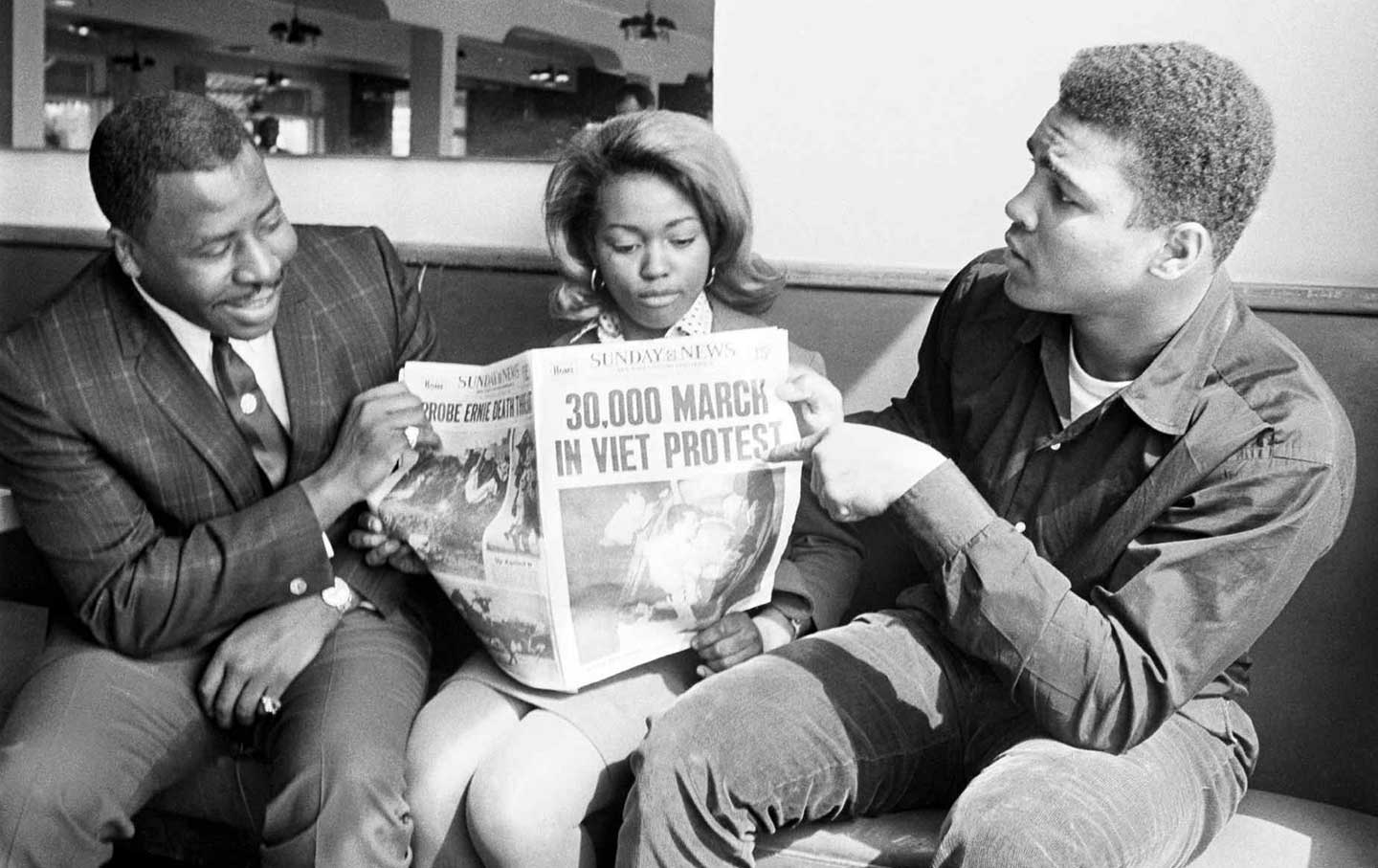
Incredibly, we are marking the 10th anniversary of the passing of “The Greatest,” Muhammad Ali. The heavyweight boxing champion, military draft-resister, proud anti-racist, and champion of the Palestinian people was laid to rest in Louisville, Kentucky, in June of 2016. Being present for his funeral and the celebration of his incredible life was an indelible experience. I wanted to recall that day not only to commemorate the passing of a giant but also because it speaks to what we have all collectively lost over the last decade.
This country is a more violent, more divided, more hateful, and more uncertain place than it was a decade ago. Then again, it’s not like 2016 was some kind of Shangri-la: Racist police killings were in the news seemingly every day. Income inequality was widening. Opioid abuse had become a full-blown epidemic. Environmental catastrophe was already a fact. The hoofbeats of authoritarianism were in the distance. Given all this, you could be forgiven for thinking we’ve always been on a toboggan ride down to our current hellscape. And yet, the future was not, nor is it ever, preordained. There were movements a decade ago, from Black Lives Matter to the push for a Green New Deal, that offered hope. As a country, we had multiple paths—we just took the most nihilistic one on offer.
On that day in Louisville, though, it was possible to feel an optimism that today seems so elusive. When Muhammad Ali was laid to rest, the entirety of the city shut down. Thousands of people, overwhelmingly Black, overwhelmingly—based upon my hurried reporting as I bounced from person to person—living within driving distance of the small city lined the streets. It was the Black South, the very people currently seeing their voting rights destroyed by neo-Confederate politicians and a Jim Crow Supreme Court, who showed up for Muhammad Ali.
School buses filled with children were part of the procession down the city’s main drag; you could hear them chanting Ali’s name as they slowly drove by. The throngs of people looking on joined them in a call and response version of “Ali, Bomaye,” the famed chant from Ali’s victory in the 1974 Rumble in the Jungle against George Foreman in Zaire, now the Democratic Republic of the Congo. Then, sticking half of his body out of a hearse to do so, the actor Will Smith began slapping bystanders’ hands. Later, Smith explained to the media later why he gave a thousand high-fives that day. During the filming of the biopic Ali, in which Smith starred, Ali had taken him aside and insisted that they go for a ride on a public bus. Smith said that he was taken aback by the request—they were both too famous for that. Ali said back: “Will, sometimes you have got to let the people touch you so they know you are real.” (It hasn’t been the best decade for Will Smith, either.)
Then there was the packed funeral service at Louisville’s basketball arena. Other than the international dignitaries who would be speaking, it was open seating, and people arrived hours early to be a part of it. The eulogists paid tribute to both the public Ali and the private Ali. Rabbi Michael Lerner spoke with gratitude about Ali’s solidarity with the Palestinian people—a speech that left Bill Clinton looking visibly uncomfortable. And Malcolm X’s daughter Attallah Shabazz pulled back the curtain on Ali’s relationship with her family after Ali’s famous falling out with Malcolm. She spoke of a relationship marked by a level of emotional and financial support that no one knew was taking place. Many of the speakers made it clear that Ali’s public persona would be with us forever. But his private persona, as Shabazz described, was revelatory: not because he was perfect, but because he understood the power of his fame’s effect on people while still holding a deep empathy for the most powerless among us.
Muhammad Ali was robbed of his speech by Parkinson’s disease in the last several decades of his life. Many have remarked that it was only after he lost his radical voice that he was fully embraced by white America. What I am realizing, 10 years after his passing, is that we don’t just miss his voice. We miss his presence on the planet: a living sign, to paraphrase the champ, that we don’t have to be the way they want us to be.
He was, is, and always will be the champ. But his legacy must be that we can all champion the deliberately unheard, and we don’t need a heavyweight title to do the work.