
What’s So Scary About the Frankfurt School?
In The Cultural Marxism Conspiracy, A.J.A. Woods looks at how the Frankfurt scholars became the latest bogeymen for the contemporary right.
What’s So Scary About the Frankfurt School?
In The Cultural Marxism Conspiracy, A.J.A. Woods looks at how the Frankfurt scholars became the latest bogeymen for the contemporary right.
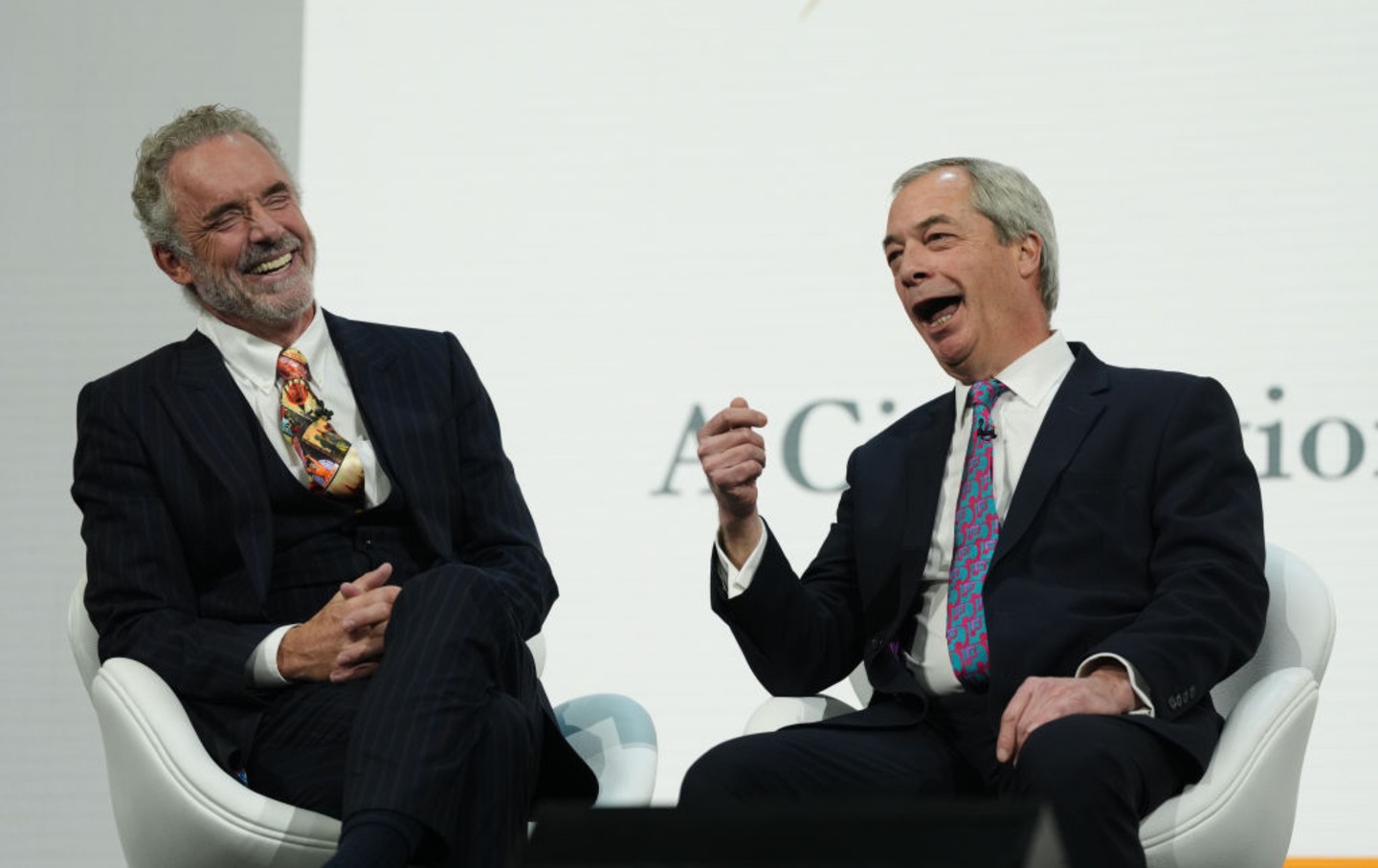
Reform UK leader Nigel Farage (right) is interviewed by Jordan Peterson at the annual conference of the Alliance for Responsible Citizenship in London, February 18, 2025.
(Ben Whitley / PA Images via Getty Images)About 90 minutes before commencing a day of terror in which 77 people would be killed, the Norwegian mass murderer Anders Breivik e-mailed a lengthy manifesto to 1,003 of his fellow “Western Europe patriot[s].” Across his meandering, heavily plagiarized screed, Breivik focused on a single bête noire: “Cultural Marxism.” This terrible ideology, Breivik explained, has “conquered” Europe, turning it into a “multiculturalist bastion.” The “lineage is clear”—all of Europe’s ills can be traced back to the Institute for Social Research, better known as the Frankfurt School. Today, civilization’s “most vital question,” Breivik argued, is “how Western Europeans [can] combat Political Correctness and retake their society from the Cultural Marxists.” His solution was to bring a semiautomatic rifle to a youth summer camp and slaughter everyone in sight.
Breivik’s incoherent manifesto is a clear product of madness. But the crux of his argument is disturbingly familiar on the contemporary American right. Breivik draws extensively from US sources, nearly all of which argue that America’s problems stem from the plague of Cultural Marxism. His manifesto lifts directly from the right-wing Free Congress Foundation, which for decades has lumped together Cultural Marxism and other distasteful creeds like “political correctness,” “deconstruction,” and “multiculturalism.”
Breivik never quite manages to define Cultural Marxism, but he isn’t alone in his slippery terminology. Last fall, Newsmax aired a television special on “Cultural Marxists’ aim to gain ultimate power” (they want to “to destroy God, traditional values, and the nuclear family,” the director explained); two years earlier, Ted Cruz published his Unwoke: How to Defeat Cultural Marxism in America; before that, the Heritage Foundation presented its paper “How Cultural Marxism Threatens the United States—and How Americans Can Fight It.” In 2017, Donald Trump Jr. even handed his father a memo—penned by a National Security Council staffer—which warned that a Cultural Marxist “counter-state” was undermining the presidency. Nearly all of these texts begin with a glancing reference to the Frankfurt School, then blur Cultural Marxism with various other right-wing grievances. Sometimes “Cultural Marxism” means the redistribution of privilege—“Marxist” economics as applied to the social sphere—while other times it refers to the authoritarian enforcement of unwelcome precepts like “diversity.” Sometimes the term is simply a metonym for everything wrong with modern life. As the right-wing historian James Lindsay explained in 2022, “If you want to understand why everything is crazy, why there’s always a double standard, why everything seems so unfair,” there’s a simple explanation: “It’s because we live in Herbert Marcuse’s world.”
For those of us who struggled through the translated German prose of Theodor Adorno and Max Horkheimer as undergrads, and found little relief in Marcuse’s deceptively fun-sounding Eros and Civilization, the right’s fanatical obsession with a sect of 20th-century European theorists may come as a surprise. Adorno can be difficult to follow across a single slaloming sentence; is it really possible that his writings are responsible for the shape of American life today?
The intellectual historian A.J.A. Woods has set out to examine the unlikely villainization of the Frankfurt School in The Cultural Marxism Conspiracy: Why the Right Blames the Frankfurt School for the Decline of the West. “Why,” Woods wants to know, does the right’s “narrative of cultural degeneration focus so much on a collective of German Marxists?” In search of answers, they have produced an absorbing intellectual history of the left-turned-right zealots who birthed a conspiracy from their willful misreadings and exaggerations.
Woods makes a strong case that the “conspiracy” originated not with Hitlerian rhetoric condemning “Cultural Bolshevism,” but rather amid an internecine political battle on the 1960s left. It then remained attached to a prominent left-wing crank as he shifted further and further right, and gradually escaped confinement in the 1980s and ’90s. Through a right-wing-inflected game of telephone, small-time grievances and sloppy analyses snowballed over time into a totalizing account of leftist domination. Call it the lab-leak theory of Cultural Marxism.
Woods’s story begins with the cantankerous leader of a local New York chapter of the Students for a Democratic Society (SDS): a man named Lyn Marcus. In the mid-1960s, Marcus was in his mid-40s, a veteran of the Trotskyite left who had refashioned himself as a “pseudo-Lenin” among his fresh-faced disciples. He led a popular course on Marxist economics at the Free School of New York, and he was an outspoken critic of Marcuse and his Frankfurt School colleagues. Marcus’s skepticism was not unique: Many hard-liners found the theorists’ distinctions between workers and revolutionaries counterproductive, and few would forgive Adorno after he called the police on his own students during a protest. Meanwhile, Marcuse had energized countless young people with his “Great Refusal,” which some on the New Left saw as simpatico with turning on, tuning in, and dropping out. For someone like Marcus, who hoped to stoke the fires of revolution, this was an exceptionally dangerous idea.
In the spring of 1968, as protests roiled the Columbia University campus, Marcus complained that Marcuse-reading moderates were diluting the radical potential of the occupation. By the fall of that year, his criticisms grew sharper. New York’s political left was then split over Mayor John Lindsay’s contentious initiative to introduce community control over public schools. What had begun as a well-intentioned, Ford Foundation–backed effort to grant predominantly Black families in Ocean Hill and Brownsville greater power over their children’s education derailed after school-district leader Rhody McCoy fired some 19 white, predominantly Jewish teachers. In response, Albert Shanker, the dogmatic leader of the United Federation of Teachers, called for a series of destabilizing strikes. Caught in a struggle between labor and integration activists, the Columbia SDS backed the mayor and the families of Ocean Hill–Brownsville. Meanwhile, Marcus and his New York SDS Labor Committee stood with the striking UFT; Marcus accused his opponents of “falling into the trap carefully laid by the government in supporting the sabotage of the Ford Foundation.” Soon enough, he was expelled from the SDS.
Now unshackled from the organization, Marcus grew increasingly radical. His course at the Free School turned into a cult, and his National Caucus of Labor Committees (NCLC) began to embrace political violence. His followers toted nunchucks and baseball bats; they launched something called “Operation Mop-Up,” which entailed countless attacks on rival left-wing groups. In time, Marcus shed his nom de guerre and returned to his birth name: Lyndon LaRouche Jr. By then, he had grown even more obsessed with Adorno and the formerly OSS-linked Marcuse: The theorists, he believed, were tied to a “CIA zombie brainwash” program.
Abidingly in need of cash, in the 1970s LaRouche’s NCLC began to cavort with the far right, soliciting donations even from the neo-Nazi Liberty Lobby. Woods recounts how LaRouche gradually came to “glorify Western civilization—especially German culture,” all while clinging to his original intra-left grievances. Today, Woods suggests, we face a strange historical accident: LaRouche’s far-left disdain for Marcuse survived his right-wing turn, metastasized into an all-encompassing conspiracy theory, and then found a warm audience among conservatives well primed to dislike the thinkers of the Frankfurt School.
The burgeoning “conspiracy” relied on consistently exaggerated misreadings of the works of Adorno, Horkheimer, and Marcuse. Since Adorno had praised Arnold Schoenberg, he could be blamed for atonal music and the excesses of rock and roll; because Adorno and Horkheimer had studied the functions of contemporary radio, they could be assailed for developing “instruments of social control.” Adorno and Horkheimer’s writings on the “authoritarian personality” were, not surprisingly, particularly unpopular among followers of LaRouche. By 1992, the LaRouchean right had gathered enough animus to produce its seminal work on the subject: Michael J. Minnicino’s “The New Dark Age: The Frankfurt School and Political Correctness,” which appeared in the LaRouche-affiliated journal Fidelio.
Minnicino’s essay is remarkable. It isn’t just that he gets everything wrong; it’s that he gets everything backward. Minnicino fiercely criticizes “the technique of mass media and advertising developed by the Frankfurt School” and the group’s “shaping of the electronic media of radio and television” in order to “manipulate the population.” This is a bit like blaming the oncologist for the tumor in your chest. Adorno and Horkheimer were sharply critical of these phenomena, horrified by how radio “makes everyone equally into listeners, in order to expose them in authoritarian fashion to the same programs put out by different stations.” They decried the “regression of enlightenment to ideology” as “expressed in film and radio”; they resented the narrow “freedom to choose what is always the same.” Adorno was little impressed by television, and even less by Hollywood: “Every visit to the cinema,” he complained, “leaves me, against all my vigilance, stupider and worse.” The phrase “culture industry” was not meant as a compliment.
Yet through a process of endless “reciprocal citation,” Woods argues, these LaRouchean misreadings found a wider audience. By 1996, they had reached William S. Lind, a military historian (and unlikely far-right transit advocate) who became America’s preeminent Cultural Marxism crank. Lind and his cohort linked the Frankfurt School to political correctness, critical race theory, feminism, and other right-wing bogeymen. A healthy dose of antisemitism, sometimes covert and sometimes not, helped animate these discussions: As one poster on the white-nationalist Internet forum Stormfront boasted, “Talking about the Frankfurt School is ideal for not naming the Jews as a group” while still “naming the Jew by proper names.” Or as Lind himself put it: “These guys were all Jewish.” In the increasingly far-right Cultural Marxism discourse, Minnicino’s essay became a seminal text. In 2011, Breivik cited it directly in his manifesto. His massacre led Minnicino to disavow his work and to condemn LaRouche’s “crack-brained world-view.”
Popular
“swipe left below to view more authors”Swipe →By the time Woods’s history reaches the 1990s and 2000s, the “conspiracy” has been almost entirely divorced from the theorists’ writings. What mattered was that a few German Jews invented something called the “culture industry” and, in turn, injected cultural pessimism into American life. By the 2010s, Andrew Breitbart could call Barack Obama a “Frankfurt School scholar” and get away with it; by 2022, James Lindsay could connect Marcuse to “the Davos set.” The Davos set?
Woods’s task in this book—wringing a historical and political chronology from an essentially empty signifier—is not an easy one. They do an admirable job sifting through the speeches, pamphlets, and films of a multigenerational right-wing fringe, and they extract from these loosely coherent texts a worthy theory of the case. But they do themselves few favors with lengthy digressions on contemporary British politics, which rarely advance their argument. Woods admits that “‘Cultural Marxism’ rarely turns up in [British] anti-woke discourse,” in part because “British conservatives lack a clear and plausible narrative about the rise of Cultural Marxism in the UK” (a somewhat self-defeating admission in a section on Cultural Marxism conspiracies in that country). The natural next move might be to argue that the paucity of references in Britain proves the speciousness, and sheer Americanness, of the Cultural Marxism conspiracy theory—because if Britain is ensconced in the same War on Woke as the United States, bedeviled by the same critical race theories, why should Adorno be our villain and not theirs? Instead, Woods reminds their readers that “a Labour government is not necessarily a left-wing” one and chides the recently resigned prime minister, Keir Starmer, for “exclud[ing] left-wing MPs and activists.”
There is a missed opportunity here. Woods has made a clear decision not to draw from the works of Adorno, Horkheimer, and Marcuse, but their concluding chapters might have benefited from a direct engagement with them. Why not meet the charges of the Cultural Marxism conspiracy theorists on their own terms? Why not consider precisely what it is in the often abstruse, always dialectical arguments of these thinkers that makes them so threatening to the contemporary right?
It’s clear that few of the Frankfurt School’s critics have read them closely, since so much of what these theorists are accused of—Adorno of inventing mass media and advertising; Marcuse of endorsing predatory “grooming”—is diametrically opposed to what they actually believed. But the primary texts are worth examining: If there is a single dominant theme across the variegated works of Adorno, Horkheimer, and Marcuse, it is a resistance to what might be called “status quo–ism.” These theorists implored their readers to resist acquiescence, to conceive of lives more individual and more free. They enjoined the public to interrogate “the myth of that which is the case” (Adorno and Horkheimer), to embrace “the Great Refusal—the protest against that which is” (Marcuse).
If conservatism, to borrow the famous phrase of William F. Buckley Jr., is to mean “stand[ing] athwart history, yelling Stop”—if it is predicated on preserving that which is, on slowing all efforts toward racial and sexual progress—then these are fighting words. Modern life, as Marcuse knew well, offers countless social and economic incentives to submit. Citizens have little “reason to insist on self-determination if the administered life is…comfortable,” he wrote; this is precisely what forms “the rational and material ground…for one-dimensional political behavior.” But there’s more out there, Marcuse insisted—much more than the “comfortable, smooth, reasonable, democratic unfreedom” that we live and breathe. The hard part was imagining it. The legacy of the Frankfurt School, Lind argued during a 1998 panel, is “the most destructive criticism possible.” Critical theory, he said bitterly, is “designed to bring the current order down.” In a way, that was the point.
More from The Nation

The Architectural Follies of Trump’s Washington, DC The Architectural Follies of Trump’s Washington, DC
The president plans to remake the capital in his own image, but is all he is doing destroying what’s already there?

The Genius of Charli XCX The Genius of Charli XCX
On her new album, Music, Fashion, Film, the musician embraces rock.
The Carnival of Venice Biennale The Carnival of Venice Biennale
That so much of the art of “In Minor Keys” is muted in effect is ironic, because so much of it is overproduced, aspirationally eye-catching, and so big.

