
The Revolution Heard Around the World
The global politics of 1776.
The Revolution Heard Around the World
The global politics of 1776.
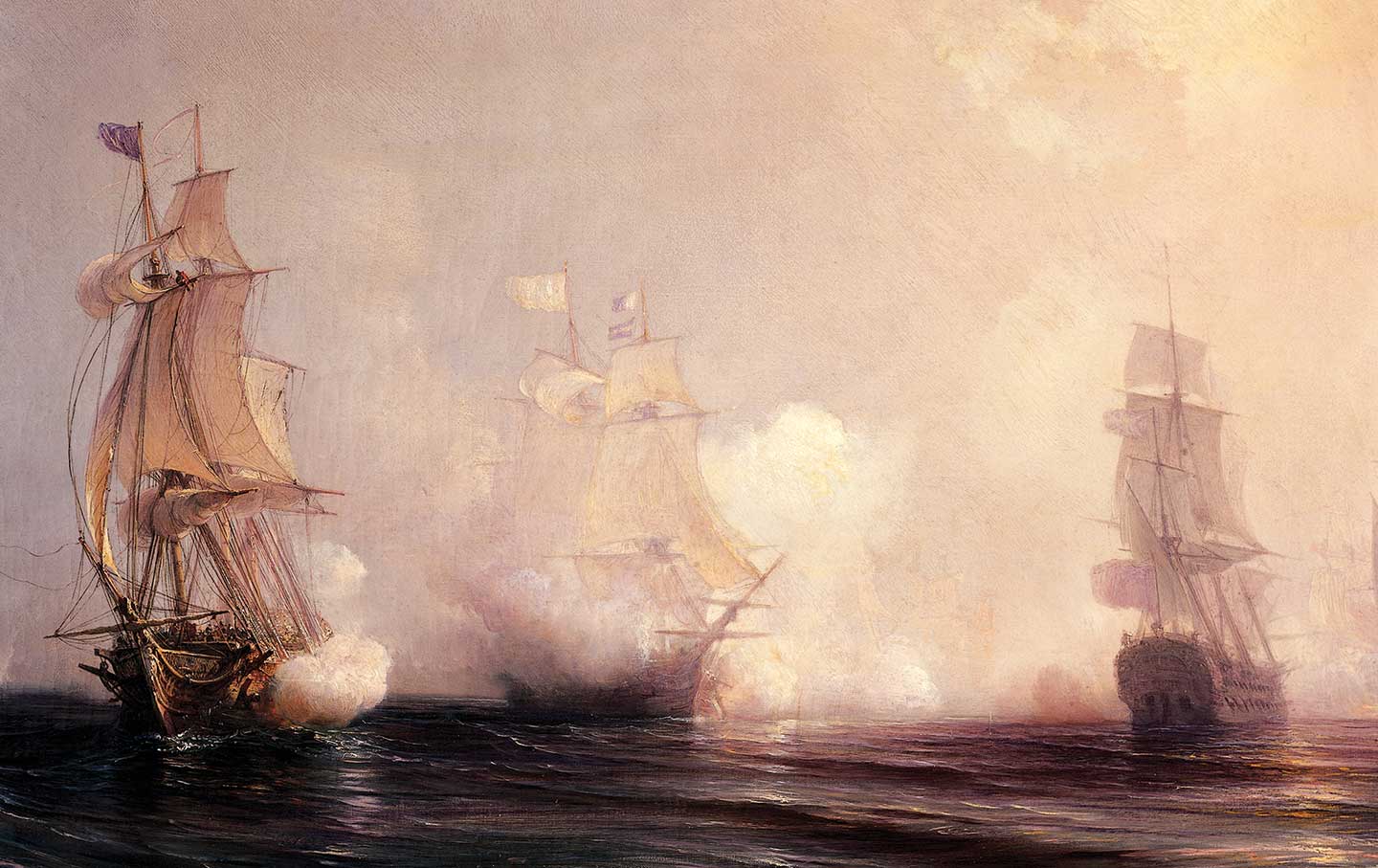
(Getty Images)
What a time to try to commemorate this nation’s founding! Imperialism is back. Militarized federal agents have been massing in cities to root out people deemed unwelcome or disloyal. The president styles himself more as a monarch than a civil servant, from the plans for his new golden ballroom to the parade of courtiers and oligarchs paying him homage. Given this situation, what are the options for narrating the story of the Declaration of Independence 250 years after the fact? Are we left with anything other than irony—or tragedy?
Books in review
The American Revolution and the Fate of the World
Buy this bookOf course, histories of the American Revolution published to help mark the current semiquincentennial of the Declaration of Independence were written at least in part before the second Trump administration began. So it isn’t entirely fair to expect their authors to take the story up to the point of telling us what to make of the head-spinning past 18 months. But such histories do have an added function in this anniversary year: Their job is to tell us where we’ve been in a way that illuminates aspects of the present and, ideally, get us to think afresh about where we should be going. So far, it doesn’t seem like historians have found any real answers.
Richard Bell’s The American Revolution and the Fate of the World provides, in this regard, an opportunity to reflect on the difficulty of that charge and also the limits of the response. Bell’s primary solution in this ambitious volume is to widen his scope. Addressing the reader in jaunty, confident prose, he works hard to convince us that the American Revolution was a lot less provincial than we were taught in school. The events of 1776 and their aftermath, he argues, not only required white English settlers and British government officials to pick a side—they swept up and reshaped the lives of all kinds of other peoples in what would become the United States and around the world. That includes enslaved people of African descent and the people of numerous tribal nations native to the Americas. It also includes aristocratic French generals and Spanish navy men, Chinese dockworkers and Indian rulers, British anti-war agitators and Hessian mercenaries, convicts en route to Botany Bay and Sierra Leonean settlers, Irish American printers, farmers, and arms dealers, Jamaican washerwomen, and Loyalist wives looking for safety in British Canada.
Bell’s global approach fits broadly within several ongoing trends in academic history writing. One is treating the multiple revolutions that took place on both sides of the Atlantic in the 18th and early 19th centuries as interconnected, especially with regard to the demands of maintaining and funding commercial empires. Another is decentering the 13 original British seaboard colonies in North America in favor of what is often called “Vast Early America,” a segment of the globe stretching from the Caribbean to French Canada to the Spanish American and Native West, with links to places as far-flung as China, India, and Brazil as well as continental Europe and West Africa. And yet another is drawing attention to the uncelebrated and even the nameless as much as the famous “founders”—which has also meant emphasizing the significance of bloody power struggles on the frontier, the plantation, and the high seas as much as what happened in the meeting halls and taverns of Philadelphia. Our picture of revolutionary America is very different today, and considerably more complex, than that which accompanied the Bicentennial’s tall ships back in 1976. Bell’s synthetic account is indicative of just how much we’ve learned in the ensuing years.
What Bell does not tell us, however, is also typical of much of the newest history of the revolutionary era. Readers will discover little in The American Revolution and the Fate of the World about what to make of it all then or now. Bell declares early on that America’s turn to independence was a “geopolitical earthquake” that “shook every quarter of the globe,” sending people, goods, and news in extraordinary new patterns around the planet. The revolution, he adds, professing no exaggeration, “set much of the world as we know it in motion.” But in his episodic and kaleidoscopic telling, it’s hard to see how the many compelling pieces that Bell offers fit together as a whole—and, if they don’t, what made this particular war any different from those that preceded it, including the similarly global Seven Years’ War less than two decades earlier, or most that came after. Which is to say that The American Revolution and the Fate of the World is a global history that never really informs us how the revolution ended up defining the “fate of the world,” or what it might mean for the world at present.
Bell’s rousing introduction suggests that one major theme connecting all of his varied subjects is, loosely, liberty. Many of the specific stories that pepper his chapters highlight the ways that, in the course of the struggle for national independence and its aftermath, the quest for freedom and self-sovereignty animated different people in different places with varying degrees of success. Early on, for example, we meet the minor Prussian nobleman Friedrich Wilhelm von Steuben, who helped transform the Continental Army by introducing European tactics as well as sanitation standards before dying mired in debt, having crafted an unconventional life as a naturalized citizen in upstate New York. We also spend time with, among others, Molly Brant, a Mohawk woman partnered with an Irish-born diplomat, who became a spy and a refugee-camp coordinator in the service of the survival of her tribe; William Russell, a Boston teacher who dreamed of riches as a privateer (i.e., a government-licensed pirate) and ended up escaping a series of terrible confinements, from England’s southwest coast to a dungeon ship anchored in Brooklyn Bay; and a variety of abolitionists, from British radicals to Black escapees from slavery and “freedom fighters” like Harry Washington, once the property of the first president, who made it to Canada only to find himself stuck in terrible circumstances in West Africa, now governed by a British trading company.
Bell narrates these micro-histories with aplomb, even as some readers may grow weary of the many similes and metaphors evoking bombs, thunderbolts, and shock waves. But the overheated martial language serves a purpose: Bell’s history is, at its core, a chronicle of military action. What his subjects get caught up in are not the elevated principles of the Declaration of Independence so much as a long and brutal inter- and intra-imperial trade war that stretched in both its origins and its implications well beyond its official beginning at Lexington and Concord in 1775 or its conclusion with the 1783 Treaty of Paris, an agreement highly beneficial to the new United States, whose genesis Bell describes exceptionally well.
King George III, we learn, was sure the whole disturbance would be over quickly because of Britain’s objectively superior forces. (Where have we heard that before?) But, as Bell notes, “Europe’s quarrels” turned into “America’s opportunity.” Foreign allies—driven considerably less by ideology than by self-interest in the form of potential territorial and economic gains against their rivals—soon signed on, dragging the fight to many corners of the world.
For their own part, the American patriots had few objections to making common cause with Catholic kings, in the case of France and Spain in the 1770s, or aristocratic Muslim rulers in South Asia by the start of the next decade, as long as it helped stretch the British thin enough to make their defeat possible. Nevertheless, Bell points out, the consequences of these skirmishes were ultimately more than just military or diplomatic. For it was in the interstices of sea and land battles around the globe, especially after the French and Spanish were rallied to the cause and privateering took off, that the possibility of some new kind of liberty, frequently rooted in survival strategies as much as anything else, drew expanding rounds of participants into the conflict. Given the highly fluid nature of this global struggle, people like Molly Brant, William Russell, and Harry Washington—not to mention more privileged figures like Peggy Shippen, the co-defector and wealthy wife of Benedict Arnold—could be said to have been improvising, or maybe just capitalizing on new possibilities as they materialized, in sometimes successful efforts to improve their lots.
Yet a countervailing theme in Bell’s book, as with much of the recent historiography, is the endurance and even expansion of racialized slavery across the period of the American Revolution and the bitter irony of widespread Black and Indigenous support for the Loyalist and British side as the better option in the quest for freedom. Bell does not explore in any detail what the historian Edmund Morgan once described as the revolution’s great “paradox,” the imbrication of slavery and freedom, aside from suggesting that an attachment to property and profit outweighed concerns about humanity on the part of unnamed white patriots. Nonetheless, Bell rehearses the tragic story of slavery’s postrevolutionary endurance right along with the growth of abolitionism’s international ranks. The same goes for the accelerated Native dispossession that was a result of the victors’ steady westward expansion. By the end of the 18th century, Bell makes clear, the revolution that had opened up novel questions about what it would mean to build a nation rooted in freedom had simultaneously extended the geography of racialized slavery into new territory and stripped Indigenous people of ever more of the land on which they had long dwelled.
No legitimate history can, in fact, ignore these painful stories today. Bell is very clear that the full history of the American Revolution requires close attention to its many “catastrophic” costs in human terms, including thousands dead; widespread disease and famine; a global migrant crisis; growing authoritarianism and the repression of colonial subjects in the highly profitable parts of the British Empire that the crown was not obliged to relinquish at war’s end (thanks to the favorable terms of the Treaty of Paris for Britain, too); and veritable “war crimes” when it came to, for example, the massacre by Pennsylvania militiamen of unarmed Indian men, women, and children, all converts to Moravian Christianity, in eastern Ohio Country. This is a take on the revolution that does not lend itself to the celebratory.
And therein lies the problem before us now. The MAGA right wants a celebration of 1776 that sticks to the old myths, untouched by any of these stains on national political mythology or even world history. Veneration of the revolution’s heroes has to take place apart from any mention of their investment in racialized chattel slavery or, really, involvement of any kind in the fates of non-white peoples. Witness the federal government’s forcible removal this past winter of the panels on Independence Mall in Philadelphia explaining George Washington’s well-documented dependence upon slave labor in the original President’s House. Or recall the spring 2026 White House conference clothing the “Founding” in Christian, providential language. For the Trump administration, the title of the author and radio host Eric Metaxas’s most recent contribution to the field, Revolution: The Birth of the Greatest Nation in the History of the World, should be taken as fact and with no irony intended.
But the left in recent years has given us very little to hold on to when it comes to 1776. Progressive historians have been dismantling for some time now, partly by employing a global lens, the fiction that the revolution in North America was nonviolent, at least compared with those in France and Haiti; that it was consensual; and that it ultimately paved the way for liberty, equality, and respect for the natural rights of man, broadly construed. Some have also questioned the continued relevance of 1776 for our national identity and wondered why not make the institution of slavery the key turning point in the story of the emergence of the United States.
Bell seems to hope that showing how the revolutionary war touched all corners of the earth and involved all sorts of people is sufficient to revive readers’ interest in, if not necessarily full-on enthusiasm about, 1776 and its aftermath. Implicitly there is also a suggestion that if we only understood that the United States was founded in a global context and won by immigrant, foreign, and multilingual troops, it might be enough to counter MAGA ideology and convince us that we have an obligation to forgo isolationism and nativism and eagerly nurture our ties to the rest of the world. But this is potentially weak tea (to invoke the global commodity that sets Bell’s story in motion), especially considering the upside-down power dynamics of the present, when it is the US, not Britain, that has taken on the role of hegemon and global aggressor.
Popular
“swipe left below to view more authors”Swipe →Another issue is that Bell seems to have relied almost entirely on sources in the world’s current dominant language, English, in writing this wide-ranging history. That’s the case even when he’s telling us about places as far afield as Mysore, Cuzco, and Versailles, which also suggests something of the cultural imperialism of our own moment. Might there be the risk of a new kind of empire-building connected to the act of pulling every plausible group of people around the world into the story of the birth of the US, but doing so apart from the idioms and historiographies of other, non-English-speaking places from which things might look quite different?
Bell’s globe-trotting narrative certainly helps fill in much that was overlooked in previous synthetic histories of the American Revolution. But what is needed now is more than just remarkable stories of individual trajectories set against the backdrop of a protracted war to determine the fate of a part of Britain’s 18th-century imperial holdings. Any comprehensive narrative of 1776 and its aftermath also has to grapple with the questions of what was promised to whom, and why, by the revolution’s chief architects, and how that pattern has been perpetuated, extended, disrupted, and even reversed down to this day. And that means that the institutions and foundational texts designed to give meaning and legal form to the chaos of events, starting with the Declaration of Independence, need to be reintegrated into this story. (The Declaration’s chief author, Thomas Jefferson, makes sporadic appearances in Bell’s book, but James Madison, one of the main authors of The Federalist Papers and Jefferson’s ally, doesn’t even make the index.) In our current climate of anger and pessimism about the future, we need histories that do not simply remind readers how the sins of the founders taint what was otherwise one of the most inspiring promises of all time—a government constructed on the basis of self-rule to ensure the equal rights of all, including to life, liberty, and the pursuit of happiness—or suggest an “unfinished” revolution will be finished someday. We also need clarity about how the contradictions got baked in, sometimes inspiring movements over the last 250 years that sought to rectify their glaring flaws and exclusions, but currently pushing us in the other direction, away from the revolutionaries’ boldest and most inspiring claims, despite all the flag-waving on the right.
It is time now, too, with the semiquincentennial upon us, for a full accounting of the Trump era in light of 1776 and its legacy. This is a project for which the current popularity of “No Kings” protests actually suggests a hunger. What needs illuminating most obviously is the Trump administration’s refusal to abide by many of the formal terms of that other foundational 18th-century text, the US Constitution, whether we are talking about limits on the power of the executive or who qualifies as a citizen. Just as much, though, it bears repeating that what has been on the chopping block this past year and a half is also the Declaration’s idealism—that is, its universalist, proto-democratic language and sense of a purpose that has nothing to do with “deals” or “winning.” Both the Republican and Democratic parties seem to have largely accepted levels of economic inequality that could be said to violate the Declaration’s main promises every bit as much as slavery once did.
And maybe just as seriously, with MAGA forces leading the way, Americans have largely given up on many of the key shared assumptions and habits of mind that the practice of democracy has bred over time. That includes a common respect for factual truth; a mutual commitment to the basic rules of the political game, starting with the conduct of elections; an openness to compromise; and some loose sense of solidarity with, if not actual affection for, others, no matter how differently they live and think and vote from the way you do. These are the very minimal ties that have, at their best, intellectually and emotionally bound us across all other kinds of divisions and that the Trump presidency, with assistance from a large number of other sectors in American life, is trying hard to undo.
What will it take to restore these basic conditions for subsequent political progress? Historians of theAmerican Revolution have a role, albeit a modest one, to play here. But it will take a collective effort at finding a new storyline—one that isn’t all critique and despair but that isn’t blandly multicultural or global either. A revitalized left vision for the future requires a reading of 1776 and its legacy, and not just the post–Civil War nation, that fully engages with the complex meaning of freedom and equality from the start. It should also give us back the founding of the nation and the invention of modern democracy in a usable form, suitable to active citizenship as opposed to hero worship, on the one hand, or resignation and nihilism, on the other. Otherwise, there may not be anything left to commemorate the next time a big anniversary rolls around.
More from The Nation

Israel’s Extremist Election Israel’s Extremist Election
The run-up to the vote on Tuesday is exposing the façade of Israeli democracy—and the fealty of the country's so-called opposition when it comes to matters of Jewish supremacy.

“NAZA” and Israel’s History of Automated Warfare “NAZA” and Israel’s History of Automated Warfare
As violent technologies like spyware, predictive targeting algorithms, and 2,000-pound warheads become ordinary instruments of military rule, once-abhorred practices become routin...
Brazil’s Workers’ Party Is Not Stopping Brazil’s Workers’ Party Is Not Stopping
With just a few days remaining before the runoff election, supporters of Lula’s party are doing everything possible to rally support behind the president.

Brazil’s Decision Brazil’s Decision
The moral compass and basic humanity of political leaders really does matter.
Albanian Student Strikes Spur a Political Crisis Albanian Student Strikes Spur a Political Crisis
A new round of protests against the ruling party’s corruption has Prime Minister Edi Rama giving cops bonuses to crack down on dissent.

