
Everything Is a Scam
Our economy allows poor and working people to be shafted every day—does anyone care?
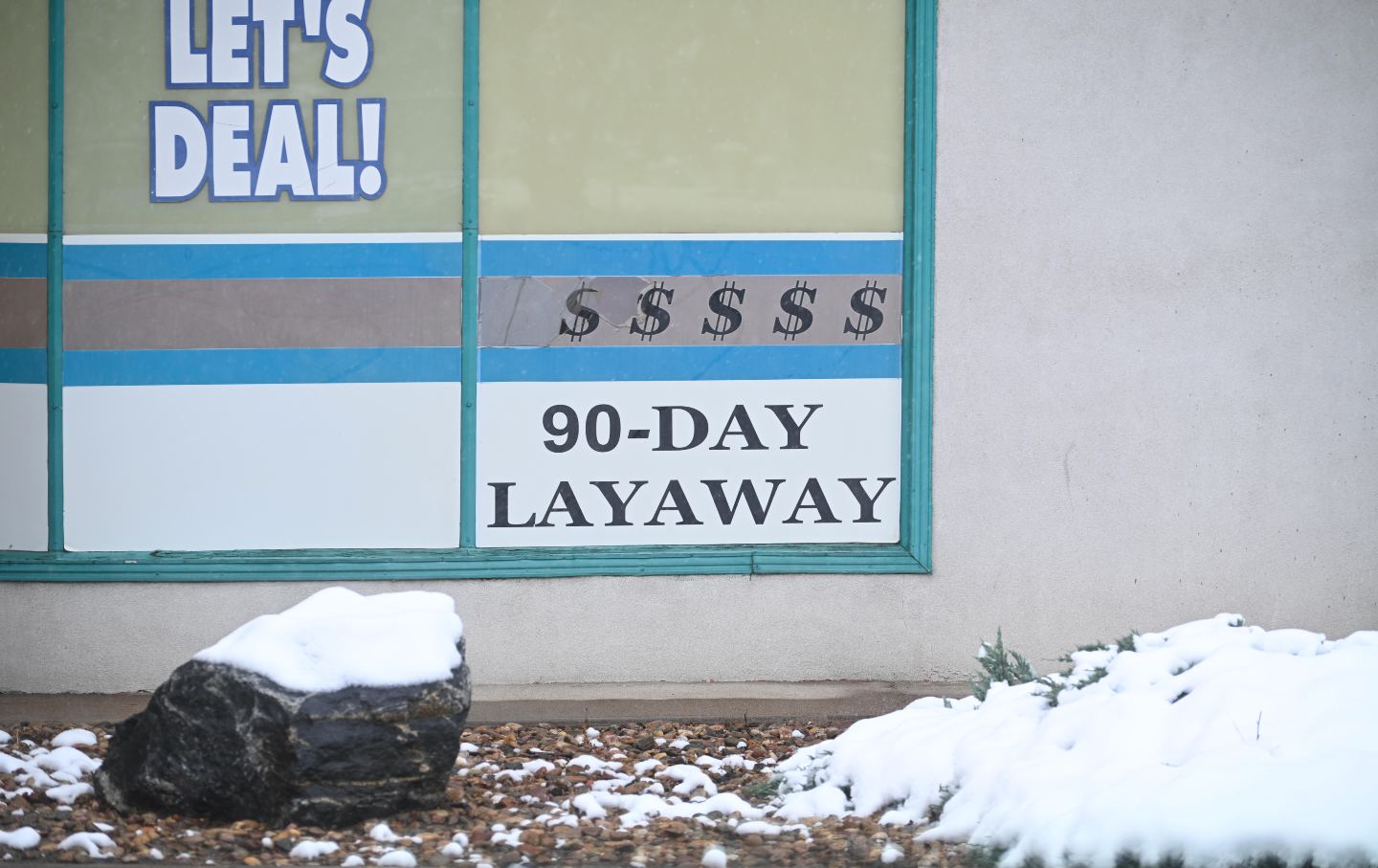
Snow accumulates outside a pawn shop in Longmont, Colorado, on May 6, 2026.
(Mark Makela / Getty Images))
Iclimbed over the chain-link fence to my neighbor’s yard, a fistful of twenties in my hand. My neighbor, Al, had replaced some rotting boards on my deck while I was at work. His apartment was tacked onto another house, enclosed but flimsy and without a real foundation. Al worked for his landlord’s roofing company, and I’m pretty sure he got the apartment in lieu of pay.
Al was smoking on his doorstep. His big, leathery, tanned shoulders—Al was shirtless for nine months of the year—were drooping, his head hanging between his knees. “Thanks for your help today,” I said, holding the cash out to him. But he shook his head.
I pushed the cash toward him again. He brushed it away.
“Why not? It looks great!” I said, nodding toward my deck.
“Because I pawned your circular saw.” I had left my tools out for him to use.
“Dude, that was my dad’s saw!”
“I know! I’m sorry,” he said. “I’m going to get it back!”
“Please do.”
Al stood up but didn’t move. After an awkward moment, I realized he needed the money from me to go get the saw out of the pawn shop. I handed it to him, but he still stood there. “What?” I asked.
“Can you give me a ride?”
We drove to the American Cash and Pawn at the edge of our neighborhood. It stood between Kroger and the laundromat where it cost $20 a week to do two loads, because the half-broken dryers would eat your quarters until you went home defeated with your jeans still wet. Al went into the pawn shop and soon came back out grinning and waving my saw above his head. He’d set things right and I appreciated that.
That was many years ago now, but I still think about that day and the strange economy we live in. Everything had worked out fine for me that day: I went to bed that night with a repaired deck and all my tools locked up in the shed. But Al came out 10 dollars short of what he could have made that day—the pawn shop charged him a “storage fee” for the saw even though it was only there one afternoon.
I don’t know why Al couldn’t wait until I was home to pay him. Maybe he bought some food, maybe a loan from someone else came due, maybe he bought beer. It’s not my business. But I do know that Al and I lived in a neighborhood where the only places to get cash were pawn shops and payday loan places; the closest bank was miles away. And Al didn’t have a debit card, a credit card, or a job that paid him in checks anyway.
Most places I have lived have been like this. My current neighborhood has three pawn shops, one check-cashing center where you can also prepay a cell phone, and a dollar store. We’ve been waiting for a promised Piggly Wiggly to open in the vacant strip mall behind my house since 2020.
Most of the businesses offered to low-income and working-class neighborhoods—and increasingly small, rural towns—are predatory, scammy, and trap us in terrible cycles. When rent is due but payday is still a week and a half away, a payday loan can have an APR as high as 390 percent. Appraisal fees at a pawn shop could be $50, and a check-cashing operation might charge you 10 percent. I’ve sat on my porch and watched a neighbor’s Rent-A-Center couch get repossessed, her children’s crayons falling out of the cushions as it was loaded into a truck and driven away.
So when I was recently walking through my hard-up neighborhood with a friend, and she commented on the Trump 2028 sign pinned to a fence, asking, “Don’t they know he’s a scam?”—all I could think was, “Well, yeah.” Of course they know that.
Trump has shocked so many Americans with his brazen swindles, schemes, and cons. From Trump University to the Stop the Steal donation funnel to NFTs, crypto ventures, and betting markets, it’s hardly controversial to say this administration is running some pretty stunning grifts. To a lot of folks, it feels incredible that he’s allowed to get away with it.
But to many other Americans, we hardly blink an eye. After all, grifts are what we’ve long been left with. Our bosses, banks, landlords, and even that little kid who knocks on your door selling candy for his basketball tournament are all running a con. I usually shrug and give the kid $5 for a Hershey bar anyway. We’re used to it.
Poor and working people are usually the mark of all these scams and we know it. It’s not like we think what’s happening is fair, but it is familiar. We’ve long been left to navigate these cons alone, paying “risk mitigation” fees to property owners and overdraft fees to banks. We’ve long been told by the rest of America that it’s our problem to figure out. All these cons are perfectly legal, but they’re cons nonetheless. And we know that us being conned down here helps others up the line; we know that people who have 401(k)s profit when the company my neighbor works at doesn’t give him a raise, and that people who own their homes benefit when the family renting up the street is priced out.
Popular
“swipe left below to view more authors”Swipe →My neighbor Al was no dummy. Like so many others, he tried to stay one step ahead in the game he was being forced to play. One summer, he had an ever-changing series of cell phones, taking advantage of a “first week free” offer and making sure to return them on the sixth, never the seventh, day. Al was a resolutely good man—I’ll never forget him using some vouchers he had to get newborn clothing for my son when I was pregnant. I didn’t ask him to; he just did it. So, besides the inconvenience, I never much minded that he pawned my saw; I know it had more to do with where we lived than it ever had to do with his heart.
So why would someone in a poor or working-class neighborhood support Trump? I wish they wouldn’t, of course, because we will never win up against the size and scale of Trump’s grift. But I’m not surprised when people try to line themselves up with what they think might be the winning team—when you don’t feel like you have power, it’s not crazy to get in with the bully. A huge percentage of this country has been left to endure systems that skim, squeeze, and extract from us. One way out might be to get in on the hustle, to take your shot at coming out ahead, even when the odds are absurdly long.
If we are going to be outraged by the grift, we need to be outraged by all the grift, not just the spectacle at the top. Get outraged at the $60 application fees for apartments that never materialize; the wage theft that goes unpunished; 29.99 percent APR credit cards and car loans. Let’s get serious about the taxes that billionaires don’t pay; the Polymarket bets and insider trading; the congressional stock trading; the tech and utility monopolies that are always favored to win, win, win while ordinary people like Al and me and the family with the Trump flag pinned to their fence absorb all the consequences.
Become a Sustaining Donor This September
Between the reemergence of right-wing red-baiting and Donald Trump’s use of the chilling National Security Presidential Memorandum–7 to criminalize left political organizing, we’re seeing McCarthyism reborn before our eyes.
This assault on democracy cannot be ignored or wished away. Resisting it requires bravery in the face of threats and repression, a steadfast commitment to the truth, and the unwavering belief that we can—and will—overcome this darkness.
We must have an independent media that sets the record straight, unearths corruption and abuses of power, and advances a politics of justice and dignity for all if we’re to win this fight.
That’s why I’m writing to you today. This September, The Nation needs to add 100 monthly donors to sustain our progressive journalism. Your contribution makes the next investigative report, the next truth-speaking column, and the next pathbreaking essay all possible.
I hope you’ll support our work with a recurring donation today. If you donate $10 or more a month, we’ll send you a brand new “Hands Off the Free Press!” sticker to recognise your commitment to our cause. Please, donate today.
Onward,
Katrina vanden Heuvel
Editor and Publisher, The Nation
More from The Nation
The School Behind the Billionaires and the Billionaire Tax The School Behind the Billionaires and the Billionaire Tax
UC Berkeley will inevitably be behind the defeat or victory of Proposition 40.
Dolly Parton Was a Proud Union Sister Dolly Parton Was a Proud Union Sister
Organized labor is celebrating the life and legacy of an artist who championed working women and carried a union card for almost 60 years.
Of Debt and Deficits and the Dollar System Of Debt and Deficits and the Dollar System
By force of preset agendas, conservatives and liberals react to debt headlines like Pavlov’s dogs.
What Happens When 8 Million People Lose Their Student Loan Repayment Plan? What Happens When 8 Million People Lose Their Student Loan Repayment Plan?
As the Biden-era SAVE plan ends, borrowers are facing unaffordable bills, lost payment records, and errors that have falsely put some into default.
David Ellison’s Delusional Stab at Self-Justification David Ellison’s Delusional Stab at Self-Justification
While the Skydance–Warner Bros. merger is in legal limbo, the CEO seeking to pull it off makes a disingenuous case for it in the court of public opinion.
The War on the UAW The War on the UAW
The United Auto Workers called for a ceasefire in Gaza. The union’s federal monitor didn’t like it—and now he’s investigating Shawn Fain, just weeks before union elections.

