
The Troubled History of Charlottesville
Deborah Baker’s Charlottesville: An American Story is history of the city and how its checkered past ultimately led to the Unite the Right rally.
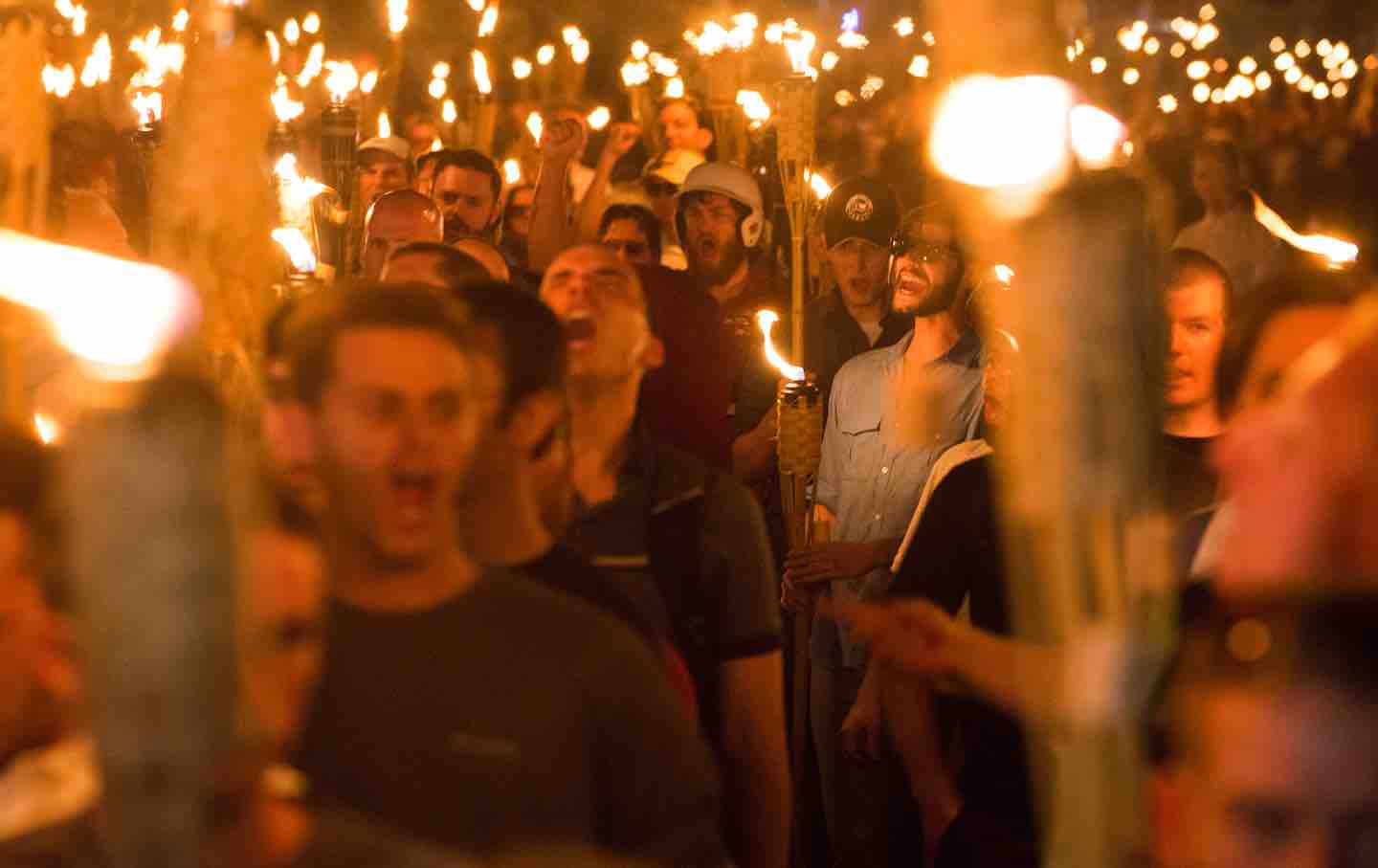
Tiki-torch wielding protestors on the campus of the University of Virginia on the night before the “Unite the Right” rally in Charlottesville, 2017.
(Zach D Roberts / NurPhoto via Getty Images)
When Joe Biden ran for president in 2020, among the reasons he cited for his campaign’s very purpose was the 2017 “Unite the Right” rally in Charlottesville, Virginia, which culminated in the tragic murder of Heather Heyer. She was killed by the speeding car of a Donald Trump–supporting neo-Nazi named James Fields Jr. Then-President Trump refused to denounce the right-wing activists who’d held the rally, more or less, in his name and said that there “were very fine people on both sides.” Liberals were aghast. What was also shocking, according to the mainstream press, was that this hate-fest could have taken place in the genteel college town of Charlottesville.
Books in review
Charlottesville: An American Story
Buy this bookNearly a decade later, the infamous footage from the rally—such as the tiki-torch-toting extremists chanting “Jews will not replace us!”—has faded into the background as the second Trump regime enacts its authoritarian agenda through ICE raids, attacks on the “DEI” boogeyman, and a wholesale dismantling of the welfare state. And yet while Charlottesville might seem like just one more awful spectacle among the many we’ve been forced to witness, it was arguably a key prefigurative moment of the 2010s, one that ushered in our current state of affairs. Yet its importance has been sidelined amid the quotidian exhibitions of violence and gleeful cruelty that the Trump administration has committed or permitted; the daily assaults on our collective dignity by the MAGA movement have made it difficult to remember the horrors of the recent past as well as the popular resistance to them.
Deborah Baker’s Charlottesville: An American Story is an in-depth, forensic, and panoramic view of the long road to the Unite the Right rally. Through meticulous detective work and journalistic narrative, Baker shows us that the effort to unite the right goes back decades, incubated alongside Charlottesville’s history of harboring anti-Black reactionaries. After all, looming over the town is Monticello, the estate of the University of Virginia’s founder, Thomas Jefferson. Jefferson, who spoke loftily about liberal ideals like reason and liberty, also (as we all ought to know at this point) owned enslaved Black people and, through rape, fathered children by an enslaved woman named Sally Hemings. Baker looks at the self-satisfying glow of Monticello and the politesse it casts on the city below, revealing the sordid underbelly of the city’s legacy of racial hatred, segregation, and subjugation.
There is something all too American, Baker argues, about believing that bucolic scenery and bourgeois pretensions can keep the repressed and foundational histories of this country’s utmost oppressions at bay. Though often weighed down by their encyclopedic density, the book’s numerous character studies untangle seemingly everything about Charlottesville through the four centuries of its existence, from the town’s colonial-era settlement, founded in racial enslavement, to 20th-century UVA professors espousing eugenics, to the small-town activists who violently fought against court-mandated desegregation orders. By doing so, Baker makes it clear that no one should be surprised that this town was the same place a murderous right-wing rally took place in the 21st century.
The first and second parts of Charlottesville: An American Story deal with the historical backdrop, and the book’s third and final part concentrates on the days before and during the rally itself. Between the first and second parts is an interlude titled “The Heart of Whiteness,” which centers on a white Charlottesville resident who seems like an early-20th-century forerunner to Richard Spencer. Similarly, a final interlude before the third part, titled “A School of Backward Southern Whites,” is about a heroic and compellingly flawed white woman who resembles something of an earlier Heather Heyer. It is a curious narrative and structural choice to put the carts before the horses here, introducing contemporaries in the beginning before delving into the history and antecedents, back and forth, over and over again. A more linear and chronological argumentation could have been useful for readers. To her credit, Baker has centered the bulk of the book’s recurring characters not on the headline-grabbing, bumbling far-right nitwits like Spencer and other nationwide hate figures, but on a charming cast of little-known left-wing activists and organizers who call Charlottesville home. Introduced in the first part of the book are the likes of Wes Bellamy and Zyahna Bryant. Bellamy, a Black man, arrived in Charlottesville in 2009 to work as a computer science teacher before launching a quixotic campaign for City Council; he was sarcastically nicknamed “Fresh Prince” and mistrusted by the locals, who saw him as something of an attention-seeking carpetbagger, though he eventually did win public office. Bryant, at that time a high-school freshman, had called upon then–Vice Mayor Bellamy to take down the statue of Gen. Robert E. Lee in a public park. She was precocious and iron-willed, someone “sustained” by the Black church who was impelled to embrace a life of activism after the murder of Trayvon Martin by George Zimmerman. Baker mentions dozens and dozens of others in this book, yet paradoxically, their moving biographies often get lost in the forest of names, dates, archival evidence, and so forth. Sometimes a discriminating eye has its noble uses—though thankfully, Baker does provide a helpful list of the book’s 105 characters.
Baker devotes the book’s interludes to just one person each. The first, “The Heart of Whiteness,” traces the entanglement of the liberal intelligentsia and baldfaced white supremacism in the figure of John Kasper, a 26-year-old graduate of Columbia University. Kasper arrived in Virginia in 1956, months after the state’s “Massive Resistance” movement tried, and failed, to convince the state government to pass laws banning desegregation. Like so many young, alienated white men, Kasper joined the feverish politics of white backlash. Raised in New Jersey, he was an intellectual jack-of-all-trades, admiring tough-talking men of various politics, from Machiavelli to Stalin and, most prominently, Ezra Pound. The Mussolini-loving Pound, who advocated for Fascist Italy and Nazi Germany from an Italian radio station during World War II, was brought back to the United States and committed to an asylum in Washington, DC, in 1945. Kasper began aping Pound’s worldview in this period, combining old-fashioned European antisemitism with thoroughly American anti-Blackness, estranging former colleagues and friends in bohemian Greenwich Village. Possessed of a “smoldering charisma” and described by the New York Herald Tribune as a “Hollywood version of the All-American boy,” Kasper would team up with a UVA student to burn crosses on the lawns of Supreme Court Chief Justice Earl Warren and Justice Felix Frankfurter.
Like the well-groomed and respectable fascists of today, Kasper had the looks and charisma that charmed audiences and disarmed elites. Kasper and his ilk chose to decamp to Charlottesville as a battleground because the NAACP had done so as well. Future Supreme Court justice Thurgood Marshall, then the chief counsel of the NAACP’s Legal Defense and Educational Fund, had sued Charlottesville’s school authorities over its segregated schools, recognizing the city’s importance. Baker writes, “On Marshall’s side were seventy students whose families were willing to risk their livelihoods for their children’s education.” The Charlottesville chapter of the NAACP had grown into the Commonwealth’s largest. Kasper’s far-right rabble-rousing earned him the loyalty of a notorious circle of like-minded racists, with one associate credited with writing George Wallace’s “Segregation now, segregation tomorrow, segregation forever” speech, while others were involved, Baker writes, in “eighty-eight bombing incidents in the Deep South between 1955 and 1960.” Despite Kasper’s agitations, Charlottesville’s schools would become fully integrated in 1962. Still, as a figure, Kasper is interesting because he is emblematic of the type of person that Richard Spencer represents, which makes for one of Baker’s most convincing historical parallels: telegenic all-American men with educational pedigrees and preppy backgrounds who, alienated from the polite societies they were being groomed to join, fall from grace to become an uglier, less respectable type of white supremacist.
“A School for Backward Southern Whites,” the book’s second interlude, is about Patty Boyle, a high-born and pious Virginian woman with a clergyman father who was raised on a plantation, a grandfather who was General Lee’s scout, and another grandfather who was a colonel under Thomas “Stonewall” Jackson. Boyle was “moonlight and magnolias” personified: In her 40s and married to a UVA professor, she began a campaign to welcome the law school’s first Black student, Gregory Swanson, believing it to be the Christian thing to do. Boyle wanted sincerely to greet him with open arms and argued in local newspapers about how Virginia’s best should treat “our Negroes.” (Her campaign, despite its good intentions, was still tone deaf.) Yet Boyle’s white upper-crust milieu soon began to turn on her. As Kasper stormed around town denouncing the “red-controlled Supreme Court,” posters appeared targeting Boyle and other local “homos, perverts, freaks” and “hot eyed Socialists.” Eventually, Boyle found a cross burning in her front yard and would be radicalized by her estrangement from the community. She was praised in Martin Luther King Jr.’s “Letter From a Birmingham Jail”; she participated in the March on Washington; her 1962 autobiography, The Desegregated Heart, became a national bestseller; and she was even jailed for the first time, for three days, in St. Augustine, Florida, in June 1964 for protesting against segregation at the Monson Motor Lodge. When desegregation came to Charlottesville, she began to be seen as a courageous rebel, and she joined a Black church that she tithed for the rest of her life. Patty Boyle led the kind of life that Heather Heyer was robbed of.
The third part of Charlottesville: An American Story flows from a trove of citations, and it attempts, often deftly so, to express in writing what has been seen countless times in tweets and videos. Baker acknowledges the narrative difficulties of channeling thousands of social media posts into a neatly organized retelling: “To portray the multiple, nearly simultaneous, explosions of violence that took place in and around the park is a near impossibility,” she writes. One wonders if this is a methodological issue with doing historical work concerning a recent past that lives on millions of phones and in terabytes of ephemeral data.
The road to the Unite the Right rally began at the start of 2017, when an unknown, directionless, and fame-seeking local blogger and UVA alum named Jason Kessler began attacking Black community leaders and the city’s Jewish mayor for voting to remove Confederate statuary in the city. And the rally in Charlottesville was generated from the energy of two other events earlier in the year: the Battle of Berkeley in February, which was sparked by Milo Yiannopoulos coming to town, and a violent protest in Pikeville, Kentucky, that was spearheaded by Matthew Heimbach and his Traditionalist Workers Party. After Berkeley and Pikeville, Richard Spencer held a nighttime gathering in Charlottesville in May to protest what he had seen as an affront to white heritage and civil rights. Here, Kessler “networked furiously”—he later reached out to Heimbach, Spencer, and others over Discord, 4chan, and so on. It wouldn’t be long before the next Charlottesville rally would get a name and a date: Unite the Right, on August 12, 2017. Although Kessler had been struggling for weeks without success to obtain a permit, authorities allowed the rally to proceed as planned, even with the unannounced torchlight rally at UVA occurring the night before.
Before and during the rally, state and local police ignored repeated warnings of gun-toting, “Sieg heil!”–ing street fighters descending from around the country. The Charlottesville cops had been meeting with the fascist provocateurs for weeks leading up to the rally, negotiating with them to keep the protests relatively civil. As for the liberals, they haplessly sang songs and clasped hands on the day of the rally in the face of Confederate-flag-waving neo-Nazis and other far-right militants more heavily armed than the cops themselves. They were quickly driven off the streets, while anti-fascists and other leftists engaged the far right with ferocity. Cops stood idly by as the counterprotesters, left and liberal alike, were assaulted, including the near-lynching of a 20-year-old Black man named DeAndre Harris in a parking garage “literally next door to the Charlottesville Police Department” by a Proud Boy and six other fascists. An eleventh-hour declaration of the hate-fest as an unlawful assembly rang hollow: By that point, punches had landed, epithets and slurs had been hurled, smoke bombs and chemical sprays were already unleashed, and there was an ambient bloodlust in the air.
Ultimately, and monstrously, a car driven by James Fields Jr. sped into a crowd and killed Heather Heyer, a dedicated paralegal and charming waitress. A passionate, hardscrabble defender of working people like herself, Heyer’s last words on Facebook read: “If you’re not outraged, you’re not paying attention.” Even after the half-hearted damage control that Trump attempted after his “both sides” comment, no White House officials showed up for Heyer’s memorial service.
Since Heyer’s murder, some Unite the Right participants have risen to greater stardom or notoriety, while others have fallen into obscurity and imprisonment. Jason Kessler, who helped organize the rally, attempted a failed sequel in Charlottesville a year later, which was undone by infighting on the right. Richard Spencer and other leaders distanced themselves from Kessler, and Heyer’s murder, altogether; Spencer had fallen so low that he was reported by Jezebel in 2022 to be on Bumble, describing himself as a “moderate.” As for the little-known rank-and-filers at the rally and the sympathizers throughout the country who followed events with approval on their screens, quite a few ended up at the US Capitol on January 6, 2021, including members of paramilitary and street-fighting groups like the Proud Boys and the Oath Keepers. White-nationalist figures, such as the Internet personalities Nick Fuentes and Anthime Gionet (better known as “Baked Alaska”), were also prominent at both. And another common through line between the explosion of far-right violence in 2017 and in 2021 is Trump’s tacit approval. Charlottesville and January 6 reveal how far-right paramilitaries outside the state machinery and elements within the state are connecting with each other and maturing. Many of the goals that animated the 2017 tiki-torch wielders, from mass deportations to authoritarian power grabs, are coming to fruition under Trump 2.0.
Popular
“swipe left below to view more authors”Swipe →Despite being markedly unpopular on nearly every issue, from kleptocratic malfeasance to a metastasizing cost-of-living crisis, MAGA has faced no real opposition. Like the Democratic officials in Charlottesville who repeatedly ignored the threat from violent right-wing reactionaries, the Democratic Party establishment is proving itself to be just as ineffective. Asleep at the congressional wheel, the likes of Hakeem Jeffries and Charles Schumer prefer to scapegoat and castigate the party’s left flank or participate in photo ops with Benjamin Netanyahu, who is carrying out the ultimate goal of far rightists the world over: illiberal attacks on representative and judicial institutions, ethnic cleansing, and, finally, genocide. If Biden truly reckoned with the legacy of Charlottesville, how can we explain all the mass carnage he permitted in Gaza? Liberals and centrists, from 2017 till now, from Charlottesville’s local government to the upper echelons of the Democratic Party, have stumbled and fallen over their commitments to moderation—misapprehending the threat of authoritarianism and enabling its growing strength. And because of liberalism’s failures, Charlottesville has come to the Oval Office.
Become a Sustaining Donor This September
Between the reemergence of right-wing red-baiting and Donald Trump’s use of the chilling National Security Presidential Memorandum–7 to criminalize left political organizing, we’re seeing McCarthyism reborn before our eyes.
This assault on democracy cannot be ignored or wished away. Resisting it requires bravery in the face of threats and repression, a steadfast commitment to the truth, and the unwavering belief that we can—and will—overcome this darkness.
We must have an independent media that sets the record straight, unearths corruption and abuses of power, and advances a politics of justice and dignity for all if we’re to win this fight.
That’s why I’m writing to you today. This September, The Nation needs to add 100 monthly donors to sustain our progressive journalism. Your contribution makes the next investigative report, the next truth-speaking column, and the next pathbreaking essay all possible.
I hope you’ll support our work with a recurring donation today. If you donate $10 or more a month, we’ll send you a brand new “Hands Off the Free Press!” sticker to recognise your commitment to our cause. Please, donate today.
Onward,
Katrina vanden Heuvel
Editor and Publisher, The Nation
More from The Nation
America Without the NFL America Without the NFL
Chuck Klosterman’s Football is a eulogy for the sport on the eve of its decline.
Edward Said: Between Worlds Edward Said: Between Worlds
A new film biography depicts the Palestinian writer as still out of place—and ahead of his time.
Imani Thompson’s Grad-School Thriller Imani Thompson’s Grad-School Thriller
In Honey, the novelist offers a different take on the campus satire.
Love and Literature in Leslie Fiedler’s America Love and Literature in Leslie Fiedler’s America
When will the American novel grow up?

