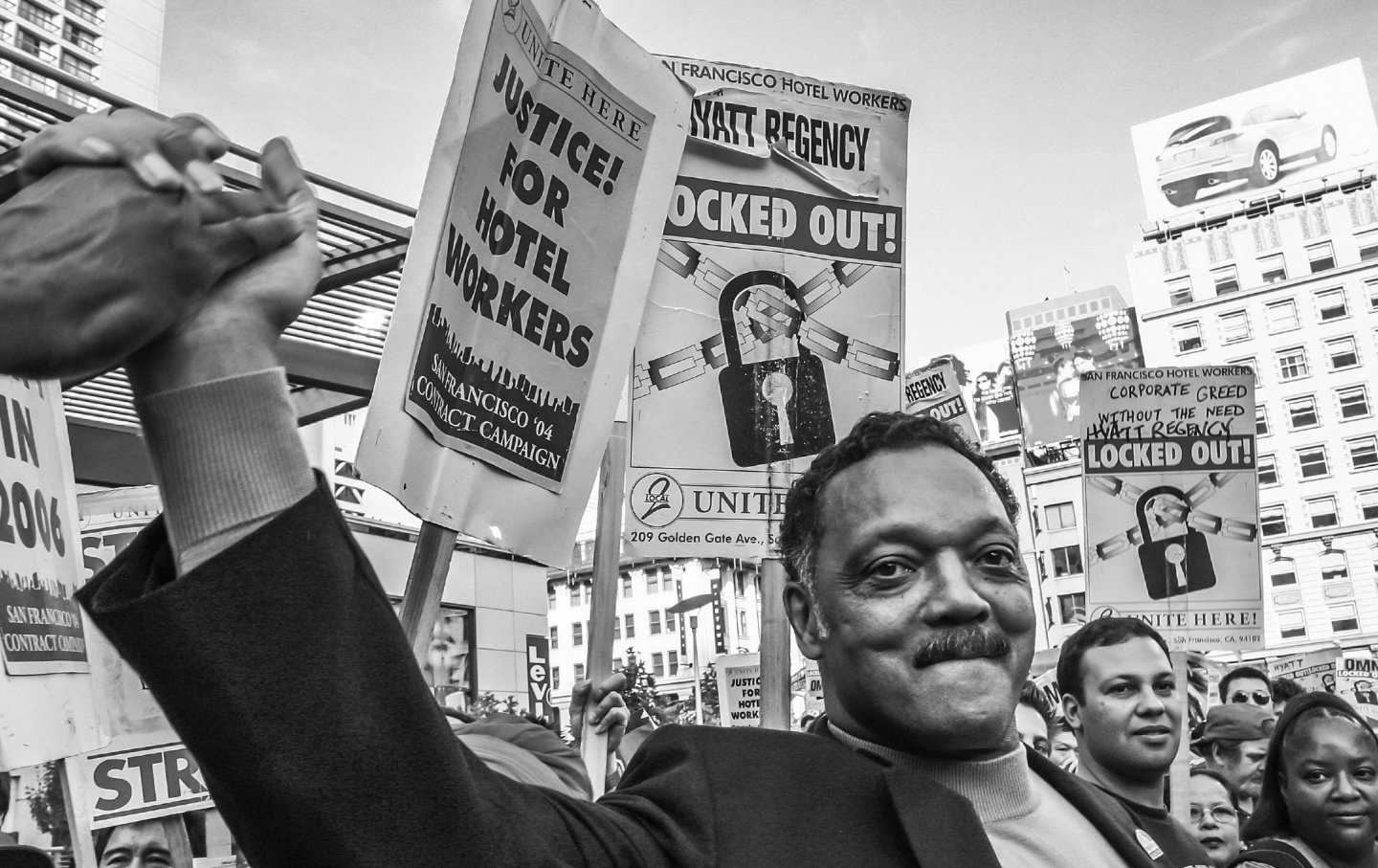
“Jesse Jackson is one of the very most significant political leaders in this country in the last 100 years,” declared Senator Bernie Sanders, summarizing the importance of Jackson’s remarkable life and his historic 1984 and 1988 presidential campaigns.
His historic journey began in the humblest of circumstances. He was born the son of a single, teenage mother in Greenville, South Carolina, deep in the Jim Crow segregated South. He rose to be in the public eye for over six decades, a globally recognized warrior for justice. He became the youngest of Dr. Martin Luther King’s SCLC leadership group, organizing Operation Breadbasket, which mobilized African Americans to apply economic pressure on corporations to open their jobs, contracts, and boards to minorities. After King’s tragic assassination, he rapidly rose to be a leading voice of the civil rights movement as the head of People United to Save Humanity (PUSH), which he founded in Chicago.
Directly challenging the right-wing reaction that brought Ronald Reagan to the White House in 1980, Jackson’s 1984 and ’88 presidential campaigns electrified the country, registered millions of voters and energized millions more, fulfilling the promise of the Voting Rights Act, Dr. King’s crowning achievement. In 1984, he registered 2 million new voters and inspired millions more to vote, contributing directly to Democrats’ taking back the Senate in 1986. In 1988, Jackson garnered over 7 million votes (more than Walter Mondale had won in winning the 1984 nomination). In 54 primary contests, he came in first or second in 46, winning 13. His orations at the 1984 and 1988 conventions rank among the greatest political speeches in our history.
Others followed through the doors that Jackson’s campaigns kicked open: the first African American mayors of New York City, Seattle, and Durham; the first African American governor of Virginia; the election of the ’88 Minnesota co-chair Paul Wellstone and Vermont’s Bernie Sanders to the US Senate; as well as the first African American woman in the US Senate, Carol Mosely Braun. Minority members of the US House of Representatives doubled in size between 1990 and 1992. Barack Obama acknowledged that Jackson’s campaigns awakened him to what was possible. More importantly, Jackson’s campaigns forced rules changes on the Democratic Party to make it, well, more democratic—lowering the threshold for winning delegates, eliminating winner-take-all and “bonus” delegate selection rules. Without these, Obama would not have defeated Hillary Clinton in the 2008 primaries. This, as Jackson’s key aide Steve Cobble wrote, “is a mathematical statement, not a rhetorical one.”
Both in 1984 and 1988, the campaigns’ greatest asset was their candidate. Facing a skeptical, often hostile press, with little money for paid advertising, Jackson relied on generating free media and drawing big crowds. Among the Democratic contenders, he was by far the best orator, the best on the debate stage, and the best at rousing a crowd. Washington Post columnist David Broder wrote that comparing the oratory of Jackson with that of other Democratic presidential candidates is “like comparing a mighty organ with a kazoo band.” As New York Governor Mario Cuomo noted, Jackson campaigned in poetry, while the others droned in prose. The poetry, however, had a purpose. Jackson’s genius was in presenting a complicated message and agenda in language that, as William Greider put it, “had a beat so strong that even white folks can dance to it.”
The greatest testament to Jackson’s brilliance and his greatest legacy is that the mission, strategy, message, and agenda of those campaigns remain directly relevant four decades later.
“I did not start with the money, the ads, the polling or the endorsements,” Jackson said, “I started with a mission and a message.” The mission was to build a “progressive rainbow coalition—across ancient boundaries of race, religion, region and sex,” and move Americans from “racial battlegrounds to economic common ground and on to moral higher ground.” “If whites begin to vote their economic interests and not racial fears, and blacks vote their hopes and not despair, we can change America,” he argued. “We have the numbers and the need; if we have the will, we can win and we deserve to win.”
His message focused on “economic violence,” the violence done to working and poor people in an economy that, as today, works for the few and not the many. He put forth a bold agenda to address real needs: a national healthcare plan, and major public investment, including a National Infrastructure Bank, to rebuild America.
He pushed for empowering workers—raising the minimum wage and indexing it to median incomes, card check to make organizing unions easier, equal pay and comparable worth, paid family leave—and for holding corporations accountable. He championed notice and reparations for plant closings, and protecting worker rights and the environment in global trade accords. “When the plant closes and the light goes out, we all look the same in the dark.”
He challenged Reagan’s racial slanders directly, educating the country. “Most poor people are not lazy. They work every day. They are not Black or brown. They are mostly white, female and young. Most poor people are not on welfare. They work every day. They take the early bus. They work every day.”
He campaigned for a still-unrealized care agenda: “The cost of welfare and jail care on the back side of life is so much greater than the cost of Head Start and day care on the front side of life,” he argued, laying out a plan to fund Head Start, prenatal care, and daycare while doubling the education budget.
He pushed for using public pension funds with government guarantees to build affordable housing.
Arguing that we have guided missiles but misguided leaders, he called for a new common sense in foreign policy. He supported working with the USSR’s Mikhail Gorbachev to end the arms race, and for adopting a no-first-use policy. He denounced Reagan’s brutal Central American wars. He challenged the then-bipartisan embrace of South Africa’s apartheid regime and the libeling of Nelson Mandela as a terrorist, helping to spark the Free South Africa movement that eventually brought an end to apartheid. He earned praise even in The Des Moines Register as the only candidate to speak sense about the Middle East, arguing that “Israeli security and Palestinian justice are two sides of the same coin.”
He put forth a budget to prove that we could pay for our dreams. “Jackson,” reported Newsweek, “is saying more than any other candidate for president and saying it better.”
To bring his coalition together, his strategy was to stand with people “at the point of challenge.” Over the years, Jackson walked more picket lines, helped to resolve more strikes, inspired the enlistment of more union members, helped forestall more farm foreclosures, marched with peace activists, gays and lesbians, environmentalists, and visited more public schools and campuses (and won the vote of those 18–44 in the 88 primaries). In 1984, he rescued Lt. Robert Goodman from Syria; by the end of his life, he had negotiated the release of more prisoners and hostages than any other civilian in American history.
Even as he appealed to shared economic interests, he called on the various segments of the Rainbow to recognize their need to come together. America, he argued, is not a blanket, made up of one thread or one color. It is a quilt of many colors and many textures. He used the metaphor of his grandmother’s quilt. When she didn’t have the money to buy a blanket, she would take patches of cloth, different colors, different textures, and sew them together with a strong cord to make a quilt, a thing of beauty and warmth. “Workers,” he would argue, you’re right. You deserve a living wage, but your patch isn’t big enough. Farmers, you seek fair prices and you are right—but you cannot stand alone. Your patch isn’t big enough. Women, you’re right. You seek pay equity and comparable worth, you are right, but your patch isn’t big enough. Gays and lesbians, when you fight against discrimination and for a cure for AIDS, you are right, but your patch isn’t big enough.”
“But don’t despair. Be as wise as my grandmama. Pull the patches and the pieces together, bound by a common thread. When we form a great quilt of unity and common ground, we’ll have the power to bring about healthcare and housing and jobs and education and hope to our nation.”
Popular
“swipe left below to view more authors”Swipe →Jackson is survived by Jacqueline, for over six decades his wife, fierce partner, and steady anchor, and by their five children. His son Jonathan now serves in Congress. His oldest son, Jesse Jr., is campaigning for a return to Congress, after his initial congressional career was cut short when he was convicted of misuse of campaign funds. The Rev. Jackson acknowledged fathering and supporting a child out of wedlock. He was a towering figure, but, as he said in his 1984 convention speech, “I am not a perfect servant. I am a public servant doing my best against the odds.”
In his 1984 convention speech, Jackson, responding to the question of why he ran against the odds and took on such big and controversial issues, quoted a poem by an anonymous author:
“I’m tired of sailing my little boat,
far inside the harbor bar.
I want to go out where the big ships float
out on the deep where the great ones are.
And should my frail craft prove too slight
for waves that sweep those billows o’er,
I’d rather go down in the stirring fight
than drowse to death at the sheltered shore.
“We’ve got to go out, my friends, where the big boats are.”
In his remarkable journey, Jesse Louis Jackson sailed out on the deep where the big ships are and proved himself both a skilled navigator and a farsighted captain. We would be wise to follow the path he forged.
More from The Nation
No, Woke 1 Was Not Crazy No, Woke 1 Was Not Crazy
AOC and others are laughing off 2020 as a wild, isolated moment. None of that is true.
How Occupy Wall Street Still Explains Politics Today How Occupy Wall Street Still Explains Politics Today
It sowed the seeds for a new era of social movements—but its politics of powerlessness should act as a cautionary tale.

Abdul El-Sayed’s Win Is a Landmark. But the Fight Is Far From Over. Abdul El-Sayed’s Win Is a Landmark. But the Fight Is Far From Over.
Even though the Palestine movement is on the march, we can’t afford any complacency.
Mamdani’s Team Redefined Political Video. Now They’re Betting on Short Films. Mamdani’s Team Redefined Political Video. Now They’re Betting on Short Films.
Premiering exclusively in The Nation, a new short film produced by City Hall and narrated by Morgan Spector highlights the efforts of the biggest tenant-led union in New York City...
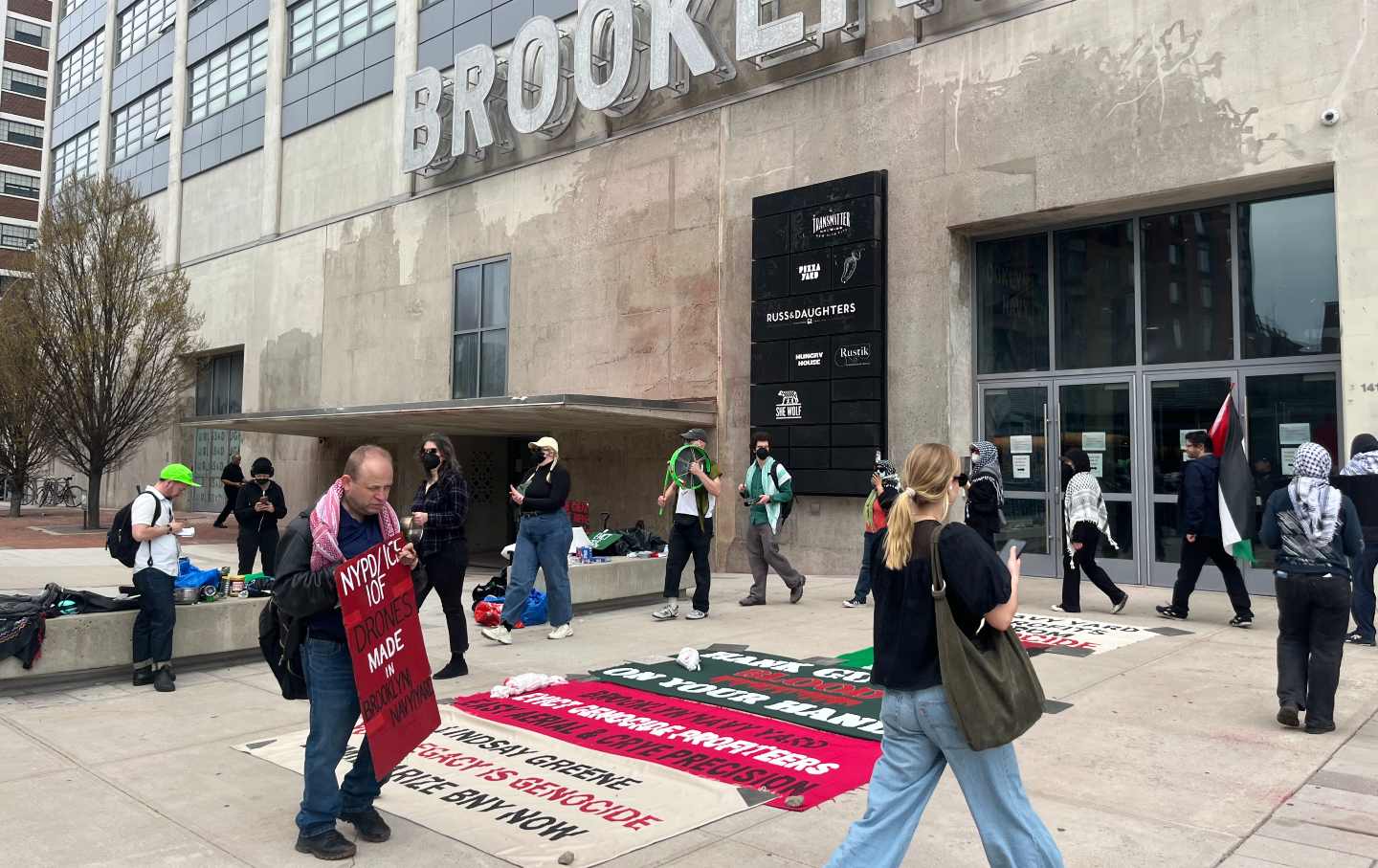
The Weapons Manufacturer Next Door The Weapons Manufacturer Next Door
It’s been six years since I began attending pro-Palestine demonstrations. The most recent campaign at the Brooklyn Navy Yard feels different.

Slavery’s Musical Threads Slavery’s Musical Threads
As ICE violence resurges in the US, the musical history of black Brazil offers lessons in resistance.

