

For all the stacks of material that 79-year-old Maria Gitin has in her archives, there are just a couple grainy photos from the summer of 1965—right before her sophomore year at San Francisco State—which she spent in Wilcox County, Alabama, sleeping on church pews, ducking gunfire, getting arrested, and helping Black residents exercise their long-standing 15th Amendment right to vote.
One Monday in March, the 19-year-old turned on the news to footage of violent attacks against peaceful demonstrators on Selma’s Edmund Pettus Bridge. The camera cut to Dr. Martin King Jr. at the pulpit, asking Americans to stand up for what was right, good, and true. A young white woman who was “very idealistic” in believing a better world was possible, she felt personally called to the cause by King’s speeches and his “liberation theology of love and compassion.” She wrangled a signed legal waiver from her furious parents, raised the money for her transportation to a training in Atlanta, and joined hundreds of other college students from across the US as they dropped into counties across the roiling South to support voter registration. “I loved it,” she recalled of the training, “because Dr King said youth are where history is being made. He made us feel that, collectively, we could change the world.”
Gitin was assigned to the very small, very segregated town of Camden, Alabama, where peaceful protests turned to smoke-bombed mayhem, along with marches, cross burnings, mass arrests, gunfire, and rallies, and multiple visits from Dr. King himself, who sometimes spoke from inside a bulletproof trailer locals had constructed for him. Movement leaders thought the presence of white youth would mean media coverage. But even the local paper, The Wilcox County Progressive Era—where a vehement segregationist led the newsroom—never ran a story.
It was “the neglected summer,” Gitin says. But little has changed since then, she suggests, given that the local historical society’s website contains nary a mention of King’s private visits or public rallies there, much less the words “civil rights movement” at all.
As the civil rights veteran approaches her 80th birthday, she is preparing her archives for acquisition by Stanford University LIbraries—the final step in her decades-long project of documenting what King scholar Lewis V. Baldwin calls Wilcox County’s many “ordinary voices and agents of struggle who, up to this point, have been left out of the history books.” Stanford Libraries’ American History curator became aware of Gitin’s trove when taking in the archives of her friend and fellow Southern Christian Leadership Conference (SCLC) volunteer Bob Finch, King’s “official photographer.” Much of it was amassed leading up to the 2014 publication of her historical account and memoir, This Bright Light of Ours, which civil rights historian Hasan Kwame Jeffries called “one of the most nuanced treatments of white involvement in the movement that I have read.”
I sat down with her recently to ask what about King persuaded her to set comfort aside and join Alabama’s voting rights fight, and what advice she has for people who wish to be useful now, in another period of American upheaval.
—Alexandra Marvar
AM: You write about how, in the spring semester of your freshman year at San Francisco State, you turned on the TV and saw news footage of violent attacks on peaceful demonstrators on Selma’s Edmund Pettus bridge. You were this 19-year-old white girl, 2,300 miles away, yet you were so moved by it, and you felt that everything was converging—your values, your beliefs, your family history. When you heard King’s call to nonviolent arms you “decided right there and then, ‘I can do that. I have to go!’” What was it about King’s message that struck such a chord in you?
MG: Dr. King felt it was a moral war: that the whole country will rot if we do not collectively overcome this evil of racism and make people whole by this whole process of voting, and affirmative action, and both tangible and ethical/legal reparations—so it was very appealing. I was very idealistic.
From King himself, the message of nonviolent action, compassion for the whole world; that is when I really got deep in my heart. It just irritates the heck out of my political activist friends now that I keep saying no, only love can conquer hate. I am not going to spend my life in resistance to what is, because it is what it is. And I did spend a lot of my life in resistance to what is: I founded a domestic violence shelter. I’ve worked a lot with child sexual abuse survivors and women’s health centers and done lots of things where we were militantly defending people who have been mistreated for no reason. But I always had that undercurrent of: You have to come from a place of compassion. If you’re just filled with hatred and resentment and resistance, that’s what people get from you. That was really what I got from King.
AM: What was the movement’s strategy around programs like SCLC’s Summer Community Organization and Political Education (SCOPE) project?
MG: The idea was that white kids coming would bring publicity. That the media would stay down there the way they had in Selma—which they did not. They thought that it would help the laws to get passed, because we would be mistreated, and then our parents would be outraged and write their Congress members and insist that they pass the Voting Rights Act—which didn’t happen. Instead, our parents wrote us and told us, “You have to come home right now.” And they thought our parents and our communities would send money to support the organization, which also did not happen. Those were their three objectives. However, the point was to get as many African Americans registered as we could and to begin by letting them know their rights.
We had these orientations at Berkeley, and then everybody who was participating in the project convened in Atlanta, Georgia, and that was where we met Dr. King and Ralph Abernathy and Andrew Young and Dorothy Cotton. We had people from President Johnson’s Department of Justice. We had people from—there was actually an anti-poverty office at one time. Hard to imagine today, but it was kind of the golden era of Johnson, and even [some] Republicans were saying people were going to riot if they didn’t do something about poverty and racism in this country.
All the SCLC leaders were there, as well as the young people who had just come out of Selma. So that was an intensive bootcamp. We had 10 days of a 10-hours-a-day schedule. And then we had wrap sessions and parties at night. So, zero sleep.
AM: Did you ever meet Dr. King in person?
MG: The night before we were off to our separate counties, he then had us all in a circle—the Friendship Circle—which we closed every evening, and people lined up to shake his hand. But I had been hardly sleeping, hardly eating, not used to the humidity, and I’ve never been in the most perfect health—and I passed out. And they took me to a local hospital. So no, I didn’t shake his hand.
AM: How did you end up being assigned to Wilcox County?
MG: We didn’t know where we were going to be assigned until the second to last day, and then we met with a leader from that county. When I told somebody else in my dorm, “Oh, I got assigned to Wilcox County—I hear things are really good up there [because] Dr. King went to Morehouse College with Reverend T.L. Threadgill, and that means that Dr. King has a really strong connection there.” Somebody else said, “Do you know they have the worst sheriff for the entire South and you’ll probably get killed?” So that’s how I got there.
AM: What did locals in this super-segregated community think of these young white kids showing up in town to help with the fight for voting rights?
MG: In Wilcox County, people had been organizing secretly. They had a branch of the NAACP, had the Wilcox County Improvement Association, had their own organizations, had meetings for quite some time… And that’s when, to the best of my understanding, Reverend Threadgill, who was the chaplain at the segregated Camden Academy, invited Dr. King. He said, “You know, I think this county is really ripe—that we can do more—that we need help from outside.” King made multiple visits there, for public events, and also under-the-radar visits. There were leaders there and Dr. King’s organization SCLC had already decided that they would send some paid staff from their field staff to help coordinate this summer project and maybe to be there longer. One of them, Reverend Dan Harrell, was already there.
People who had been organized were eager for us to come. The Grassroots people and the youth were a different story. Many of them had been out marching and demonstrating all spring for better schools, as well as for their parents’ right to vote, and there had been quite a few high-profile incidents [peaceful demonstrations that ended in tear gas, smoke bombs, mass arrests, or gunshots fired]. They were a little more skeptical. Because what do white Northerners know? And it was the first time I realized I was a Northerner—I always thought of myself as a Westerner—but once I went there, I realized I was a Yankee, and it didn’t matter what I did, nothing was going to change that view.
AM: Was it what you expected?
MG: We didn’t know exactly what to expect, but our training was to listen to and take our cues from local leaders, and then, we were each assigned a local youth to work with. Once I’m in Wilcox, every single person I speak to is Black. I had no interaction with the white community, except when being arrested—or chased. We couldn’t go in the diners to eat, or to the stores. There was zero interaction. It would have been risking our lives. When we did see white people—like if they drove by us on the road—they would either yell or point a gun out the window. They hated seeing integration.
The little kids were very fascinated by us and we’d go to the church and talk with them and so forth, and one time I was carrying a little girl, and I was just going through downtown, which I usually didn’t do with another Black person. And a woman just rammed her car up on the sidewalk. She wanted to run over us.
It’s hard to describe how shocking the segregation was—so strong socially and economically. There was a complete barrier to advancement, which of course forced people to unite across classes. One of my friends there, Rosetta Anderson said, “Segregation kept us united, and we all worked on behalf of each other.” And now the middle class—and the people who’ve been able to get ahead—they’re like, “I don’t want to talk about it. I don’t want to think about it.”
AM: As you were on your way home to California, the Watts riots erupted in Los Angeles: six days of rioting that led to 34 deaths, 1,000 injured, some 4,000 arrests, and an estimated $40 million in property damage triggered by word of police brutality against a Black man during a traffic stop. King arrived there in the aftermath and broadened his focus to urban areas outside the US South. What was it like, coming back to that moment?
MG: I came home very discouraged, and also that summer, before we even got home, the riots broke out in Watts, and very soon there were troopers in San Francisco. There was definitely this idea that it was very fine to go and march peacefully or register voters in the South, but don’t be bringing that demand for jobs and schools and housing to the North—and it was suppressed violently.
And that was heartbreaking, because I had hoped that this nonviolent movement would catch on, but instead, when I went to the SNCC office to report back in about my summer—nobody even wanted to see me or have anything to do with me.
AM: What were the next few years like after that experience in Wilcox County?
MG: I went years and years without talking about it with anybody. And I was not alone. When we’ve had reunions, almost everybody said the same thing: that if they were white, and they had gone [to the South to volunteer for the movement], that they came home and they realized nobody could comprehend what it was. And also, we didn’t want to… it was like “Who Gets to Tell My Story?” in Hamilton. It was like that: You can’t tell these stories.
Many of the white kids who came back immediately got involved in the anti-war movement, or students for democratic society, or other “white people projects.” Most people were not quite as shaken as I was—a lot of things happened, including with my family and school. San Francisco State was ground zero for troopers on campus, and Black people occupying the buildings.
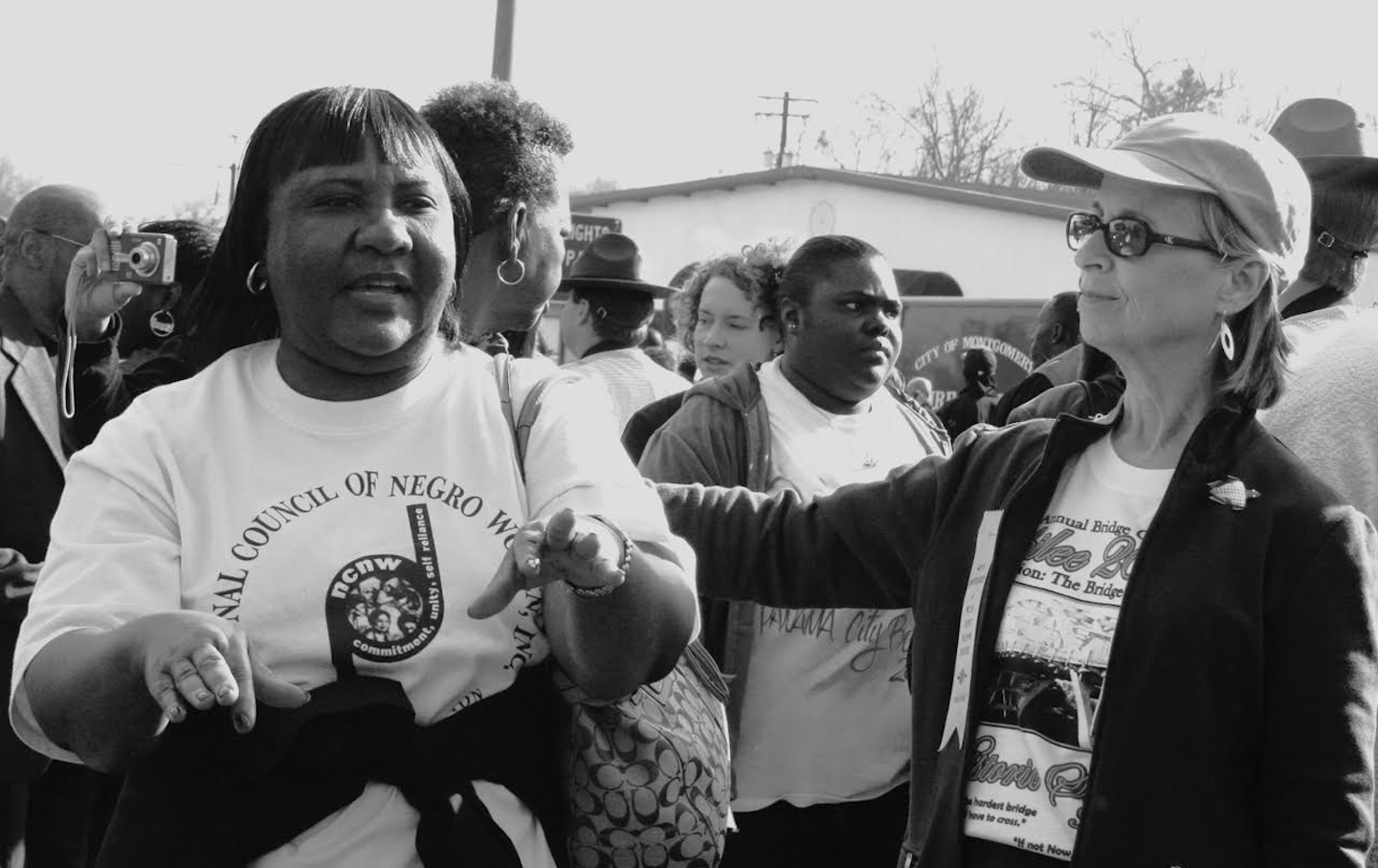
AM: It would be decades before you started sketching out the idea for your book—hybrid memoir and history—and you eventually, finally, went back and revisited that history in person.
MG: I feel so grateful that, when I did go back, that people trusted me to tell my stories, because I went back mostly for my own healing, to say, Did we do more harm than good? Was it helpful at all? And many people were like, “I can’t believe you came all this way, and faced this, and joined with us.”
AM: You’ve noted how there’s not much documented about Dr. King’s visits to Wilcox County. You’ve created a pretty comprehensive timeline of his activities there—both to meet in private with people and to give speeches. Are you swimming against the current doing this kind of memory work in Wilcox County?
MG: If you go to the Wilcox County Historical Association website, there is not one word about civil rights. That goes to this fear that if they acknowledge it—if they even open that door a crack—that the whole edifice would come down; that civil rights veterans would start sharing these stories they’re sharing in private groups on Facebook now. They would start sharing them in the community, and saying, “Hey, you know what? Your grandfather raped my grandmother.” “We need to get some of our land back.” “You fired my family.” “You hung my father.” I mean, there’s a woman on [the private civil rights forums] whose brother witnessed her father being lynched in the 1970s.
AM: Over the years, you’ve spoken at many places, including universities across the US. Do you ever feel that there is no possible way that college students—or anyone who wasn’t there—can really understand what you went through?
MG: I have to say, when I gave a talk at the Defense Language Institute, which is a military school in Monterey, the audience was soldiers, and they really understood. Many of them had been in combat, and they knew what it was to have somebody want to kill you.
I’ve spoken quite a bit in the South to students at the University of South Alabama, Emory, Vanderbilt… I decided when I give these talks or these interviews, I just want to represent as honestly as I can the situation as I saw it. White students were reactive, like: Why didn’t I ever learn any of this in high school? Why didn’t I ever hear about this before? I never knew any of this happened—kind of a disbelief. The Black students, the younger ones, often really didn’t want to hear about it. It was like: That was my grandparents, and maybe my parents (or great-grandparents, depending on their ages)…I’m safe. I don’t want to hear about this old stuff. And I especially don’t want to hear white people talk about it.
That had shifted in 2020 with George Floyd and Trump. Prior to that, I had more speaking engagement invitations than I could possibly respond to. That became: White people shouldn’t even be talking about race. But I still continued to be asked by people in the South, because they’ve only just barely started talking about this stuff. And now, they’re being told they can’t talk about it all over again.
Popular
“swipe left below to view more authors”Swipe →AM: What guidance do you have for people who feel called to do something today, but they just can’t figure out what?
MG: I am very much living in the question of how to be useful at this time in history.
Back when we had in-person NAACP meetings, I would go and people would say, “Do you want to speak?” I’d say no, and I would go in the kitchen and help cook. I would just look for: Where can I be to show that I don’t think that I’m better than you? Where can I go to be in a support role? Where can I go that you wouldn’t expect me to be? And a lot of it is just not putting yourself forward.
We didn’t see the big rewards right away. We didn’t see it really, until, you know, Johnson and the GOP became afraid of young people. They became afraid of Black power. They became afraid of the disaffection of white youth over the war. And they created all these anti-poverty programs, public health centers, women’s health centers, [and so on]…
I think it’s a biblical saying in the South: Make a way out of no way. You take what you have and you run with it, and you gather other people to run with you, to make it happen, and to build something.
To young activists: You probably won’t see your results right away, and that’s why it’s important to have a local group where you just get somebody elected to the school board who doesn’t believe in creationism. Where you even back a less than perfect woman candidate because she’s a woman, because she would be the first woman, even if she’s too mainstream for you. You’ll be proud later, because you’re helping move things forward.
Serving that summer of 1965, and then starting the Monterrey domestic violence shelter are probably the two most rewarding things that I’ve done in my life, to feel that I not only was part of something bigger than me, but I helped move it forward.
I want to emphasize the importance of being a little person in a big piece of history. If you’re operating from you want to see your impact, or you want it to be measurable, or you want to be recognized, or you want to go down in history, it happens for some people, I suppose, but it’s certainly not the way I operated. I think that’s part of what it made it possible for people to be so open with me. People are still open with me. You don’t know what difference you make. You can’t know. You just have to operate from a good heart and from hoping that it makes a difference.
More from The Nation

The Culture of Experts and the Rise of MAHA The Culture of Experts and the Rise of MAHA
The left won’t win over rural Americans by condescending to them.

What’s It Like Inside a Data Center? What’s It Like Inside a Data Center?
Northern Virginia is laden with structures that house data for Fortune 500 companies. I went inside just one of those monstrosities that bothers its neighbors.
What Trump and Tucker Carlson Have in Common What Trump and Tucker Carlson Have in Common
Carlson has broken with Trump largely over the war in Iran. But on Ukraine and immigration, the two speak very much the same language.
The Jewish Case Against AI The Jewish Case Against AI
Haredi rabbis and the secular left agree: This technology is a threat to the entire social fabric.
The Fight for Educational Equality Is Also a Fight for a Just Supreme Court The Fight for Educational Equality Is Also a Fight for a Just Supreme Court
The court has severely weakened our ability to make an education system that fulfills the promise of Brown.
The Fall of “Scientific American” The Fall of “Scientific American”
When the Trump administration objected to the magazine's political coverage, its corporate owners stepped in. Now its future is uncertain.

