
Despite Themselves, Democrats Look Well Positioned for the Midterms
An otherwise inert opposition party may well clean up on Donald Trump’s destructive and hubristic governing record.
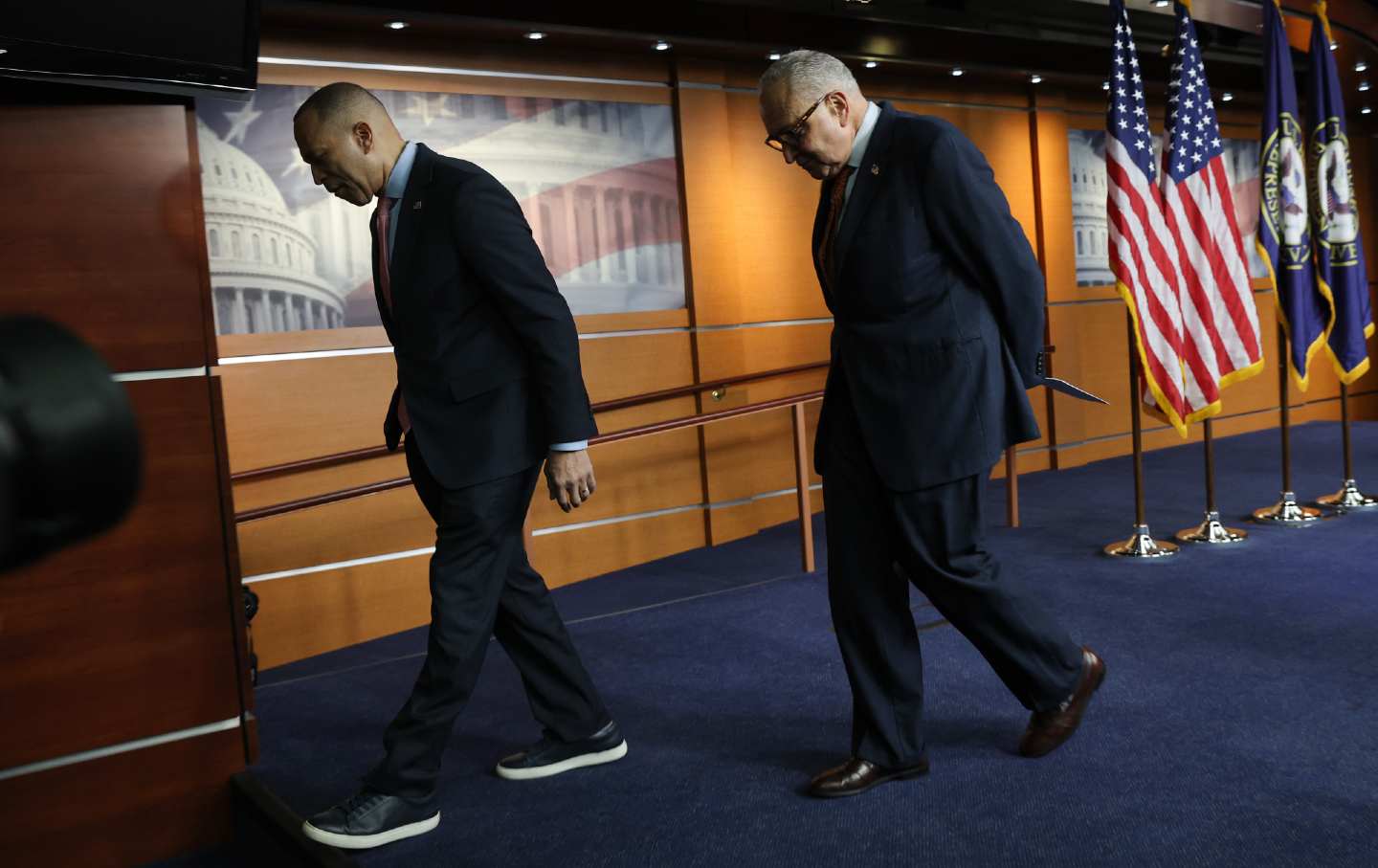
Congressional leaders Hakeem Jeffries and Chuck Schumer exit a press conference last week.
(Kevin Dietsch / Getty Images)
Ten months is an eternity in political time, but from today’s vantage point, Democrats have to feel pretty good about their chances of delivering an electoral shellacking to President Donald Trump and his congressional allies in November. To be clear, this has very little to do with any change in the campaign strategy, policy thinking, or moral imagination of national Democrats. They have been consistently wrong-footed, timid, and abjectly consultant-driven over the past year. Most of the party’s useless public-facing leadership remains inexplicably fixated on grocery prices as the president’s goons nakedly enrich themselves, terrorize American cities, and lawlessly bomb, invade, and alienate other countries. The country’s notional opposition party remains content to issue press releases and fundraising pitches that seem composed in some kind of alternate universe where the United States hasn’t suddenly become a dysfunctional gangster state.
But the Democrats are a good bet to win anyway. That’s because the president and his party have loudly and aggressively pursued a highly divisive and unpopular agenda that has not only failed to deliver an improvement in the cost of living but has also given all of us front-row seats to a seemingly never-ending circus of laughably evil corruption, ugly authoritarian overreach, unsettlingly strange policymaking, and erratic economic stewardship. In the face of all this, the president shows no signs of understanding how unpopular he is nor any remote inclination to change course in time to save his party’s congressional majorities. Nor does the vast corps of MAGA quislings on Capitol Hill seem likely to regain consciousness in time to reassert Congress’s constitutional authority over the rampant abuses of the executive branch.
This is Trump’s ship, and they have retired to their quarters hoping that their morally depraved captain has some kind of plan for the ankle-deep water sloshing around their feet other than letting them drown. Everyone with any sway inside the administration, from immigration consigliere Stephen Miller to Trump himself, seems to be huffing the fumes of their own propaganda about the putative historic mandate voters delivered to them in 2024 in what was actually an extremely close election. If they’re not high on that toxic supply, then they simply don’t care about the political consequences of what they’re doing.
The administration’s decision to attack Venezuela, kidnap President Nicolás Maduro, seize control of its oil industry, and proclaim that the United States will “run Venezuela” like some kind of 19th-century colonial vassal state is a perfect example of the party in power’s self-inflicted myopia. At a minimum, the Venezuelan coup demonstrates how Republicans still haven’t come to terms with the catastrophe of the Iraq War, and how little they seem to care about public opinion. It’s an absurd gambit that virtually no one wants and delivers nothing of value to any meaningful Trump electoral constituency. It does, however, achieve the distinction of being both unimaginably idiotic and stunningly illegal. To make matters worse, the administration can’t even seem to figure out from minute to minute whether this was a one-off coup or the beginning of a sustained and expensive policy of either regime change or horizonless containment. (Though Trump’s recent proposal to hike an already bloated $1 trillion Pentagon budget by another $500 billion suggests the latter, fathomlessly disastrous scenario may be gaining traction.)
A party interested in defending its congressional majorities would also look at the polling around, say, ICE’s mass deportation campaign and back off or soften the policy. That would seem to be an especially urgent mandate after the horrific murder of Renee Good, an unarmed ICE observer in Minneapolis, last week.
The indefensible autocratic lawlessness of a police state targeting US cities has turned a majority of all Americans against Trump’s immigration policies, according to polling. Yet neither the White House nor any leading figures in the GOP can do anything other than grotesquely and brazenly lie. A single, half-hearted speech from Trump calling for unity and promising to dial back some of ICE’s tactics would be politically astute and drive a days-long narrative in the credulous national media. But anti-immigrant demagoguery is now too deeply ingrained in the MAGA movement’s DNA for any such damage-control campaign to be thinkable.
Worse, Trump’s militarized, over-the-top internal enforcement operation is particularly repugnant to Latinos—a constituency that was crucial in his 2024 victory. Under conditions of ICE siege, many Hispanic Americans cannot even make a routine trip to the grocery store anywhere in the country without worrying that they will be harassed, detained, or worse. Rather than try to safeguard Trump’s gains among Latino voters, or even expand them, the Trump administration has chosen to sacrifice them on the altar of feeding fresh content into the right-wing propaganda machine, and building up a Freikorps contingent of middle-aged undatable sociopaths. According to a November Pew survey, a staggering 70 percent of Latinos disapprove of Trump’s immigration policies.
MAGA-battered observers might protest that Trump still has time to change course—he has, after all, survived scandals, miscues, and all-out system failures that would have been death sentences for normal politicians. Yet, a year into his second term, he’s shown zero inclination to pursue the sort of pivot to surface normalcy that helped the GOP hold on to its Senate majority in 2018. During the opening year of his first term, Trump had little to show in the way of policy achievements. He spent much of the summer that year getting into a terrifying and juvenile Twitter flame war with the nuclear-armed North Korean dictator Kim Jong Un, while continuing to fend off the fallout from the burgeoning 2016 Russian election scandal. By the time Republicans passed their signature tax cut in December 2017, Trump was polling an average approval rating of 37 percent. There was scant reason to believe it would come back up.
But it did. Between January 2018 and the onset of the Covid-19 crisis, Trump mostly governed like a standard-issue Republican president—coasting on the economic sugar high of the tax cuts, cutting blank checks to the Israelis, playing hardball with Iran, and stacking the judiciary with Federalist Society ideologues willing to carry out the far right’s long-standing plans to erase the hard-won social, racial, political, and scientific achievements of the 20th century. Had the man behaved with even a modicum of decency and gravity during the acute phase of the pandemic, he may very well have won a fairly decisive reelection in 2020. Instead, everything from that point on—from his efforts to reclaim the presidency in the failed January 6 coup to his unhinged tariffs agenda to the mass deportation regime to the Venezuela putsch—indicates that Trump is determined never again to mimic the conduct of a replacement-level GOP president.
That’s why Democrats have leaned so hard into the Trump-is-a-cancer-on-the-presidency messaging complex. But there are signs other than Trump’s clueless intransigence that a Democratic wave is inbound. For the first time in the Trump era, Democrats systematically outperformed their polling in November’s off-year elections. Even in the wave year of 2018, Democrats had underperformed earlier polling, particularly in Senate races. And in 2020, many Democrats all over the country, including presidential standard-bearer Joe Biden, did substantially worse than their final polling averages indicated. That showing deprived Biden of the kind of governing majority needed to create the “FDR-sized presidency” he dreamed of when he was still lucid. Even in 2022, when Democrats defied historical trends to enlarge their Senate majority and nearly held the House, they didn’t systematically blow out their polling. Instead, they mostly outperformed a red-wave narrative.
In 2025, Democratic candidates beat their polling averages across the board—even allowing for the smaller sample size afforded by off-year elections. In the New Jersey governor’s race, Democrat Mikie Sherrill registered a margin of victory that was more than 10 points above the predicted result. For Virginia Democratic gubernatorial candidate Abigail Spanberger, that figure was five points. While there were no statewide public polls for Virginia’s House of Delegates, it is safe to say that no one expected Democrats to pick up 13 seats and emerge with a supermajority. Ditto in New Jersey, where Democrats won a supermajority that represents the party’s largest margin in the state General Assembly since 1973.
These results raise the possibility that pollsters have overcorrected for their misses over the past decade—and that Republicans may indeed be quite vulnerable without Trump on the ballot. Democrats hold a healthy but hardly historic five-point advantage in the Strength in Numbers generic ballot polling average, but the broader trends at play in the past year’s elections suggest they may significantly exceed that margin.
Better yet, the GOP’s orgy of Trump-directed, mid-decade redistricting appears to have backfired. California Governor Gavin Newsom gives me the creeps, but he still deserves credit for navigating a complex electoral process to respond and nullify the Texas gerrymandering gambit. With Indiana Republicans refusing to play ball, and Florida Republicans only able to deliver a one- or two-seat pickup if they redraw their map, Democrats may emerge from the redistricting wars no worse than they started—particularly since Democratic leadership intends to move forward with mid-Census redistricting plans in states like Virginia. This doesn’t mean that Democrats should expect a massive, 2018-style gain, given the paucity of competitive districts nationwide. But even if the Supreme Court guts the Voting Rights Act (again), its decision will likely come down far too late to influence November’s elections.
Popular
“swipe left below to view more authors”Swipe →The Senate will be a much heavier lift, but Democrats are in a much better position than they seemed to be a year ago. They now need to net a four-seat gain to win back the upper chamber. If they can hold their seats in the battleground states of Georgia, Michigan, and New Hampshire, there is a plausible if narrow path that goes like this—they finally take out Susan Collins in Maine, flip retiring GOP Senator Thom Tillis’s seat in North Carolina, and win at least two out of the four red-state Senate races in Ohio, Texas, Alaska, and Nebraska. With GOP primary voters seemingly poised to nominate worst-case-scenario candidates like scandal-plagued and bigoted Texas Attorney General Ken Paxton, taking the Senate no longer seems completely out of reach. If Texas Latinos have turned as decisively away from Trump as they have in national surveys—a September 2025 poll showed a 12-point leftward shift among Latino voters—there is no reason to think this is a safe GOP seat.
What Democrats would do with one or both chambers of Congress, and whether their restored majorities would do much to stop America’s avalanche into autocracy is another question entirely. After all, they can’t even commit to cutting spending on ICE after last week’s public execution in Minnesota. With the Supreme Court seemingly granting the White House plenary authority over not just the composition of the executive branch but also spending and war making, a Democratic House would need to be willing to stage repeated, bruising showdowns with the president over the budget. This would include shutting the government down indefinitely if necessary as a baseline strategy to reverse the nation’s authoritarian crisis.
Among other things, such a strategy would entail a fundamental reorientation of party leadership—starting with the long-overdue repudiation of the party’s aging, do-nothing, “play dead” leadership class. And the Democrats’ bloated, change-averse consultant-and-messaging complex needs to understand in no uncertain terms that the strongman lunacy of the MAGA age won’t be reversed by stale “kitchen table” platitudes. The basic contours of American politics shifted in 2016—and the 2026 midterms may well be the Democratic Party’s last chance to let that recognition sink in.
More from The Nation

What Are Democrats Prepared to Do if Trump Rigs the Election? What Are Democrats Prepared to Do if Trump Rigs the Election?
In this week’s Elie v. U.S, our justice correspondent challenges Democrats' lack of a plan if Trump steals the midterms. Plus: the most racist, and honest, AI add ever.
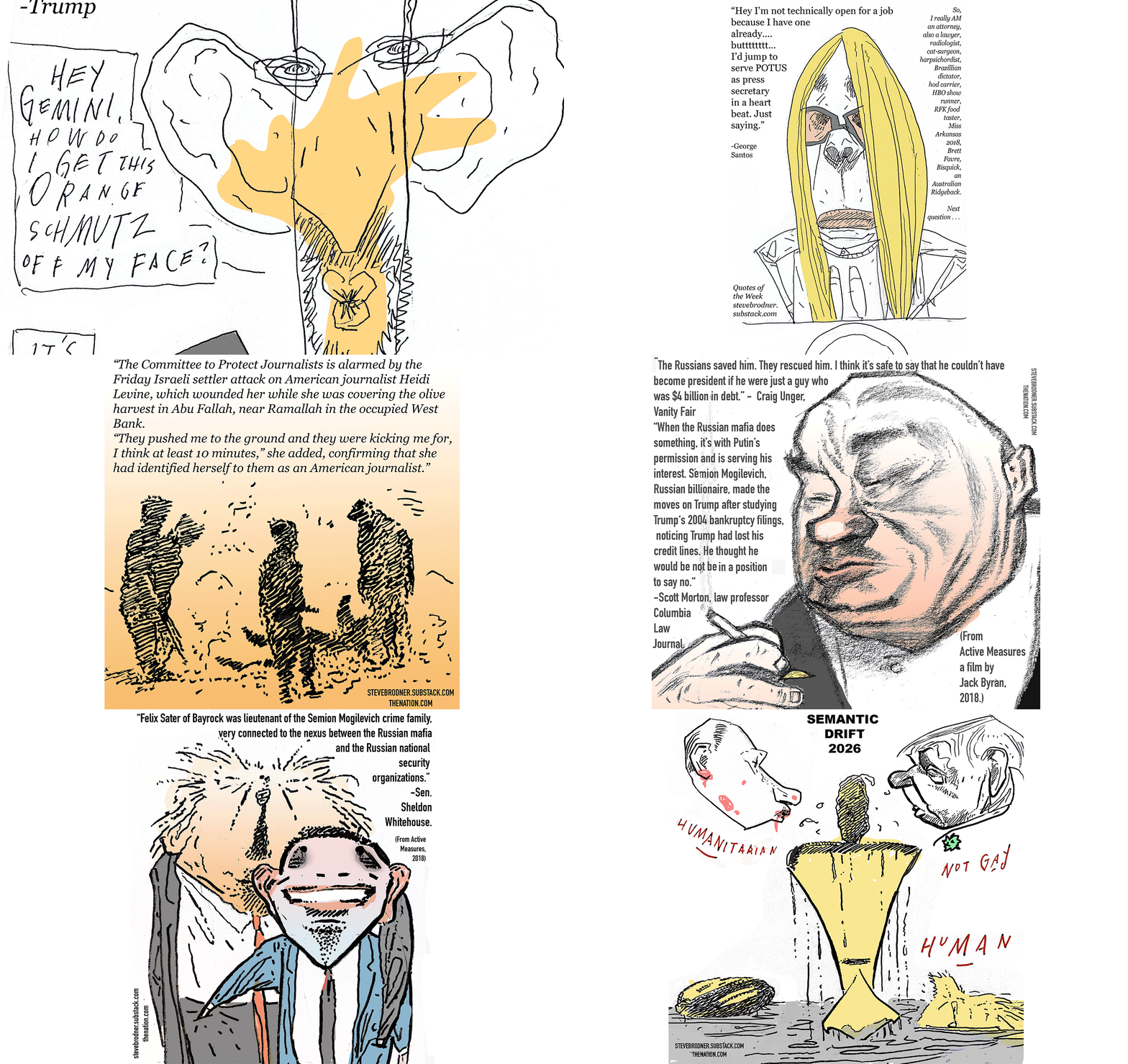
Ramaswamy’s Guide to a Better Vocabulary Ramaswamy’s Guide to a Better Vocabulary
Quotes of the Week.
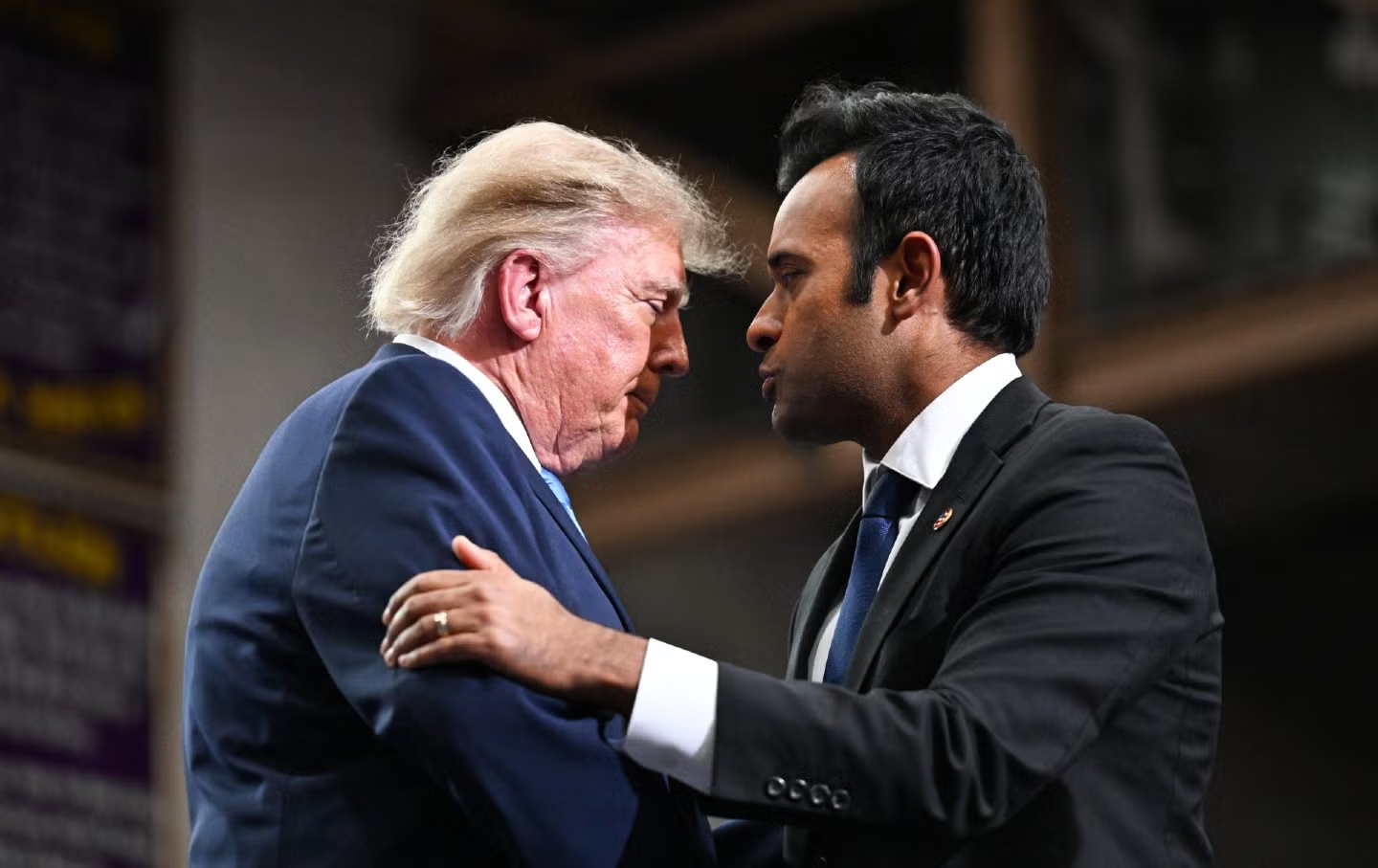
Why Trump Is Embracing Vivek Ramaswamy’s Vile Ad Why Trump Is Embracing Vivek Ramaswamy’s Vile Ad
The president is leaning into the politics of toxic parenting.

The Shadow Knows The Shadow Knows
High-tech weapons, low-tech intelligence.
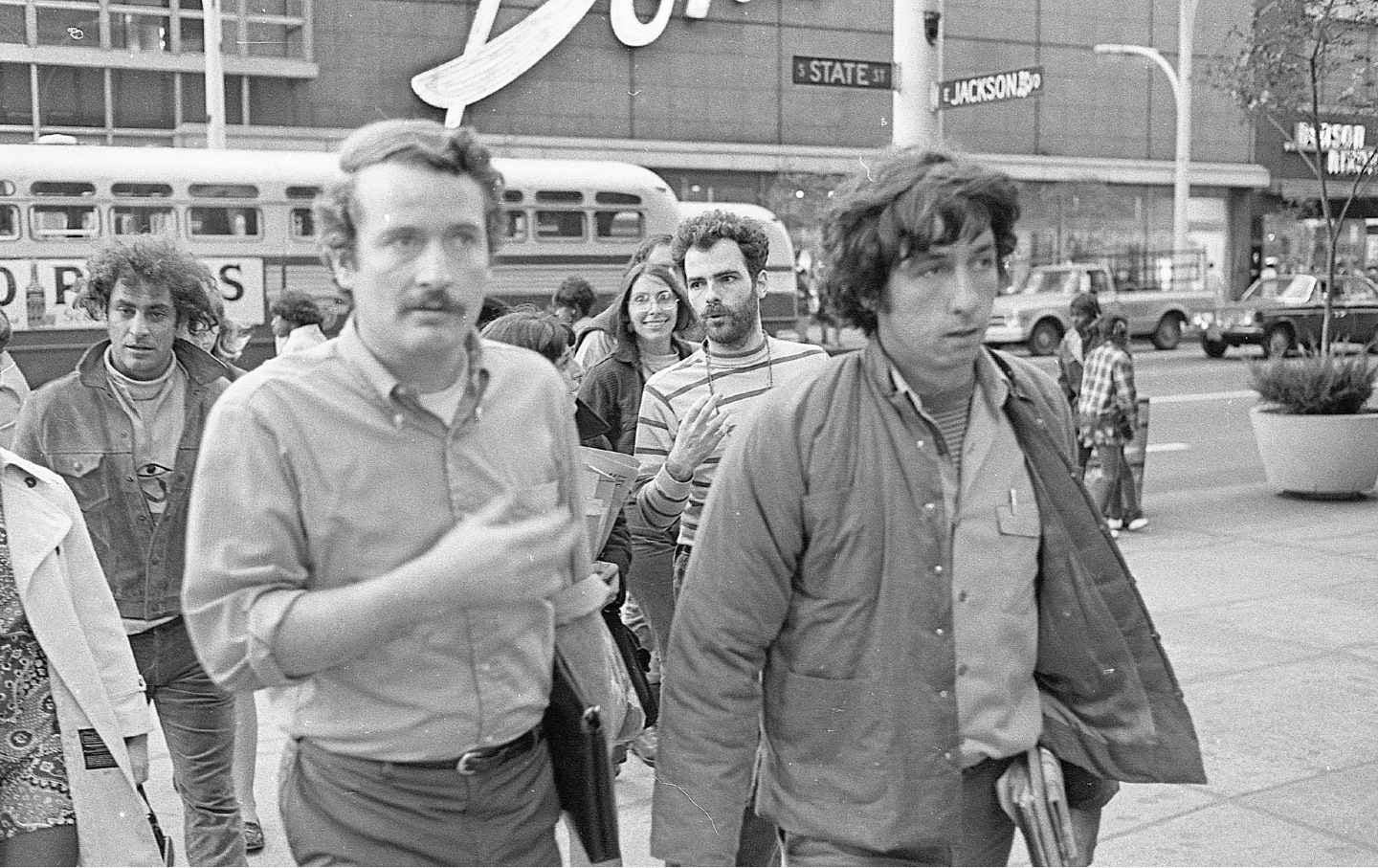
Tom Hayden’s Legacy and the New American Left Tom Hayden’s Legacy and the New American Left
It’s been 10 years since he passed away.
The Decades-Long Battle Within the Democratic Party Establishment Between the Heirs of Dean Acheson and Franklin Roosevelt The Decades-Long Battle Within the Democratic Party Establishment Between the Heirs of Dean Acheson and Franklin Roosevelt
The calamitous history of America’s wars of choice.

