The Fight for American Democracy on College Campuses
The promises of the 26th Amendment remain unfulfilled.
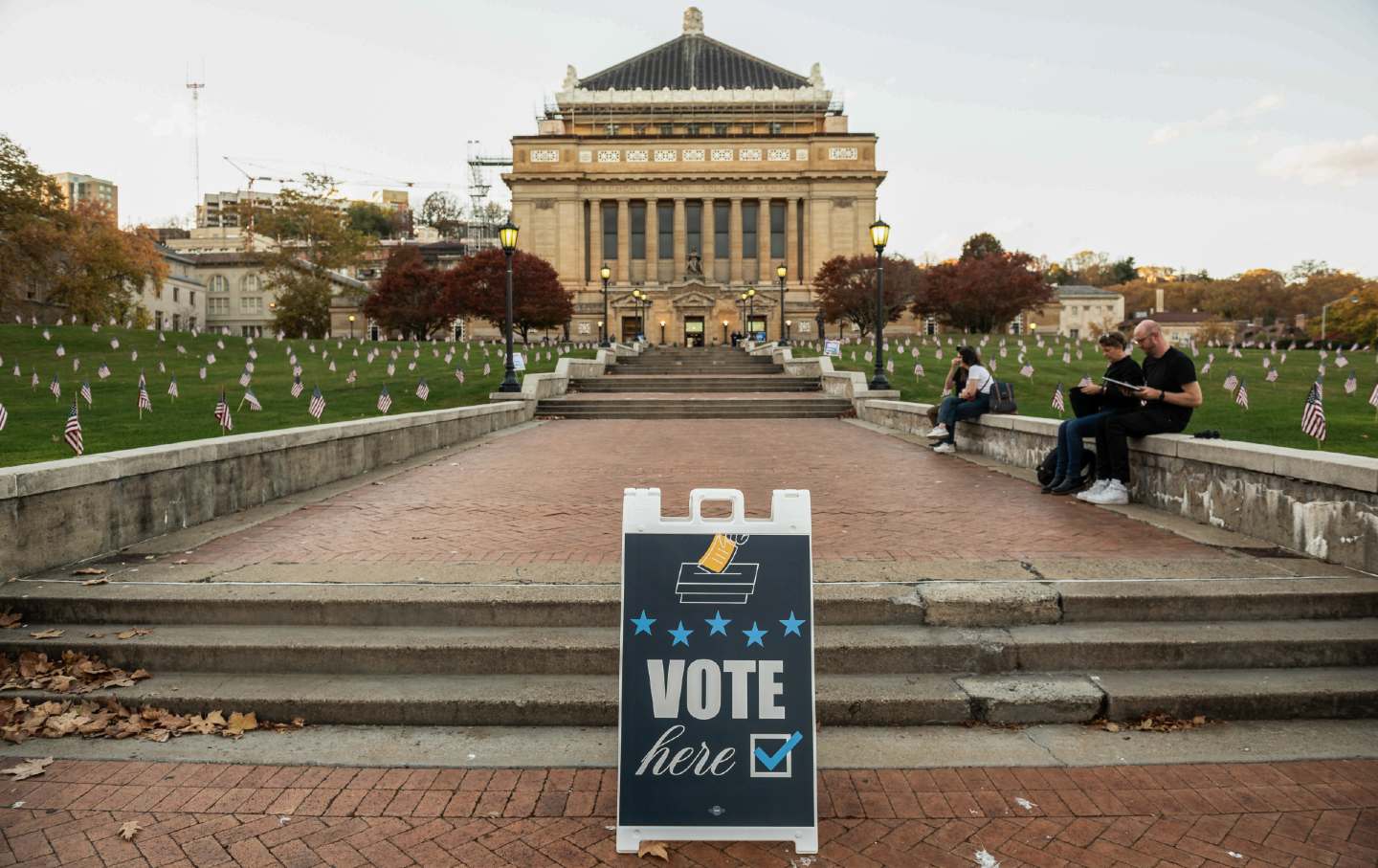
A sign encouraging people to vote sits in the middle of the University of Pittsburgh campus.
(Aaron Jackendoff / SOPA Images via LightRocket via Getty Images)The last time Congress ratified a voting rights amendment to the US Constitution was only 55 years ago, but most people could not tell you what it is. The 26th Amendment lowered the voting age from 21 to 18, but its promises continue to be unfulfilled.
The November 2025 election outcomes remind us of its purpose, consistent with that of the Voting Rights Act of 1965, to “encourage greater political participation on the part of the young.” This month’s election results are a wake-up call as the nation grapples with what feels like a new unprecedented constitutional and moral crisis every day—and young voters set the alarm. Eighty percent of young voters supported California Proposition 50, aimed to “neutralize the partisan gerrymandering” threatened by GOP-lead states—the largest proportion of any voter age cohort. In New Jersey, Virginia, and New York City, youth turnout boomed this cycle, with overall voter rates similarly on the rise.
But 2025 may prove to be an outlier. Since the passage of the 26th Amendment, the overall trend is that youth voting rates have lagged compared with every other age cohort. Compare the 18–24 voter turnout in 2024 (47.7 percent) with the 65+ group (74.7 percent)—a margin of 27 points. The widespread voting disparities between the youngest and eldest age groups is a pattern, not an anomaly: The margin was greater in 1982, when the last class of baby boomers first came out to vote.
What is preventing American’s youngest voters from turning out? While voter enthusiasm is certainly key, systemic mechanisms uniquely hold this constitutionally protected class of voters at bay.
In Montana, when the state Supreme Court struck down a 2024 voter suppression law that eliminated same-day registration, banned the use of student identification cards for voting, and prevented those recently turned 18 years old from access to vote-by-mail, the legislature was undeterred, passing a new law requiring aspiring student registrants to declare their intention to remain in the same county after graduation.
In Indiana, although student IDs have been used for voter identification for 20 years, they were recently banned. It is estimated that 50,000 students at Indiana University Bloomington used a student ID to vote in the 2024 election. The new restriction comes on the heels of the loss of an on-campus polling site at Indiana’s Purdue University, where 45,000 students are enrolled—a polling site that has been available to students since at least 2004.
In South Carolina, state law allows only voters above 65 to vote by mail without an excuse. Similar laws remain on the books in six other states, with demonstrated impact on youth voting patterns.
According to Inside Higher Ed, new laws in 27 states could keep students from voting. These restrictions run counter to the purpose of the 26th Amendment, ratified to remove “special burdens” forced upon young voters in access to the ballot.
Our new book, Youth Voting Rights: Civil Rights, the Twenty-Sixth Amendment, and the Fight for American Democracy on College Campuses, uses four case studies to explore the evolution of the right to vote from the perspective of college communities that served as sites of legal precedent. The case studies, written by faculty from the respective institutions, tell the story of the various civic actors involved in eliminating voter restrictions, and how they worked in coalition to shape the right to vote for the nation.
What is revealed is that the formula is not always identical, but that some combination of young and old, students, faculty, administrators, community organizations, and/or elected officials, can work together to achieve extraordinary success. Moreover, in addition to coalition-building, which inherently requires some form of consensus-building, a variety of tactics are necessary, sometimes in concert: a combination of organizing, advocacy, public education, and, when necessary, litigation.
Popular
“swipe left below to view more authors”Swipe →The book’s case studies carry the reader from Tuskegee, Alabama to Prairie View, Texas, and then to Greensboro, North Carolina, and up to Dutchess County, New York, to examine how, from the start of the Second Reconstruction in 1954 to the present, college communities have fought against authoritarianism to secure access to the ballot. It should come as no surprise that three of the four case studies take place at historically black college and universities, as they were the original vanguard of autocratic resistance. The obstacles facing our institutions of higher education today may not repeat, but they do rhyme—as do the opportunities to resist them.
What unfolds is how lessons learned in these campaigns are a pedagogy unto themselves, furthering the long-standing mission of institutions of higher education to promote democratic values. For example, it was the faculty at Tuskegee Institute who studied and documented the refusal of local election officials to register them to vote. They were the first to testify before the newly formed United States Civil Rights Commission in 1958, recommending key, practical solutions that informed provisions of the Voting Rights Act of 1965. They also brought the first successful case against racial gerrymandering to the United States Supreme Court, overcoming the court’s reticence to intervene in redistricting, creating a stepping stone to what became the reapportionment revolution.
The case studies also show the power of coalition building in the face of voter suppression, particularly across generations and institutional actors, to enable the nation to rise. At Bard College, once students understandably became fatigued by the refusal of the county board of elections to situate a polling site on campus, it was a community organization, the Andrew Goodman Foundation, that infused key resources. Bard President Leon Botstein even served as a litigant alongside his students in the successful push for an on-campus polling site. At Prairie View A&M University (PVAMU) and North Carolina A&T State University (NC A&T), students were the primary mobilizers, with critical backing by organizations like the NAACP Legal Defense Fund and Common Cause North Carolina.
We also discovered that these efforts shaped students’ careers. At PVAMU, where students for decades have had a front-row seat to youth voter suppression—and distinctly Black youth voter suppression—many of those student leaders were awakened to their civic agency and went on to pursue legal careers in the public interest. The same is true of students at the helm at Bard and NC A&T. These efforts align with the purpose of higher education: to train tomorrow’s leaders.
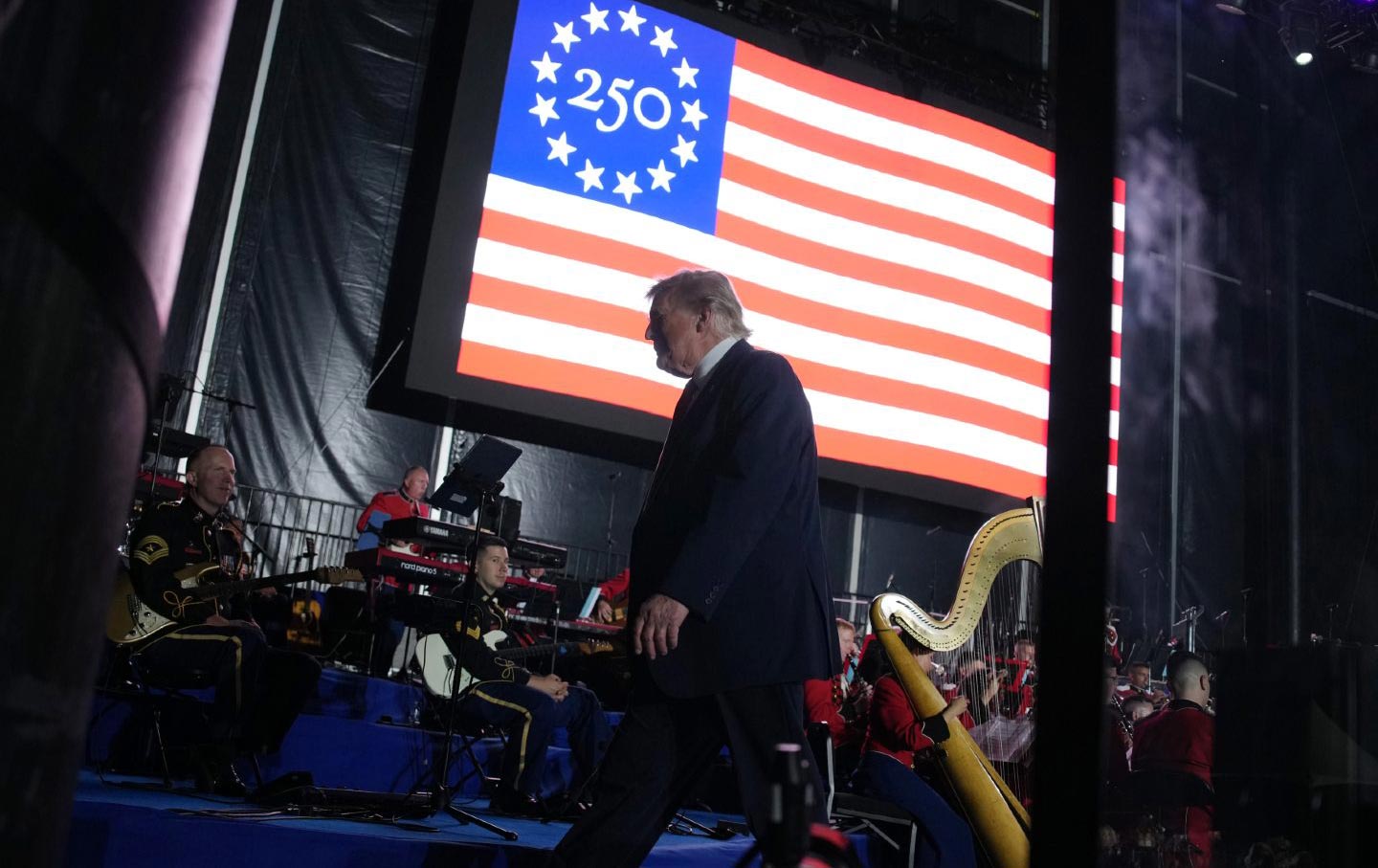
On the 250th anniversary of this nation’s independence, as the United States Supreme Court appears poised to eviscerate key protections of the Voting Rights Act, we would do well to remember that the nation has previously wrestled with the seemingly unsurmountable hegemony of corruption, subjugation, and tyranny. We have seen through these cycles of political and physical violence with a social movement architecture comprised of some combination of organizing, advocacy, public education, and litigation. This muscle is a part of the country’s DNA.
We would do well to remember that those struggles were ultimately met with an expansion of new rights—that is, Reconstruction—in the face of autocratic threats. Young people have always been a part of the multigenerational writing of the story of America, and we will need to continue to engage them to inscribe a stronger democratic and just future.
Become a Sustaining Donor This September
Between the reemergence of right-wing red-baiting and Donald Trump’s use of the chilling National Security Presidential Memorandum–7 to criminalize left political organizing, we’re seeing McCarthyism reborn before our eyes.
This assault on democracy cannot be ignored or wished away. Resisting it requires bravery in the face of threats and repression, a steadfast commitment to the truth, and the unwavering belief that we can—and will—overcome this darkness.
We must have an independent media that sets the record straight, unearths corruption and abuses of power, and advances a politics of justice and dignity for all if we’re to win this fight.
That’s why I’m writing to you today. This September, The Nation needs to add 100 monthly donors to sustain our progressive journalism. Your contribution makes the next investigative report, the next truth-speaking column, and the next pathbreaking essay all possible.
I hope you’ll support our work with a recurring donation today. If you donate $10 or more a month, we’ll send you a brand new “Hands Off the Free Press!” sticker to recognise your commitment to our cause. Please, donate today.
Onward,
Katrina vanden Heuvel
Editor and Publisher, The Nation