
There’s No Quitting the Climate Fight
This is the worst-ever year for climate politics—but the struggle is far from over.
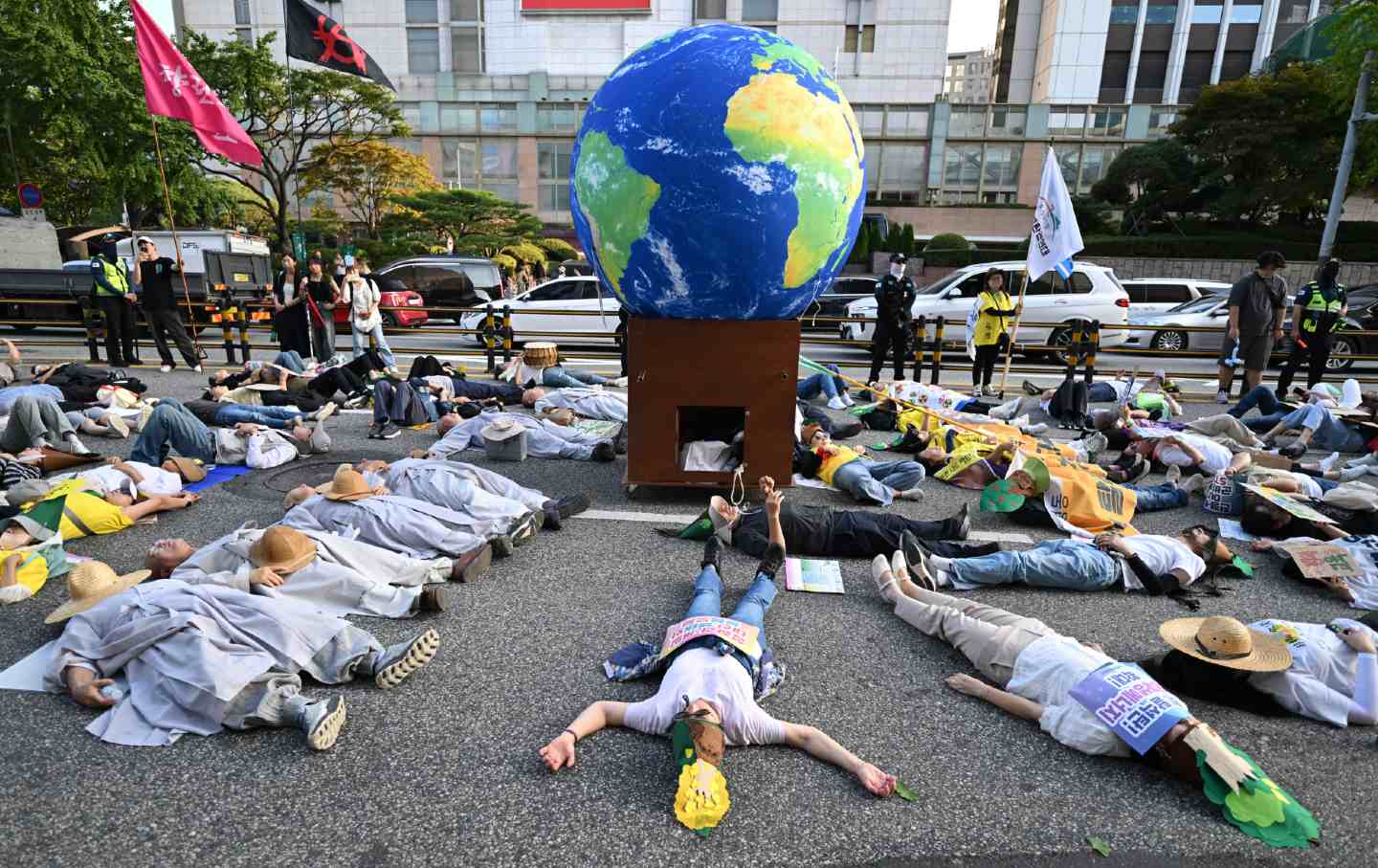
Protesters stage a “die-in” during a rally for Climate Justice in Seoul on September 27, 2025.
(Jung Yeon-je / AFP via Getty Images)“We are hurtling toward climate chaos,” writes an international team of 13 leading climate scientists in their “State of the Climate Report” for 2025, published by the Oxford journal BioScience, an annual must-read for anyone who wants a concise and accessible snapshot of deepening catastrophe.
Among this year’s stark headlines is the “significant weakening” of the Atlantic Meridional Overturning Current, better known as the Gulf Stream, the collapse of which “could trigger abrupt and irreversible climate disruptions” and “initiate cascading tipping events, amplifying the impacts to a catastrophic level” (some of which “may already be occurring”). Another: the risk of a long-feared “hothouse Earth trajectory” (in which global heating becomes unstoppable) appears to be increasing as a result of “accelerated warming, self-reinforcing feedbacks, and tipping points.”
The report’s opening paragraph cuts to the chase: “This unfolding emergency stems from failed foresight, political inaction, unsustainable economic systems, and misinformation.” Surging extreme weather disasters globally, it notes, have amounted to more than $18 trillion in damages since 2000. Taken together, the authors write, “These recent developments emphasize the extreme insufficiency of global efforts to reduce greenhouse gas emissions and mark the beginning of a grim new chapter for life on Earth.”
Allow me to pause and say something personal about how those words land. It’s hard to know what to say anymore about how we might escape our intersecting climate and political catastrophes. It’s always been hard, of course, but after three decades in national journalism—the last 15 years as a climate writer and activist—I struggle with how to keep doing this work in the face of what looks like an impossible situation.
Our present situation consists of a convergence of factors: the growing scientific evidence of accelerating, near-term climate and ecological breakdown, with all the social instability and suffering that come with it; the advances of reactionary political forces—led by fossil capital and its agents from not just the fascist right but also the neoliberal center and center-left—determined to obstruct and delay life-saving action; and, despite some localized wins, the lack of coordinated forces on the left that are sufficiently powerful to counter, much less overthrow, the status quo.
Perhaps it’s no surprise, then, to detect a scent of resignation in the air. When The New York Times Magazine tells us, not inaccurately, that the world “has soured on climate politics” heading into the 30th annual United Nations climate negotiations, COP30, in Belém, Brazil, a natural response might be, “Well, then, why bother?” After three decades of failed efforts to put the global economy on a path to decarbonization and now 10 years since the vaunted Paris Agreement, international ambition on climate policy has stalled in the Global North, where it’s most required.
When mega-billionaire donor and self-styled climate sage Bill Gates, in a now-infamous “memo,” takes a page from the fossil fuel lobby and instructs us to tamp down the “alarmism” because climate change “will not lead to humanity’s demise”—and thus to shift our focus toward “human welfare” in the developing world rather than urgent cuts in global fossil fuel emissions (a wildly false “choice”)—you can hear the cynical laughter in the board rooms of fossil capital and global finance. Thanks, Bill, we were never serious about phasing out fossil fuels anyway.
Gates’s sense of timing was indeed exquisite. The very day he dropped his memo, The Lancet reported that global heating now kills an average of one person per minute. This, The Lancet goes on, even as governments subsidized fossil fuels to the tune of $956 billion in 2023 and banks upped their investments in new fossil fuel production to $611 billion in 2024, the most in five years—and considerably more than their combined investments in renewable energy.
Also that same day, UN Secretary General António Guterres told The Guardian that surpassing the Paris Agreement’s goal of 1.5º C warming is now “inevitable”—indeed we’ve already reached 1.5º—with “devastating consequences,” especially for human welfare in the Global South. At that moment, Category 5 Hurricane Melissa, supercharged by global heating, was bearing down on the people of Jamaica with 185 mph winds and a massive storm surge amplified by sea-level rise.
Yes, the moment is dark. I haven’t even mentioned the Trump petro-state’s gleeful gutting of US climate policy. Or the fact that the stunning growth of renewables worldwide, led by China, has barely put a dent in rising global emissions.
As we head toward the end of what may well be the worst-ever year in climate politics, it would be so much easier to declare defeat—as many Democrats and others on the left seem ready to do—and find some other work to do, throw myself into some other fight, one that appears possibly winnable.
Or one could simply go home, retreat into private life, stock and fortify one’s bunker—literally or figuratively (there are many kinds of bunkers)—and live out one’s days, as best one can, in some small sphere of relative peace and stability, a kind of internal exile. Perhaps some fortunate few (mostly white, mostly comfortable) might even attain a secluded, insular sense of community—even as the world beyond descends into chaos and barbarism from which they have learned to look away.
It would be so much easier. Except for one problem: Such impulses and reveries require the pretense that we live on some other planet, in some other reality. This one is sliding fast toward various points of no return, ecologically, politically, and socially—no, not sliding, that’s too passive; being willfully driven beyond them. Once past these points—and we’re already passing some of them—any sort of stable, secure life on this planet becomes increasingly untenable. For a great many, largely invisible to those in the affluent parts of the Global North, it already is. We have reached the point where vast swaths of humanity are at the edge of an abyss.
To acknowledge these basic facts, and then to pretend all of this can be avoided, would be to align with the forces of nihilistic denial and domination—and to become one more willfully blind accomplice.
But for anyone compelled to engage politically in this moment, avoiding the climate fight is not an option. To retreat from climate politics is to retreat from the fundamental material conditions of the world in which all politics must take place. It’s been said many times and in many ways by various prophets of the present juncture: All politics are now climate politics; every election is a climate election.
There is no other world than the one in which the climate system is breaking down before our eyes: The world in which the polar ice caps are collapsing and great ocean currents that determine the weather for billions, from northern Europe to the global tropics, are weakening, approaching critical thresholds. The world in which the oceans are at record temperatures and, still worse, approaching levels of acidification that threat the marine food chain, with unthinkable consequences for all who depend on it. In which the great boreal and tropical forests are burning and, along with vast expanses of arctic permafrost, are becoming sources of greenhouse emissions instead of climate-saving carbon sinks. The world in which the planet’s hydrology has entered a pattern of whiplashing extreme drought and flood. In which heat waves regularly reach lethality in the places where most of humanity lives. In which ever-increasing masses of climate migrants are on the move, and the havens they seek are increasingly cauldrons of political and social instability, if not walled ecofascist fortress states. In which billionaire-funded geoengineering schemes, entailing catastrophic global risks, are now all but inevitable, opening new fronts in the climate-justice struggle.
There is no other world. Try to hide from it if you want, but it will only get worse with every gigaton of carbon emitted and every fraction of a degree the planet warms. And at some point, it will get abruptly and inconceivably worse.
Olúfémi Táíwò, in his groundbreaking 2022 book, Reconsidering Reparations (reissued last spring), wrote something that I wish many more on the left would embrace: “The possibility of keeping justice alive in our time hinges on our response to the reality of a warming planet.” In a more recent essay, Táíwò made refreshingly explicit what that response requires. “The strategic imperative,” he argued, “must be clear: nothing less than the total defeat of the organized political interests of oil, gas, and coal producers is necessary to make any other climate justice goals even a remote possibility.”
I quote Táíwò not only because he’s right but also because he’s not just addressing the climate movement; he’s addressing the entire left.
It’s no stretch, at this late date, to conclude that nothing short of revolution, in some form, will be required to salvage progressive visions of a better world. It should be obvious—and always should have been obvious—that climate activists, a mere climate movement, can’t do this alone. What’s required, and always has been, is not simply a broader, better organized, more powerful “climate left”; what’s required is a far more powerful left—a resurgent, revolutionary left—a movement of movements, a popular front in which the total defeat of fascism and of fossil capital are understood as inseparable.
Popular
“swipe left below to view more authors”Swipe →It’s too late to prevent climate catastrophe. We’re in it now—and as scientists tell us with increasing desperation, every tenth of a degree matters as we near irreversible tipping points. This means there’s no quitting the politics of climate. Not on this planet, anyway.
The climate fight is far from over. In fact, it’s only begun.
More from The Nation
Germany and California Make Up an Environmental Superpower Germany and California Make Up an Environmental Superpower
The world’s third- and fourth-largest economies have pledged to environmental protections. Will others follow suit?
Two Years After Helene, North Carolina’s Unsettled Recovery Two Years After Helene, North Carolina’s Unsettled Recovery
The state has become a testing ground under an eviscerated FEMA and a missing-in-action “recovery czar,” Michael Whatley, with big political ambitions.
A Reckoning Comes for Nepal A Reckoning Comes for Nepal
A year after its Gen Z uprising, Nepal faces a struggle not only for democracy and human rights but for climate survival.
How Will Nepal Pay for the Latest Climate Disaster? How Will Nepal Pay for the Latest Climate Disaster?
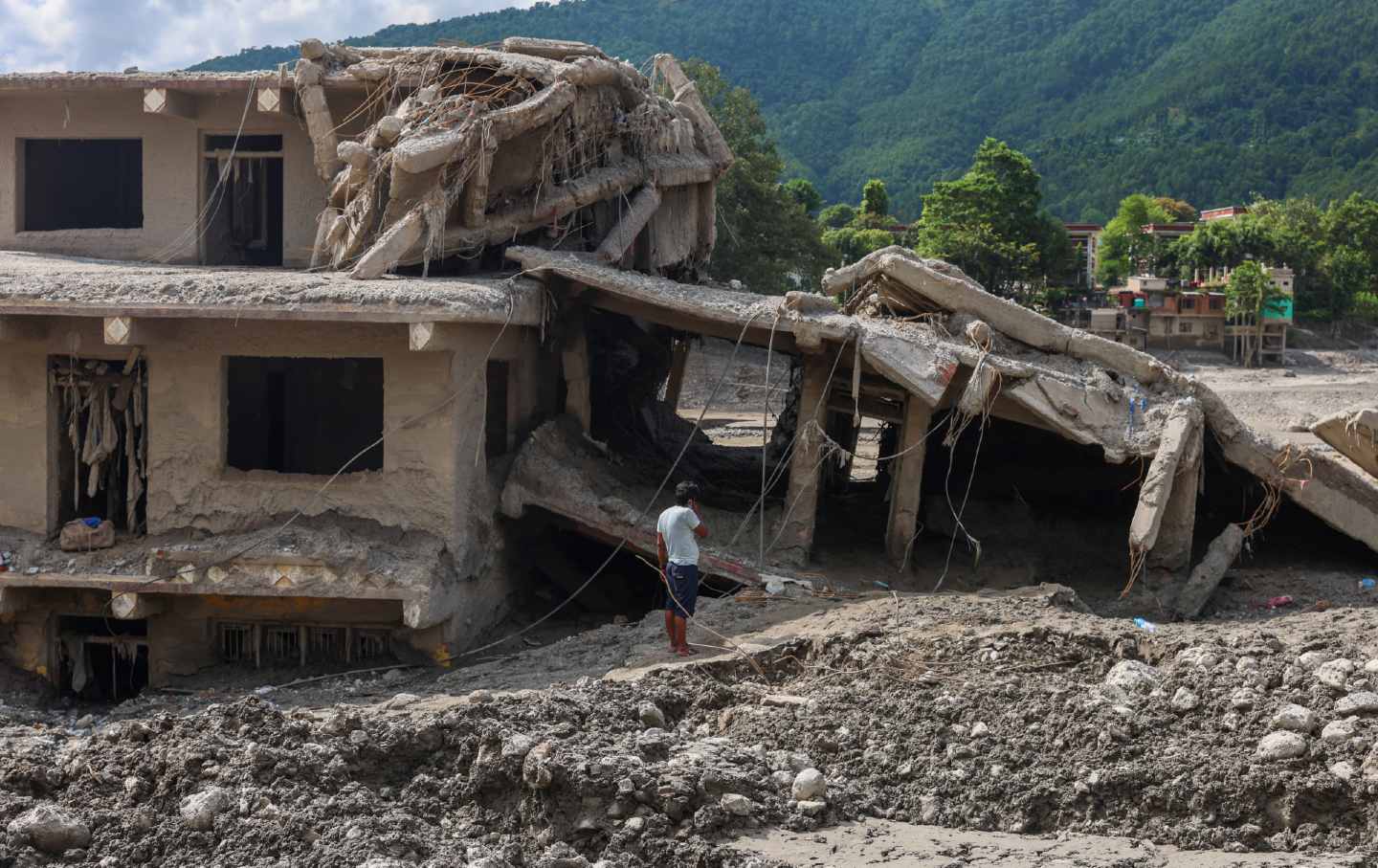
An interview with Nepali UN climate expert Manjeet Dhakal on what the massive Himalayan flood will cost Nepal.

Have We Forgotten Covid’s Lessons? Have We Forgotten Covid’s Lessons?
This summer’s deadly heat calls for news coverage based on science, not ideology.
We Can’t Surrender to Climate Destruction We Can’t Surrender to Climate Destruction
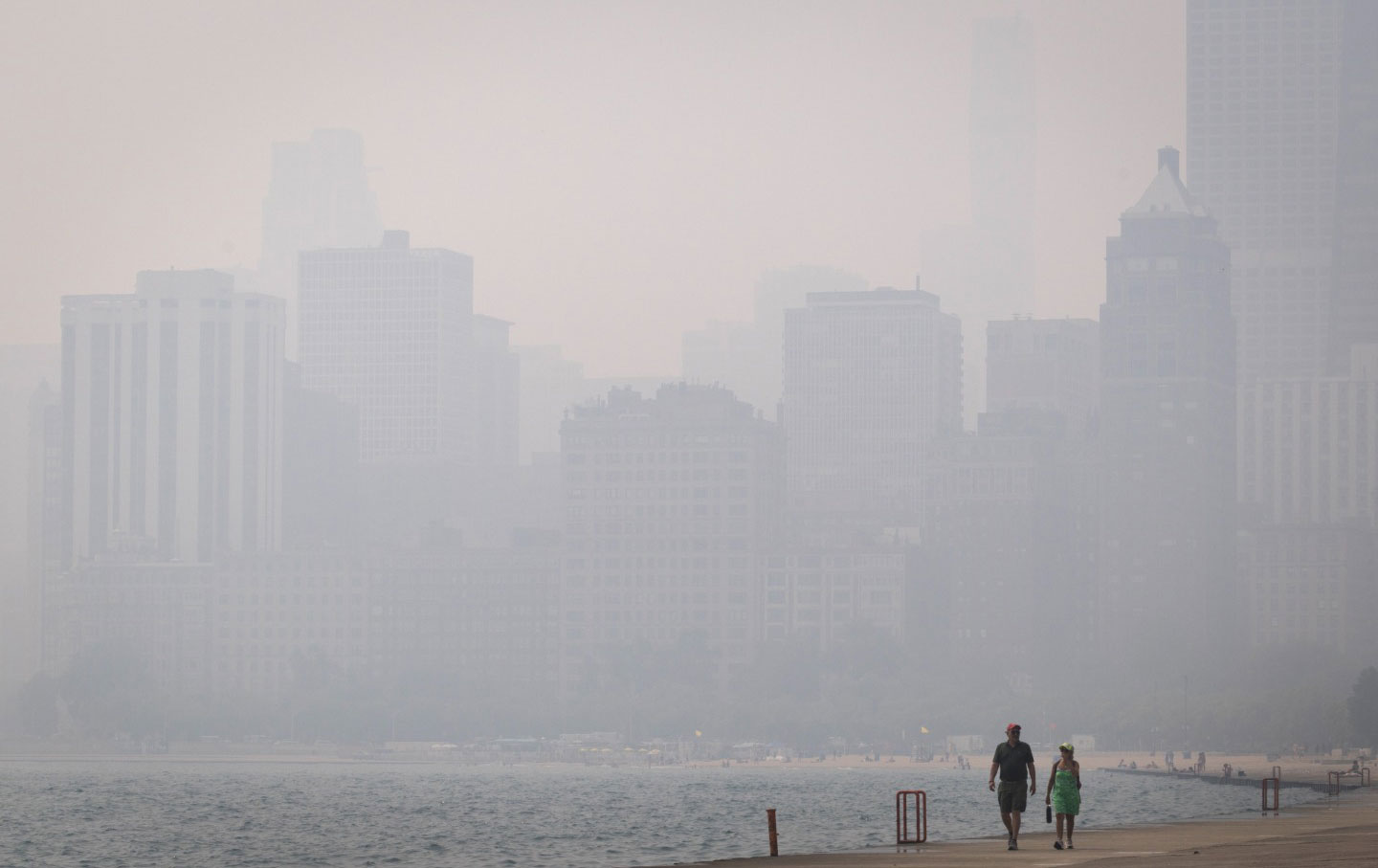
Politicians and pundits are telling us to accept the escalating breakdown of our planet. We have to fight back.

