
Where Did All the Youth Climate Activists Go?
The “Make Billionaires Pay” march might hint at where the climate movement is headed—away from fossil fuel divestment and toward broader resistance, with fewer young people.
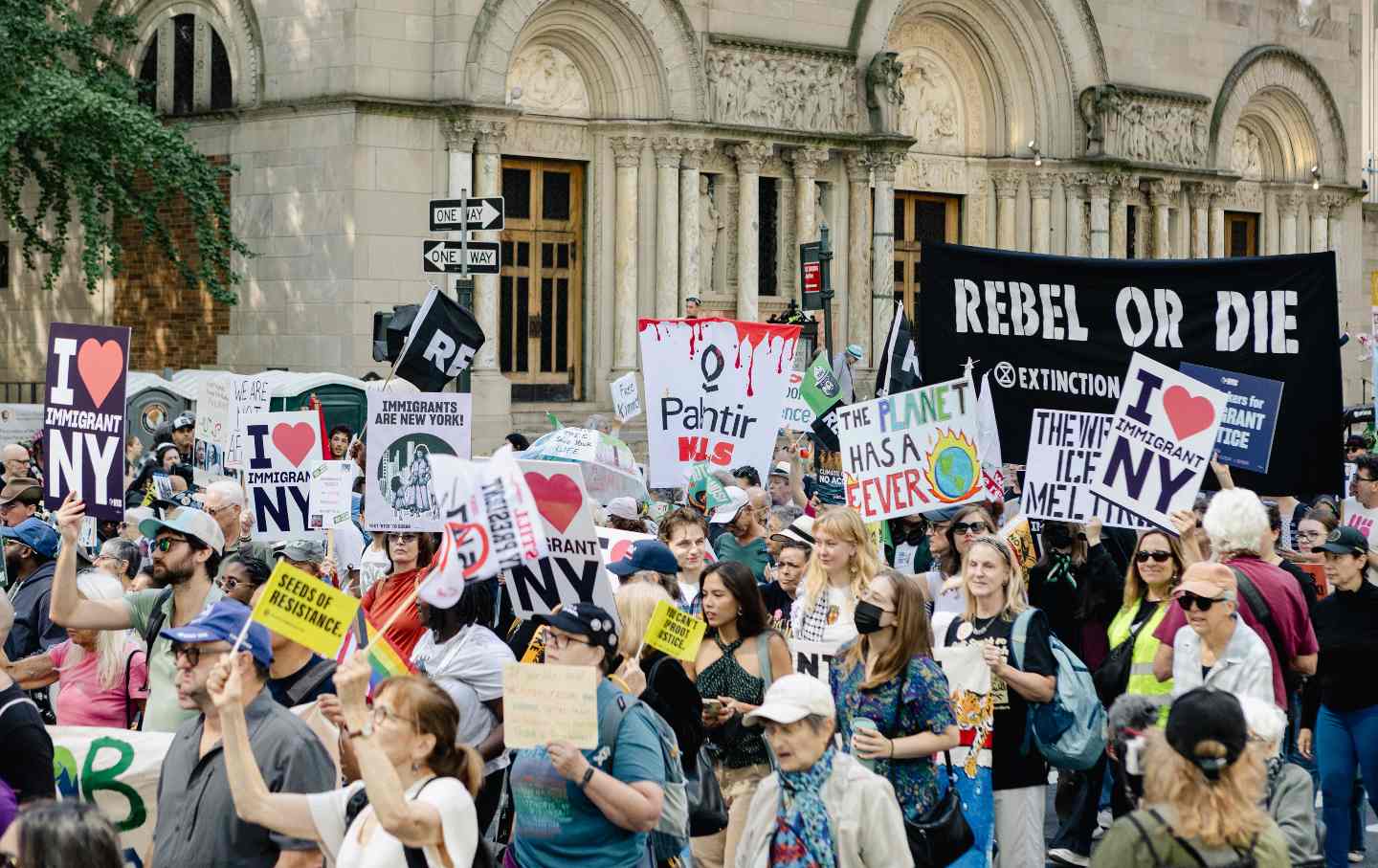
Thousands of protesters gathered on Park Avenue for the “Make Billionaires Pay March” on September 20 ahead of New York City’s Climate Week.
(Heather Chen)In March 2019, when more than a million people assembled in streets across the world to call for climate action, school children led the charge. With Greta Thunberg as the face of the grassroots climate movement, they demanded a transition from fossil fuels and immediate action from their governments. Climate activism groups like Extinction Rebellion, Sunrise Movement, and Zero Hour were in their heyday. Hope was in the air. More significant actions were already being planned for April 2020, which would coincide with the fiftieth anniversary of Earth Day. Then the pandemic hit.
Over the next few years, the US climate movement’s power waxed and waned. When the Biden administration signed off on the Inflation Reduction Act, marketed as the largest climate legislation in the country’s history, it certainly felt like a step in the right direction. Yet at the same time, it wasn’t nearly enough: It compromised with the fossil fuel industry and appealed to red states. By 2023, the high school climate activists of 2019 had also grown up. Some of them burned out and left activism. Many others remained, going on to organize on their college campuses. After the war in Gaza began, a good portion of those remaining youth activists refocused their efforts toward advocating for a free Palestine.
Fast-forward to 2025. On September 20, just 12 hours ahead of New York City’s Climate Week, thousands of protesters gathered on Park Avenue for the “Make Billionaires Pay” march. Spearheaded by climate organizations like 350.org, Climate Defenders and the Women’s March, Saturday’s demonstration was intended to draw a connection between billionaires and the climate crisis as leaders around the world descended on the city for the UN General Assembly. “We are out here because billionaires are burning down our planet,” Mel Smith of 350.org told me as we marched. “The world is so very much on fire.”
But it was often hard to spot many young people in the crowd. There were parents pulling wagons with toddlers and thousands of elderly people. The under-35 crowd, however, looked slim.
If the name of the “Make Billionaires Pay” march suggests anything, the task of mobilizing people around the issue of climate change has become more daunting in 2025. A prayer song from Cherokee elder Mary Crowe opened the proceedings. Greenpeace attempted to carry out a visual stunt, unveiling a nearly 160 foot long “bill” that listed the monetary damages caused by major oil and gas companies (moving the receipt, however, proved to be a struggle, and it was impossible to read anything on the bill because it was so large). Fridays for Future NYC unfurled a banner that read “Our Future Over Billionaires.”
But in the margins of the march, between the climate groups and their coalition partners, was a much more muddled image. While organizers had been quick to help explain the march’s messaging and its connection to Climate Week, many other marchers seemed to barely have the climate crisis in mind.
When I asked three older women if they had shown up for a climate march, they responded that they had come for “definitely something broader.” One of them wore a shirt from the “No Kings” protests against Donald Trump earlier this summer. On the sidewalk, a man held up a “Free Kimmel” sign to cheers from one part of the crowd, and at one point, a pro-Kimmel chant broke out. Another sign simply read “Epstein, Epstein, Epstein, Epstein, Epstein.” Some of the younger marchers in attendance seemed to be laughing at the absurdity of it all.
The mainstream climate movement is attempting a rebrand, refocusing the image of climate activism, away from fossil fuel divestment and toward broader resistance. By the time Trump rolled back into office, it seemed, for many, that as pressing as the climate crisis is, there were other issues—like ICE raids and a crackdown on higher education—that needed to be handled first.
It’s no surprise then that this year’s march played into the aesthetics of a broader rebellion against authoritarianism. Among the three demands for the march, one that focused on shutting down billionaires, and another on protecting migrants and “the global majority,” the climate-related one was listed last: “Shut Down Polluters. Defend Mother Earth.”
Keanu Arpels-Josiah, a longtime organizer with Fridays For Future NYC, told me that the march’s theme was “a recognition that the fight for climate justice is the same as the fight against ICE.”
“It’s the same as the fight against the attacks on our trans siblings. It’s same as the fight against genocide in Gaza. It’s the same as the attacks on affordability we’re seeing across the country and across our city,” he said.
At the same time, centrist Democrats—like the newly formed Searchlight Institute—have pushed for climate policy to be deprioritized. “The First Rule About Solving Climate Change: Don’t Say Climate Change,” reads a recent research paper from the institute.
But, overall, the hope expressed to me by Saturday’s organizers is that this new strategy—one that extends the arms of the climate movement around every other major issue afflicting our nation and the world—would help bring in more people.
“The pivot is really because we’re in a moment of crisis, where all these things are collapsing together,” Tamika Middleton, managing director of the Women’s March, told me. “I think this is where movements broadly are going.… And of course, there’s going to be the necessity for us to talk about specific fights, but broadly, we have to be building the biggest tent possible in order to fight back against the attacks we’re facing.”
Popular
“swipe left below to view more authors”Swipe →As I walked alongside marchers, bearing my city press pass, an organizer approached to ask if I wanted to speak with New York Lieutenant Governor Antonio Delgado. Marching alongside frontline community members, he discreetly led at the head of the march, at once another body in the crowd and a powerful political ally. “The people that are feeling the smoke, they are being left behind, and profit is being put before them,” Delgado said.
I asked him if he thought this was a climate march. “It’s a call for justice at every level, from economic inequality, protecting our environment, to protecting worker’s rights and human rights, race, gender inequity, everything,” he told me.
It’s hard to disagree with organizers that climate is, in fact, the central issue where all crises can coalesce. But if even climate activists can’t champion their own cause, it’s hard to say who is left defending the earth. And, if anything, turnout seemed smaller than usual. In 2023, the “March to End Fossil Fuels” in NYC drew a crowd of 65,000, according to organizer estimates. Then, pictures of young climate activists jubilantly charging through the streets of Manhattan had made the front page of The New York Times. This time around, however, organizers sent me an estimate of around 25,000 protesters. Earlier in the day, when I had arrived at the march, I asked a volunteer to direct me to the youth contingent. They told me they weren’t sure there was one.
More from The Nation
Abby Martin on the Climate Cost of US Empire Abby Martin on the Climate Cost of US Empire
The filmmaker discusses military pollution, her reporting in Hawai’i, and why the climate and antiwar movements belong together.
Trump Is Making Deals With Big Oil Trump Is Making Deals With Big Oil
Democrats and the press should be paying attention to how this pay-to-play behavior relates to the midterms
This Lawsuit Could Make Big Oil Pay for the Harm It’s Caused This Lawsuit Could Make Big Oil Pay for the Harm It’s Caused
The question is whether the Supreme Court will let it.
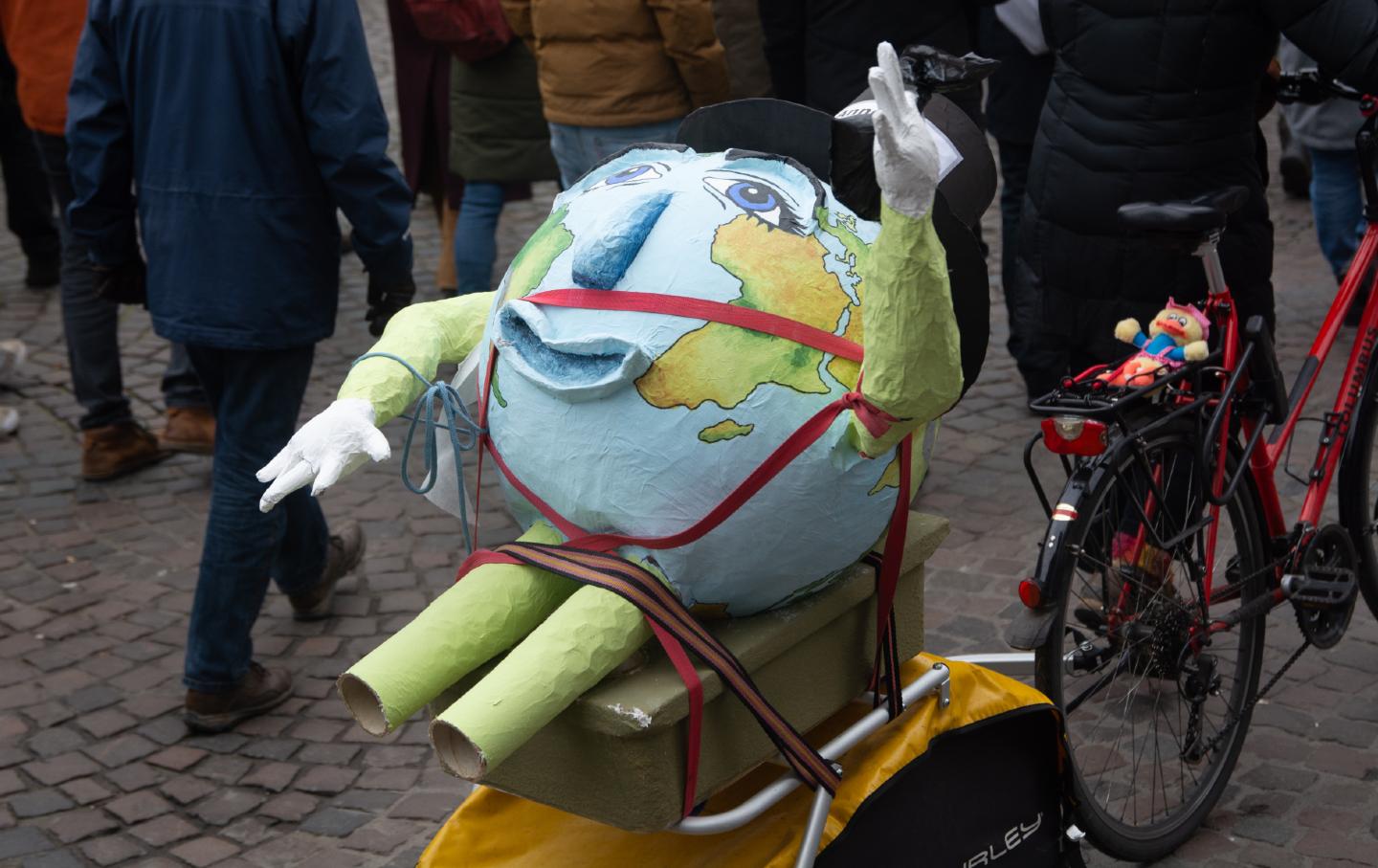
Germany and California Make Up an Environmental Superpower Germany and California Make Up an Environmental Superpower
The world’s third- and fourth-largest economies have pledged to environmental protections. Will others follow suit?
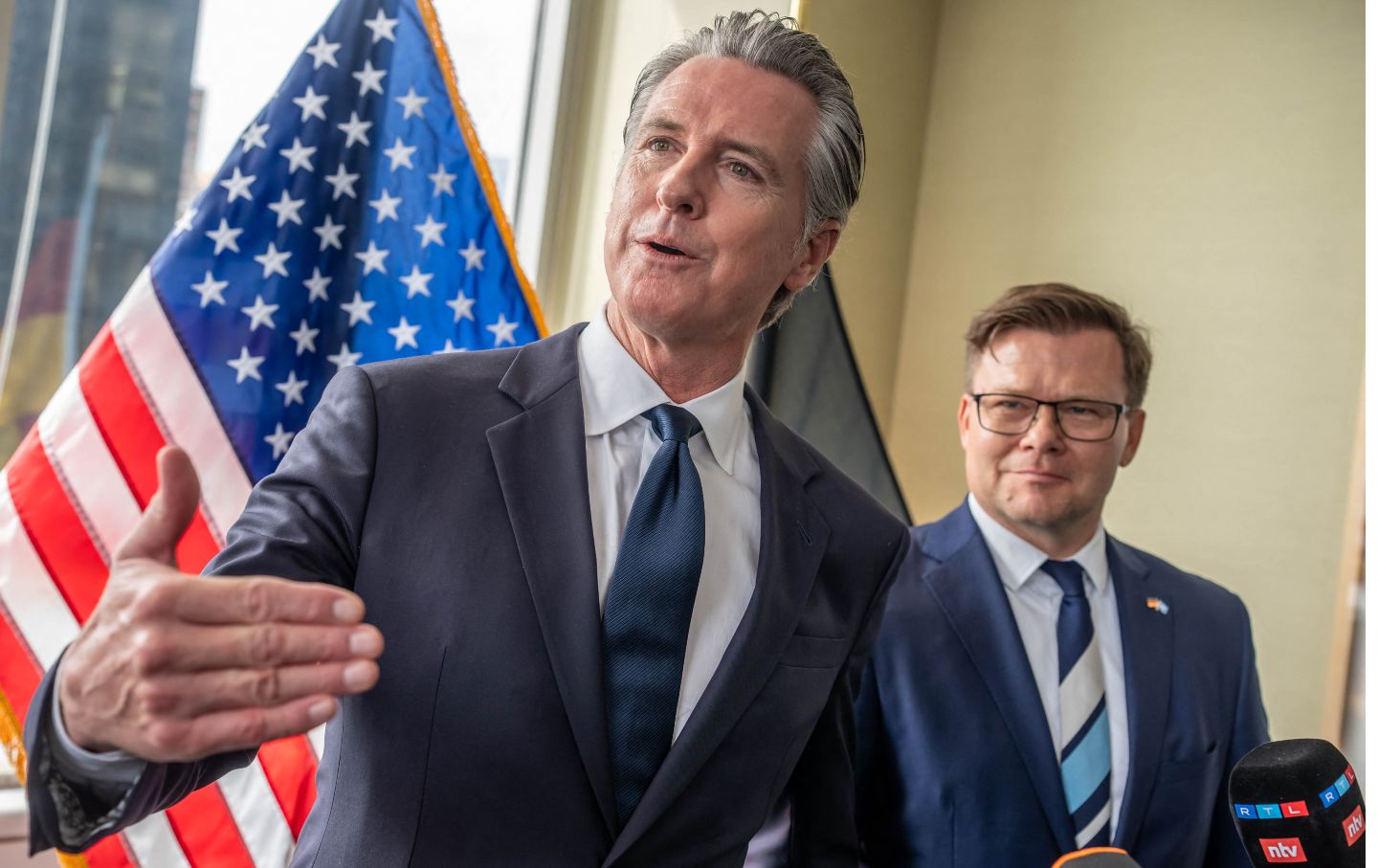
Gavin Newsom Comments on Climate Gavin Newsom Comments on Climate
On the sidelines of the UN General Assembly meeting and New York Climate Week, the California governor called AOC “the real damn deal.”

Cities as Climate Labs: Inside the U20 Summit Cities as Climate Labs: Inside the U20 Summit
Mayors at the Urban 20 Summit worked across borders to confront the climate crisis at the local level.

