
How CBS Decided It Couldn’t Afford to Let Stephen Colbert Speak His Mind
The network claims it’s canceling The Late Show for financial reasons, but the real bottom line here is Trump appeasement.
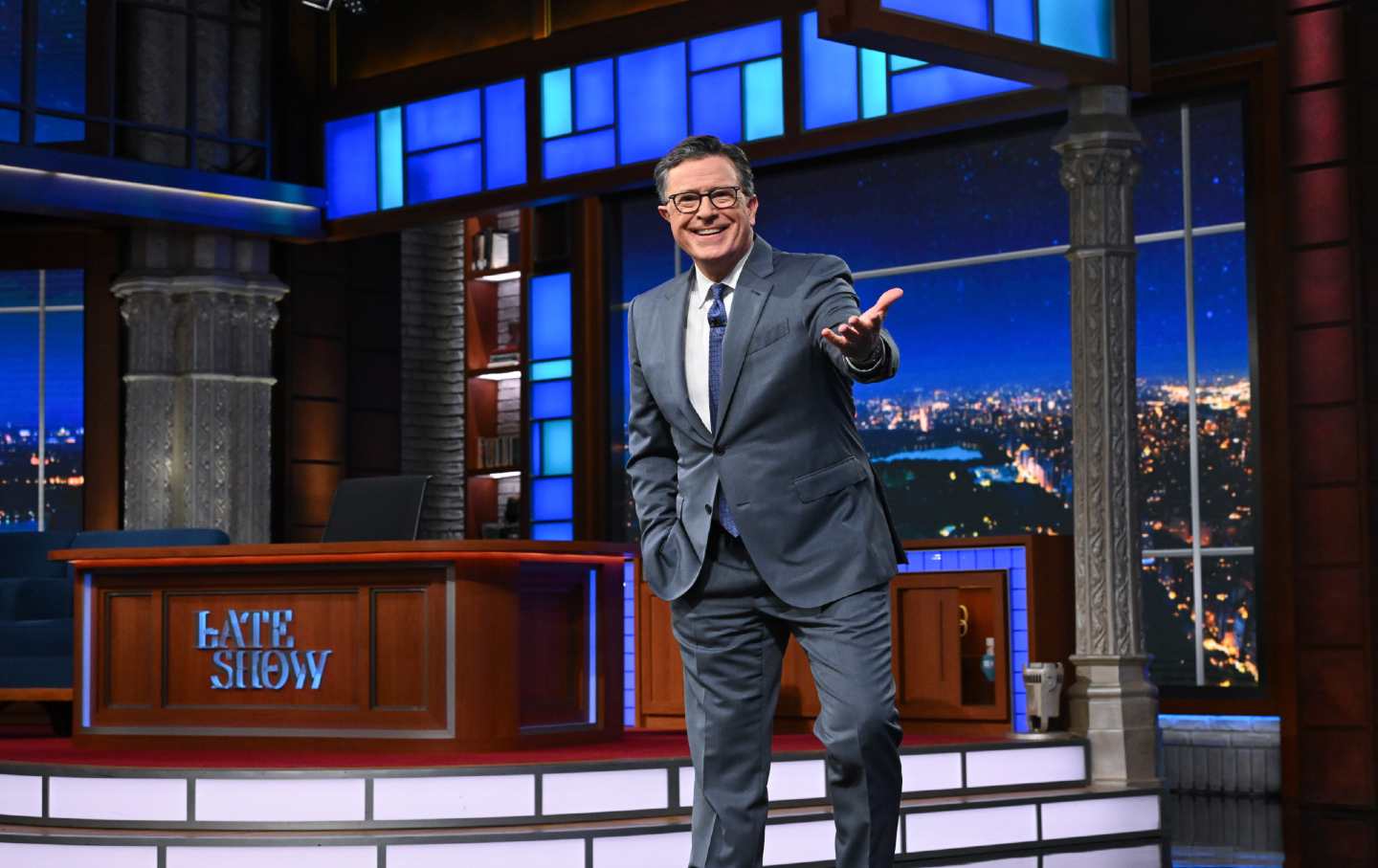
Stephen Colbert on the set of The Late Show last week.
(Scott Kowalchyk / CBS via Getty Images)Last Thursday, President Trump, desperate for the nation to stop talking about his close personal friend and frequent travel companion Jeffrey Epstein, got a momentary reprieve. He scored a pair of major victories over his critics, real and imagined, and further reshaped the mainstream media landscape along the lines of his personal vendettas. In Washington, Congress finally cut federal funding for the Corporation for Public Broadcasting (PBS) and National Public Radio (NPR), a goal of the right for decades. The president’s loathing for PBS and NPR is such that he threatened to primary any Republican who pushed back against it. “Any Republican that votes to allow this monstrosity to continue broadcasting will not have my support or Endorsement,” Trump announced.
To no one’s surprise, congressional Republicans did as told. They did so even though their rural constituents will be the hardest hit—people who depend on those stations for earthquake and flood warnings, as opposed to the elite coastal socialists the president imagines as the network’s sole demographic. That same day in New York, Trump got a large bonus. The Late Show’s Stephen Colbert, Trump’s most highly rated late-night comedy critic, was fired. Just three days earlier, Colbert had roasted his corporate bosses, CBS and its parent company, Paramount. Paramount had paid Trump $16 million to settle a lawsuit Trump filed against 60 Minutes while a deal for the Ellison family’s Skydance to buy Paramount hung in the balance at Trump’s Federal Communications Commission (FCC). Colbert quipped, “I believe this kind of complicated financial settlement with a sitting government official has a technical name in legal circles: It’s ‘big fat bribe!’”
Days later, Colbert got word that he was getting the axe: At the end of his present contract in May 2026, CBS will let him go. What’s more, network executives said that The Late Show itself, which David Letterman founded in 1993, would cease to exist. Last March, Bill Maher, a sometimes harsh critic of the president, flew out to Mar-a-Lago at the behest of Kid Rock to have dinner with Trump and bend the knee. Notably, Trump supporter David Zaslav’s WB Discovery properties, including CNN, have gotten off relatively lightly compared to ABC, CBS, NPR, and PBS in Trump’s media wars. Bill Maher still has a show. Stephen Colbert, who did not bend the knee, does not.
We still don’t know if CBS was pressured into firing Colbert or simply offered him up as a sacrifice to appease Trump’s FCC. Despite the timing, and the billion-dollar stakes around the Skydance deal, CBS executive George Cheeks denied that the move was political and insisted that the cancellation was “purely a financial decision.” Taking CBS at its word for the moment, Cheeks isn’t wrong. Late-night talk shows have struggled to turn a profit for their corporate owners for years. They remain expensive relics of a long-gone three-network broadcast world. When James Corden left The Late Late Show in 2023, which aired after Colbert’s, CBS canceled it, too. The network replaced it with a rebooted, cheaply produced comedy game show, After Midnight. Colbert’s ratings still run far ahead of his two chief rivals, ABC’s Jimmy Kimmel and NBC’s Jimmy Fallon, but late night’s ad revenues have steadily dropped for years. Seven years ago, late night cleared $439 million; last year, that total was cut in half, to $220 million. Meanwhile, over at Fox News, Greg Gutfeld’s late-night entry Gutfeld!, which goes on an hour earlier, manages competitive numbers with nothing but five people sitting on chairs guffawing at its host’s attempts to make the word “Nazi” fun.
While the financial free fall of late night is real, so is the precise political timing of the Colbert decision. CBS went to great lengths to avoid apologizing or admitting wrongdoing on behalf of 60 Minutes when it paid Trump his $16 million. If CBS wants to avoid embarrassing employees who did nothing wrong, why fire Colbert just days after his widely quoted comment? By calling his firing a “purely financial decision,” CBS executives want to give the impression that they were only following the balance sheets. They had to know their timing would look like more groveling. They could have waited another week. Why announce three days after Colbert attacked them and Trump? What’s the hurry?
The hurry is that Colbert called the payoff “a big fat bribe” on Monday, and Skydance’s David Ellison met with the FCC’s Brendan Carr on Tuesday. At the meeting, an FCC filing states that Ellison and his lawyer “discussed Skydance’s commitment to unbiased journalism and its embrace of diverse viewpoints, principles that will ensure CBS’s editorial decision-making reflects the varied ideological perspectives of American viewers.”
Perhaps it’s just another incredible scheduling coincidence, but that promise of unbiased journalism came days after Ellison sat down at the Allen and Co. retreat in Sun Valley for early-acquisition talks with Bari Weiss for her archconservative site, The Free Press. As the media industry newsletter Puck asked: “Is it sound business or just savvy virtue signaling in a Trump 2.0 world?” One can ask the same question about firing Colbert. With only tea leaves to read for now, it sure looks like the Skydance media behemoth we’re about to get—with Larry Ellison, a longtime Trump supporter and Elon Musk Twitter investor hovering over it—will take a decidedly far-right tilt. And if it turns out anything at all like Ellison’s Twitter investment, it will also be a truly ugly tilt.
If Paramount thinks caving, paying up, and Trump-focused MAGA virtue signaling will help grease the wheels to put Skydance’s deal through, then Colbert’s firing produced an instant return on investment. Trump took to Truth Social Friday morning to crow his delight about CBS’s purely financial decision. “I absolutely love that Colbert’ got fired. His talent was even less than his ratings. I hear Jimmy Kimmel is next. Has even less talent than Colbert! Greg Gutfeld is better than all of them combined, including the Moron on NBC who ruined the once great Tonight Show.”
CBS—long known among industry watchers as “the Tiffany network”—has a long history of silencing talent with loud, liberal opinions. With Colbert’s firing, it was as if the network’s late founder, William S. Paley, had risen from the grave to haunt his old home. The best known example remains Paley’s canceling The Smothers Brothers Comedy Hour not only for its anti–Vietnam War and religiously themed satire but also for booking leftists like Harry Belafonte and Joan Baez. But CBS’s history of suppressing dissident views goes back further than that. In June 1939, another top-rated CBS comic, Eddie Cantor, appeared at the New York World’s Fair to address a Hadassah meeting of thousands. He used the moment to lash out against the rise of domestic fascism and antisemitism in the United States after 900 Jewish refugees from Hitler on the SS St. Louis were sent back to Europe by our immigration authorities. “Unless we are terribly careful, unless we fight for life and liberty, the whole business now going on over there can be transferred over here,” Cantor said. “Some people told me I seem to be getting pretty panicky. They don’t know what important industrialists are behind this business, behind Senator Reynolds and Father Coughlin and General Moseley and George Deatherage. These men are the enemies of not only the Jews but of all America.” Democratic Senator Robert Rice Reynolds came from North Carolina, as did Cantor’s sponsor at CBS, RJR Reynolds Tobacco. Cantor lost his show within two weeks.
George Clooney recently played CBS News correspondent Edward R. Murrow for the Broadway production based on his 2005 film Good Night, and Good Luck. After scoring a body blow against Senator Joseph McCarthy in 1954, the polarizing Murrow was exiled by Paley out of CBS’s prime-time lineup to sporadic appearances on Sunday afternoons. Clooney’s play tells the story of Murrow’s public demise as much as McCarthy’s.
In February 1982, the Screen Actors Guild president and star of CBS’s Lou Grant, Ed Asner, appeared on the steps of the State Department in Washington, DC. Asner stood alongside actors and filmmakers Howard Hesseman, Lee Grant, Penny Marshall, Bert Schneider, and Ralph “Pa Walton” Waite. He presented a check for $25,000 to “Medical Aid for El Salvador,” which went to the rebels who opposed the right-wing government backed by the Reagan administration. They hoped to raise $1 million in the future. A reporter asked Asner if he would support a communist government in El Salvador. He said yes, so long as that government was democratically elected. Lou Grant sponsors like Kimberly-Clark soon pulled out of the show. CBS canceled it in May. The company pointed to a drop in ratings, or a “purely a financial decision,” as we say now. Just more odd timing? As Asner said back then, “It allows the Jerry Falwells, the Kleenex people and the Caucus of Conservative consumers to think they can curb freedom of speech at will.”
Popular
“swipe left below to view more authors”Swipe →And so it did, and so they still do today. Stephen Colbert now joins that list. It’s doubtful that Colbert will disappear. The Late Show may not make the network all the money it would like, but Colbert still commands an audience of millions. As the path to the White House goes increasingly through podcasts and YouTubers and non-network shows, Colbert can still remain a loud critic of Trump if he wants.
Become a Sustaining Donor This September
Between the reemergence of right-wing red-baiting and Donald Trump’s use of the chilling National Security Presidential Memorandum–7 to criminalize left political organizing, we’re seeing McCarthyism reborn before our eyes.
This assault on democracy cannot be ignored or wished away. Resisting it requires bravery in the face of threats and repression, a steadfast commitment to the truth, and the unwavering belief that we can—and will—overcome this darkness.
We must have an independent media that sets the record straight, unearths corruption and abuses of power, and advances a politics of justice and dignity for all if we’re to win this fight.
That’s why I’m writing to you today. This September, The Nation needs to add 100 monthly donors to sustain our progressive journalism. Your contribution makes the next investigative report, the next truth-speaking column, and the next pathbreaking essay all possible.
I hope you’ll support our work with a recurring donation today. If you donate $10 or more a month, we’ll send you a brand new “Hands Off the Free Press!” sticker to recognise your commitment to our cause. Please, donate today.
Onward,
Katrina vanden Heuvel
Editor and Publisher, The Nation
More from The Nation
What’s the Matter With Effective Altruism? What’s the Matter With Effective Altruism?
President Trump has decried the techbro creed for indulging in AI doomerism, but its excesses are far worse than that.

As Morale Sags, More Military Service Members Are Having a Crisis of Conscience As Morale Sags, More Military Service Members Are Having a Crisis of Conscience
According to multiple GI rights organizations, service members are inquiring in unprecedented numbers about seeking conscientious objector status.
What Remains of Riis? What Remains of Riis?
A new members’ club has revived Riis Park’s long-vacant bathhouse, reopening old questions about whom the People’s Beach is really for.

When Texas Sex Ed Falls Short, Gen Z Women Turn to Social Media When Texas Sex Ed Falls Short, Gen Z Women Turn to Social Media
A 2025 study found that 70 percent of adolescents sought reproductive health information through social media platforms.
Justice for Macklemore Justice for Macklemore
The rapper has been dumped from Ed Sheeran’s tour for saying “free Palestine.” That’s a disgrace.
We Are Living Under Roy Cohnian Logic We Are Living Under Roy Cohnian Logic
The political fixer created a career for himself as a self-promoting, ubiquitous hustler. Like Trump, he got away with it by having the right friends.

