
Has the Climate Movement Been Too Polite? This Senator Thinks So.
US Senator Sheldon Whitehouse called on Democrats to stop enabling the fossil fuel industry’s “malevolent propaganda operation.”
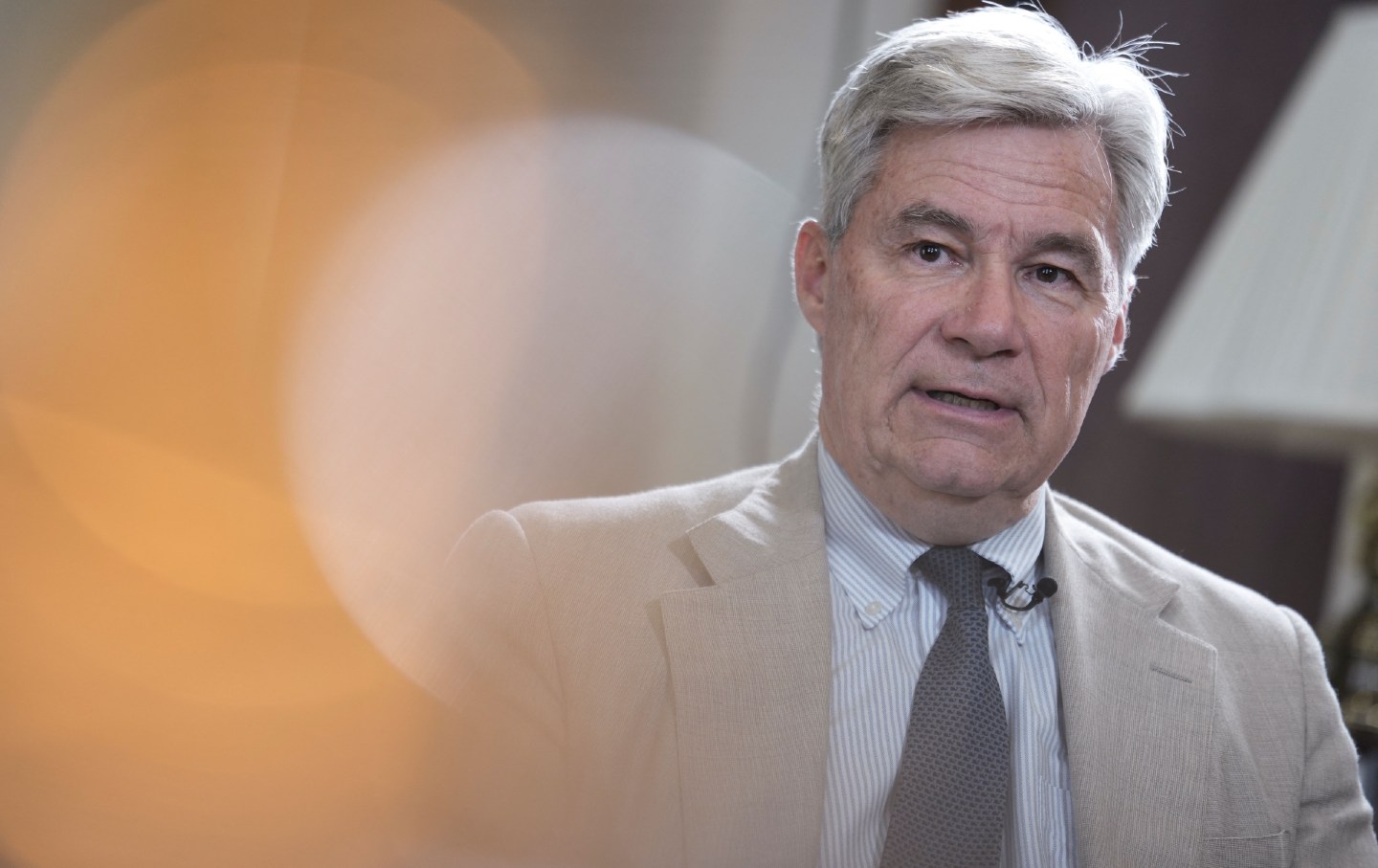
US Senator Sheldon Whitehouse, Democrat from Rhode Island, speaks during an interview on Capitol Hill on July 8, 2025, in Washington, DC.
(Oliver Contreras / AFP)
The Democratic Party and the climate movement have been “too cautious and polite” and should instead be denouncing the fossil fuel industry’s “huge denial operation,” US Senator Sheldon Whitehouse said.
“The fossil fuel industry has run the biggest and most malevolent propaganda operation the country has ever seen,” the Rhode Island Democrat said in an interview Monday with the global media collaboration Covering Climate Now. “It is defending a $700-plus billion [annual] subsidy” of not being charged for the health and environmental damages caused by burning fossil fuels. “I think the more people understand that, the more they’ll be irate [that] they’ve been lied to.” But, he added, “Democrats have not done a good job of calling that out.”
Whitehouse is among the most outspoken climate champions on Capitol Hill, and on Wednesday evening, he delivered his 300th “Time to Wake Up” climate speech on the floor of the Senate.
He began giving these speeches in 2012, when Barack Obama was in his first term, and has consistently criticized both political parties for their lackluster response to the climate emergency. The Obama White House, he complained, for years would not even “use the word ‘climate’ and ‘change’ in the same paragraph.”
While Whitehouse slams his fellow Democrats for timidity, he blasts Republicans for being in the pocket of the fossil fuel industry, an entity whose behavior “has been downright evil,” he said. “To deliberately ignore [the laws of physics] for short-term profits that set up people for huge, really bad impacts—if that’s not a good definition of evil, I don’t know what is.”
The American Petroleum Institute, the industry’s trade association, says on its website that “API and its members commit to delivering solutions that reduce the risks of climate change while meeting society’s growing energy needs.”
Long before Donald Trump reportedly told oil company CEOs he would repeal Joe Biden’s climate policies if they contributed $1 billion to his 2024 presidential campaign, Republicans went silent on climate change in return for oil industry money, Whitehouse asserted. The key shift came after the Supreme Court’s 2010 Citizens United ruling, which struck down limits on campaign spending. Before that, some GOP senators had sponsored climate bills, and John McCain urged climate action during his 2008 presidential campaign.
But Citizens United, Whitehouse said, “told the fossil fuel industry: ‘The door’s wide open—spend any money you want in our elections.’” The industry, he said, promised the Republican Party “unlimited amounts of money” in return for stepping away from bipartisan climate action: “And since 2010, there has not been a single serious bipartisan measure in the Senate.”
Whitehouse said that after delivering 300 climate speeches on the Senate floor, he has learned to shift from talking about the “facts of climate science and the effects on human beings to calling out the fossil fuels’ massive climate denial operation.”
He said: “Turns out, none of [the science] really matters while the operation is controlling things in Congress. I could take facts from colleagues’ home states right to them, and it would make no difference because of this enormous, multibillion-dollar political club that can [punish] anyone who crosses them.”
Most Republicans even stay silent despite climate change’s threat to property values and other traditional GOP priorities, Whitehouse said. He noted that even the Federal Reserve chair Jerome Powell—who is not known for climate bona fides, he noted—testified before the Senate in February that in 10 to 15 years there will be whole regions of the country where nobody can get a mortgage because extreme weather will make it impossible to afford or even obtain insurance.
Democrats can turn all this to their advantage if they get “more vocal and aggressive,” Whitehouse argued. “The good news is that the American people hate dark money with a passion, and they hate it just as much, if not more, in districts that went for Trump as in districts that went for Biden.”
Democrats also need to recognize “how much [public] support there is for climate action,” he said. “How do you have an issue that you win 74 to 12 [percent] and you don’t ride that horse as hard as you can?”
Whitehouse said he was only estimating that 74 percent figure, but that’s exactly the percentage of Americans who want their government to take stronger climate action, according to the scientific studies that the 89 Percent Project, The Guardian, and other Covering Climate Now partner news outlets began reporting in April. Globally, the percentage ranges from 80 to 89 percent. Yet this overwhelming climate majority does not realize it is the majority, partly because that fact has been absent from most news coverage, social media, and politicians’ statements.
Popular
“swipe left below to view more authors”Swipe →Democrats keep “getting caught in this stupid doom loop in which our pollsters say: ‘Well, climate’s not one of the top issues that voters care about, so then we don’t talk about it,’” said Whitehouse. “So it never becomes one of the top issues that voters care about. [But] if you actually go ask [voters] and engage on the issue, it explodes in enthusiasm. It has huge numbers when you bother to engage, and we just haven’t.”
Nevertheless, Whitehouse is optimistic that climate denial won’t prevail forever. “Once this comes home to roost in people’s homes, in their family finances, in really harmful ways, that [will be] motivating in a way that we haven’t seen before around this issue,” he said. “And if we’re effective at communicating what a massive fraud has been pulled on the American public by the fossil fuel industry denial groups, then I think that’s a powerful combination.”
Become a Sustaining Donor This September
Between the reemergence of right-wing red-baiting and Donald Trump’s use of the chilling National Security Presidential Memorandum–7 to criminalize left political organizing, we’re seeing McCarthyism reborn before our eyes.
This assault on democracy cannot be ignored or wished away. Resisting it requires bravery in the face of threats and repression, a steadfast commitment to the truth, and the unwavering belief that we can—and will—overcome this darkness.
We must have an independent media that sets the record straight, unearths corruption and abuses of power, and advances a politics of justice and dignity for all if we’re to win this fight.
That’s why I’m writing to you today. This September, The Nation needs to add 100 monthly donors to sustain our progressive journalism. Your contribution makes the next investigative report, the next truth-speaking column, and the next pathbreaking essay all possible.
I hope you’ll support our work with a recurring donation today. If you donate $10 or more a month, we’ll send you a brand new “Hands Off the Free Press!” sticker to recognise your commitment to our cause. Please, donate today.
Onward,
Katrina vanden Heuvel
Editor and Publisher, The Nation
More from The Nation
Gavin Newsom Comments on Climate Gavin Newsom Comments on Climate
On the sidelines of the UN General Assembly meeting and New York Climate Week, the California governor called AOC “the real damn deal.”

Cities as Climate Labs: Inside the U20 Summit Cities as Climate Labs: Inside the U20 Summit
Mayors at the Urban 20 Summit worked across borders to confront the climate crisis at the local level.
Big Oil’s Origin Story Big Oil’s Origin Story
Amy Westervelt’s new book, Brought to You By, exposes the deep history of today’s “information pollution.”

Two Years After Helene, North Carolina’s Unsettled Recovery Two Years After Helene, North Carolina’s Unsettled Recovery
The state has become a testing ground under an eviscerated FEMA and a missing-in-action “recovery czar,” Michael Whatley, with big political ambitions.

A Reckoning Comes for Nepal A Reckoning Comes for Nepal
A year after its Gen Z uprising, Nepal faces a struggle not only for democracy and human rights but for climate survival.

How a Creative Mind Lives in Nature How a Creative Mind Lives in Nature
Working in the wilderness could not satiate my intellectual impulses. But for the protagonist of Hothouse Bloom, the binary between mental and physical labor is what calls her.

