
Can New York Adapt the Subway for the Climate Crisis?
As climate change leads to record rainfalls, the city’s 120-year-old subway system is more vulnerable to flooding than ever.
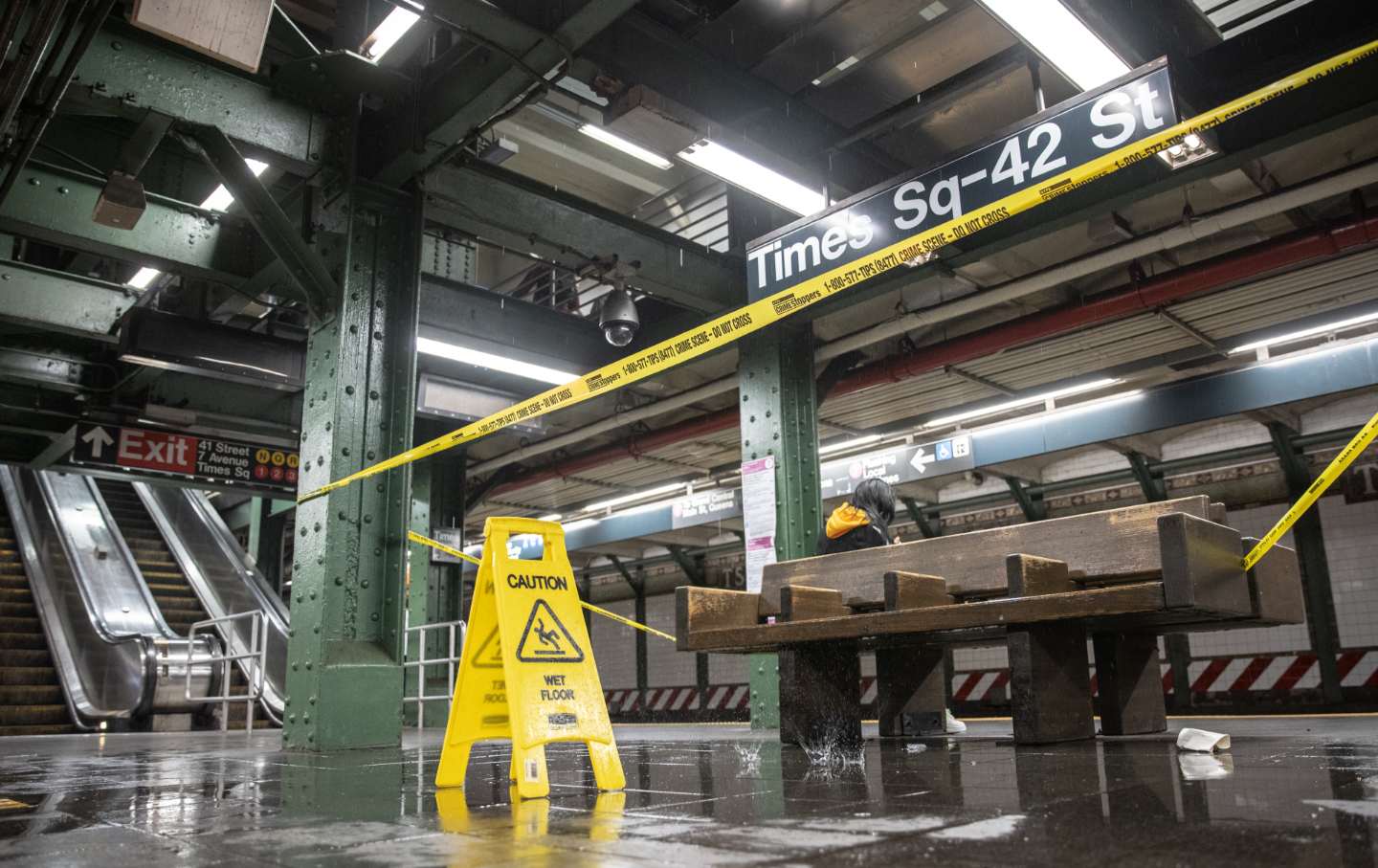
A flooded floor is blocked off in the 42nd Street Times Square subway station during a rain storm in New York.
(Jeenah Moon / Getty)Only two months before Zohran Mamdani was sworn in as New York City’s mayor at a decommissioned subway station beneath City Hall on January 1, stations across the city flooded following a record rainfall.
Videos of “waterfalls” forming inside stations circulated online, reflecting what has become a new norm of commuter chaos amid extreme weather events. In July, videos of passengers climbing their way out of a submerged station similarly went viral. During the summer, riders face sweltering heat in poorly ventilated stations, as 90 degrees Fahrenheit days and dire heat waves become more likely. In August, New York Governor Hochul ordered an investigation into New York City transit’s climate vulnerability.
As a largely underground system, the subway is profoundly vulnerable to flooding as climate change intensifies downpours, fuels coastal erosion, and raises sea levels that threaten to inundate entire neighborhoods. The need to adapt and upgrade the 120-year-old system, built for an entirely different climate, has become more pronounced amid concerns about a cost-of-living crisis that propelled Mamdani’s campaign, which focused on the intertwined issues of affordability and transit.
New York is racing against “a climate system that is changing very rapidly,” according to Louise Yeung, the city’s newly appointed chief climate officer. “And so as we’re rushing to make these improvements, we also need to be…catching up with the speed at which the climate is changing.”
These adaptation challenges are not limited to New York, according to Lykke Leonardsen, program director of Resilient & Sustainable City Solutions in Copenhagen, Denmark, who has collaborated with city officials mainly on the Cloudburst Program, designed to mitigate the effects of sudden, heavy downpours. Public transit operators globally are grappling with severe climate impacts. These operators oversee newer transit systems, like the Copenhagen Metro, and legacy systems, like the London Tube and the Paris Métro, to which the MTA has looked for inspiration. “There [are] conversations happening worldwide as we think about vulnerabilities for urban metro systems,” said Eric Wilson, the MTA’s senior vice president of climate and land use strategy. “It’s our goal to provide continuity of service and reliable service even during extreme weather events, so people can get to where they need to be.”
Unlike drivers of passenger cars, which contribute significantly to the 29 percent of greenhouse gas emissions generated by the transportation sector in the United States, New York regional transit riders “avoid at least 20 million metric tons of greenhouse gas emissions from being pumped into the atmosphere”—the equivalent to the amount of carbon absorbed by a forest the size of Indiana. “Transit,” according to Kara Gurl, the planning and advocacy manager of the Permanent Citizens’ Advisory Council, “is the antidote to climate change.”
In 2012, the devastation of Superstorm Sandy increased climate consciousness among New Yorkers, reminding the city that it was far from immune to the crisis and catalyzing the MTA to install coastal surge protections across 31 vulnerable subway stations. Still, riders in recent months have struggled to get to and from work, home, school, and more amid subway flooding, which can trap and strand riders. In more extreme cases, such as China in 2021, subway flooding can cause injuries and even deaths.
In the first three-quarters of 2025 alone, the New York City subway system had more than a billion riders, making any service disruption a big deal. When public transit was shut down for less than a day during a snowstorm in 2015, for example, the city lost an estimated $200 million in economic activity. Yet the costs of climate adaptation are also steep. The initial estimate of capital costs for climate resilience work outlined in the MTA’s Climate Resilience Roadmap total more than $6 billion over a decade.
The road map, released in April 2024, consists of 10 goals, including shielding subway stations and tunnels from storm water and expanding underground air circulation and cooling. As the unpredictability of torrential rainfall events makes “temporary solutions like deployable flood doors and vent mechanical closure devices” less effective, the road map called for “structural redesigns.”
Last year, the MTA reported that its latest capital plan supports $1.5 billion of climate resilience investments, with a dedicated allocation of $700 million specifically for storm water flood mitigation efforts. These investments include upgrading old pump rooms that help transport storm water out of the subway into the City’s sewer system. (As of 2023, 11 percent of these pump rooms were in marginal or poor condition.) More immediate actions include adding elevated steps at street-level subway station entrances to prevent rainwater from spilling directly into the subway, as can already be seen at the 28th Street station in Chelsea. The MTA has also sealed manholes that have caused miniature geysers in previous heavy rains, and has elevated some drains and enhanced drainage more broadly.
The MTA identified 10 priority locations spanning all five boroughs—including Longwood Avenue in the Bronx and 4th Avenue in Brooklyn—as prone to storm flooding risks and urged the city to fortify protections in these areas. “Inequity is always a factor in this conversation,” said Tiffany-Ann Taylor, the vice president for transportation at the Regional Plan Association. Making its decisions transparent to the public can help ensure accountability for the MTA in doing climate resilience work equitably, she said. The MTA’s Capital Dashboard, a publicly available project process tracker, provides a helpful baseline.
Under the Mamdani administration, many feel optimistic about the future of city transit. While the mayor’s campaign focused on making buses free and engaged less with climate policy, Gurl sees his concern for transit and identity as a rider as signifying a broader commitment.
Popular
“swipe left below to view more authors”Swipe →Amid expansive federal environmental regulatory rollbacks and withdrawal from international climate action, this commitment comes at a crucial moment.
The Trump administration has continued to attack congestion pricing, which has provided crucial revenue for transit improvement projects. Yet, in a crucial win for New York, a federal court recently ruled that the administration had illegally canceled millions of dollars’ worth of federal grants for clean energy and transportation projects in Democratic states, including funding allocated for expanding the Second Avenue subway.
A hostile and anti–climate science presidential administration represents a significant challenge, according to Taylor. Even with sufficient capital funding, she explained, the funding available to operate and maintain new climate infrastructural upgrades remains limited. (The MTA’s operational budget, which supports the day-to-day costs of running the subway and uses revenue from transit fares, is distinct from its capital budget, which supports broader work.)
“This is not an issue that we’re going to solve overnight, and we’re going to need funding coming in for the next few decades,” said Gurl. For now, she added, “there’s always going to be a viral video of a new station underwater, and it’s difficult to get ahead of that,” especially when subway adaptation can entail short-term tradeoffs, such as construction impeding service and inconveniencing riders. Leonardsen also emphasized how the subway’s extensiveness, significant ridership, age, and design pose distinct challenges compared to adapting smaller and newer systems like Copenhagen’s Metro.
Both Wilson and Gurl highlighted the importance of continued close collaboration between state and city agencies. How the city manages its sewage system and streets, for example, can impact the MTA’s ability to fortify stations against flooding. Wilson also said that though heat mitigation continues to prove challenging, the MTA is exploring innovations in heat recovery technologies, such as geothermal cooling technologies. He’s also heartened that the MTA works closely with the New York City Panel on Climate Change, an independent advisory body that synthesizes climate science to inform City policy and incorporates projections about local climate impacts into its approach to transit resilience.
Yeung described the city’s ongoing efforts to bolster the climate resilience of its streets and public infrastructure, including “doing the basic work of repair that is often very unsexy, but very necessary to make sure that our infrastructure works properly” (like maintaining sewers, siphons, catch basins, and water mains), in coordination with the MTA’s efforts. When asked about any impacts of a hostile federal government, she added, “We don’t really need external partners of the federal government to make New Yorkers’ lives better and safer and healthier. And so we’re really leaning into all of those solutions that we can do right here in the five boroughs.”
More from The Nation
Abby Martin on the Climate Cost of US Empire Abby Martin on the Climate Cost of US Empire
The filmmaker discusses military pollution, her reporting in Hawai’i, and why the climate and antiwar movements belong together.

Trump Is Making Deals With Big Oil Trump Is Making Deals With Big Oil
Democrats and the press should be paying attention to how this pay-to-play behavior relates to the midterms
This Lawsuit Could Make Big Oil Pay for the Harm It’s Caused This Lawsuit Could Make Big Oil Pay for the Harm It’s Caused
The question is whether the Supreme Court will let it.
Germany and California Make Up an Environmental Superpower Germany and California Make Up an Environmental Superpower
The world’s third- and fourth-largest economies have pledged to environmental protections. Will others follow suit?
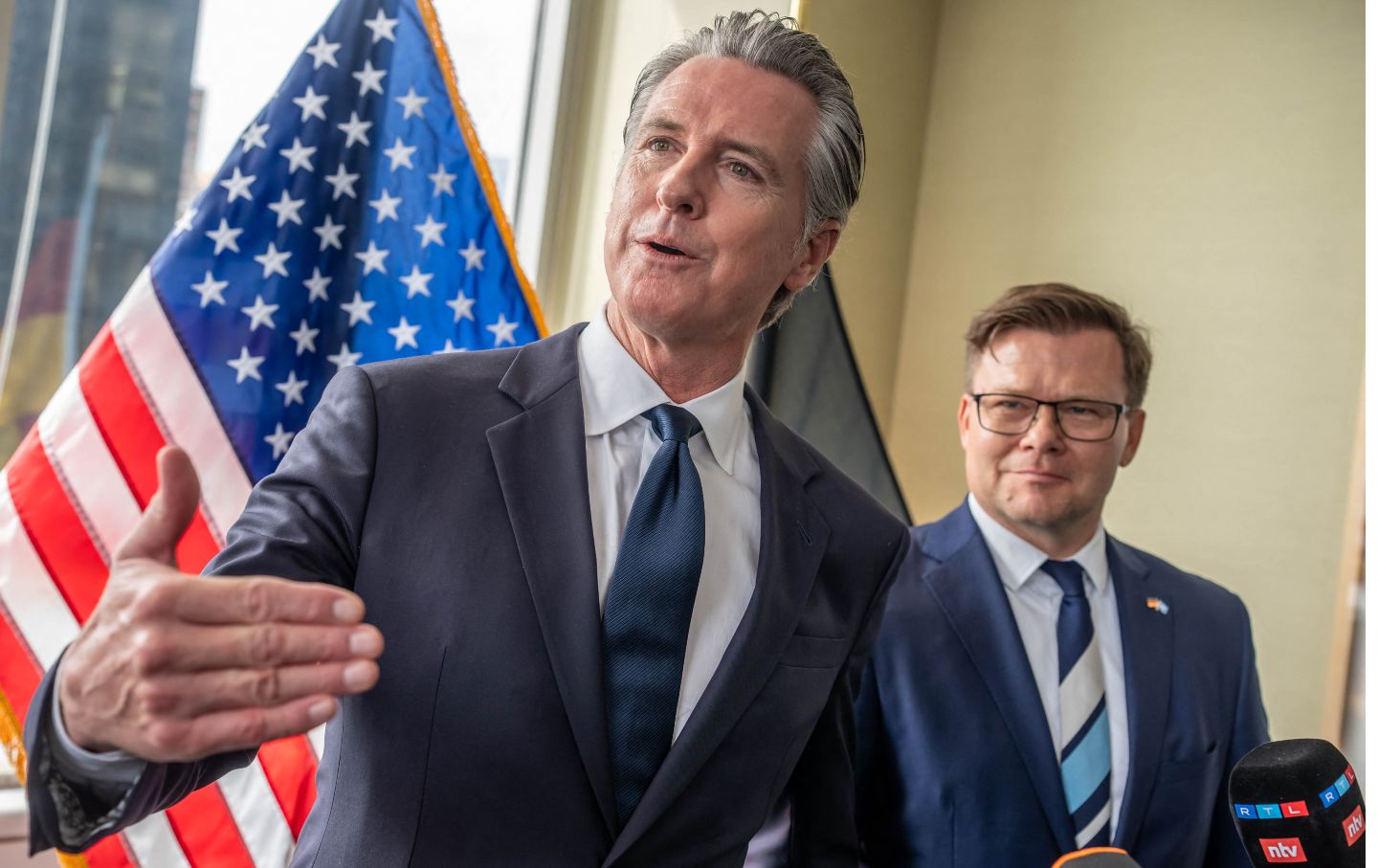
Gavin Newsom Comments on Climate Gavin Newsom Comments on Climate
On the sidelines of the UN General Assembly meeting and New York Climate Week, the California governor called AOC “the real damn deal.”

Cities as Climate Labs: Inside the U20 Summit Cities as Climate Labs: Inside the U20 Summit
Mayors at the Urban 20 Summit worked across borders to confront the climate crisis at the local level.

