“Do You Want to Throw Israelis Into the Sea?”
A guide to fielding even the most ridiculous anti-Palestinian smears.
How to Answer the Stupidest Questions About Palestinians
A guide to fielding even the most ridiculous anti-Palestinian smears.

Mohammed El-Kurd on Democracy Now!
(YouTube)In 1973, a British parliamentarian named Christopher Mayhew promised a £5,000 reward to anyone able to prove that Egypt’s second president, Gamal Abdel Nasser, had indeed declared his intent to “drive the Jews into the sea.” Mayhew then expanded his criteria to include any documentation of genocidal statements made by a responsible Arab leader. Whatever quotations he received he deemed inauthentic. It was not long before one claimant, a 22-year-old Jewish student, sued Mayhew and their dispute went to the High Court. The case was dropped after the student’s lawyer admitted that the statement his client provided, a quote from the first secretary general of the Arab League, “was not genocidal.”
Mayhew called the trope “apocryphal.” Still, apocryphal as it may be, I am often asked if I want to throw Israelis into the sea. This question has persisted for decades, leveled as an accusation against Palestinians and allies of our cause. Almost every time, anywhere I take the stage, it is an expected though unwanted guest. Whether I am singing my usual nagging refrain about Zionism or talking about the “creative process” (i.e., stimulants and sedatives), someone will spring from their seat, tripping over themself to ask that million-dollar question. More accurately, I am asked why I want to throw Israelis into the sea, not if. That I possess such genocidal intent is already assumed. It is an attempt to implicate me in the inquisitor’s worldview. A worldview where I am a savage, pathologically murderous Arab.
“Israelis” and “Jews” are usually used interchangeably by those posing the question and understood, irrefutably, as interchangeable. The responsibility to then make a pristine distinction between the two falls on me. The burden of pedagogy. But none of those words—“if,” “why,” “Israelis,” “Jews”— interest me the most. It is the word “want” that is most telling. Wanting is neither policy nor procedure, neither present nor material. Wanting is hoping, longing. Colonial logic says that if I were to have that mere desire within my heart; if I am fantasizing about cartoonish revenges, that alone negates my claim to justice. Thus, any testimony of the injustices I have witnessed and endured is unreliable. The brutality of colonialism, the very brutality that is institutionalized and legalized, can then be excused or even warranted, if I were to want such a turn of events. Such desires, according to mind-reading critics, linger deep within our psyche and should discredit the Palestinian. Our yearnings impugn our plight. The trouble here is not that our enemies employ this illicit tactic (that is what enemies do) but that we submit to it. We attempt to refute defamation instead of repudiating it. We placate this fallacious logic instead of saying: Even if—even if!—my dreams were your worst nightmares, who are you to rob me of my sleep?
To simply imagine Palestine without settlers, to simply imagine a sky without drones—that, in the Zionist imagination, is genocidal. If you stick with the “want” of the charge, the notion that Palestinians want to kill all Jews, you find that Zionism is at war with our future. It is at war with our ability to articulate, even if only through poems and protest chants, a future in which Zionism does not reign. For in the past 100 years, Zionism has situated us in a condition of constant dispossession and premature death; our Nakba remains and renews. We are besieged in an inescapable, eternal present tense.
But in his dreams, the Palestinian who lives landlocked near the sea, unable to swim in it due to checkpoints, who has spent years tormented by its salty humidity visiting his kitchen in the summer, tormented by old photographs of his grandparents’ house that still stands on the shore, that Palestinian swims in the Mediterranean, declaring, “This sea is mine.” In her dreams, the Palestinian walks from Bethlehem to Jerusalem uninterrupted, picking prickly pears on her way, humming, “This sea air is mine.” In my dreams, I return to Palestine of the future. I return to “what was mine: my yesterday. / What will be mine: the distant tomorrow.” There are no sirens, no settlers, no strip searches under the streetlights, and I do not stop to wonder why. That, in the Zionist imagination, is genocide.
The irony of such colonial projections is not lost on me. Not only because it is the Israelis who are in fact committing a televised genocide but also because, out of the countless genocidal remarks made by Israeli officials in recent months, plenty have invoked the sea. Recently, Netanyahu reportedly advocated for using the temporary “pier” built by the Pentagon on the shore of Gaza to forcibly transfer Palestinians to other countries. Weeks before that, the Israeli minister for the advancement of the status of women said to a nodding TV anchor, “I don’t care about Gaza, I literally don’t care. For all I care, they can go out and just swim in the sea. I want to see dead bodies of terrorists around Gaza. That’s what I want to see.” In 1992, Yitzhak Rabin, the West’s beloved “Soldier of Peace,” said, “I would like Gaza to sink into the sea.” I could flood the next few pages with similar quotes.
One instinct might be to argue that every accusation is a confession. Another is to neatly show that the colonizer and colonized are governed by two sets of rules—what would the diplomatic response be if, say, Mahmoud Abbas said those words? What would happen to a Palestinian’s career and reputation should they sing the same tune? What free speech? But pointing out double standards is not a sustainable, long-term political program. And do their words matter when their policies speak for themselves?
I do not rank Zionist rhetoric high up on my list of priorities. I do not have an interest in restricting the psychic allowance of the Israeli public. Whatever helps them sleep at night. That our enemies serenade their children with myths to help them survive their neighboring nightmare, us, is not my concern. I do not care if I am a “human animal” in Israeli folk tales, or if they dream about drowning me in the Mediterranean. My concern is that they have the power to actualize their fantasies, fables, and theology. They have the tools to transform them into a macabre reality, much like they have done in the besieged Gaza Strip. I only care about their dreams because they have taken them to the Knesset.
We are, after all, the villains in their stories, the fabric of their nightmares. For we exist in opposing universes: In ours, they have razed our homes and looted our towns, transformed us into populations of refugees and amputees. In theirs, we have acted senselessly, stabbing settlers and kidnapping soldiers. We have rained rockets on their prosperous, fenced-off colonies. The question of our motives is obsolete. Why their prosperous colonies are surrounded by poverty is a question I doubt they ever ask. The settler’s gaze ignores the ruins atop which the settler town is built. Always in the settler’s peripheral vision, rubble is both ubiquitous and unobtrusive, filtered out like our eyes do our noses.
In the Zionist imagination, we are the aggressors, the invaders. And while Ben-Gurion can say to his disciples, “Let us not ignore the truth among ourselves…politically, we are the aggressors and they defend themselves…. The country is theirs,” most Israelis, raised on a different chorus, do ignore the truth among themselves. They believe Palestine is theirs by divine decree and we, “the children of darkness,” have stolen it from them. This aphorism, absurd and ahistorical as it may be, is not weakened by the truth—it exists despite it.
Palestinians were invented in the 1960s by Yasser Arafat to be a thorn in Jews’ side, or so the saying goes. Israel is defending itself is another mythological parable. While such a claim is silly to me, it is sacred to many. Thus, it would seem unwise to smirk. Mocking false convictions often strengthens them, some argue. When you tell a believer that their idol is inanimate, the stone of the idol turns to flesh before their eyes. What is suppressed festers; what is silenced grows louder; psychological reactance, and so on. But there are two holes in this argument: One, even with the best will, belief is far less deterministic and impartial and far more malleable than we would like it to be. Two, this argument assumes that the person hurling such aspersions is the intended audience of my response. But such individuals, whose telepathic abilities entitle them to call me genocidal, who believe that I am part of a fake, invented people, are not going to have a change of heart if proven wrong. Certainly not in the auditorium where his enemy is speaking. Certainly not when their goal is chaos, not reconciliation.
Even if we take into consideration the possibility that the provocateurs in the crowd genuinely believe the bullshit they are spewing, we drastically underestimate how personal incredulity, cherry-picking, and confirmation bias distort how the indoctrinated receive, classify, and retain information. We forget that belief has little to do with truth. People tend to believe the powerful, the compelling, not the sincere. The truth, that which is factual and historically accurate, is irrelevant in the face of the dominant, institutionally mainstreamed narratives that forge their truth. “Conquerors, my son, consider as true history only what they have themselves fabricated.”
When confronting leading or loaded questions on a public stage, it is imperative to remember that there is an audience to address: all kinds of people—curious, sympathetic, skeptical, receptive, on-the-fence—people whom you need to speak to with both words and body language. One option is to accept that you have been charged and stand trial. Plead your case before this self-appointed judge, gesturing at the dossiers of exonerating evidence you have prepared, hoping for acquittal. Another option is to reject his jurisdiction and to reject the premise that you are a defendant, to refuse to live any more of your life in cross-examination.
Again, I am often asked if I want to “throw Israelis into the sea.” My answer has become increasingly facetious, even flippant. “If they are so afraid of drowning why don’t they learn how to swim?” Sometimes I get gasps, occasionally a muffled snicker, and other times, unabridged laughter. After the joke comes the thesis: Such questions are red herrings and straw man fallacies asked in bad faith. I obviously believe in freedom and dignity for all, etcetera. Those asking, What happens to the settlers? have not once thought about the fate of the 6 million Palestinian refugees agonizing in exile. This is not so much a polemic but a fatigued observation, reiterated incessantly. Such distracting questions feed the discursive loop that prioritizes the settlers’ theoretical future over our material present that is already marked with extermination.
As Steven Salaita writes, “The question ‘but what about the Israelis?’ presents itself as innocent, perhaps even crucial, but its underlying rhetoric is insidious…. It informs the audience that Zionism must be affirmed before the Palestinian can speak of liberation.” As such, the decision to answer a derailing question becomes a political act: Should I take the bait? Should I skip over the tanks that set our neighborhoods ablaze, the fires engulfing Khan Yunis to extinguish hypothetical flames? Should I forget about the wells they have poisoned, the waters they have arrogated to quench an imaginary thirst? Lately, I just scoff at the question.
But why laugh at a flammable question when I know my words will be twisted and turned upside down? Why make snarky remarks in front of thousands, many of whom might, on a subconscious level, already be suspicious of me? Because, most important, it is funny. It feels good to laugh, to ridicule the ridiculous. I could cite Freud, but my grandmother said it more eloquently: “If we don’t laugh, we cry.” If we move beyond the reductive idea that the humor of the oppressed is merely a “defense mechanism,” we can reveal its strategic advantage and transformative potential.
On stage, on television, whenever I talk about the brutality of Zionism and the genocide it is waging against Palestinians, I routinely come across assertions like, A second Holocaust is afoot and the Jews are afraid. Such postulations act as a gag order, a muzzle, and conversations become whispers. Although there are numerous people who experience profound cognitive dissonance in the face of brazen colonial projection, most feel that they lack the language or necessary audacity for rebuttal. After all, no one wants to be accused of “blood libel.” Here, facetious or flippant responses—irreverence at large, really—become pedagogical.
So deride liars who throw rocks and hide their hands; deride manipulators who exploit taboos and tragedies to maintain a monopoly on violence, who craft their words to extract an urgent, penitent reverence out of you. Derision, in this context, teaches those who share your frustrations that they should not be shamed into accepting an upside-down world. It acts as a catalyst for critical thinking and intellectual autonomy, empowering the audience to question the status quo, to satirize it, to strip it naked before its yes-men and sycophants.
Irreverence subverts the terms of engagement and rearranges the topics of discussion in accordance with their moral or political weight. It does more than merely disrupt the flow of conversation; it actively reconfigures the hierarchy of what deserves outrage—the serious, the consequential—forcing a reevaluation of priorities. Or, in other words, irreverence “functions at the level of unseating previously established patterns of power—it works to move the morally trivial from equal status with the truly serious.”
Some of my friends, particularly the upwardly mobile Palestinians among them, are often dismayed with my caustic approach. It is not as amusing to them but terrifying, and I can understand why. As Palestinians, our every civic engagement becomes a public trial. Our every utterance is a test of character. We are always one error away from transforming into terrorists. I misspoke at a march in London some time ago and that simple slip-up spawned tabloid headlines and led to the Metropolitan police investigating me for terrorism. Vague and broadly defined “anti-terror” laws have translated into a far-reaching crackdown on political advocacy, nationalist expression, and anticolonial speech, so much so that virtually anything can be interpreted as “incitement” or “material support for terrorism.”
Popular
“swipe left below to view more authors”Swipe →For the Arab in the West, the task is to carefully detonate presumptions or suffer their explosions. We must measurably show, before all else, our distance from the charges lodged at us. We need to prove, in the face of preposterous hostility, that we are respectable civilians, journalists, medics, and professors who “are not like Hamas.” One blunder is enough to give credence to the rumors that haunt us. The numbers of casualties we report? Inflated. Our tragedies? Orchestrated in “Pallywood.” Our mutilated children, incinerated by Israeli warplanes? Dolls used as war propaganda.
So we write our books and make our films knowing that anything we say—seriously or in jest, even anything we imply—can and will be used against us in the courts of law and public opinion. We talk to each other as if the sniper is standing over our shoulder. And I understand the impulse to self-censor. I know that as Palestinians our notoriety precedes us; we are guilty until proven otherwise and otherwise is often impossible. I know that I probably do not resemble myself in most people’s imaginations. But there are vast universes outside of the sniper’s gaze, worlds beyond the colonizer’s field of vision. What matters more than how we will be viewed by our enemies or our allies is how we view one another and what we inspire in one another. Is it self-respect or self-reproach?
To be irreverent at the podium is to remind yourself that you are part of a collective, a scrutinized people whose psychic and affective allowances are shrinking endlessly; the working classes, the exhausted, the under-resourced, those who do not have access to Ivy Leagues or a knack for doublespeak. And in that performance of irreverence, you enmesh yourself in their complexities, you make room for them in the public discourse, no matter how they articulate themselves, and you reassign the blame from the victim to the perpetrator. Otherwise, we would be punching down—we would save ourselves and ascend in our careers by throwing others under the bus. For one to be described as genteel, someone else needs to be viewed as savage.
Who among our enemies is given the microphone? Government officials, whose remarks, by virtue of their positions, are often featured in the introductory paragraphs of news articles. And who among us is allowed to speak? Most of the time, it is the bereaved, the dispossessed, and the vulnerable, those who are thrust into the domain of advocacy in spite of themselves and individually transformed into one-person media ministries, without perfect scripts or institutional backing.
I am not flippant because of contrarian tendencies or for the entertainment value. I am flippant because I realize that the majority of the Palestinian people do not possess the capacity or desire to coddle ethnocentric values and racist attitudes. Where, in the war zone, would I find the space to alter our vocabulary? And why should I want to? Why would I want to search in our dreams for an indicting lucidity? Or comb through our colloquialisms looking to filter out the uncouth? Again, why should I bypass the fires engulfing our cities to extinguish hypothetical flames?
Time is running out to have your gift matched
In this time of unrelenting, often unprecedented cruelty and lawlessness, I’m grateful for Nation readers like you.
So many of you have taken to the streets, organized in your neighborhood and with your union, and showed up at the ballot box to vote for progressive candidates. You’re proving that it is possible—to paraphrase the legendary Patti Smith—to redeem the work of the fools running our government.
And as we head into 2026, I promise that The Nation will fight like never before for justice, humanity, and dignity in these United States.
At a time when most news organizations are either cutting budgets or cozying up to Trump by bringing in right-wing propagandists, The Nation’s writers, editors, copy editors, fact-checkers, and illustrators confront head-on the administration’s deadly abuses of power, blatant corruption, and deconstruction of both government and civil society.
We couldn’t do this crucial work without you.
Through the end of the year, a generous donor is matching all donations to The Nation’s independent journalism up to $75,000. But the end of the year is now only days away.
Time is running out to have your gift doubled. Don’t wait—donate now to ensure that our newsroom has the full $150,000 to start the new year.
Another world really is possible. Together, we can and will win it!
Love and Solidarity,
John Nichols
Executive Editor, The Nation
More from The Nation

Brace Yourselves for Trump’s New Monroe Doctrine Brace Yourselves for Trump’s New Monroe Doctrine
Trump's latest exploits in Latin America are just the latest expression of a bloody ideological project to entrench US power and protect the profits of Western multinationals.

Chile at the Crossroads Chile at the Crossroads
A dramatic shift to the extreme right threatens the future—and past—for human rights and accountability.

The New Europeans, Trump-Style The New Europeans, Trump-Style
Donald Trump is sowing division in the European Union, even as he calls on it to spend more on defense.

The United States’ Hidden History of Regime Change—Revisited The United States’ Hidden History of Regime Change—Revisited
The truculent trio—Trump, Hegseth, and Rubio—do Venezuela.
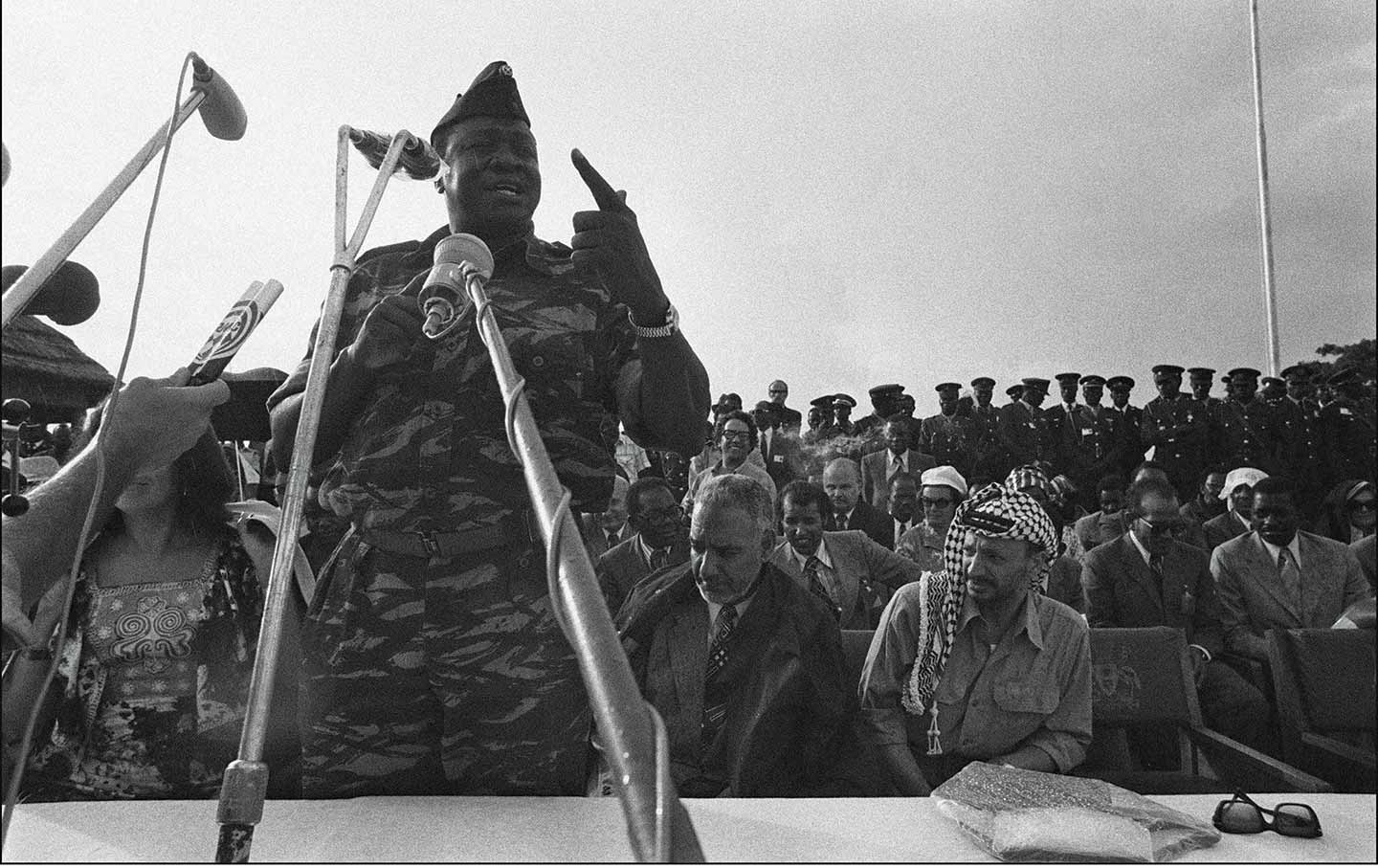
Mahmood Mamdani’s Uganda Mahmood Mamdani’s Uganda
In his new book Slow Poison, the accomplished anthropologist revisits the Idi Amin and Yoweri Museveni years.

The US Is Looking More Like Putin’s Russia Every Day The US Is Looking More Like Putin’s Russia Every Day
We may already be on a superhighway to the sort of class- and race-stratified autocracy that it took Russia so many years to become after the Soviet Union collapsed.

