
The New Pope Delivers a Consistent Message on Gaza: Ceasefire!
Pope Leo XIV has echoed his predecessor’s urgent call for an end to the assault that has killed more than 52,000 Palestinians.
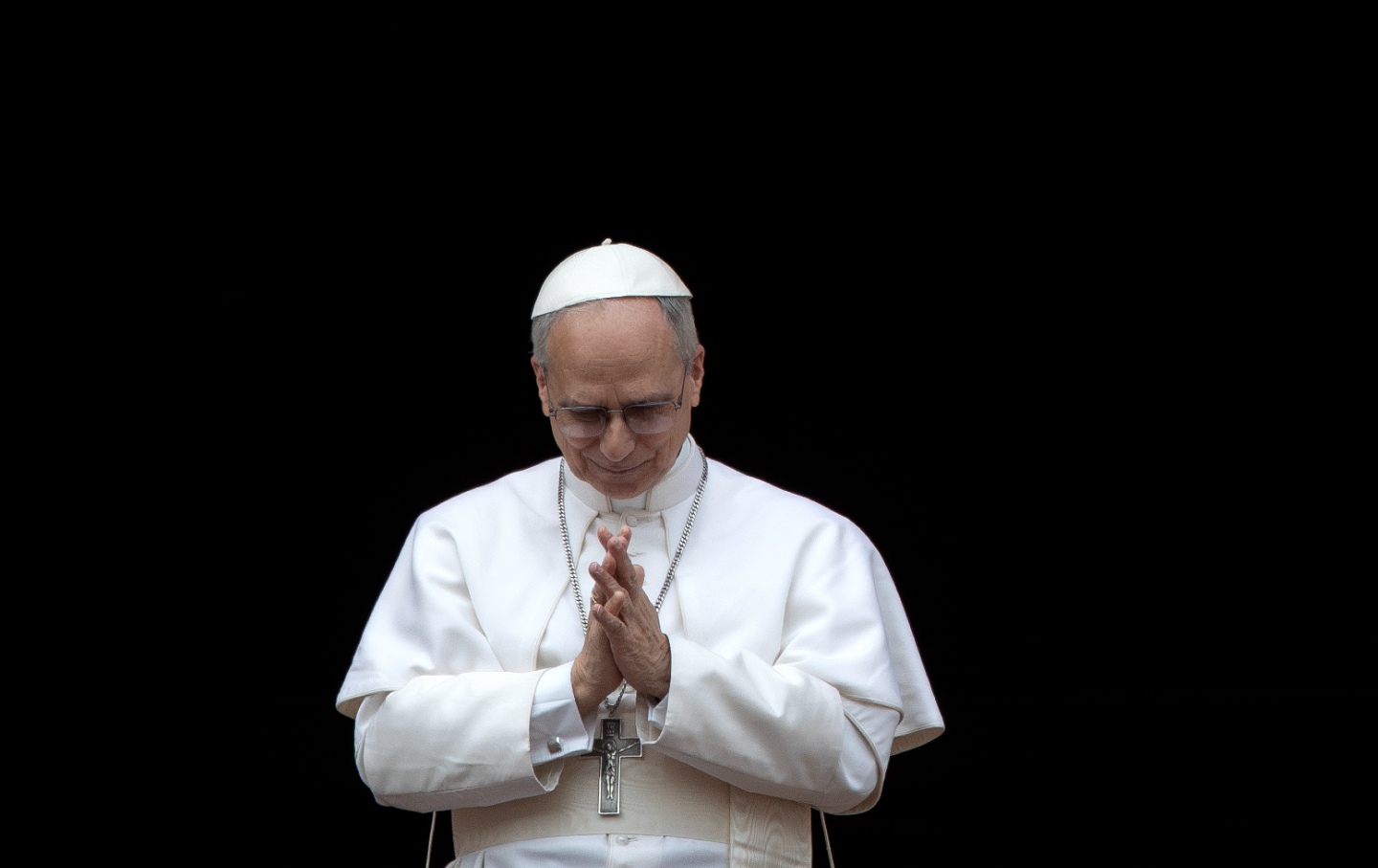
Pope Leo XIV leads his first Regina Caeli prayer from the Central Loggia of St. Peter’s Basilica at the Vatican on May 11, 2025.
(Maria Grazia Picciarella / SOPA Images / LightRocket via Getty Images)Pope Leo XIV used a portion of his first Sunday blessing from the loggia of St. Peter’s Basilica to plead for an immediate ceasefire in Gaza. The new pope also delivered an urgent call for the removal of barriers to the flow of food, medicine, and other essentials to the Palestinian enclave.
With that message, spoken just three days after he was chosen to lead the world’s 1.4 billion Catholics, Pope Leo made it clear that he would carry forward the advocacy on behalf of Gaza that was a hallmark of the tenure of Pope Francis, his predecessor, who died April 21, at age 88.
Referring to the region where an ongoing Israeli assault has killed more than 52,000 Palestinians—most of them women and children—and destroyed much of the civilian infrastructure, Pope Leo announced Sunday, “I am deeply saddened by what is happening in the Gaza Strip: may there be an immediate ceasefire! Let humanitarian aid be provided to the stricken civil population and let all the hostages be freed.”
Those were reassuring words for many around the world, including author and activist Trita Parsi, the cofounder of the Quincy Institute for Responsible Statecraft, who said on Sunday, “The Pope may be new, but the moral (and strategic) clarity remains solid and unchanged.”
Pope Leo’s statement on Gaza, which has been devastated by the ongoing Israeli military assault that began after the October 7, 2023, Hamas attack, came as part of a broader appeal by the pontiff for peacemaking in conflict zones from Ukraine to India and Pakistan.
“The immense tragedy of the Second World War ended eighty years ago, on May 8, after having claimed sixty million victims,” explained the new pope. “In today’s dramatic scenario of a piecemeal third world war, as Pope Francis stated many times, I too address the world’s leaders, repeating the ever-timely appeal: ‘Never again war!’”
It was one of several strong signals over the last week that Pope Leo intends to follow in the footsteps of Pope Francis. Indeed, on Saturday, in remarks to the cardinals who made him the church’s 267th pope, Leo paid tribute to his predecessor’s “complete dedication to service and to sober simplicity of life, his abandonment to God throughout his ministry and his serene trust at the moment of his return to the Father’s house,” adding, “Let us take up this precious legacy and continue on the journey, inspired by the same hope that is born of faith.”
Francis did much to chart Leo’s course in the church hierarchy, appointing the Augustinian as the Bishop of Chiclayo in Peru, a role that the then–Robert Francis Prevost filled from 2015 to 2023. The two worked closely together in the last years of Francis’s papacy, especially from 2023 onward, when the American-born cleric was chosen to serve as prefect of the Dicastery for Bishops, and later as a cardinal, with responsibility for recommending clerics to serve as bishops.
Because Francis was so engaged with peace-and-justice issues, there has been a good deal of discussion in recent days about the direction in which Leo might move on a variety of global questions. That’s been particularly true regarding Middle East affairs, because of Francis’s unceasing engagement with the condition of the embattled Palestinians of Gaza.
Pope Francis’s steady focus on Gaza made him arguably the most consistent high-profile defender of the humanity of the Palestinian people during a period when the Israeli assault on Gaza was pursued with virtually relentless violence.
Popular
“swipe left below to view more authors”Swipe →The late pope’s advocacy for an end to the killing in Gaza was always understood in the context of his broader focus on peace and justice. Francis challenged economic inequality, racism, environmental neglect, militarism, and the abuses of new technologies that increase inequality.
During his tenure, Pope Francis faced his share of criticism, not just from conservatives who disapproved of his views but also from reformers who sincerely wished that he would do more to modernize the church. Yet, in a time of too much indifference and impunity, this pope remained uniquely engaged with the embattled regions that political and media elites neglect or abandon.
This was especially true in relation to Gaza, where Francis argued for ceasefires, arms blockades, aid convoys, and a diplomatic urgency that might finally and fully recognizes that Palestinians and Israelis are “fraternal peoples [who] have the right to live in peace.”
With his public statements, and with his nightly calls to Palestinian Christians and others in Gaza, Pope Francis displayed what Palestinian Christian theologian Munther Isaac described as “true compassion to Palestinians, most notably to those in Gaza during this genocide.”
After the death of Pope Francis, Isaac wrote, “Today I wonder: Will the millions who will mourn his death these coming days respect this wish of his? Will they care for Gazans and Palestinians the way he did?”
Pope Leo XIV answered those questions with an appeal that echoed Pope Francis’s final statement regarding Gaza. The late pope wrote an Easter Sunday message, which was read to the faithful by Archbishop Diego Giovanni Ravelli, the Vatican’s master of pontifical liturgical celebrations. “I think of the people of Gaza, and its Christian community in particular, where the terrible conflict continues to cause death and destruction and to create a dramatic and deplorable humanitarian situation,” explained Pope Francis, who would die just hours after the message was delivered. “I appeal to the warring parties: call a ceasefire, release the hostages and come to the aid of a starving people that aspires to a future of peace!”
This is a period of transition for the Catholic Church. Not everything will be as it was, because with each new pope there is change. But it is also a moment of papal consistency and clarity when it comes to the urgent need to end the suffering of the Palestinians of Gaza.
More from The Nation
Israel’s Extremist Election Israel’s Extremist Election
The run-up to the vote on Tuesday is exposing the façade of Israeli democracy—and the fealty of the country's so-called opposition when it comes to matters of Jewish supremacy.
“NAZA” and Israel’s History of Automated Warfare “NAZA” and Israel’s History of Automated Warfare
As violent technologies like spyware, predictive targeting algorithms, and 2,000-pound warheads become ordinary instruments of military rule, once-abhorred practices become routin...
Brazil’s Workers’ Party Is Not Stopping Brazil’s Workers’ Party Is Not Stopping
With just a few days remaining before the runoff election, supporters of Lula’s party are doing everything possible to rally support behind the president.
Brazil’s Decision Brazil’s Decision
The moral compass and basic humanity of political leaders really does matter.
Albanian Student Strikes Spur a Political Crisis Albanian Student Strikes Spur a Political Crisis
A new round of protests against the ruling party’s corruption has Prime Minister Edi Rama giving cops bonuses to crack down on dissent.

