Trump’s Presence at the Super Bowl Is an Affront to Every NFL Player
From his position on Colin Kaepernick, to his slanders about those concerned about brain injury, the sitting president has demonstrated just how much he disrespects the NFL.
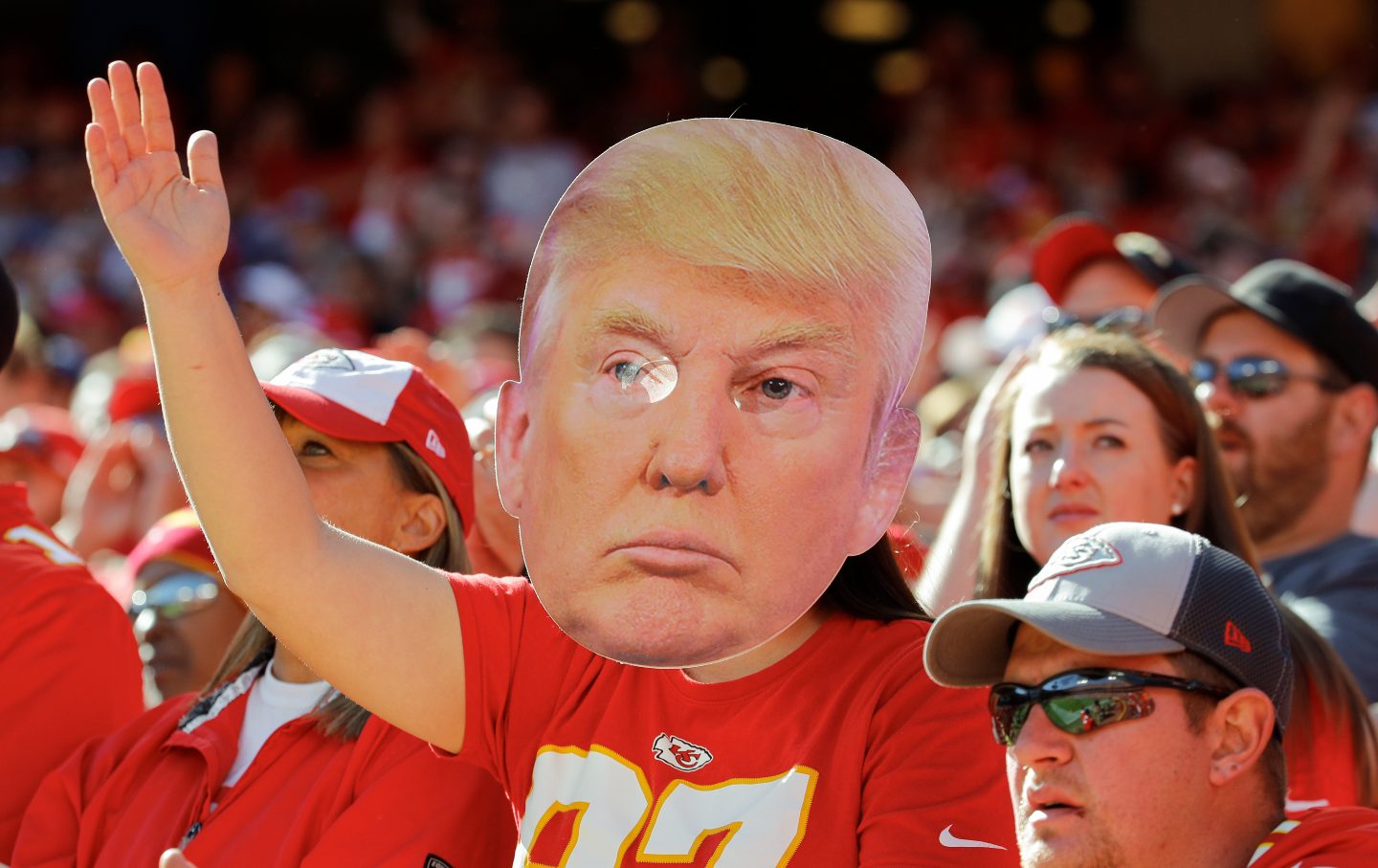
A Kansas City Chiefs fan wears a cutout of President Trump.
(Charlie Riedel / AP Photo)
Donald Trump will be the first sitting president to attend a Super Bowl, and his presence will be a gob of spit in the face of every NFL player, whether they voted for him or not. Trump’s plan to attend the game is made even more egregious by commissioner Roger Goodell’s ostentatious decision to remove the words “End Racism” from the end zone for the first time in four Super Bowls. There are those in the NFL offices, according to longtime football scribe Michael Silver, who think that this decision was a sop to Trump, lest his fragile self would have to see words he is trying to blot out of existence. To put a point on it, they know Trump is a racist—he’s canceling Black History Month FFS—and they wouldn’t want to offend their honored guest.
As folks who read my last column know, I asked NFL VP of communications Brian McCarthy about this and he said the narrative that the NFL switched out the slogan to please Trump was “total bullshit.” They went instead with the previously used “Choose Love” in order to “lift the imagination” after recent horrors like the California wildfires and the plane crash at DC National Airport. But, as former president of the Pro Football Writers of America Jim Trotter pointed out, why doesn’t the league think that ending racism “lifts the imagination”? Especially when we consider that the California wildfires destroyed historic Black communities like Altadena. And especially when we realize that Trump turned the fires and the DC plane crash into a racist whip against DEI. As Trotter said to me archly, “Seems to me that, in a moment like this, ‘end racism’ would be a more powerful statement than ‘choose love.’” One might even call it uplifting.
There are those who will say that the NFL, which has had a long history of racial inequity, was just engaging in the performative spewing of hot air by having “end racism” stenciled on the field in the first place. But as irksome as performative anti-racism is, what we have now is far worse: the performative silencing of the aspiration so as not to offend a racist. I’ve heard from Capitol Hill folk here in DC that Trump’s minions are bragging that they have brought the mighty NFL to heel, and created what Musk gleefully calls “a vibe change.” They believe that the all-powerful league is engaging in a voluntary surrender. Others angry at the decision, like late Hall of Famer Reggie White’s son, Jeremy White, who took to social media to call it “cowardly,” believe it to be intentional. The NFL and Roger Goodell can say this has nothing to do with Trump, but if people on both sides feel that way and the league sticks with the switch, that speaks for itself. The Super Bowl will start—and I gave Goodell credit earlier this week for this in the current climate—with Grammy award winner Ledesi singing “Lift Every Voice and Sing,” otherwise known as “The Black National Anthem.” There is a less than zero chance (it would be a million to one on FanDuel) that Trump will stand when Ledesi performs this civil rights anthem, insulting his hosts and daring them to do something about it, knowing they’ll do nothing.
The fact that this song is played at all is a product of the anti-racist struggles of NFL players from 2016–20. Here we get to an even more fundamental reason why Trump’s Super Bowl appearance is so rancid: It was Trump during the 2016 campaign, in an on-the-nose preview of what was to come, who said he wanted 49ers quarterback Colin Kaepernick to be kicked out of the country for taking a knee during the national anthem to protest police violence. In 2017, Trump infamously called all protesting players “sons of bitches,” and whined that they should be fired. In response to his abusive rant, the entire league stood together the following Sunday and knelt in protest. There was so much boiling rage among players that even franchise owners—many of whom are major bankrollers of Trump—joined the protest. Hell, even Dallas Cowboys franchise owner Jerry Jones took a knee. This fight continued as Trump attacked Black NFL players relentlessly at rallies and many players, including Tom Brady, refused to show up at the White House after winning a Super Bowl, so toxic was Trump’s name in the football world.
Trump has also routinely slandered players as “soft” for being more conscientious about concussions and tackling rules after a mass class-action lawsuit by players. He would mince around on stage, with blaring homophobia, mocking players as “unmanly” due to their concern about traumatic brain injuries. Trump never played football. But he loves the sport as long as Black athletes are seen and not heard and they do as much physical damage to each other as possible. This is what sports were like in the 19th century, a place Trump seems determined to drag us to.
Trump has never apologized for any of this, of course. That’s why his presence Sunday is not an act of reconciliation by the NFL but a surrender. We have seen players in the lead-up to the game tread extremely carefully when asked about Trump’s presence. If football players stand up to Trump in front of the world on Sunday, that’s great, but waiting for them to step out alone in the absence of a movement is a fool’s errand. It’s our job to build that movement, just as Colin Kaepernick would never have taken that knee without the context of Black Lives Matter. As for Trump, his presence Sunday is an affront. It’s an affront to anti-racist athletes. It’s an affront to any player that has suffered from the violence of the sport. And it’s an affront to every fan who doesn’t think someone currently acting outside the law should be on a pedestal at the most widely viewed event of the year. I’ll say it again to Roger Goodell and the NFL: Performative anti-racism isn’t worth much. But performative erasure is far, far worse.
Become a Sustaining Donor This September
Between the reemergence of right-wing red-baiting and Donald Trump’s use of the chilling National Security Presidential Memorandum–7 to criminalize left political organizing, we’re seeing McCarthyism reborn before our eyes.
This assault on democracy cannot be ignored or wished away. Resisting it requires bravery in the face of threats and repression, a steadfast commitment to the truth, and the unwavering belief that we can—and will—overcome this darkness.
We must have an independent media that sets the record straight, unearths corruption and abuses of power, and advances a politics of justice and dignity for all if we’re to win this fight.
That’s why I’m writing to you today. This September, The Nation needs to add 100 monthly donors to sustain our progressive journalism. Your contribution makes the next investigative report, the next truth-speaking column, and the next pathbreaking essay all possible.
I hope you’ll support our work with a recurring donation today. If you donate $10 or more a month, we’ll send you a brand new “Hands Off the Free Press!” sticker to recognise your commitment to our cause. Please, donate today.
Onward,
Katrina vanden Heuvel
Editor and Publisher, The Nation