
The Trump Administration Unabashedly Embraces the Monroe Doctrine
Despite other foreign-policy disagreements, a consensus is emerging among Republicans: The US must take an ultra-hawkish approach to Latin America.
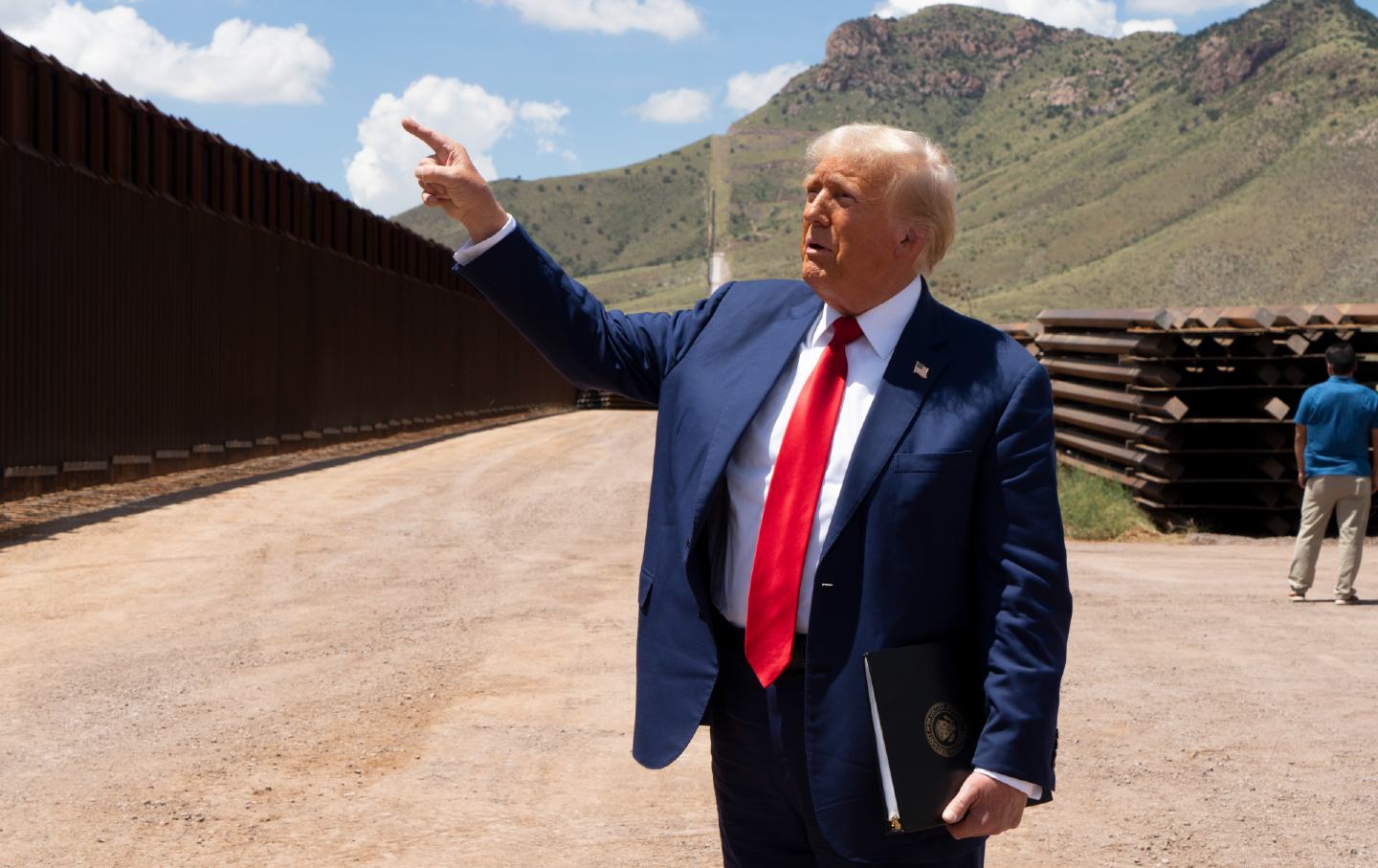
Then-candidate Donald Trump walks along the US-Mexico border south of Sierra Vista, Arizona, on August 22, 2024.
(Rebecca Noble / Getty Images)
Before Donald Trump’s first 10 days back in the White House were up, Latin America had already borne the brunt of several of his outbursts. The reincorporation of Cuba on the list of state sponsors of terrorism, hours after his inauguration, set the tone. Days later, in his first social media spat with a head of state as the 47th president, Trump imposed outlandish tariffs on Colombia and threatened President Gustavo Petro and his cabinet with sanctions.
The conflict erupted after US military planes landed in Brazil having transported deportees in appalling conditions—their hands and feet tied, some having fainted because of heat and stress. Outraged, the Brazilian government protested the “degrading treatment” of its citizens, prompting Petro to deauthorize a similar US military landing on Colombian soil. Trump reacted by berating the “unpopular” and “socialist” president, slapping 25 percent tariffs on all Colombian imports, and announcing sanctions and visa bans on the members of the Colombian government. The issue was partially resolved when Colombia offered to facilitate the return of its nationals in its own aircrafts under dignified conditions.
The announcement last year of Marco Rubio’s elevation from influential senator on all things Latin American to secretary of state heralded a hardline US approach toward the region. Pundits have often highlighted Rubio’s potentially diverging foreign-policy preferences—for example regarding NATO and relations with traditional allies—from others in the new administration, including the president. But none of these differences appear to apply to Latin America, where Rubio and his fellow neoconservatives as well as MAGA populists want the UnitedStates to maintain a hawkish approach toward the region.
This is bad news for Cuba. In the final days of his administration and following years of constant appeals from world leaders, Biden removed Cuba from the list of state sponsors of terrorism. The very next day, an enraged Rubiothreatened to revoke the order once in power—a promise Trump immediately made good on.
When in 2021 the first Trump administration, under pressure from Rubio, included Cuba on its terror list, the resulting crippling sanctions rocked the island’s economy and caused untold hardship for ordinary Cubans. Countries included on the list have great difficulties to carry out financial transactions with other countries and engage in international trade. Rubio had tightened the US embargo’s grip more than at any point since its first enactment in 1962.
Neoconservatives such as John Bolton and Elliott Abrams were also given a free hand to apply the same kind of pressure on Venezuela, which they saw as a larger geopolitical threat due to its oil reserves. The draconian sanctions imposed on Venezuela—through the 2017 financial sanctions and the 2019 and 2020 oil bans—strangled the country’s export capacity and devastated the country.
The result of these sanctions was a migratory crisis that sent shock waves throughout Latin America and in the United States. While Trump was wreaking the havoc that caused mass migration, he was building a wall—or bits of a wall—to keep migrants out, to no avail. Ironically, the very exodus that Trump played an outsized role in triggering played a decisive role in generating the anti-migrant sentiment that would eventually land him a victory in the 2024 elections.
On matters of foreign policy, it’s never entirely clear which of Trump’s own fickle preferences, and factions in his entourage, might get the upper hand. US policy toward China will be shaped, in large part, by the tensions between tech billionaires protecting their economic interests, neocons advocating for more confrontational escalation, and isolationists insisting on tariffs and decoupling. Regarding Ukraine, Trump’s MAGA base is likely to clash with neocons over their eagerness to continue allocating billions of dollars toward the war effort. But on Latin America, Trump’s own caprices are less set, and his warring tribes less likely to quarrel.
If Rubio gets a freehand, it will be at least in part because his boss doesn’t care. Trump could let the neocons determine the country’s Latin America policy—a bone to throw at the right-wing Cuban American lobby and a cohort of Cold War nostalgics.
Moreover, the political establishment in the United States, and this includes some Democrats, still believes that the only way to win Florida is to be tough on Cuba, despite the fact that the state’s Cuban American vote has playeda decisive role in only one US presidential election, in 2000. Polling data also now shows that Cuba policy isn’t the main factor in how most Cuban Americans vote.
And finally, there is the profound bipartisan belief, even more pronounced in the case of Republicans, that, whereas Latin America may not itself be the most strategic region from the point of view of US interests, to ensure its tight control is a vital precondition for both US security and the international projection of US power. This means that bullying south of the border—through sanctions, heavy-handed threats, and various violations of sovereignty—is likely to garner sufficient consensus. For many conservatives, reasserting Washington’s dominion over the Western Hemisphere is part and parcel of making America great again.
Neocons will have it their way in Latin America in large part because the priorities of Trump’s other core constituencies don’t clash with their prime concerns. Neocons won’t contradict the MAGA base’s emphasis on deportations and border walls. They will likely ignore the administration’s rolling back free trade so long as they can still push forward with their regime-change operations. And they will enthusiastically back the libertarian billionaires’ crusade against taxation and regulation, whether in support of Javier Milei’s reckless fantasy-based economic experiment in Argentina or anywhere else.
Popular
“swipe left below to view more authors”Swipe →We can also expect actions to be met—and often surpassed—by words. No more fig leaves or euphemisms. Biden’s condescending “Everything south of the Mexico border is America’s front yard” will be replaced by all sorts of bombastic threats, including against Panama’s sovereignty over the canal. The administration will likely be explicit, as it was last time around, in its unabashed reiteration of the Monroe Doctrine, originally proclaimed in 1823 to ward off the colonial presence of European powers, but resurrected for use against social movements and governments during the Cold War with the Soviet Union and new cold war with China.
In practice, a strict enforcement of the Monroe Doctrine will be harder to deliver. Trump’s attempts to coerce Latin American countries to downgrade their relations with Beijing largely failed in his first term, as regional elites refused to abandon the newfound autonomy that they obtained from enjoying greater trade ties with China than with the United States, particularly in South America.
In matters of security, however, the Pentagon’s SouthCom and US intelligence agencies continue to reign supreme in the hemisphere. Conveniently for the US, a reignited War on Drugs is providing the perfect conduit for the strengthening of security cooperation with several Latin American governments. Trump’s designation of drug cartels as foreign terrorist organizations will play into this enhanced security leverage in the absence of the US’s erstwhile economic muscle.
Next month’s presidential elections in Ecuador, followed by elections in Bolivia, Chile, and Honduras, and midterms in Argentina before the end of the year, will provide a good test of how far the new US administration is willing to go to enact its preferred outcomes. The latest clashes over US deportations confirm Brazil and Colombia should also be watched carefully given Rubio’s own public displays of hostility toward both presidents.
In Latin America, meanwhile, calls for regional unity remain the soundest counsel in the face of a new wave of divisive Monroeism. On economic terms, only regional integration can prevent a race to the bottom between peripheral neighbors competing for the favors of markets and investors. And on political terms, collective responses remain the only effective way to deter the aggression of hegemonic powers.
Time will tell whether Trump’s blunders succeed in uniting the region. But Latin American states should understand that regional unity still constitutes the best foreign-policy doctrine given the challenge posed by Trump, Rubio, and any future administration that wants to go back to days of the “big stick” and gunboat diplomacy.
More from The Nation
Progressives Are Backing Puerto Rican Independence. It’s About Time. Progressives Are Backing Puerto Rican Independence. It’s About Time.
More and more leftists are concluding that statehood for the island is not enough.
The Saudi Phase of the Iran War Signals More Chaos to Come The Saudi Phase of the Iran War Signals More Chaos to Come
The conflict that Donald Trump has repeatedly proclaimed an unequivocal American victory keeps spiraling out of control.
Andy Burnham’s Speech to the Labour Party Conference Could Be the Start of a Positive Social-Democratic Politics Andy Burnham’s Speech to the Labour Party Conference Could Be the Start of a Positive Social-Democratic Politics
But the autumn budget to be released at the end of October will offer needed details.
Why Navi Pillay’s Receiving the Nobel Peace Prize Is So Important Why Navi Pillay’s Receiving the Nobel Peace Prize Is So Important
She believes that human rights and international law are universal principles that must be enforced regardless of violator’s ideology, ethnicity, or geostrategic alignment.
Writing About War as Bombs Fall Writing About War as Bombs Fall
While the Israeli government launched a well-orchestrated offensive of disinformation and hyperbole that would make the illegal permissible in the war on Gaza.

