
Hawaii’s Storm Damage Is Deeply Rooted in the State’s Plantation Past
The latest wave of storm devastation closely tracks the regional neglect of infrastructure instituted by the state’s first modern agricultural barons
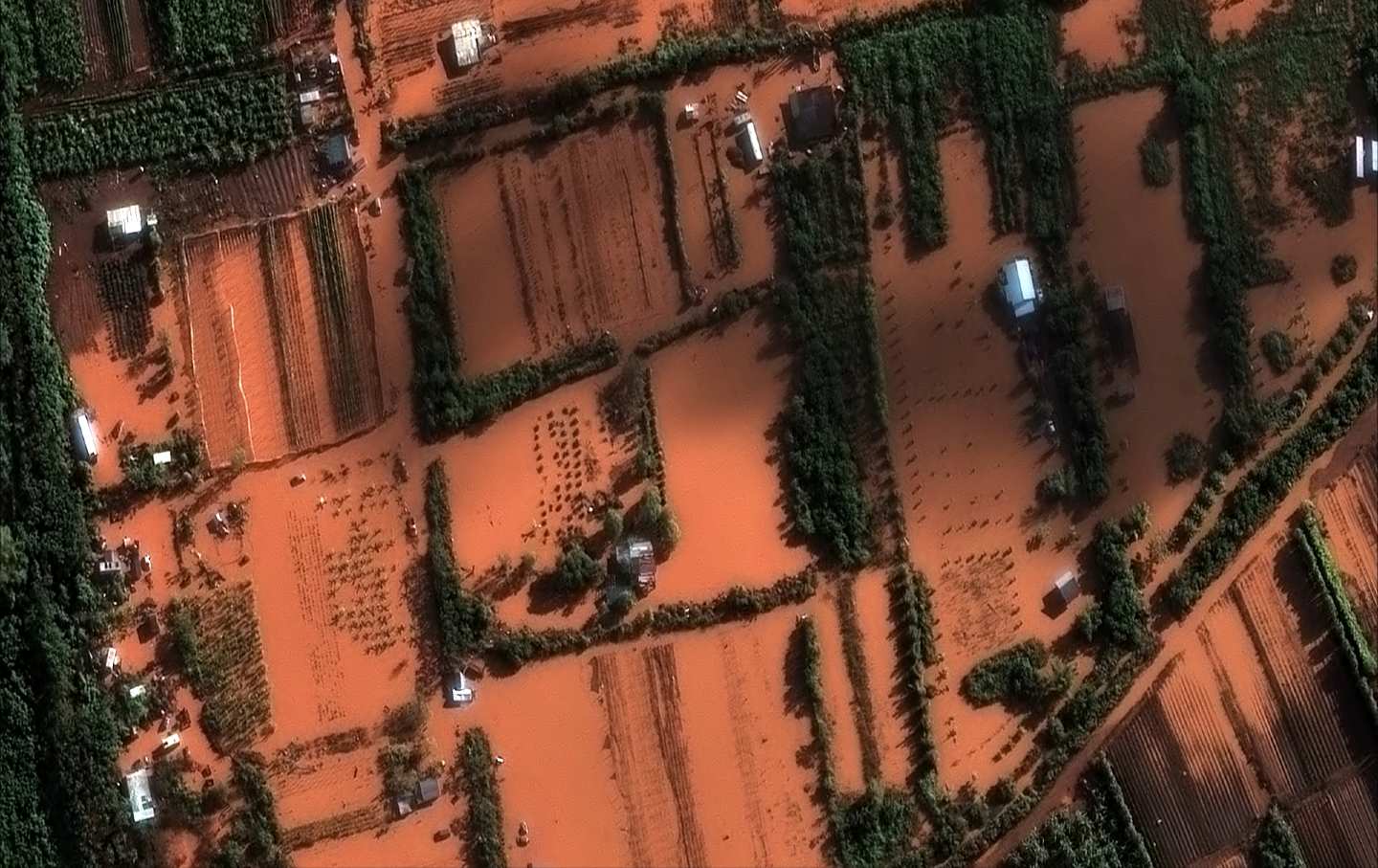
A satellite image of flooded fields and buildings near Waialua, on Oahu’s north shore.
(Satellite image (c) 2026 Vantor)Over this past week, Hawai’i has suffered some of the worst flooding the state has seen in the past 20 years, after a massive Kona Low storm—Hawaii’s version of a cyclone—pelted the islands with rain and high winds. State officials, including Governor Josh Green and Honolulu Mayor Rick Blangiardi, have sought federal assistance to coordinate an emergency response to the overwhelming rainfall, which has displaced thousands while rendering many roads impassable. As of March 20, the state had estimated that the storms would cost Hawaiians more than a billion dollars in property damage. Many homes on Maui, Molokai, and the north shore of Oahu remain submerged in brown floodwaters with floors caked in mud. Over the weekend, some 130,000 people lost power.
The destruction of the storm was also accompanied by the hot air of mainstream weather-and-disaster coverage. Press reports in the mainland US dwelled on the extreme, record-breaking volume of the storm without paying attention to the most salient forces that shape the human fallout from putatively natural disasters: socioeconomic inequality and the fraying infrastructure of emergency relief. In Hawaii, which suffers chronic bouts of extreme weather thanks to its geography, the human force-multiplier for storms like this latest one is easy to identify: plantation capitalism. Across the islands, hundreds of the plantation-era waterworks are falling into disrepair, posing a grave danger to human life and worsening climate disasters in the state.
One key pressure point in this past week’s storm was the Wahiawā Dam and reservoir on the North Shore of Oahu, the largest such facility in the state. On Friday at 5:35 am, Honolulu officials sounded the alarm that the 120-year-old earthen dam in Central Oahu was at “risk of imminent failure,” prompting the evacuation of 5,500 people. Residents of the neighboring town of Hale’iwa only reported hearing the warning sirens around 8:40 am. By 9 am, the water was surging through the 80-foot spillway—the release valve for excess water—as it neared the crest of the dam. During the heaviest flooding, the spillway was releasing some 1,500 gallons per second. Unlike a concrete dam earthen dams like Wahiawa are likely to give way when water reaches their crests—a height of 84 to 90 feet in this case. The high-water mark in the Friday floods came dangerously close to this threshold, with storm surges topping 85 feet. If the dam had burst, it would have released almost 3 million gallons of water per second and endangered the lives of at least 2,500 people.
The Wahiawā Dam is owned by Dole Food Corporation, one of the state’s oldest companies, steeped in the region’s seigneurial legacy of plantation capitalism. At one point, Dole owned the entire island of Lanai and controlled almost all of the world’s pineapple production. Located 17 miles northwest of Honolulu, the Wahiawā Dam was constructed in 1905–06 by the Waialua Sugar Company, which became a subsidiary of the Dole empire in the early 1990s. When Waialua officially ceased operations in 1996, it transferred full ownership of the dam to Dole.
Sugar cane, another of the island’s main agricultural exports, is an infamously thirsty crop; one pound of refined sugar takes 4,000 pounds of water, which is equivalent to 500 gallons. It takes roughly 4,000 tons of water, or a million gallons, to irrigate 100 acres of cane. Throughout the 19th and 20th centuries, the plantations built hundreds of ditches, dams, dikes, tunnels, and other irrigation devices to exploit the island’s resources, fundamentally altering its sensitive ecology. The Wahiawa–Lake Wilson system was once considered a crown jewel of plantation-era waterworks, supporting irrigation for the upper fields in North and Central Oahu, delivering 10–12 billion gallons of water a year.
For decades now, Dole has consistently overlooked mounting alarms over the dam’s structural integrity. Dole Food Corporation has known about serious structural issues with the dam since at least 1978, when the US Army Corps of Engineers issued a report warning of the dam’s ongoing disintegration. The report also cautioned that the spillway wasn’t large enough to lower water levels in the event of “probably maximum precipitation.” Going back to 2009, Dole has been cited four times for failing to address deficiencies in the dam, and paid a $20,000 fine to Hawaii’s land department for (among other things) inadequate spillway capacity, failure to address the embankment’s stability, delayed necessary construction, and refusal to remove excess vegetation.
In recent years, Dole has invested in some repairs and upgrades to the dam—$3 million of an estimated $15 million repairs needed according to the Engineering Division of the Department of Land and Natural Resources (DLNR). Yet, in line with its history as a prime beneficiary of government handouts on the islands, the corporation expects taxpayers to foot the bill, even as Dole Food’s parent company, the Dublin-based Dole PLC, postedrecord profits in 2023 with a net income of $155 million. The standard Dole strategy is to poor-mouth its own economic performance: Dan Nellis, a general manager with the company, complained that such upgrades would be too expensive because Hawaii-based operations were allegedly barely profitable. “We’re growing pineapples,” he explained to the state in a 2021. “We’re not growing money out here,” .
In 2021, the Engineering Division of the DLNR officially classified the Wahiawā Dam as a structure with “high hazard potential”—the highest risk category for aging waterworks. The department’s report warned that the dam’s failure would result in “probable loss of human life.” In the last week, state officials told Blaze Lovell and Thomas Heaton of Civil Beat that Dole hasn’t made any improvements on the dam since 2023. The state has been trying to purchase the dam since the 1990s. In 2023, the state legislature passed a bill alloting $23 million to DLNR to acquire the dam. Ironically enough, the state land board was scheduled to vote on the acquisition this week. Should the acquisition go through, the state would have to pay more than $20 million in repairs. Unfortunately, Wahiawā isn’t exceptional in this regard; as of 2021, a stunning 120 of Hawaii’s 131 state-regulated dams—most of which are privately owned—shared the label of “high hazard potential.”
Negligence in the maintenance of plantation-era waterworks has already claimed hundreds of lives. In March 2006, Oahu’s neighboring island of Kaua’i suffered a massive dam failure. Following four weeks of intense rainfall, the century-old Ka Loko Dam on the northeast side of the island suddenly burst, releasing an estimated 325,000,000 gallons of water down the Wailapoa Stream. Built in for water storage for cane irrigation by the Kilauea Sugar Plantation in the late 1800s, ownership of the dam transferred a handful of times, first in 1971 after Kilauea’s operations ceased, until it was transferred to a private individual owner. At the time, Ka Loko was considered a low hazard dam. The ensuing flood killed seven people, including a pregnant woman, and destroyed several structures. The Ka Loko Dam failure led the state to tighten regulations on dam safety, and the dam’s owner, a retired auto dealership owner, was charged with reckless endangerment in the first degree in 2014.
Plantation-era waterworks also contributed to Hawaii’s deadliest natural disaster: the 2023 Maui Fires. Once the capital of the Hawaiian Kingdom, the town of Lahaina was the epicenter of the fires. Together with the region of Maui Komohana (West Maui), Lahaina was known for its abundant streams, ponds, and rivers. Travelers gave Lahaina the nickname “Venice of the Pacific.” However, by the mid-19th century, sugar plantations across Maui started siphoning up to 1,200 million gallons of water daily for their crops, artificially worsening drought conditions and significantly changing the town’s ecology.
As U’llani Tanigawa Lum and Kaulu Lu’uwai observe in the Law & Political Economy Project, water extraction for the region’s plantations not only destroyed the livelihoods of small taro farmers but also effectively turned Lahaina into a tinderbox for wildfires by concentrating much of the region’s water into a monocrop agricultural model. Even as the state shifted from sugar to tourism as its principal source of revenue in the 1960s, water reclamation was never a priority in Lahaina. So when the Maui fires began in early August 2023, Lahaina’s condition of malign neglect was a prime accelerant. High winds pushed the fires forward, and the town’s long-term drought, aging electrical infrastructure, and unmaintained lands did the rest. When the smoke finally cleared, at least 102 residents were dead, and more than 2,200 buildings were destroyed. Today, Lahaina survivors—many of whom are from working-class Kanaka Maoli and Filipino backgrounds—still struggle to find affordable housing and rebuild their lives.
Climate change has ushered in a new age of extreme weather, but the social forces that plunge affected areas into peril are largely the same ones behind the climate crisis: extractive industries and their government retainers, which remain dogmatically opposed to restoring the ecosystems they despoil for profit. In Hawaii, working-class locals and native populations are bearing the brunt of climate disasters, while the descendants of plantation oligarchs—and their new tech-lord neighbors—remain insulated from the harms they create. Once the true costs of plantation capitalism are measured and mitigated, we can build a better world from the wreckage.
Become a Sustaining Donor This September
Between the reemergence of right-wing red-baiting and Donald Trump’s use of the chilling National Security Presidential Memorandum–7 to criminalize left political organizing, we’re seeing McCarthyism reborn before our eyes.
This assault on democracy cannot be ignored or wished away. Resisting it requires bravery in the face of threats and repression, a steadfast commitment to the truth, and the unwavering belief that we can—and will—overcome this darkness.
We must have an independent media that sets the record straight, unearths corruption and abuses of power, and advances a politics of justice and dignity for all if we’re to win this fight.
That’s why I’m writing to you today. This September, The Nation needs to add 100 monthly donors to sustain our progressive journalism. Your contribution makes the next investigative report, the next truth-speaking column, and the next pathbreaking essay all possible.
I hope you’ll support our work with a recurring donation today. If you donate $10 or more a month, we’ll send you a brand new “Hands Off the Free Press!” sticker to recognise your commitment to our cause. Please, donate today.
Onward,
Katrina vanden Heuvel
Editor and Publisher, The Nation
More from The Nation

Gavin Newsom Comments on Climate Gavin Newsom Comments on Climate
On the sidelines of the UN General Assembly meeting and New York Climate Week, the California governor called AOC “the real damn deal.”

Cities as Climate Labs: Inside the U20 Summit Cities as Climate Labs: Inside the U20 Summit
Mayors at the Urban 20 Summit worked across borders to confront the climate crisis at the local level.
Big Oil’s Origin Story Big Oil’s Origin Story
Amy Westervelt’s new book, Brought to You By, exposes the deep history of today’s “information pollution.”
Two Years After Helene, North Carolina’s Unsettled Recovery Two Years After Helene, North Carolina’s Unsettled Recovery
The state has become a testing ground under an eviscerated FEMA and a missing-in-action “recovery czar,” Michael Whatley, with big political ambitions.
A Reckoning Comes for Nepal A Reckoning Comes for Nepal
A year after its Gen Z uprising, Nepal faces a struggle not only for democracy and human rights but for climate survival.

How a Creative Mind Lives in Nature How a Creative Mind Lives in Nature
Working in the wilderness could not satiate my intellectual impulses. But for the protagonist of Hothouse Bloom, the binary between mental and physical labor is what calls her.

