The Big Picture / January 14, 2025

A Tale of Two Presidents

Remembering Carter as we steel ourselves for Trump’s second inauguration.
D.D. Guttenplan
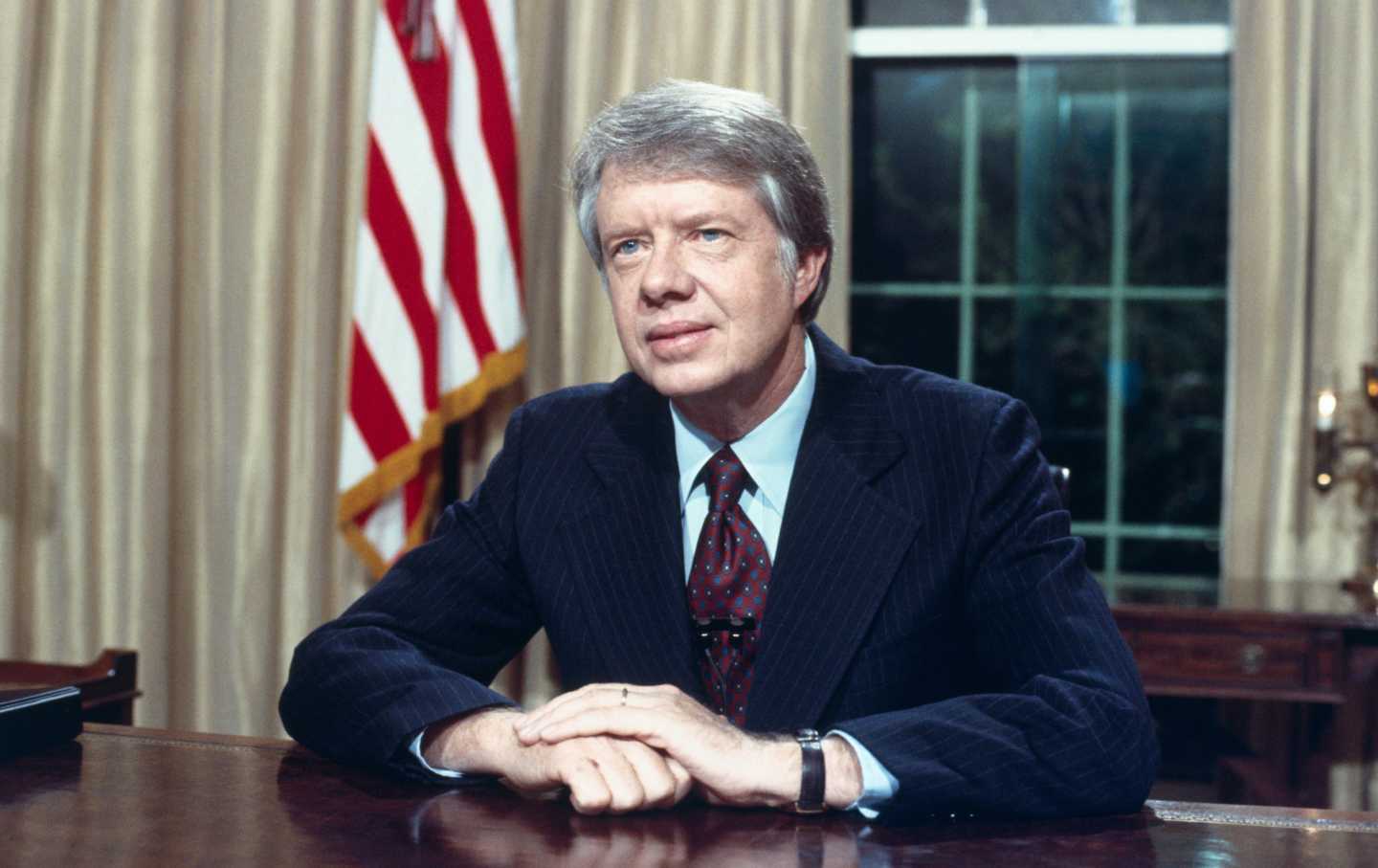
Jimmy Carter addresses the nation nearly half a century ago.(Getty)

The first vote I cast in a presidential election was for Jimmy Carter in the 1976 New York primary. Carter came in fourth, after Senators Henry Jackson and Morris Udall and a slate of uncommitted delegates. Yet I bet two friends that the Georgia governor would win the nomination and go on to victory in November—the last political bet I ever won.

What made me so confident? Mainly Carter’s frank rejection of racism—a turn that, as someone born and raised in the South, I felt the country desperately needed. But also a turn that it seemed the country fervently wanted. Carter had lost his first run for governor of Georgia, in 1966, to the arch-segregationist Lester Maddox, and in his second attempt he had been careful to say as little as possible about race, or even to campaign too hard for Black votes. So it made headlines when, during his inauguration speech, he announced:

I say to you quite frankly, the time for discrimination is over. No poor, rural, weak or black person should ever have to bear the additional burden of being deprived of the opportunity of an education, a job or simple justice.

Carter’s record as a populist governor, combined with his forthright commitment to racial justice, gave him an appeal that no other candidate could match. But would coastal liberals give a man who sounded like him, and who described himself as a “peanut farmer,” any chance at all? A win in the Iowa caucuses lent him credibility, while victories in Pennsylvania (which prompted Jackson to withdraw) and Wisconsin (where he edged out Udall) gave him the nomination—and, eventually, victory over Republicans still scarred by Watergate and Vietnam.

In office, Carter’s record was mixed: He normalized relations with China, pursued the Strategic Arms Limitation Talks with the Soviet Union, and brokered the Camp David Accords between Israel and Egypt. He also kept his campaign promise to deliver a full and unconditional pardon to Vietnam War draft resisters. But his focus on reducing the federal deficit—at the time, a mere $79 billion (compared with $1.9 trillion in 2024)—limited new initiatives, while his administration was also hamstrung by persistent stagflation (a politically lethal combination of high inflation and low growth). Out of office, as we’ve been reminded since his death on December 29, Carter became a superstar among ex-presidents, waging peace from South Africa to North Korea, speaking out against Israeli apartheid, and remaining a staunch defender of voting rights and human rights at home and abroad. (Readers who want more detail should consult Nation editorial board member Kai Bird’s sympathetic biography The Outlier.)

This month will see the inauguration of another outsider president, whose first-term ambitions, like Carter’s, often ran aground on the shoals of inexperience. At 78, Donald Trump will be the oldest man ever inaugurated as president, and he is unlikely to have a very long post–White House career. But this time, he takes office not as a political novice, but with a veteran’s awareness of the levers of power in Washington and how they can be used to further his aims.

Here at The Nation, we make no pretense to neutrality. Whenever Trump moves to restrict the rights of women, people of color, or indeed any US citizen, whether native-born or naturalized, we will oppose him. As we will oppose any effort to abridge our civil liberties, shred the social safety net, rob the poor to fund tax breaks for the rich, or turn our flawed republic into an autocracy. But those are differences of principle, and if Trump pursues aims we would otherwise support—loosening the hold of Big Ag on farmers or that of Big Pharma on our healthcare, pursuing peace in Korea or seeking to negotiate an end to the war in Ukraine—we won’t oppose them simply because he’s the one in office.

Meanwhile, as Ethan Iverson’s cover story reminds us, the cultural life of the country continues. Likewise Sam Adler-Bell on the new Bob Dylan biopic, Bijan Stephen on the dance music of Jamie xx, and Jess Cotton on Olga Tokarczuk’s magic mountain. Of course, politics and culture are not so easily separated, as Daniel Bessner’s appreciation of Noam Chomsky and Hussein Omar’s essay on the poet Fady Joudah both underline. Not to mention our usual array of stellar columnists and commentators; a harrowing account by contributing writer Mohammed Mhawish of being buried by Israel; cartoonist Steve Brodner’s take on the incoming administration; and much, much more.

So stay with us. It could be a long four years.
D.D. Guttenplan
Editor
Disobey authoritarians, support The Nation

Over the past year you’ve read Nation writers like Elie Mystal, Kaveh Akbar, John Nichols, Joan Walsh, Bryce Covert, Dave Zirin, Jeet Heer, Michael T. Klare, Katha Pollitt, Amy Littlefield, Gregg Gonsalves, and Sasha Abramsky take on the Trump family’s corruption, set the record straight about Robert F. Kennedy Jr.’s catastrophic Make America Healthy Again movement, survey the fallout and human cost of the DOGE wrecking ball, anticipate the Supreme Court’s dangerous antidemocratic rulings, and amplify successful tactics of resistance on the streets and in Congress.

We publish these stories because when members of our communities are being abducted, household debt is climbing, and AI data centers are causing water and electricity shortages, we have a duty as journalists to do all we can to inform the public.

In 2026, our aim is to do more than ever before—but we need your support to make that happen. 

Through December 31, a generous donor will match all donations up to $75,000. That means that your contribution will be doubled, dollar for dollar. If we hit the full match, we’ll be starting 2026 with $150,000 to invest in the stories that impact real people’s lives—the kinds of stories that billionaire-owned, corporate-backed outlets aren’t covering. 

With your support, our team will publish major stories that the president and his allies won’t want you to read. We’ll cover the emerging military-tech industrial complex and matters of war, peace, and surveillance, as well as the affordability crisis, hunger, housing, healthcare, the environment, attacks on reproductive rights, and much more. At the same time, we’ll imagine alternatives to Trumpian rule and uplift efforts to create a better world, here and now. 

While your gift has twice the impact, I’m asking you to support The Nation with a donation today. You’ll empower the journalists, editors, and fact-checkers best equipped to hold this authoritarian administration to account. 

I hope you won’t miss this moment—donate to The Nation today.

Onward,

Katrina vanden Heuvel 

Editor and publisher, The Nation

D.D. Guttenplan

D.D. Guttenplan is a special correspondent for The Nation and the host of The Nation Podcast. He served as editor of the magazine from 2019 to 2025 and, prior to that, as an editor at large and London correspondent. His books include American Radical: The Life and Times of I.F. Stone, The Nation: A Biography, and The Next Republic: The Rise of a New Radical Majority.

More from The Nation

Jules Feiffer, Elizabeth Pochoda, Bill Moyers

In Memoriam: Beautiful Writers, Influential Editors, Committed Activists In Memoriam: Beautiful Writers, Influential Editors, Committed Activists

A tribute to Nation family we lost this year—from Jules Feiffer to Joshua Clover, Elizabeth Pochoda, Bill Moyers, and Peter and Cora Weiss

Obituary / Richard Kreitner

President Donald Trump in the White House in January 2025.

Trump’s Anti-DEI Crusade Is Going to Hit White Men, Too Trump’s Anti-DEI Crusade Is Going to Hit White Men, Too

Under the Trump administration’s anti-DEI directives, colleges would be forced to abandon gender balancing, disadvantaging men.

Kali Holloway

Why We Need Kin: A Conversation With Sophie Lucido Johnson

Why We Need Kin: A Conversation With Sophie Lucido Johnson Why We Need Kin: A Conversation With Sophie Lucido Johnson

The author and cartoonist explains why we should dismantle the nuclear family and build something bigger.

Q&A / Regina Mahone

CBS News editor in chief Bari Weiss hosts a town hall with Erika Kirk on December 10.

Bari Weiss’s Counter-Journalistic Crusade Targets “60 Minutes” Bari Weiss’s Counter-Journalistic Crusade Targets “60 Minutes”

The new editor in chief at CBS News has shown she’s not merely stupendously unqualified—she’s ideologically opposed to the practice of good journalism.

Elizabeth Spiers

Donald Trump, October 2025.

The Remaking of Trump’s Washington, DC The Remaking of Trump’s Washington, DC

The ballroom and his other proposed building projects are many things, but they are not exactly works of architecture.

Books & the Arts / Karrie Jacobs

Are Cell Phones to Blame for the Youth Loneliness Epidemic?

Are Cell Phones to Blame for the Youth Loneliness Epidemic? Are Cell Phones to Blame for the Youth Loneliness Epidemic?

David Landes argues that cell phones represent an isolated life whereas Kimberly Hassel blames the loneliness crisis on a society unable to support or protect its youth.

Column / David Landes and Kimberly Hassel