NFL Head Injuries Are Part of the Product
The league creates spectacles that distract from the dangers—but that doesn’t mean they’re not there.
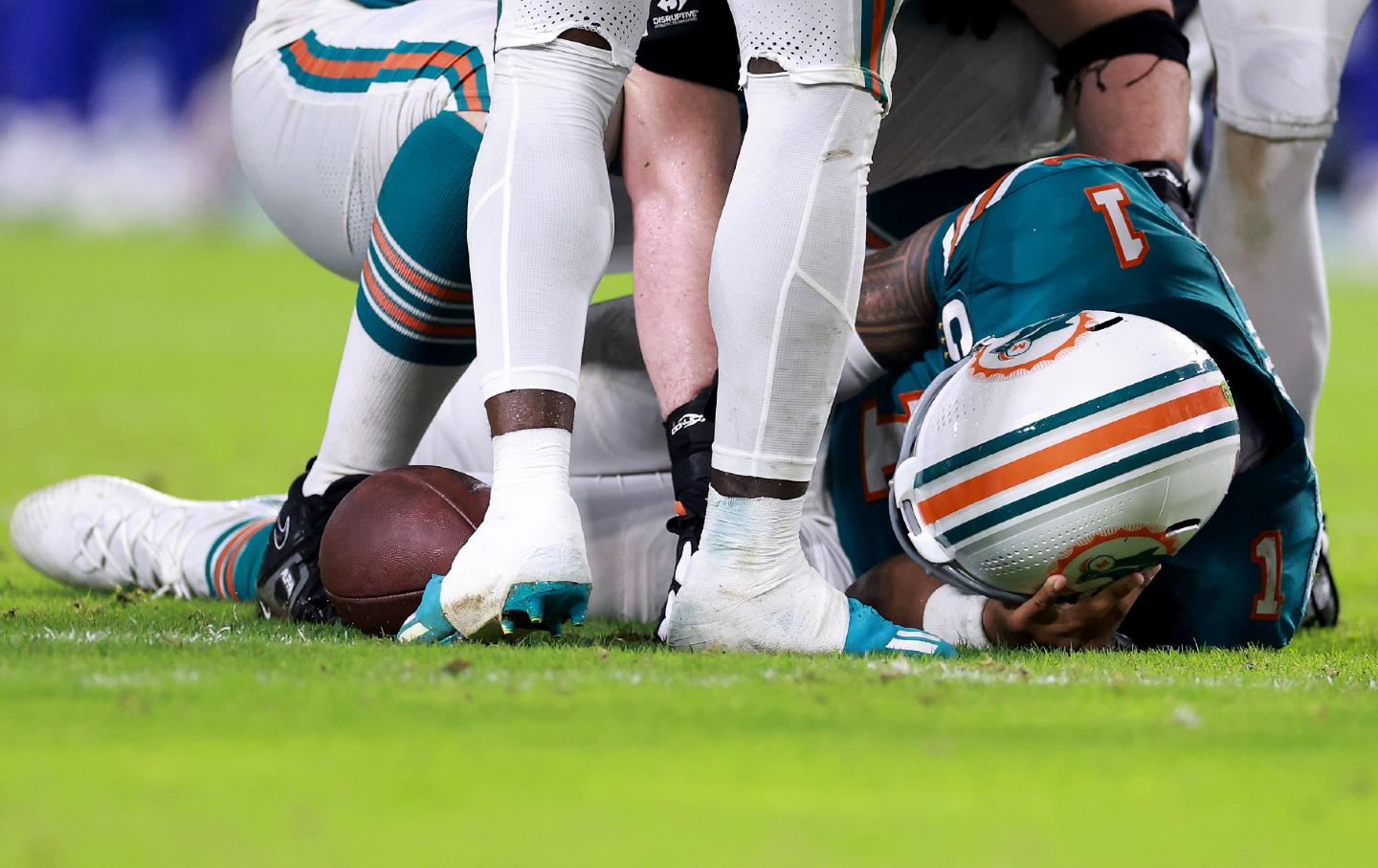
Tua Tagovailoa of the Miami Dolphins lies on the ground after colliding with Damar Hamlin of the Buffalo Bills during the third quarter on September 12, 2024, in Miami Gardens, Florida.
(Carmen Mandato / Getty Images)
The NFL’s great talent is creating spectacles that distract from scandals. Whenever the league suffers stories that can’t be contained by the sports page, it’s able to change the subject to the latest on-field action and transactions. Yesterday’s disgrace becomes today’s afterthought. This is a league able to cleanse its own stink faster than Minnesota Vikings receiver Justin Jefferson streaking down the field on a 97-yard touchdown pass. (Let’s look at the highlight now! Wait, what were we talking about?)
We are living this dynamic now in the case of Miami Dolphins quarterback Tua Tagovailoa, who has been sidelined by a concussion since last week’s game against the Buffalo Bills. As the Dolphins trailed late in a lackluster effort at home, Tagovailoa ran headfirst into the body of a Bills defender. He immediately fell to the turf and went into an alarming post-concussive pose known as “the fencing response.” After several minutes of lying prone and being attended to by various medical personnel, as players from both teams took a knee, Tagovailoa walked off the field under his own power.
This is not Tagovailoa’s first experience with a concussion. In 2022 he had two traumatic brain injuries on the field, each time taking place when his head slammed into the turf. That offseason, Tagovailoa considered quitting the sport. His mother, according to Tagovailoa, convinced him to get back onto the field. She now wants him to retire. Tagovailoa returned triumphantly last year with a concussion-free season, a playoff berth, and a new $200 million contract. Yet that memory of his body crumpling on the field in 2022 has always shadowed his career.
In the offseason, during a wide-ranging interview with radio host Dan LeBatard, Tagovailoa revealed that he had been learning jiu jitsu to learn how to fall without his head taking the impact. He also announced in August that he had started wearing one of the new VICIS helmets that is supposed to limit head trauma. As Tagovailoa said, “It was like a percentage better than the helmet that I had. Everything matters and so I’m going to play that percentage. So if you look at it last year, it wasn’t anyone really hitting my head. It was really just the ground.”
In Tagovailoa’s comments, we see the inexorable problem with the NFL’s PR approach to concussions—namely, that the NFL has protocols and guardrails in the hope that no one worries or thinks about it any longer. Yes, one can have new helmets, a softer turf, and changes in tackling rules. But all that can do at best is make the game safer, not safe. These rule and equipment changes are like cigarettes with extra-long filters. I don’t question whether the VICIS helmet is a few percentage points safer than what players have worn before. But even in an NFL drunk on gambling profits, those are not odds we should ask anyone to play.
Within the league, the reaction to Tagovailoa’s concussion was strikingly different from what we are used to hearing. Las Vegas Raiders head coach Antonio Pierce said, “I’d tell him to retire. It’s not worth it.” Members of the media, especially the former players working for the networks, called upon him to leave the sport before he ended up like so many players before him: retired with slurred speech, poor memories, and the syndrome known as CTE (chronic traumatic encephalopathy). “If I’m him, at this point, I’m seriously considering retiring from football,” said studio host and Hall of Fame tight end Tony Gonzalez. “If that was my son, I would be like, ‘It might be time.’ This stuff is not what you want to play around with.”
It is a terrible irony that the Bills player whose body caused Tagovailoa’s brain to bruise and bleed was that of safety Damar Hamlin. People may remember that Hamlin was once in Tua’s position: prone on the field and surrounded by medical personnel. Hamlin almost died, suffering cardiac arrest after a routine play. His return to the field has been described as a miracle. Maybe it is. But it’s also the kind of miracle that inspires others to follow in his risky footsteps and become tragedies. We cannot deny that such a return for Hamlin, Tagovailoa, and others is fraught with danger. When Tagovailoa returns, as he insists he will, his career will be stalked by the possibility of tragedy. The NFL, however, won’t have to work too hard to get fans to think about anything else.