
The Toughest Fight to Win Back Abortion Rights Is On in Florida
A six-week abortion ban in the state has unleashed widespread suffering. Now voters in the state have a chance to restore Florida as a haven for abortion care in the South.
Five patients sit on mauve-and-gray chairs in the waiting room at the Planned Parenthood health center in Sarasota, Florida, waiting to be sorted under the cruel math of the state’s six-week abortion ban. Some are already too late to terminate their pregnancies. Some are just in time. Until the ultrasound probe touches their bellies, they won’t know for sure. Two friends lean toward each other, chatting in Spanish, while a woman with a sunflower tattoo rests her head on her partner’s shoulder. A young woman in gray sweatpants comes back into the waiting room, gives her boyfriend a tight smile, and nods. They’ve made it. Just minutes later, another woman wearing purple Crocs comes out crying and texting frantically. She hasn’t.
Of the 25 women who come to the clinic seeking an abortion on this Tuesday in mid-June, seven will be turned away because the pea-sized embryo they are carrying is just a few millimeters too large. Many people don’t know they are pregnant at six weeks, which means a significant number of Floridians who need an abortion never make it to this room at all; by the time they realize they’re pregnant, it’s too late, and they are filtered out by the exhausted call-center staff on the other side of the fogged glass window, to be informed of options that, for many of them, will be out of reach—like boarding a plane to Washington, DC, or Illinois.
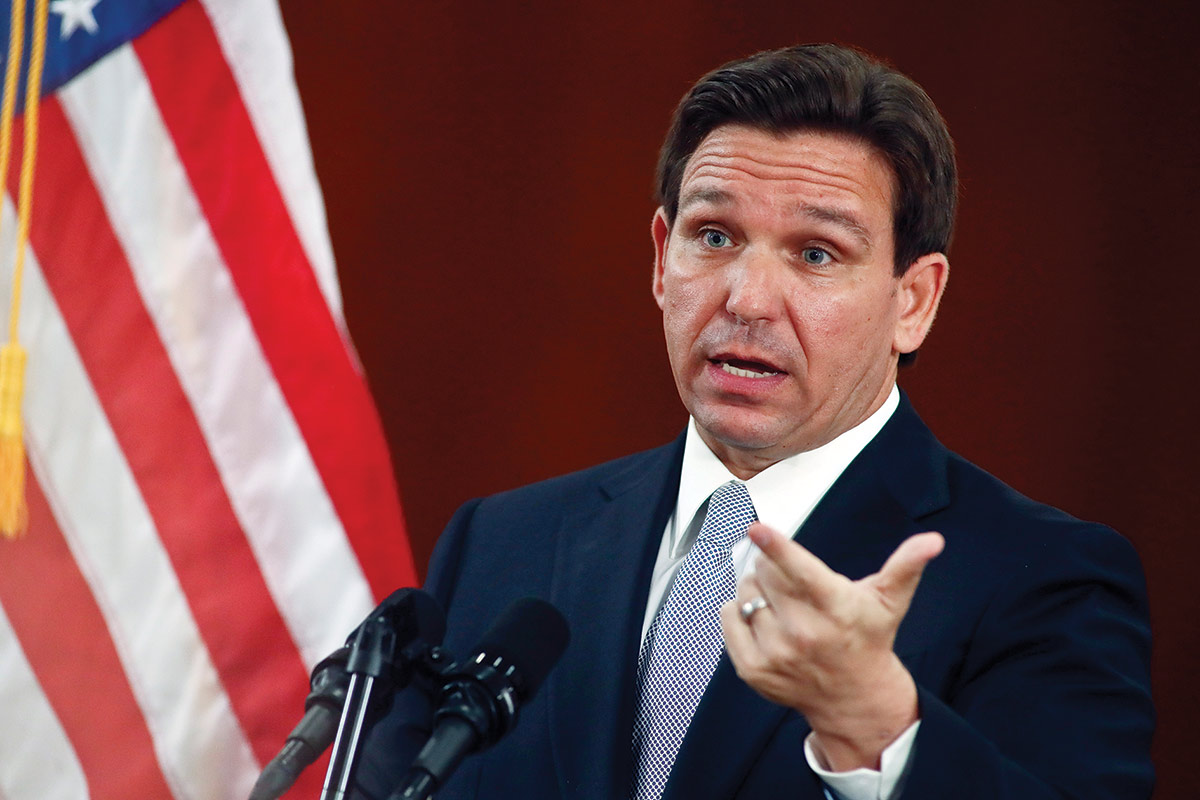
In April 2023, Florida Governor Ron DeSantis signed the six-week ban into law. Lawmakers had stipulated that the six-week ban would only take effect after Florida’s Supreme Court upheld the state’s existing 15-week ban, which had been in effect since shortly after Roe was overturned. The court’s decision came this past April, and the six-week ban went into effect on May 1.
Back at the clinic, the heat outside begins to break as the wind gusts under a heavy sky; a storm is coming. A woman walks in off the street and struggles her way through requesting an appointment in Haitian Creole. She’s called in for an ultrasound. She is six weeks, one day. Too late.
But the woman whose story I can’t get out of my head after seven hours of observing an average day in hell is the woman in the red blouse. She is neither too late nor just in time, but on the impossible borderline in between. She is five weeks, five days, I hear her telling someone on the phone. If she wants an abortion, she needs to be counseled by the doctor so that she can return for a second appointment 24 hours later, as required by state law. But she does not know if she wants an abortion. “I only have two days to decide,” she says, pacing the hallway, running her hand over her blond hair, which is pulled back into a bun. Caught in the vice grip of two divergent futures, she says into her phone: “The whole thing is stupid as shit, honestly.”
Patients like the woman in the red blouse present a cruel irony, the doctor on duty that day, Robert Slackman, tells me at the end of his shift. Before the six-week ban took effect in May, Slackman, an older man who speaks with a quiet deliberateness, would tell patients who were unsure whether they wanted an abortion to go home and think it over. Now he watches helplessly as terrified patients rush to have an abortion before they can even process it. “The whole idea, I’m sure, by the conservative Legislature is they want to limit the number of abortions,” he says wryly. “And now maybe they’re forcing some people into having an abortion who otherwise might think about it and wouldn’t have it.”
Slackman had to turn away another patient today for a different reason. She had been off her blood pressure medication for a month because of a problem getting access to it. Her blood pressure was so elevated that she was in danger of having a stroke at any moment. “It was actually a higher pressure than I think I’ve ever seen,” he says, “and the problem is that the pressure was so high it’s contraindicated to do an abortion,” because under those circumstances, the abortion itself could provoke a stroke. “So I told her she should go to the emergency department right now and get started on medicine, and then come see me Friday. She’ll be six weeks pregnant.”
Just in time, Slackman hopes, to avoid a pregnancy that could kill her if her blood pressure stays this high. The state’s six-week ban has no exceptions for cases like hers. In fact, the state’s official regulations claim that the “immediate danger” from the ban comes not from the policy itself but from widespread criticism about how women might die as a result of it—or, as the state calls it, “a deeply dishonest scare campaign and disinformation being perpetuated by the media, the Biden Administration, and advocacy groups.”
This scene repeats itself day after day in each of Florida’s more than 40 clinics. Slackman calls the too-late patients in by their first names and then watches their eyes well up with tears. Before he says goodbye he tells them, “Be sure to vote in November.”
This fall, these patients will have the chance to weigh in directly on Florida’s abortion ban, when the state’s Amendment 4, an initiative to enshrine a right to abortion up until “viability” in the state Constitution, will be on the ballot. Two years after the Supreme Court overturned Roe, 41 states now impose some form of a ban on abortion, including four states that ban it at six weeks and 14 that ban it entirely. At the same time, voters in seven states have preserved or expanded abortion rights at the ballot box since Roe was overturned, a perfect winning streak so far. November will be the most important moment yet for these efforts, when as many as 11 more states will vote on ballot initiatives to expand or restore abortion rights. But nowhere are the stakes higher than here, in what used to be the South’s last refuge for abortion access. Last year, more than 84,000 abortions were recorded in Florida, the fourth-highest in the country. Now, Floridians who can afford to travel, as well as Southerners from across the region who had turned to Florida when their states cut off access, have been forced to seek care in states like Illinois, Colorado, and Maryland—if they’re able to get there. In the month after Florida’s ban took effect, New York’s main abortion fund reported a 460 percent increase in Florida callers. Hope Clinic in Illinois has seen a significant increase in the number of patients from Florida, peaking in June with a 1,200 percent rise.
Florida’s fight to protect abortion through a voter referendum will be the toughest, most complicated, and most consequential such effort to date. Amendment 4 will need to clear the second-highest threshold in the country, winning 60 percent of voters—higher than the 57 percent who voted to codify abortion rights in Ohio’s Constitution in 2023. Florida encompasses 10 media markets and is home to a population that, from the panhandle to Miami to the retiree-filled beaches, is more diverse than plenty of small countries. Parts of Florida feel like the Deep South, others more like Cuba or Puerto Rico. To reach all of these voters, the Floridians Protecting Freedom campaign, coordinated by activists and organizations like the local Planned Parenthood affiliates and the Florida ACLU, hopes to raise an astronomical $98.5 million, nearly twice what was spent on the Ohio referendum. Its strategy is to emphasize stories that its internal polling shows are moving voters, like that of Anya Cook, who almost died after she was denied an abortion under the 15-week ban. Most Floridians oppose the six-week ban, the campaign’s internal polling shows, including 52 percent of Republicans.
But many hurdles remain. Florida’s politics are so reactionary that it has become a punch line, although perhaps progressives aren’t joking when they wish that the state would sink into the sea. Under DeSantis, books have been banned, teachers muzzled from discussing LGBTQ people, and Black people arrested for voting. And yet… Democrats consider the state in play for 2024. After the court ruling that allowed the six-week ban to take effect, President Joe Biden launched digital ads here featuring Donald Trump bragging about ending Roe v. Wade. Vice President Kamala Harris, now at the top of the ticket, is polling better than Biden was in the state, though she currently lags behind Trump by five points, according to the latest numbers. Still, in an election this tight, strange, and shifting, no scenario feels impossible. If Harris wins Florida, it will happen because of abortion. And if abortion wins here, well, then maybe it can win anywhere.
“I think that if we are able to do this, that it can be the blueprint,” says Natasha Sutherland, a spokesperson for the Florida ballot campaign Yes on 4. “Florida tends to be one of those states that sort of sets the trends in the country.”
But there are less visible trends brewing in the state, which represent some of the most significant yet underreported aspects of this election. Young Floridians are registering masses of first-time voters who are disenchanted with the Democratic Party’s support for Israel’s war on Gaza but are galvanized by the state’s ballot measures on abortion and marijuana legalization. New political candidates like Sarah Henry, a 28-year-old former clinic escort running in Seminole County for the state House of Representatives, are helping to set a thrilling benchmark: Florida’s Democrats are running a full slate of candidates for the state House and Senate this year, the first time the party has done so in over 30 years. It’s part of a rise in Democratic engagement in local races that is spreading nationwide, a welcome sign that Dobbs has finally awakened the party to the need to take the fight to the states. And quietest yet perhaps most gratifying of all, Floridians are at the forefront of scaling up robust models of community care for abortion that are outside the law. It is here, in a nondescript housing complex, that I find the headquarters of one of the country’s largest networks for self-managed abortion. Because of all this inspiring activism in the belly of the beast, I wholeheartedly abandon that tired and misguided progressive yearning for Florida to simply drop into the sea—just in time for it to rain so hard that I almost wind up there myself.
After the Sarasota Health Center closes at 4, the skies open up over the city. The deluge feels inevitable; Florida in June is like a sponge full of hot water. I watch the downpour from inside a restaurant, thinking about how I finally understand the phrase “raining buckets.” Within an hour, a record-setting four inches of rain has caused water to inundate the major intersections. “Turn around don’t drown!” an alert on my phone warns as I ford the street to my rental car. “Most flood deaths happen in cars!” I steer around a corner, discover that the parking lot is underwater, turn around, encounter another flood, and turn around again. I think of the seven women turned away from the clinic earlier. What if they had already embarked on the 10-hour drive to North Carolina or been swamped on the way to the airport?
We tend to measure travel barriers to abortion in miles or hours, but these measures are irrelevant when there’s no passable route. Most Americans don’t have enough cash to cover a $1,000 emergency expense, so learning that you’re too late for an abortion in your home state is, for most people in this country, like driving right up to a flooded road. They’d be stranded, at least without a skilled navigator, which is what finally saves me from the sodden streets of Sarasota. I call the receptionist at the hotel where I’m staying, who tells me about a flood map available online; then I call my husband, and he uses the map to navigate me block by block, past floating cars, to safety.
The next day, when the flood has receded, I drive to Orlando to meet the woman who does this work for Florida’s abortion patients.
“Hey, Google, play smooth jazz,” Olivia says, looking out over a pond behind her home where an alligator she calls Leonard likes to shuffle up onto the grass. “I can’t work in complete silence. My mind gets to racing,” she tells me. Olivia, who has asked me to use a pseudonym because she’s afraid of harassment, is an abortion access travel navigator. She works for Florida Access Network, an abortion fund in the state, which spent $440,000 to help 1,500 people last year, before the six-week ban took effect. On this sunny morning, she’s at her desk, typing on a baby-pink keyboard, wearing a black T-shirt that reads “Reproductive justice is for every body,” her black hair with its golden highlights swept back into a bun. She’s a trained social worker who used to work with domestic violence victims, and they often told her about how their abusers got them pregnant on purpose. In 2008, Olivia, who had two young children and commuted to a domestic violence shelter an hour each way, found herself pregnant. Her partner drove her to her appointment to get an abortion but left her to find the money to pay for it on her own. They split up not long after that. Now Olivia helps other people pay for their abortions; she’s become the person she really could have used back then.
Olivia’s first order of business this morning is rebooking a flight for someone from Fort Lauderdale who missed her previous flight. Last night at 11, the woman messaged to ask if there was any way she could have another chance. Her missed flight and hotel cost the fund $700. But Olivia is understanding. Life happens.
“You’re all booked,” she texts the woman. “I will now be working on booking your hotel.”
She pivots between three computer screens, reading messages about a Florida patient traveling to the Washington, DC, area for an abortion at 25 weeks; multiple funds are chipping in to reach the needed $5,000. Then a new intake pops up from a woman in Tampa; Olivia messages Bree Wallace, the director of case management at the Tampa Bay Abortion Fund.
“I’m working with her now,” Wallace confirms.
Later, over the phone, I ask Wallace about the woman from Tampa, and she tells me that the woman had initially planned to go to North Carolina, until Wallace explained that the state’s 72-hour waiting period would mean that she had to stay there for at least three days. The woman chose Illinois instead. Wallace, who has blanketed her office walls with signs like “Abortion access is a community responsibility,” charged a credit card $1,600 for her travel. Funds like hers are finding it harder to cover these expenses after the “rage” donations tapered off post-Dobbs and large organizations like Planned Parenthood and the National Abortion Federation cut the amount they were contributing per patient. Within six days of the cuts taking effect on July 1, Olivia’s fund had blown through its entire travel budget for the month.
Back in Olivia’s home in Orlando, a message pops up on the screen from a woman who has been turned away from a clinic for being too far along. “I’m six weeks, two days,” the woman types.
“I’m sorry to hear that,” Olivia writes back. “How are you feeling about that? We can definitely support you with traveling or give more resources to the pill.” Olivia sometimes refers clients to websites like Plan C, where they can find information about how to order abortion pills from home through community support networks or telehealth services like Aid Access. She can’t offer funding for these services, because like many other funds, hers considers it too risky to do under Florida’s laws. In fact, many providers are so risk-averse that they won’t even provide referrals to these services, which could be why Aid Access, the largest telehealth service that ships to Florida, saw only a relatively small increase in requests from the state after the six-week ban took effect. In July, Aid Access served 750 patients in Florida, compared to 500 in July of last year. Florida advocates recently told the news outlet The 19th that they believe many Floridians who are beyond six weeks are simply continuing their pregnancies because they can’t access alternatives or don’t know about them. Lana’e Hernandez, a patient navigator for the Planned Parenthood affiliate I visited, has helped plenty of Floridians travel north, even walking people who have never flown before through basic steps like finding the gate for their flight. But she told me she’s not allowed to give out information on accessing abortion pills by mail, even when patients tell her they can’t travel.
“Those are the really hard cases of patients who have completely given up hope that there is anything to assist them, and then are forced to continue their pregnancy,” Hernandez says.
Back in her home, Olivia offers the woman who is six weeks and two days pregnant the names of clinics in Puerto Rico and Virginia, and the woman chooses one in Richmond. Outside, rain begins to pock the surface of the pond. San Juan is a three-hour direct flight, procedures there are half the price, hotels are cheaper, and the city is less overwhelming than places like DC. But last weekend, a woman she sent to Puerto Rico learned that she was too far along to be attended to in one day. She flew home after a six-hour round trip, still pregnant.
“She was having houselessness issues, just recently got reemployed,” Olivia says. “It’s a lot for clients. It’s not even just the barriers, it’s just life—those things that come at them.” While Olivia books their flights and hotels, her clients are dealing with a host of unpredictable factors that can creep up, like a flood, and make the road impassable.
The path to making Amendment 4 a reality in Florida is no less daunting. Even if the initiative clears the 60 percent threshold, it’s likely to be challenged before Florida’s exceptionally conservative Supreme Court, where five of the seven justices were appointed by DeSantis and a sixth is married to a coauthor of the six-week ban. Chief Justice Carlos Muñiz has publicly entertained the idea that Florida’s Constitution protects the personhood of embryos—an argument that the court could use to nullify the amendment. It wouldn’t be the first time Florida has torched a popular referendum. In 2018, nearly 65 percent of Florida voters passed an amendment to restore voting rights to people with past convictions, only to see the Legislature and DeSantis neutralize it with fee requirements.
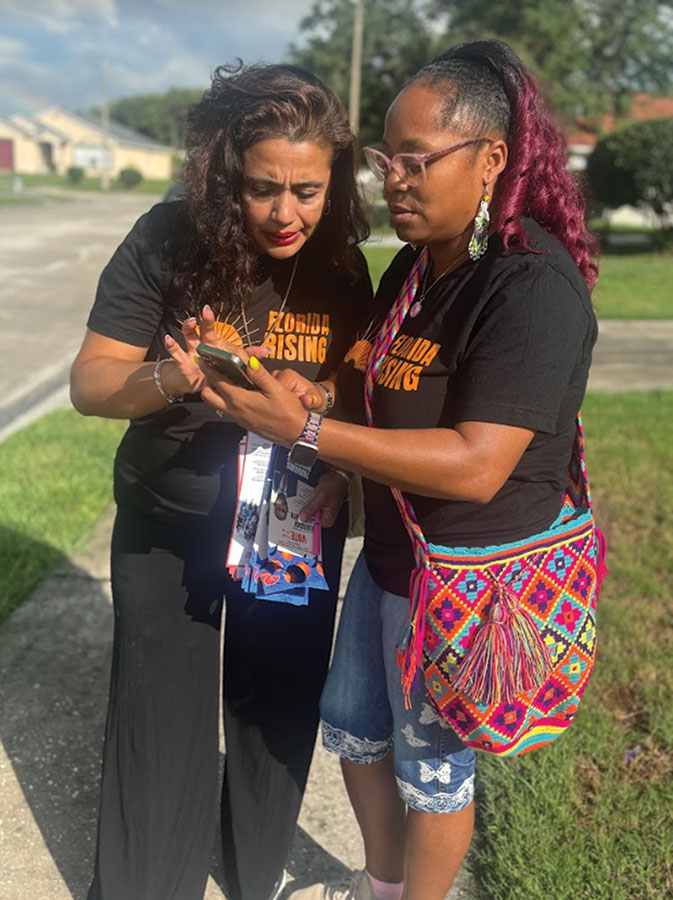
But for many activists in Florida, the ballot initiative is just one part of a wider project to energize the very voters that DeSantis has tried to disenfranchise. On a rainy Thursday afternoon, Ronda Wallace and Jessy Correa walk up the driveway of a house the color of orange sherbet in a residential neighborhood of Orlando and greet the man standing outside like an old friend. They work with Florida Rising, a membership-based organization geared toward Black and Latino voters who pay $25 in annual dues. Wallace cuts to the chase: “You know who Martin Luther King is?” she asks. “You know Nelson Mandela? That’s the work we do all year long.” Wallace banters with the man, quickly creating an easy intimacy.
“Have you voted yet?” Correa asks him. There’s a special election on Tuesday for the City Commission.
“No, I didn’t vote,” the man says. “I normally vote in the big elections.”
“The local ones are actually more impactful,” Correa says. “You know, your schools,” Wallace chimes in. “What do you feel like would make this neighborhood more resilient than vulnerable?” she follows up.
“Education—the youth,” he says.
“I hear that!” Wallace concurs. Then she comes in with a final ask: “If reproductive justice, women’s rights, were on the ballot today, would you stand with us?”
The man creases his forehead. “Yes,” he says, like it’s a no-brainer. They show him a map of his polling place, and he fills out a card with his contact info. When he tells Wallace that he rents his house, she directs him to a tenants’ rights meeting.
“Jessy’s going to call you later,” Wallace tells the man, bidding him farewell.
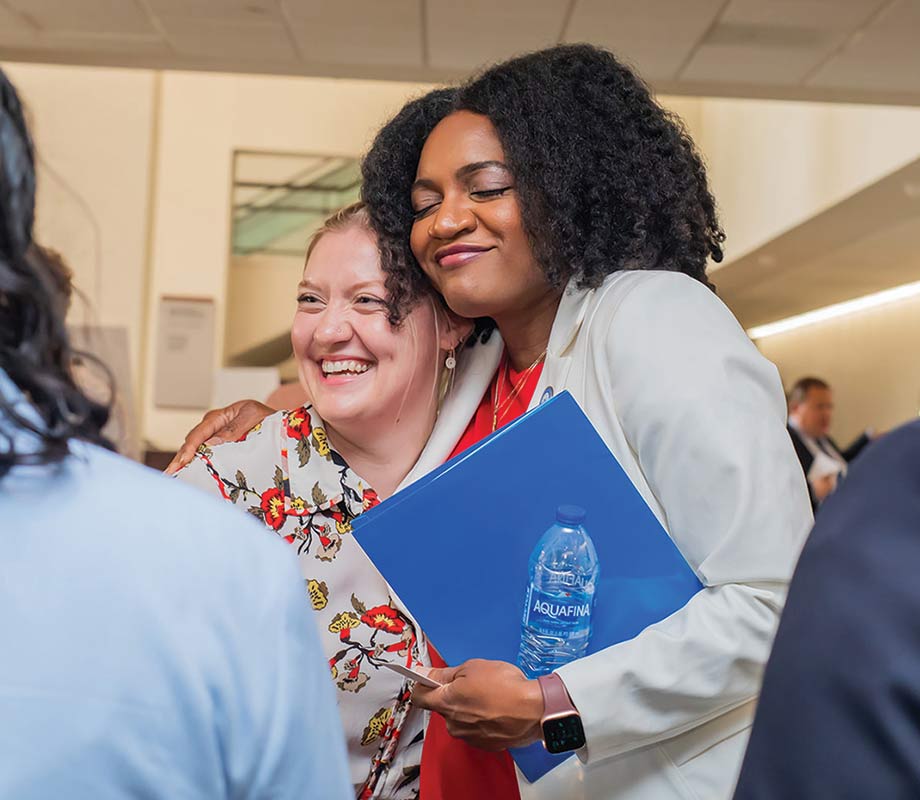
Athousand think pieces have been written about how abortion will shape the 2024 presidential election. Less discussed, but perhaps more significant in the long run, is how the presence of abortion on the ballot is likely to change Florida. Democrats are hoping that the issue will catalyze voters into chipping away at the Republican supermajority in the Legislature. Sarah Henry, the former clinic escort running for a state House seat, is in a tightly contested district outside Orlando. In 2022, she lost to a Republican by 3,000 votes. Voters used to tell her that their top concern was the astronomical cost of property insurance—a major issue in a state beset by the effects of climate change, including intensifying hurricanes. When the six-week ban took effect, those conversations changed. “Since then, without question, the first thing, the most common answer, is some version of ‘reproductive choice,’ ‘reproductive freedom,’ ‘freedom to take care of my body,’ or just ‘abortion,’” Henry says. A few thousand angry pro-choice Floridians won’t be enough to turn the state blue overnight, but they could be enough to put Henry in the Legislature.
Popular
“swipe left below to view more authors”Swipe →A key question—for her and every other candidate nationwide—is how many young people will vote. That calculus has changed immeasurably since Kamala Harris replaced Biden as the Democratic nominee. “I’m very, very excited not to have to settle for somebody who is the lesser of two evils to an even more insane extent,” Cameron Driggers, a 19-year-old student activist, tells me. Driggers says many young, politically engaged activists like him—the people Democrats rely on to run phone banks, knock on doors, and get peers to the polls—were so outraged over Biden’s support for Israel’s war on Gaza that they were protesting the Democratic Party rather than ginning up support for it. “Now that Kamala Harris is at the top of the ticket and is signaling a shift on that issue, you’re going to have a lot more enthusiasm,” he says.
In 2022, when he was in high school, Driggers helped lead the student walkouts against DeSantis’s notorious “Don’t Say Gay” law, and the following year, he founded Youth Action Fund, a collective of Gen Z Florida voters. Now he’s busy training high school students to register their friends to vote. “When I started pitching [the idea], I was laughed out of the room” by more veteran activists, Driggers says. Then he trained over 50 students on nine high school campuses, and within a week, they’d signed up more than 500 new voters. Now, Driggers says, the Florida Democratic Party is looking at his idea as a model, and the Yes on 4 campaign is partnering with YAF to register high schoolers. “To get to 60 percent, you really need to bring in people that don’t typically vote—and that’s high schoolers, that’s the youngest voting demographic,” Driggers says.
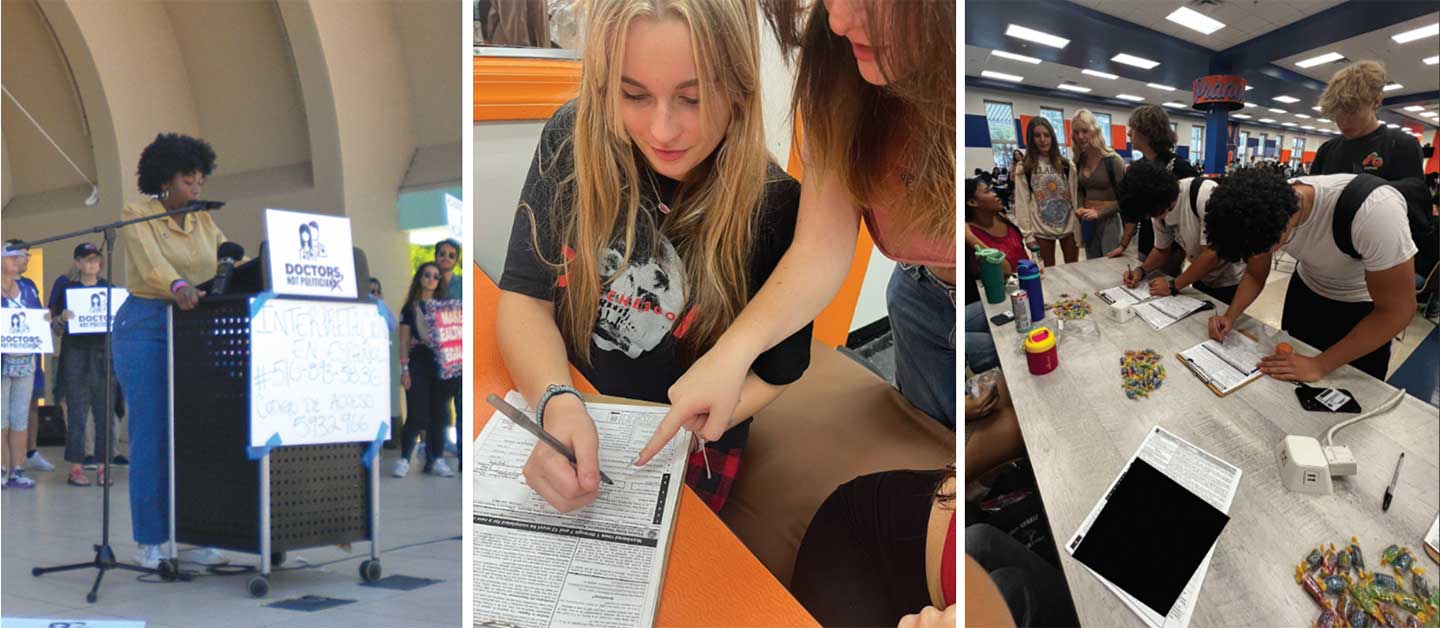
The path to victory for Amendment 4 relies not just on the participation of young people, who proved pivotal in stopping the anticipated “red wave” in the 2022 midterms, but on reaching Republicans, who outnumber registered Democrats in the state by almost a million voters. That’s perhaps why the ballot initiative’s official messaging on abortion sounds like it could have been written by a libertarian think tank.
“Nobody should make this decision unless it’s the patient and their doctor, and the government should get out of it,” says Sutherland, the campaign spokesperson. That’s “a core value of what it means to be a Floridian: You do what you want; I do what I want.” The campaign’s polling shows that this message about limiting government interference is effective: 73 percent of respondents agree with it, compared with 63 percent who agree with the message that the state Constitution should be amended to protect the right to an abortion.
“Did you follow anything with Covid and stuff in Florida?” Sutherland asks me.
“It was hard to miss,” I reply, recalling how DeSantis banned mask mandates in schools, dismissed the pandemic as “media hysteria,” and then withheld Covid data, costing thousands of lives. His handling of the pandemic was so catastrophic that the mayor of Miami Beach dubbed him “the Pied Piper of COVID-19, leading everybody over a cliff.”
“That message was pretty salient back then. It seems like when it comes to healthcare, Floridians don’t want anyone to tell them what to do,” Sutherland says, hastening to add that the campaign isn’t explicitly tying the abortion initiative to anti-masking sentiment, although it certainly seems to be capitalizing on it.
This strategy is not new. NARAL first used language about getting the government out of private decisions to defeat an anti-abortion ballot initiative in Arkansas in 1986. To win over conservative voters, the reproductive rights organization tied the issue of “government interference” on abortion to gun ownership and even hostility toward school desegregation, William Saletan reported in his book Bearing Right. The message keeps getting reused because it has frequently worked, at least in the short term—but it can backfire when the movement takes on broader aims, such as making a case for the public funding of abortion. Nor is the language particularly accurate, since Florida’s Legislature will, under the terms of the amendment, be able to retain the state’s parental notification requirement for minors and ban abortion after “viability,” a term that the amendment does not define but that typically means around 24 weeks.
Progressive critics of the measure point out that the “viability” language is a major vulnerability, because the Florida Legislature and courts could try to change the definition of what makes a pregnancy “viable” in order to restrict abortion even earlier. The other concession, the parental notification requirement, targets young people, who “are the most impacted, aside from people who are undocumented, by these abortion bans,” says Stephanie Loraine Piñeiro, the executive director of Florida Access Network. She sees the ballot initiative’s conciliatory language as emblematic of a growing split in the movement over whether to restore Roe’s protections—and its limitations—or to fight for something better. Her own perception of its limits comes from serving hundreds of people who couldn’t afford an abortion even while Roe was the law of the land. She’s frustrated by the initiative’s focus on “talking points that are, frankly, outdated…and are not speaking to the real challenges that people are facing,” she says. While abortion funds like hers are running out of money, the ballot campaign’s aim to raise $98.5 million is more than two and a half times what the dozens of abortion funds nationwide spent helping people to obtain care in the year after Dobbs. This feels to Piñeiro like watching the mistakes of the past on repeat. “Historically, the resources have been invested in the ‘legal right’ to an abortion but not the access,” she says.
Some Floridians, I was soon to discover, have developed a robust system for access that is completely outside the law. One sunny day, I pull into a nondescript housing complex in a town I can’t name, where a woman wearing dangly earrings and canvas shoes shows me a garden of vibrant blue hydrangeas. Inside, she leads me to two plastic tubs like the kind you might use to store holiday decorations. But instead of decorations, these contain the medications for 15,000 abortions, which is about a sixth of what the entire state of Florida would need for a year. “I usually don’t have this much product at once,” says the woman, whom I’ll call Ruth, but she’s just returned from a trip where she retrieved it. She looks like someone you might pass in the grocery store and take for a snowbird with a golf habit. In fact, she and another woman, who sits sipping iced tea from a glass, have a far more interesting hobby—sending abortion pills by mail.
Ruth is frustrated with the expense of the ballot initiative, money that could be used more efficiently, she notes, to buy and distribute these pills, which are generic versions of the medications you get in a clinic. For community providers, a bulk purchase this size of generic pills, sourced from India, costs $26,000. Meanwhile, for clinics, which can charge around $650 a pop to keep up with the expense of running and staffing their facilities, providing a similar number of abortions could require raising $10 million.
Ruth doesn’t plan to volunteer for the campaign. She’ll be too busy helping to distribute her pills to other activists in the network, such as Ivy, a 37-year-old Floridian who assembles the packages in her home. The next link in the chain are the doulas, like Eden, a 58-year-old former bank executive. (Ivy and Eden are also being referred to by pseudonyms.) All day, every day, Eden texts back and forth with people who are in the process of self-managing their abortions, starting from about 7 in the morning until 10 at night, when she goes to bed. She answers questions about the medications and their side effects and, when appropriate, shares information about her own abortions. Once, she stayed up all night with a frightened 16-year-old who had just taken her misoprostol pills alone. Eden likes texting; she plans to volunteer as a text banker for the Yes on 4 campaign. But nothing will stop her from continuing work that has given her a profound sense of meaning. She gets a “sick satisfaction,” she tells me, from doing it in Ron DeSantis’s backyard.
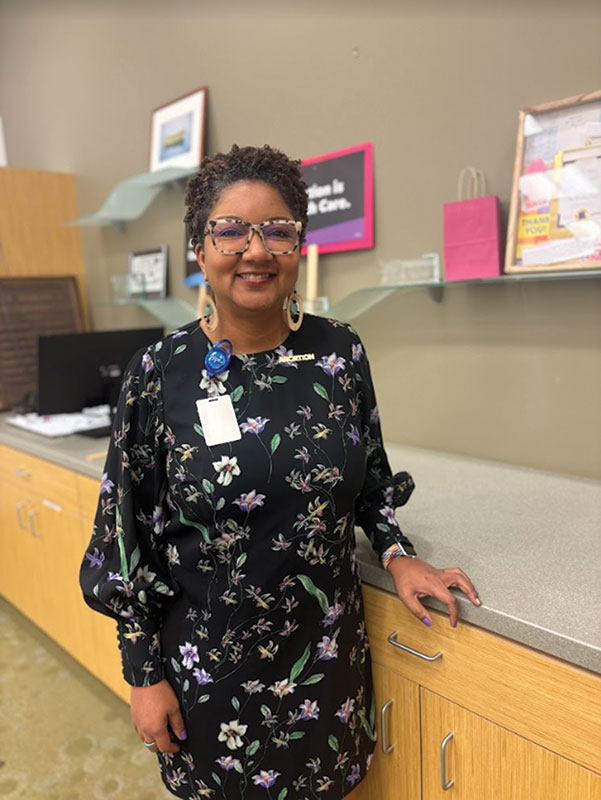
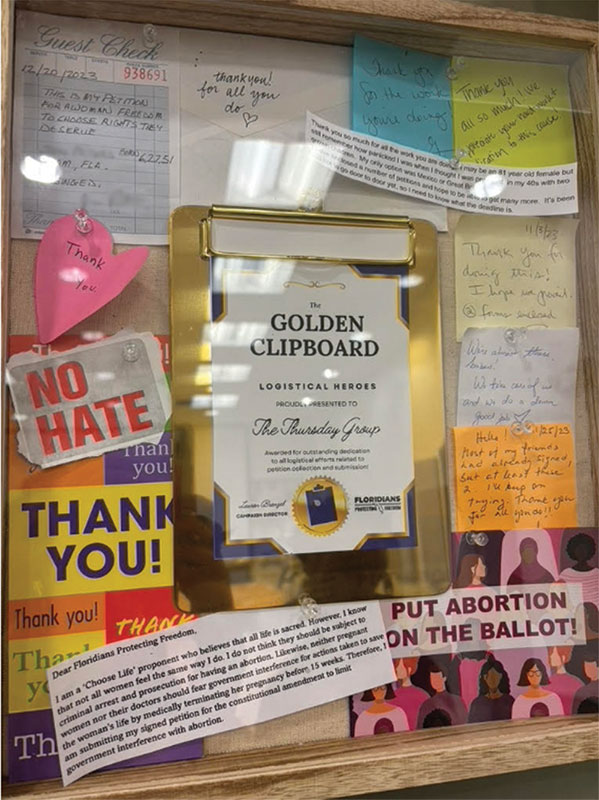
Back at Planned Parenthood’s Sarasota Health Center, in an office that sits one floor below the clinic, Dawnyelle Singleton, a manager of volunteers for Planned Parenthood of Southwest and Central Florida, sits behind a desk, wearing a gold pin that says “Abortion.” On the wall in front of her is a torn-off piece of easel paper that she’s mounted there for inspiration. It lists the number of signature petitions that flooded in during the effort to put the initiative on the ballot—as many as 3,271 in a single week. Twice a week, volunteers would pick up a tub of petitions from the post office, and a rotating team of 65 people would sort them. If they got demoralized, Singleton sent them to the wall to read the thank-you letters she had posted there. “I am a ‘Choose Life’ proponent who believes that all life is sacred,” one letter reads. “However, I know that not all women feel the same way I do…neither pregnant women nor their doctors should fear government interference for actions taken to save the woman’s life…. Therefore, I am submitting my signed petition.” “I got my friends to sign this petition. I think it is a very important issue,” a woman in Fort Lauderdale wrote. “Is it possible for you to send me 50 petitions?”
Singleton’s favorite came from a man in Fort Myers who wrote, “I’m 90, longtime registered voter and without any electronic services in my home other than a TV remote I can talk to.” He enclosed a self-addressed stamped envelope to send him a petition.
If there is a pro-choice majority even in the reddest swaths of America, Florida voters will have a chance to prove it—and to restore the rights of the patients waiting to be cared for one floor above. Win or lose, what happens in Florida will be one of the defining stories of this election. Or, as Singleton puts it, “I told all the volunteers: You have your hands in history.”
More from The Nation
Smoke and Mirrors: The Right's Latest Attacks Against Trans People Smoke and Mirrors: The Right's Latest Attacks Against Trans People
The MAGA movement is redoubling its attacks on trans healthcare in an attempt to win votes this November.

Is Blockbuster Video the Answer to Our Digital Privacy Woes? Is Blockbuster Video the Answer to Our Digital Privacy Woes?
The Supreme Court is weighing whether a 1988 video-store law can be used to protect our digital privacy.
How Congress Is Cashing In on the AI Boom How Congress Is Cashing In on the AI Boom
Roughly one in five members of Congress has household investments in the industry.
Obviously, the Knicks Should Not Visit the White House. Why Is This Even a Discussion? Obviously, the Knicks Should Not Visit the White House. Why Is This Even a Discussion?
The Knicks shouldn’t let their legacy include genuflecting to Donald Trump, one of the most hated figures in the very city printed on their jersey. New Yorkers deserve better.
The Real AI Threat Is Already Here The Real AI Threat Is Already Here
Never mind some future apocalypse—AI is being used right now to cause enormous suffering.
The Plundering Oligarch You Haven’t Heard Of The Plundering Oligarch You Haven’t Heard Of
Private-equity magnate Jeffrey Leerink has been busy pillaging healthcare and the life sciences.

