
The Man Using Sports to Fight Israeli War Crimes
Jibril Rajoub, the head of the Palestine Olympic Committee, says sports can be a nonviolent tool to resist occupation.
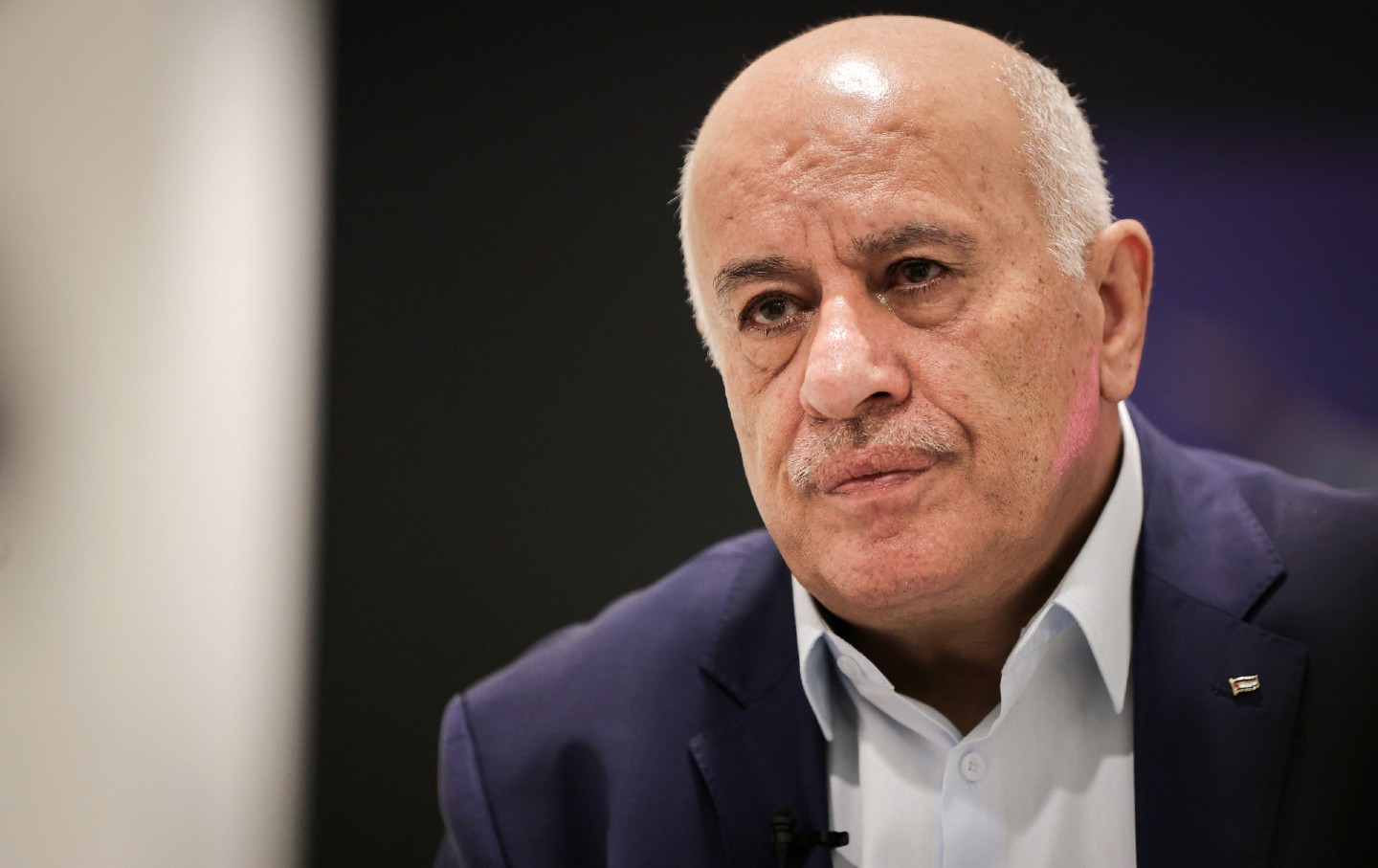
Jibril Rajoub, head of the Palestine Olympic Committee, sits for an interview in Paris on July 27, 2024.
(Thibaud Moritz / AFP via Getty Images)
Paris—Jibril Rajoub, the 71-year-old head of the Palestine Olympic Committee, has been fighting the Israeli Occupation for almost 60 years. He told us that he started after Israel imprisoned him at age 14 for attempting to help Egyptian military members flee Israeli capture. As a teenager in prison, Rajoub was recruited to the Palestinian political and military resistance organization Fatah, also known as Palestinian National Liberation Movement. Rajoub, in total, has spent almost two decades in Israeli prisons. In 1985, Israel freed him as part of a hostage exchange, but Israel arrested him soon after and placed him in solitary confinement, where he almost died during a 30-day hunger strike.
Rajoub’s long career in both Palestinian politics and athletics has earned him many enemies. Fifty-four years ago, as part of the PNLM, he threw a grenade at a bus and was sentenced to life in an Israeli prison (emerging only after the aforementioned prisoner exchange). He is often referred to in the Israeli press as “convicted terrorist Jibril Rajoub.”
He continues to resist the Israeli state, but for the last almost two decades, he has done so through sports. His political and military opponents accuse him of using sports to promote “violence and hatred”—a charge he vociferously denies. By supporting athletes who refuse to play Israeli competitors on political grounds and calling for sporting bans of Israel, he has also faced charges and investigations into his conduct by international sports federations. Yet, while he walks now with weariness, he is still standing.
“Sport today is a global language,” he told us. “I have spent 17 years in Israeli jails, which was worse than the Bastille. But in spite of that, I don’t want to cause suffering to anyone, no matter who he is and where he is coming from. I do believe that using sport, using athletes as an asset in our resistance and in our struggle, is very effective. And even here in France, the way that we were received, and all over the world, is encouraging me and motivating me to continue this path. A peaceful, nonviolent tool: sport.”
Rajoub said these words wearing a rumpled suit, sitting slightly slouched in a bar booth at Paris’s Hyatt Regency at 10 pm. The hotel was an Olympic hub, with officials and the press scurrying around. Amid the hyper, happy chatter around us, he is deliberate in his speech, slow in his cadence: tired but resolute.
Rajoub wants sports to show the world the resilience of Palestine and how Israeli occupation has warped even something as commonplace as organized athletics. He has long campaigned to bar Israel from the Olympics and World Cup—or, as he put it, to give them “a red card”—because of their violations of the Olympic Charter and FIFA resolutions against apartheid in sports. He said, “It’s not a political issue for me. It’s a moral issue. It’s a legal issue. It’s an ethical issue.”
In the last 10 months, Israel has killed Palestinian Olympic athletes and coaches and bombed facilities. The Israel Defense Force has even turned Gaza’s historic Yarmouk Stadium into a detention and “interrogation” center. For all this and more, Rajoub wants to make Israel a pariah in the athletic world.
He told us, “I am working in spite [of the] closure, killing, suffocation, ethnic cleansing in Gaza, destroying all the facilities of sport—and even some of them are used as concentration camps in the West Bank. We had to suspend all official sport activities.… But in spite of that, you see that we came with eight athletes trying to convey a message to the international community: It’s the time to end the suffering of the Palestinian people.”
Even with Israel’s war on Gaza, Rajoub said he sees something hopeful in Paris: the warm treatment of the Palestinian athletes. He described them as being received “with roses.” We have also seen the cheers, the flags, and the graffiti—testaments to the solidarity that, while not being offered by the International Olympic Committee, is felt in the streets.
Eight Palestinian athletes traveled to Paris to compete in the 2024 Summer Olympics. Omar Ismail fought in the 58-kilogram taekwondo event, marking the first time that a Palestinian qualified in a combat sport without taking the “wild card” path. Layla al-Masri and Mohammed Dwedar competed in track and field, both in the 800-meter run. Fares Badawi represented Palestine in judo. Swimmers Yazan al Bawwab and Valerie Tarazi participated in the pool. Waseem Abu Sal took to the Olympic boxing ring, while Jorge Antonio Salhe participated in skeet shooting. Shot-putter Fadi Deeb of Gaza is the only Palestinian in the Paralympics. He is in a wheelchair after being shot in the back by the IDF two decades ago.
Meanwhile, scores of Palestinians from the upper echelons of sport have been killed by Israel in recent months. In November 2023, national volleyball players Ibrahim Qusaya and Hassan Zuaiter were killed in the Jabalia refugee camp in Gaza by an Israeli raid. The following month, an Israeli air strike killed the national athletics federation coach Bilal Abu Samaan. Then, in January 2024, another air strike killed Palestinian Olympic soccer team coach Hani al-Masdar. The list goes on.
Israel, of course, isn’t the only country to blame for the suffering of the Palestinian people. The United States is providing Israel with weapons and intelligence. We asked about whether Rajoub has a message for the US. He replied, “They are arming, they are supporting, they are defending, and they are protecting.”
He added: “The Israelis have the right to live in peace and security, but within their internationally recognized borders. The establishment of a Palestinian sovereign state next to the state of Israel will contribute to regional stability, global peace. The Israelis cannot continue their expansionist and their fascist policies on the ground and at the same time think that they can enjoy security and being integrated in the Middle East. No security, no integration without the emergence of an independent sovereign state.”
Popular
“swipe left below to view more authors”Swipe →Rajoub brought his message to Paris, even though the IOC has demonstrated selective morality. It has forced athletes from Russia and Belarus to participate as “individual neutral athletes” under strict conditions, but Israeli athletes are allowed to compete freely under their national flag. Kat Pijetlovic, the head of the Palestine Football Association’s legal department and an academic in international sports law, told us that the IOC had, in effect, “shredded the Olympic Charter.” She said the Fundamental Principles of Olympism are worthless if you ignore or apply them inconsistently.
Israeli apartheid will end only with a global solidarity movement, and that push, Rajoub believes, has taken a step forward in Olympic Paris. He ended our interview saying, “The ball is in the court of the international community, the free peoples, France. The French Revolution two centuries ago inspired the whole world. Thirteenth of July, 1789, inspired the whole world. It’s the time. It’s the time for the disciples of that revolution to come up and say, ‘Enough is enough.’”
More from The Nation
Progressives Are Backing Puerto Rican Independence. It’s About Time. Progressives Are Backing Puerto Rican Independence. It’s About Time.
More and more leftists are concluding that statehood for the island is not enough.
The Saudi Phase of the Iran War Signals More Chaos to Come The Saudi Phase of the Iran War Signals More Chaos to Come
The conflict that Donald Trump has repeatedly proclaimed an unequivocal American victory keeps spiraling out of control.
Andy Burnham’s Speech to the Labour Party Conference Could Be the Start of a Positive Social-Democratic Politics Andy Burnham’s Speech to the Labour Party Conference Could Be the Start of a Positive Social-Democratic Politics
But the autumn budget to be released at the end of October will offer needed details.
Why Navi Pillay’s Receiving the Nobel Peace Prize Is So Important Why Navi Pillay’s Receiving the Nobel Peace Prize Is So Important
She believes that human rights and international law are universal principles that must be enforced regardless of violator’s ideology, ethnicity, or geostrategic alignment.
Writing About War as Bombs Fall Writing About War as Bombs Fall
While the Israeli government launched a well-orchestrated offensive of disinformation and hyperbole that would make the illegal permissible in the war on Gaza.

