The Reactionary Justices Won’t Stop Until Abortions Are Illegal Everywhere
Oral arguments in Idaho case make clear that further, even more radical attacks on reproductive freedom are coming.
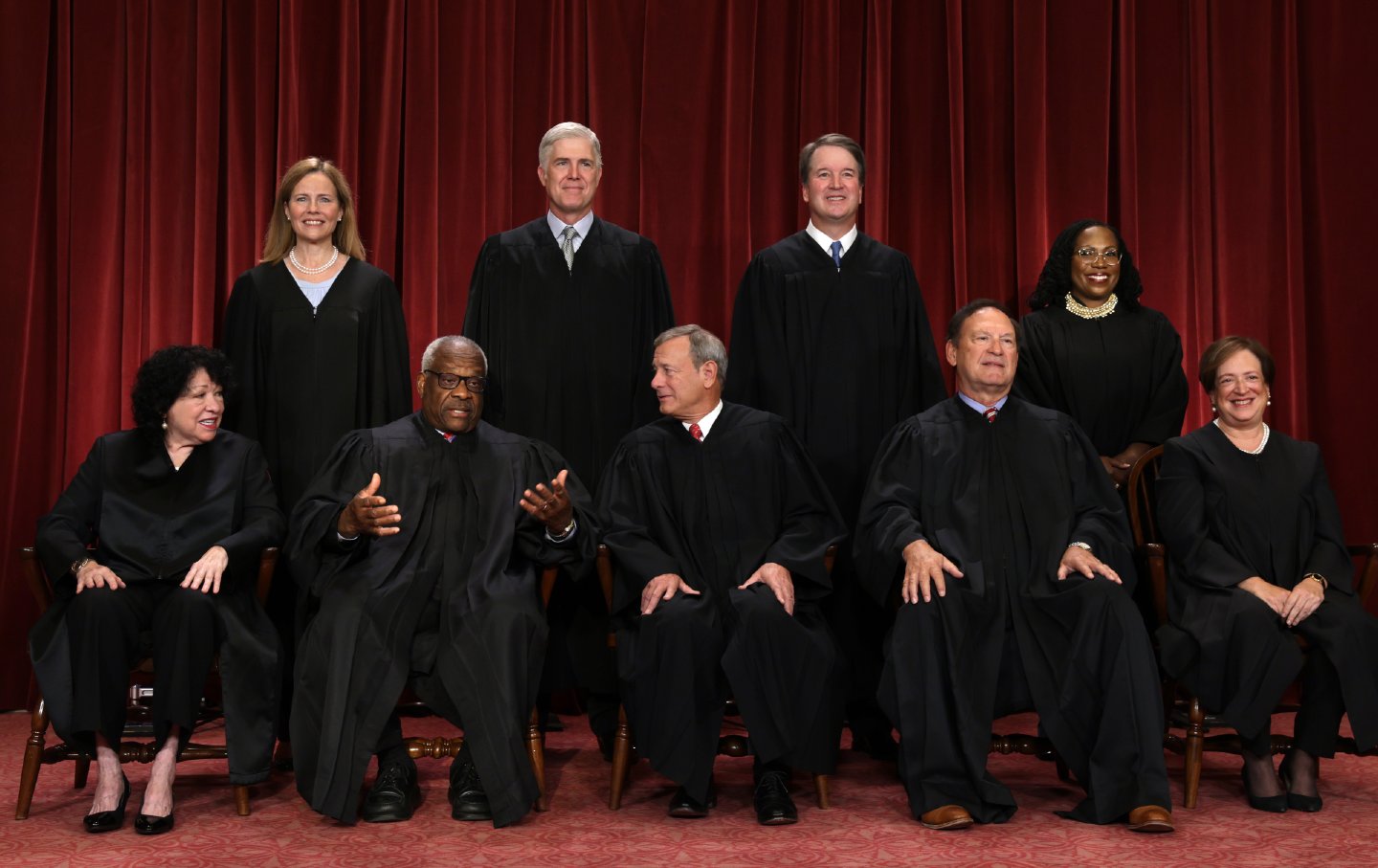
United States Supreme Court justices pose for their official portrait on October 7, 2022, in Washington, DC.
(Alex Wong / Getty Images)The five right-wing Supreme Court justices who overturned the constitutional right to abortion in the 2022 decision Dobbs v. Jackson built their argument on lies, one of which was a promise (pinkie swear!) that, despite the apparent radicalism of extinguishing Roe v. Wade, the court would henceforth respect precedent, leave abortion to the political arena, and not touch other decisions recognizing social and sexual rights. Writing for the majority, Justice Samuel Alito told a story that went something like this: Roe was such a bad decision that it was an outlier, a rare precedent that—like the 1896 Plessy v. Ferguson decision that enshrined racial segregation—was so egregious the court had to cast it aside. Roe was bad because it took abortion, properly a decision best left to the democratic contestation in the state and federal legislatures, and imposed a national consensus that had no popular legitimacy. According to Scalia, “The Court short-circuited the democratic process by closing to it the large number of Americans who dissented in any respect from Roe.”
Dobbs, the argument went, would return the subject of abortion to state and federal legislatures at the state and federal levels who could sort it out based on democratic deliberation. Alito further distinguished Roe from other precedents that he insisted were safe, notably Griswold v. Connecticut, which enshrined the right to birth control in 1965; Lawrence v. Texas, which quashed anti-sodomy laws in 2010; and Obergefell v. Hodges, which recognized same-sex marriages as a right in 2015.
Alito’s assurances were met with skepticism by myself and other commentators—and indeed by his fellow judges. In their dissent, Justices Stephen Breyer, Sonia Sotomayor, and Elana Kagan wittily compared the Constitution to the game Jenga, where the structure collapses if you keep pulling the blocks out. Tellingly, Justice Clarence Thomas, who voted with the majority and is a long-time ally of Alito, agreed with his liberal colleagues. He also thought that overturning Dobbs created a rationale for ending Griswold, Lawrence, and Obergefell.
In this case, Thomas was more honest than Alito. This is not just a matter of logic but also of political alliance. The conservative justices don’t exist in some ivory tower of pure legal reasoning. They are intimately tied to the conservative legal movement that elevated them and, in the case of Thomas and Alito, showers perks on them. This is the whole world of the Federalist Society, the religious right, and the Republican Party.
The conservative legal movement didn’t spend decades organizing for the overturning of Roe to leave decisions about abortion to such an unreliable and disreputable group of people as American voters. Their goal was to end abortion access by hook or by crook. After Dobbs, it became almost immediately clear that voters, even in very red states like Mississippi and Kansas, didn’t like abortion restriction. The courts are a stronghold of right-wing power, so it took extreme naïveté to believe that the anti-choice movement would not want to continue using its judicial allies to push its unpopular agenda.
Further, the federal government has laws in place that could alleviate at least the most extreme abortion restriction. One example is the 1986 Emergency Medical Treatment and Labor Act (or EMTALA), which states that hospitals receiving Medicare funding (so virtually all hospitals) have a duty to provide abortions to women whose health is endangered.
Given the extremism of the conservative legal movement, it was inevitable that the Supreme Court would take up abortion again, contrary to Alito’s pinky promise. We saw this week in oral arguments over Idaho’s harsh anti-abortion laws, which conflict with EMTALA.
Idaho has among the most draconian anti-abortion laws in the world. In Idaho, there is no rape or incest exemption for abortion. There is an exemption if the life of the mother is endangered. But, in keeping with punitive agenda of the anti-choice movement, this exemption is narrowly defined, making a spurious distinction between “health emergencies” and “death emergencies.” In other words, if a woman needs an abortion to avoid being maimed or injured for life, Idaho won’t give her an exemption. Only if a woman faces death itself would an exemption be granted.
Of course, this distinction is absurd, since many health emergencies can quickly escalate into death emergencies. Further, the distinction is premised on the cruel idea that forbidding abortion is so important it can justify maiming or injuring women. As Moira Donegan observed in The Guardian:
Idaho’s abortion ban requires doctors to treat pregnant women’s health as disposable, and the loss of their lives as an acceptable risk. For this, the Biden administration sued. As the case wound its way through the federal courts, the supreme court stepped in to allow Idaho to enforce its abortion ban pending litigation, even without a health exception. Their own Dobbs decision, after all, did not require any state to allow abortions in the case of risks to women’s health. Sepsis, organ failure and loss of fertility in women were thereby tacitly accepted by the court as an acceptable cost of prohibiting abortions.
During the oral arguments, the conservative justices indicated sympathy for Idaho’s position. In other words, they seem to be preparing go beyond Dobbs and side with anti-abortion states over the federal government.
Equally disturbing is that during oral arguments, both Justice Alito and Justice Neil Gorsuch seemed to agree with the idea that EMTALA implicitly endorses the idea of fetal personhood, because it includes provisions for protecting unborn children as well as pregnant mothers. In trolling mode, Alito called attention to the phrase “unborn child” in EMTALA and asked, “Isn’t that an odd phrase to put in a statute that imposes a mandate to perform abortions? Have you ever seen an abortion statue that uses the phrase ‘unborn child?’”
Enshrining constitutional recognition of fetal personhood is the long-run end goal of the anti-abortion movement. It would make abortion a crime throughout the nation.
The current case won’t end with fetal personhood being recognized, but it’s clearly an idea Gorsuch and Alito are toying with for future cases. Justice Thomas also seems sympathetic to the concept. All it would take is two more conservative justices to sign on for it to become a new constitutional norm. In alluding to the concept in the oral arguments, Gorsuch and Alito were dropping hints to the conservative legal movement that this promising line of thought might be developed if the proper case were brought before the court.
Dobbs was a disastrous decision, but it wasn’t the final disaster. Contra Alito’s prevarication in Dobbs, he and his reactionary colleagues are only just starting to cook.