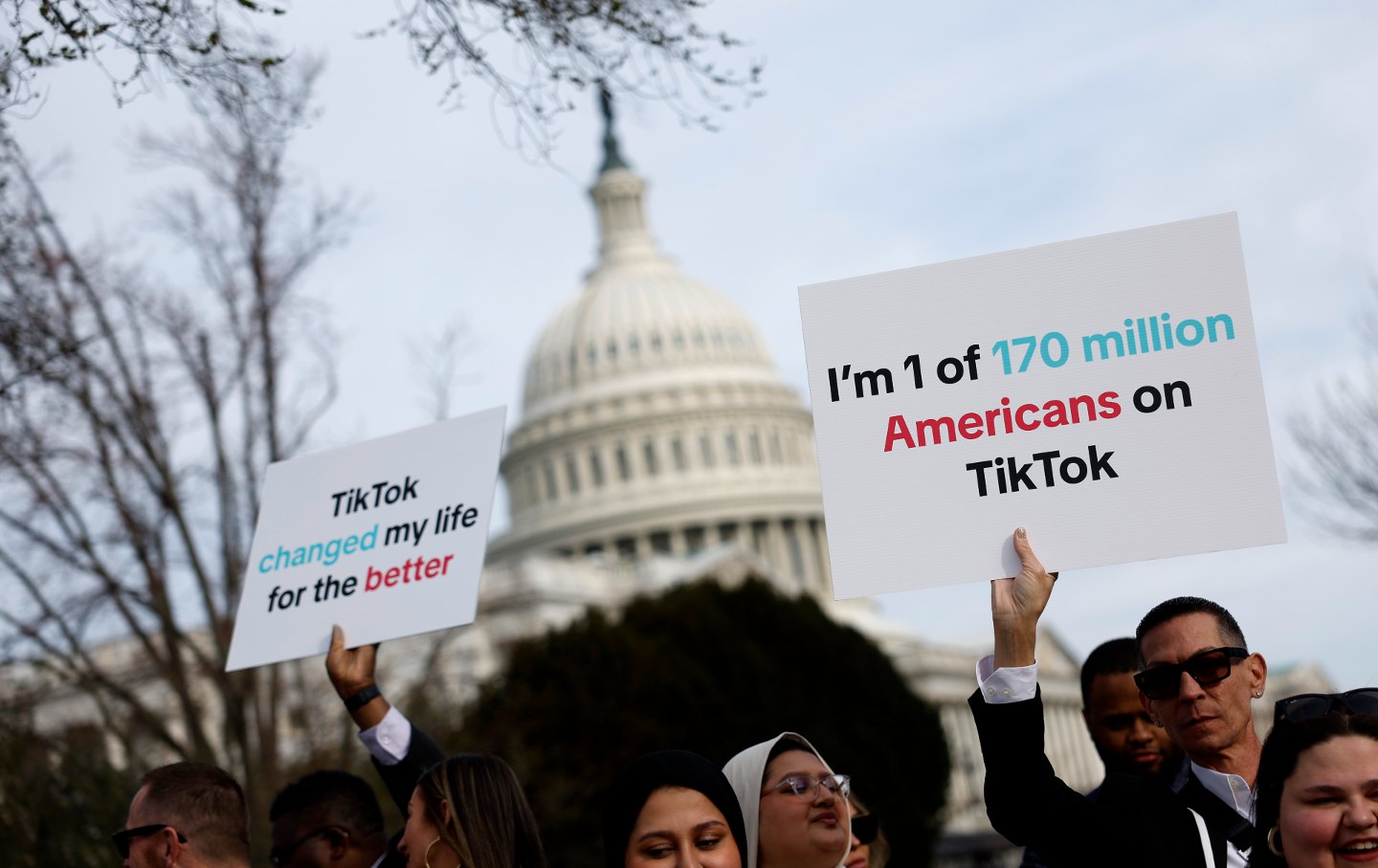
Last month, the House of Representatives passed the Protecting Americans From Foreign Adversary Controlled Applications Act, a bill that could result in a nationwide ban on TikTok. The legislation essentially demands that ByteDance, TikTok’s Beijing-based parent company, find a non-Chinese buyer for the social media app, and fast—divesting within just six months. The legislation, which has yet to be taken up by the Senate, cruised through the House with support from a majority of both Republicans and Democrats. No matter how you feel about the bill, can we all admit that this demonstration of bipartisanship is proof of our representatives’ willingness to put aside differences and dispense with political theater when it really counts? That’s a hard no, considering the bill itself is exactly the latter, scapegoating China for problems our homegrown apps have plenty of. Still, is it a first step in bringing overdue government regulation to social media? LOL, also definitely no. But at the very least, isn’t it a good proposal for President Biden, who has backed the bill, to get behind in an election year? I’m afraid the answer remains hell to the no.
Let’s start with a defense of TikTok on its own merits. The most notable is the endless stream of incredibly talented and creative users the platform has attracted, a sizable number of whom are young and Black. TikTok served as the vehicle of visibility for Lil Nas X, who then altered the sonic and aesthetic landscape of both hip-hop and country music. It’s where Keith Lee, now one of the Internet’s most visible food critics, leverages his popularity to boost overlooked Black eateries. The Senegalese Italian comedian Khaby Lame has been the site’s most-followed creator since 2022, and just last month, Reesa Teesa’s viral heartbreak confessional series landed her a deal with CAA, the powerful Hollywood talent agency. None of this is to minimize incidents of anti-Blackness (including white TikTokers performing and profiting off dances created by Black influencers) that led underappreciated Black creators to boycott TikTok in 2021, nor the racism alleged in an EEOC complaint against ByteDance filed by two Black former employees. Still, despite an industry-wide pay gap of 35 percent between Black and white social media influencers, TikTok has a number of Black “macroinfluencers”—those with 100,000 followers or more—who bring home six figures or more each year. TikTok is the house that Black creators built—one that adds $24.2 billion to America’s GDP, according to a study released by the financial consultancy Oxford Economics and commissioned by TikTok, and generates $14.7 billion in revenue for US small businesses.
kali
Banning TikTok in the US would destroy a hub for progressive political organizing, activism, and cultural influence. Starbucks workers garnered support for unionization efforts with a series of TikTok videos that went viral. In 2022, a group of TikTok creators signed a pledge not to work with Amazon over its mistreatment of workers. And TikTok has been indispensable in building solidarity with the Palestinian cause among young Americans concerned about Israel’s war on Gaza. Pro-Israel voices have claimed that the TikTok algorithm favors content that is critical of Israel. But The Washington Post and Politico have found that pro-Palestinian sentiment is dominant across social media—including on Facebook, Instagram, and YouTube (and an NBC News investigation concluded that whether pro-Palestinian content outpaces pro-Israel content on TikTok comes down to a matter of “how you parse TikTok’s data”). Surveys from Pew and Gallup before October 7, 2023, found that pro-Israel views were already waning among Gen Z and millennials, groups that make up 60 and 26 percent, respectively, of TikTok users. Those numbers suggest that pro-Palestinian content on TikTok reflects—rather than drives—users’ political outlooks. With Gen Z users having long ago fled Facebook, Biden’s campaign has taken pains to meet young voters where they are, launching its own TikTok account in February and attempting to enlist the site’s influencers in its reelection campaign. A TikTok ban would destroy a critical means of outreach to young voters who are already dismayed by the president’s handling of the Israel-Gaza war and climate change policies.
And let’s not forget how comical it is to suggest that the US has any interest in protecting privacy. The Brennan Center has noted that our lawmakers permit a slew of federal intelligence and law enforcement agencies to engage in social media surveillance. In addition, Section 702 of the Foreign Intelligence Surveillance Act allows certain intelligence agencies warrantless access to a database of foreign users’ e-mails, phone calls, and texts, which, according to recently declassified documents, the FBI misused 278,000 times in 2020 and early 2021, including tens of thousands of incidents in which it spied on US citizens—a violation of Justice Department rules. A whole industry of firms regularly scrapes your information from every publicly available source and sells it to the government. American intelligence officials admit that the fears that TikTok will share user data with the Chinese government are theoretical. Then there’s the fact that 60 percent of ByteDance’s ownership consists of investors who are, per the Financial Times, “overwhelmingly American.” A Pew survey published in October 2023 found that most Americans—72 percent—believe “there should be more government regulation of what companies can do with their customers’ personal information.” If members of Congress want to fulfill that wish, they could start by cleaning their side of the street.
The Equal Rights Amendment has been withering on the vine for a century, and in that time we’ve seen women’s rights both extended and cruelly retracted. The possibility of comprehensive gun safety reform in this country has become an international punchline. But a TikTok ban—this our Congress can unify behind? It’s a cynical distraction from what truly ails us.
Become a Sustaining Donor This September
Between the reemergence of right-wing red-baiting and Donald Trump’s use of the chilling National Security Presidential Memorandum–7 to criminalize left political organizing, we’re seeing McCarthyism reborn before our eyes.
This assault on democracy cannot be ignored or wished away. Resisting it requires bravery in the face of threats and repression, a steadfast commitment to the truth, and the unwavering belief that we can—and will—overcome this darkness.
We must have an independent media that sets the record straight, unearths corruption and abuses of power, and advances a politics of justice and dignity for all if we’re to win this fight.
That’s why I’m writing to you today. This September, The Nation needs to add 100 monthly donors to sustain our progressive journalism. Your contribution makes the next investigative report, the next truth-speaking column, and the next pathbreaking essay all possible.
I hope you’ll support our work with a recurring donation today. If you donate $10 or more a month, we’ll send you a brand new “Hands Off the Free Press!” sticker to recognise your commitment to our cause. Please, donate today.
Onward,
Katrina vanden Heuvel
Editor and Publisher, The Nation