
Far From a Kink, Donald Trump’s Dictator Fetish Puts Him Squarely in the Mainstream
The American elite has long had a soft spot for “our sons of bitches” like those Trump now befriends.
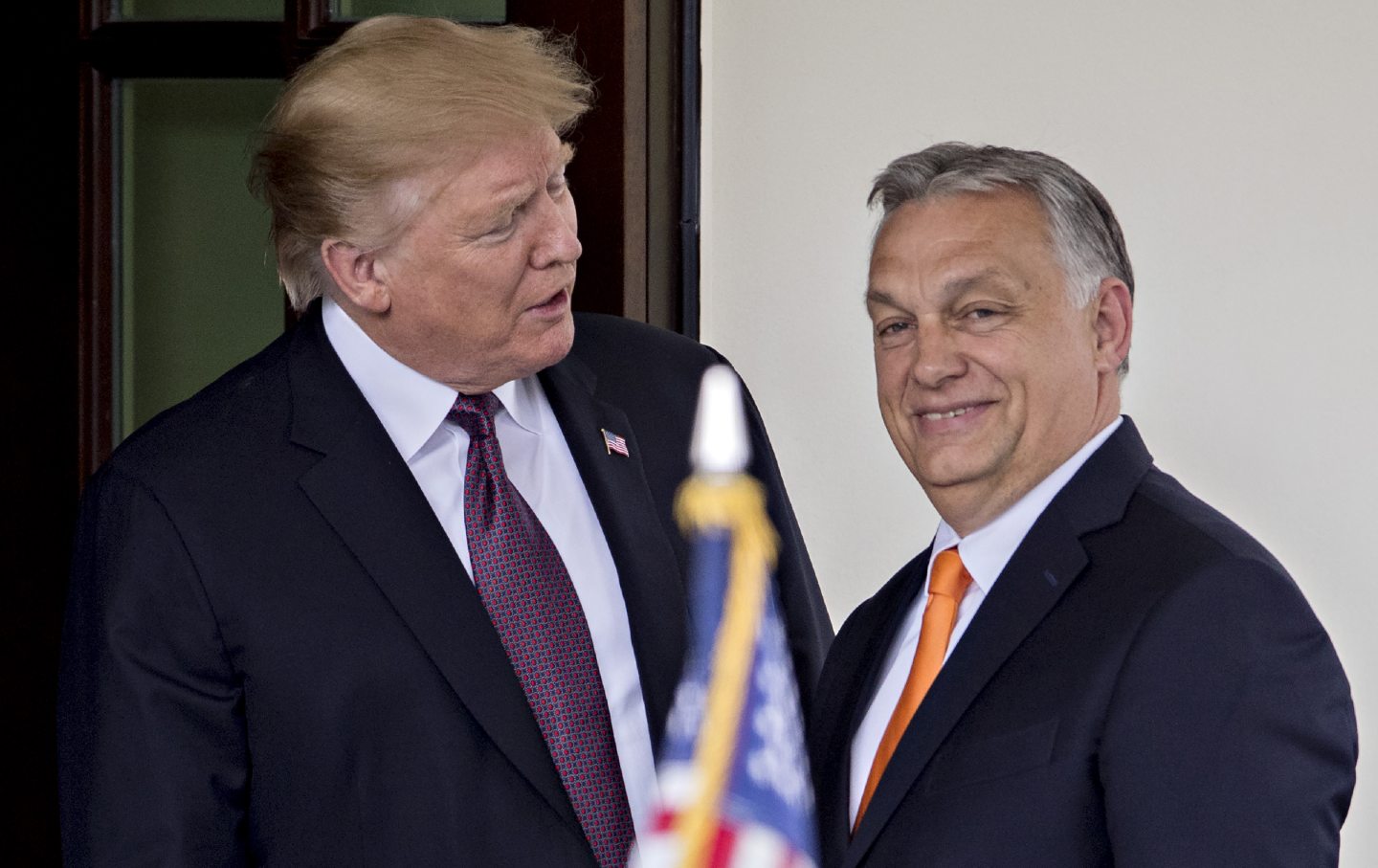
Donald Trump is rarely happier than when he’s enjoying the company of an autocrat or dictator. Indeed, it often seems that for Trump one of the chief perks of being a politician is the chance to hang out with strongmen. On Friday, March 8, Trump hosted Hungarian Prime Minister Viktor Orbán. Praising his guest, Trump said, “There’s nobody that’s better, smarter or a better leader than Viktor Orbán. He’s fantastic.” Trump slyly alluded to Orbán’s record as an aspiring authoritarian who has run roughshod over Hungary’s fragile democracy—but the former president made clear that this was a selling point rather than a liability. Trump sarcastically noted that Orbán is “a noncontroversial figure because he said, ‘This is the way it’s going to be,’ and that’s the end of it, right? He’s the boss.” For Trump, being “the boss” is an admirable goal.
Effusively praising autocrats is nothing new for Trump. Four days after that Orbán lovefest, Trump’s former chief of staff John Kelly told CNN about Trump’s habit of celebrating despots past and present. Trump told Kelly that Adolf Hitler “did some good things,” in particular signaling out the economic growth under Nazi rule and the führer’s ability to command the loyalty of his generals. (Trump seems to have forgotten the July 20 plot in 1944 where at least a few Wehrmacht officers conspired in an attempt to assassinate Hitler.) Trump also described Chinese leader Xi Jinping as “brilliant” and had kind words for North Korean dictator Kim Jong Un and Russian President Vladimir Putin. According to Kelly, “He thought Putin was an OK guy and Kim was an OK guy.”
CNN claims that Trump’s praise of dictators reflects “a worldview that would reverse decades-old US foreign policy.” This might be a consoling thought, but it isn’t true. Trump’s dictator fetish shouldn’t be treated a merely a personal peccadillo. Trump has the gift of turning subtext into text, of making visible powerful tendencies in American history and culture that have often been ignored by polite society. Because Trump is a loud vulgarian, he often blurts out shameful impulses that are more widely shared—but carefully hidden.
The deep historical roots of Trump’s pro-dictator sensibility have been explored by the journalist Jacob Heilbrunn in a brisk, timely, and lively new book, America Last: The Right’s Century-Long Romance with Foreign Dictators. With a bounty of telling detail and devastating quotations, Heilbrunn documents how, since the First World War, the American right has often felt a deep affinity with autocrats and tyrants, including Kaiser Wilhelm II, Benito Mussolini, Francisco Franco, Adolf Hitler, and Augusto Pinochet. Leading promoters and intellectuals from the American right have been unabashed in praising the apartheid government of South Africa as well as murderous regimes and death squads in Central America, South America, and Africa.
With a keen eye for anecdotes, Heilbrunn dredges up figures like Walter Harnischfeger, a Wisconsin businessman who helped finance Joseph McCarthy’s rise and believed that the Nuremberg trials were “worse than anything Hitler did. It beats Dachau.” In 1977, William F. Buckley Jr.—often wrongly mourned as the voice of a civilized conservatism—swooned: “In Chile, General Pinochet is archetypically the leader. His portrait is now seen in every government office; standing erect, big-chested, penetrating eyes, the faintest glimmer of suspicion there, coordinating with the slightly arched, light traced moustache: regal, is another way to put it.”
In 1986, Jeane Kirkpatrick, formerly Ronald Reagan’s ambassador to the United Nations, enthused over Angolan militia leader Jonas Savimbi. Speaking at a meeting of the Conservative Political Action Conference, Kirkpatrick gushed that Savimbi was a man of “dazzling accomplishment…linguist, philosopher, poet, politician, warrior, guerrilla tactician. Savimbi has admirers the world over, and I have long been one of them.” In truth, Savimbi was a cat’s-paw of the apartheid regime in South Africa. He was also, as Heilbrunn notes, “a ruthless leader who murdered dissenters within his own ranks, terrorized his country for decades, and refused to accept the results of a free election.”
The motives for this love of dictators and their attendant death squads were manifold: Right-wing tyrants were seen as bulwarks against communism and working-class militancy; authoritarian regimes were admired for their alleged efficiency and cultural health (contrasted unfavorably to the putative decadence of liberalism); racists doubted that non-WASPs were capable of self-governance; and, more broadly, suspicion of democracy was pervasive.
The story that Heilbrunn tells is of the repeated return of the repressed. The Old Right of the early 20th century was openly authoritarian and unilateralist. After the revelations of the Holocaust, these impulses were partly (but never completely) held in check—when the American right joined Cold War liberals in the bipartisan consensus of anti-communist internationalism. But after the end of the Cold War and the discrediting of neoconservative interventionism caused by George W. Bush’s Global War on Terror, the authoritarian right reemerged with a vengeance. Donald Trump represents the atavistic revival of the Old Right.
This is a compelling story—but also a partial one, marred by partisan blinkers. Two forms of myopia limit Heilbrunn’s work: German ethnic guilt and Cold War liberalism. Heilbrunn’s father was a refugee from Nazi Germany, and perhaps for that reason Heilbrunn is inclined to indict not just the Nazi era but German history more broadly. German American conservatives, with a propensity to whitewash their homeland, are particular villains in his book in a way that seems excessive.
Heilbrunn’s account of World War I is ridiculously simple. He flatly states that Wilhelm II was a “monster” whose “jealousy of Great Britain impelled him to pursue policies that led directly to World War I.” Heilbrunn flatly rejects the revisionist historians that emerged during the 1920s as creators of a “farrago of myths.” While Wilhelm was indeed a monster, he was not the only monster of the era. As many on the left noted at the time, the First World War was a product of a system of imperial rivalries that all the great powers (including the United States, with its holdings in Latin America and the Philippines) participated in. Scapegoating Wilhelm I and ignoring the sins of the British, the French, the Russians, and the Americans is not good history; it’s merely a comforting rationalization of the status quo as inherently just.
Cold War liberalism informs Heilbrunn’s persistent tendency to see authoritarianism as a feature only of the far right and the far left (he rightly alludes to the shameful pro-Stalinist sentiments found in many radical outlets, including, regrettably, The Nation. One example is Louis Fischer’s 1933 reports minimizing the famine in Ukraine. Fischer soon after became a fierce anti-Stalinist). But Heilbrunn’s own tradition, Cold War liberalism, itself has often shared the same delusions as the far right in thinking right-wing dictators are preferable to instability that might bring socialists or communists to power.
Heilbrunn’s work needs to be supplemented by two exceptionally thoughtful volumes by the Whitman College historian David F. Schmitz, Thank God They’re On Our Side (1999) and The United States and Right-Wing Dictators (2006). In these books, Schmitz documents that there has been consistent bipartisan support for right-wing dictators by American governments since World War I, fueled by many of the same impulses that animated the right-wing intellectuals quoted by Heilbrunn.
In the first book, Schmitz notes that after the First World War, “the economic and political dislocation that had occurred during the last decade could easily lead to the spread of the revolutions in Mexico, China, and Russia. Policymakers, therefore, came to support authoritarian governments that promised stability, anti-Bolshevism, and trade with the United States.” This attitude was summed up by John F. Kennedy in 1961 when he said of the Dominican Republic, “There are three possibilities in descending order of preference: a decent democratic regime, a continuation of the Trujillo regime or a Castro regime. We ought to aim at the first, but we really can’t renounce the second until we are sure that we can avoid the third.” Or, in an apocryphal statement often attributed to Franklin Roosevelt about Nicaraguan strongman Anastasio Somoza, “He may be a son of a bitch, but he is our son of a bitch.”
To be sure, this strong bipartisan consensus was never total or unchallenged. With the rise of Hitler, Roosevelt came to adopt anti-fascism as a policy stance—although even then making exceptions for favored despots in Latin America.
Popular
“swipe left below to view more authors”Swipe →Centrist liberals, particularly during the Cold War or when dealing with regions such as the Middle East, have not been exempt from this tradition. Two of the great heroes of centrist anti-communism (Dean Acheson and George Kennan) were ardent fans of the apartheid regime in South Africa. It was, after all, the liberal Presidents Kennedy and Lyndon Johnson who supported autocracies in Vietnam, counterrevolutionary coups in Latin America in the 1960s, and the 1965 anti-communist purge in Indonesia. Nor is this tradition merely a historical relic; witness Joe Biden’s fist-bumping of Saudi crown prince Mohammed bin Salman. For that matter, there is a bipartisan consensus to continue the alliance with the increasingly authoritarian government of Israel.
I queried David Schmitz about Trump’s relationship with this bipartisan tradition of supporting dictators. He suggested that Trump is “consistent” with some aspects of this tradition but has broken with it in other ways. There is nothing novel about Trump’s love of “our sons of bitches.” What is novel is that Trump sees everything in personal terms. He’s not supporting dictators on behalf of American capitalism (sometimes called “the liberal international order”) but because he actually likes being friends with these thugs and wants to emulate them. In the case of Saudi Arabia, Trump’s family has also benefited from the personal relationship. Trump’s dictatorship love is a case of blowback: A corrupt foreign policy legacy is now infecting the homeland.
This personalized love of dictators may be new, but it builds on a long-standing and corrupt tradition. The alternative to this tradition was sketched out in a recent speech by Senator Bernie Sanders, outlining what a pro-democratic foreign policy might look like. The United States has never had such a policy—but to really defeat Trumpism, the Sanders alternative will have to come to the fore.
The lesson of Trump’s rise is that if you keep supporting your sons of bitches abroad, you’ll eventually end up with your own son of a bitch as president.
More from
Jeet Heer 
Even Republicans Are Waking Up to Trump’s Corruption Even Republicans Are Waking Up to Trump’s Corruption
And, somewhat shockingly, so are Democratic elites.
Where Is the Outrage Over Trump’s Racist Targeting of Ilhan Omar? Where Is the Outrage Over Trump’s Racist Targeting of Ilhan Omar?
The establishment press and some Democrats are strangely mute over the president’s flagrant abuse of the legal system.

The Real AI Threat Is Already Here The Real AI Threat Is Already Here
Never mind some future apocalypse—AI is being used right now to cause enormous suffering.

Elon Musk’s James Talarico Smear Blew Up In His Face Elon Musk’s James Talarico Smear Blew Up In His Face
But that doesn’t mean the danger from Musk’s lies is over.
Does America First Really Mean Israel First? Does America First Really Mean Israel First?
Mike Huckabee’s aide shows how an extremist agenda dominates Trump’s Middle East policy.

The Death Penalty Has Become a Torture Machine The Death Penalty Has Become a Torture Machine
Christa Pike's botched lethal injection proves there is no humane form of execution.

