
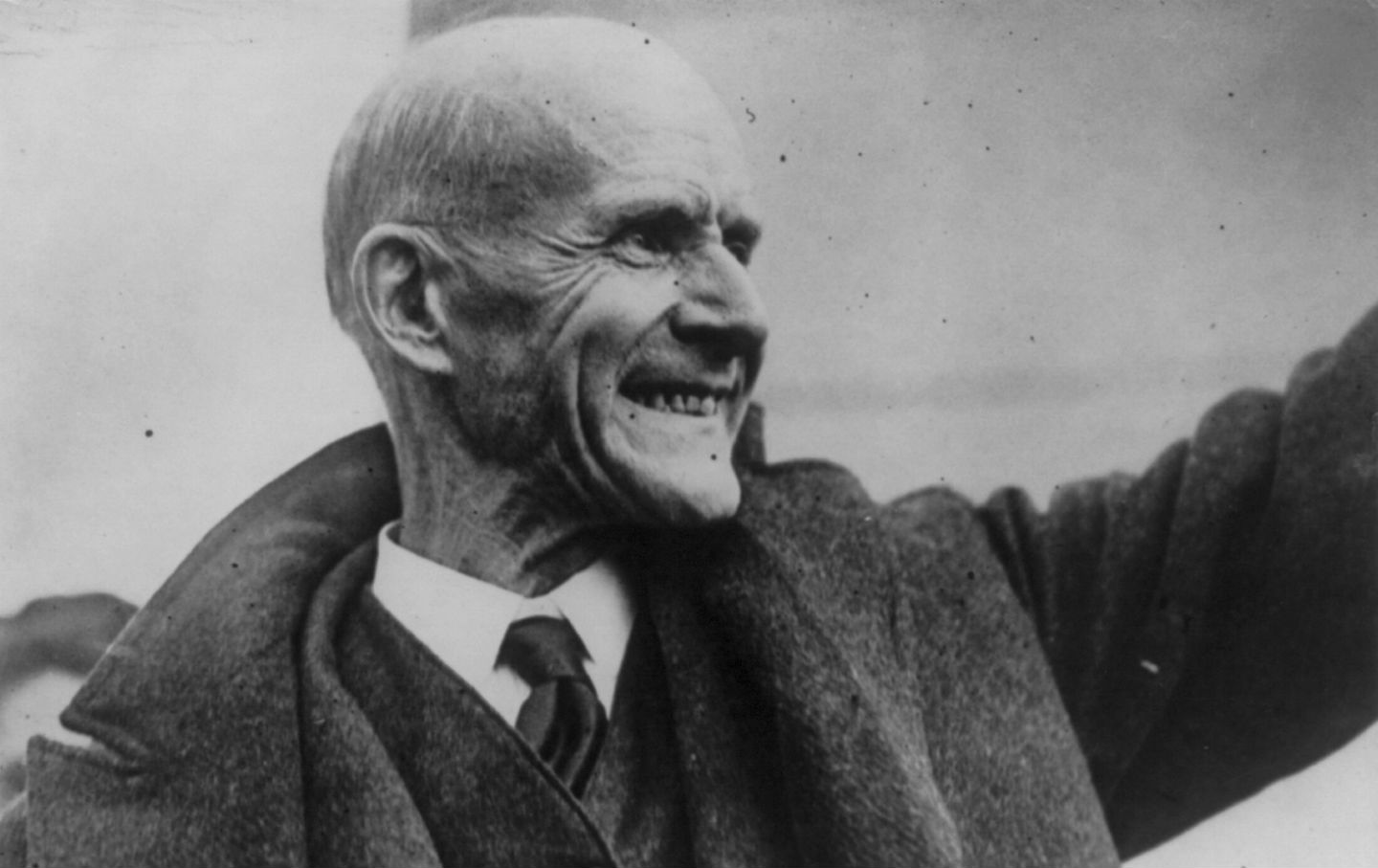
April 13, 1919: Eugene V. Debs Is Sent to Prison April 13, 1919: Eugene V. Debs Is Sent to Prison
“How can you punish a man with so compelling a consciousness of the right?”
Apr 13, 2015 / Richard Kreitner and The Almanac

Jobs and Empire Jobs and Empire
The music of Empire is the theology of capitalism.
Apr 8, 2015 / Books & the Arts / Joshua Clover

Trevor Noah’s Tweets Are Awful and Sexist. Don’t Fire Him for Them. Trevor Noah’s Tweets Are Awful and Sexist. Don’t Fire Him for Them.
The best response to the new Daily Show host’s sexism would be to put more women in the writers’ room.
Mar 31, 2015 / Books & the Arts / Michelle Goldberg
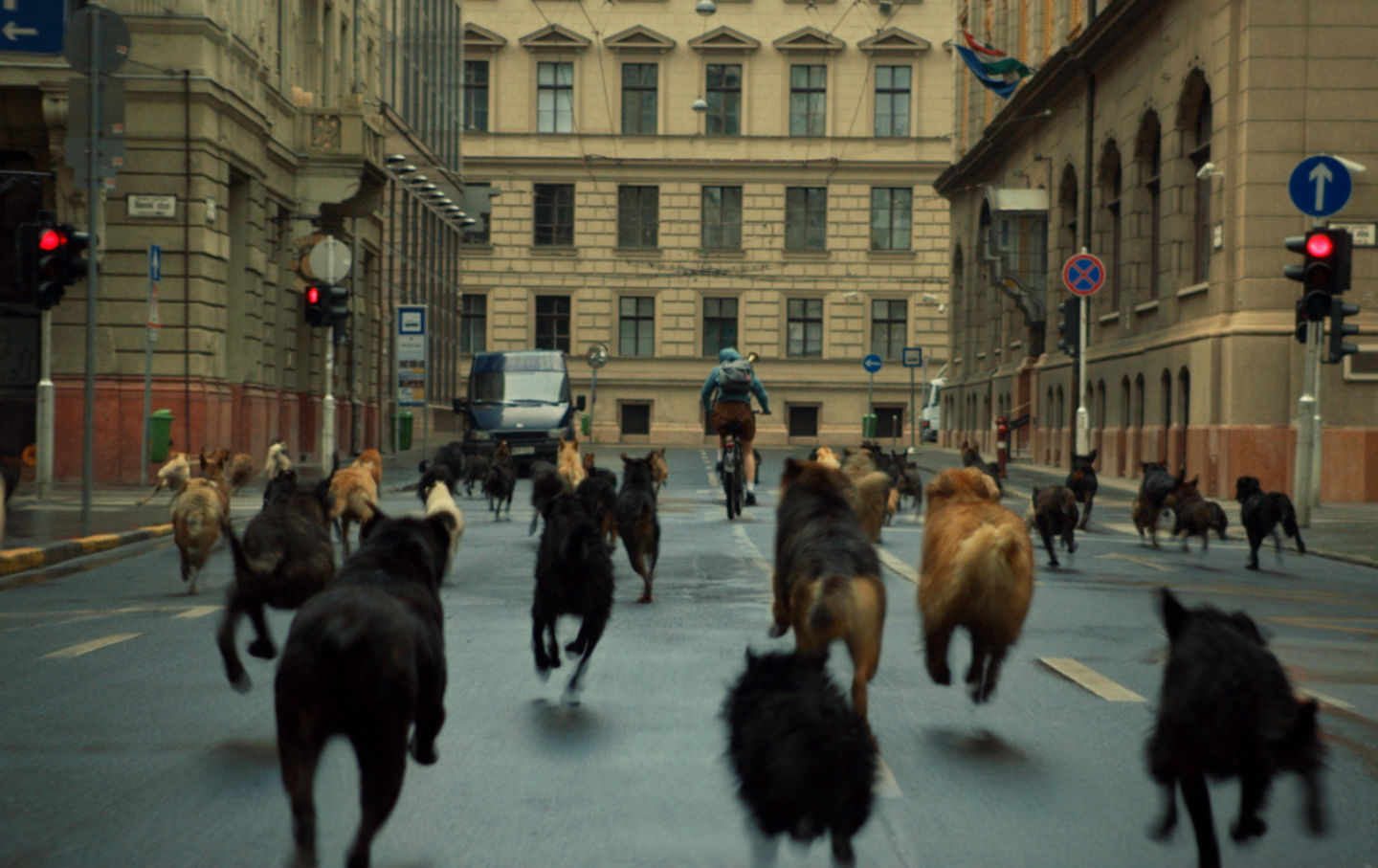
Animal Education Animal Education
War between men and dogs looms in the Budapest of White God; Ethan Hawke pays homage to New York City’s greatest piano teacher in Seymour: An Introduction.
Mar 31, 2015 / Books & the Arts / Stuart Klawans

Inequality and Broken Windows Inequality and Broken Windows
Eric responds to his critics and reviews the best shows of the week in today's Altercation.
Mar 25, 2015 / Books & the Arts / Eric Alterman

From Lenin to Lego From Lenin to Lego
Snowpiercer mocks what The Lego Movie cheers—a happy world of compulsory production.
Mar 24, 2015 / Books & the Arts / Joshua Clover
Two Views of a Cadaver Room Two Views of a Cadaver Room
January 30, 1960 I The day she visited the dissecting room They had four men laid out, black as burnt turkey, Already half unstrung. A vinegary fume Of the death vats clung to them; The white-smocked boys started working. The head of his cadaver had caved in, And she could scarcely make out anything In that rubble of skull plates and old leather. A sallow piece of string held it together. In their jars the snail-nosed babies moon and glow. He hands her the cut-out heart like a cracked heirloom. II In Brueghel’s panorama of smoke and slaughter Two people only are blind to the carrion army: He, afloat in the sea of her blue satin Skirts, sings in the direction Of her bare shoulder, while she bends, Fingering a leaflet of music, over him, Both of them deaf to the fiddle in the hands Of the death’s-head shadowing their song. These Flemish lovers flourish; not for long. Yet desolation, stalled in paint, spares the little country Foolish, delicate, in the lower right hand corner. This article is part of The Nation’s 150th Anniversary Special Issue. Download a free PDF of the issue, with articles by James Baldwin, Barbara Ehrenreich, Toni Morrison, Howard Zinn and many more, here. Sylvia Plath (1932–1963) published four poems in The Nation between 1955 and 1960.
Mar 23, 2015 / Books & the Arts / Sylvia Plath

Weird Bedfellows Weird Bedfellows
In their defense of “tradition” against the liberating potential of architecture, Prince Charles and Xi Jinping find unlikely common ground.
Mar 23, 2015 / Books & the Arts / Michael Sorkin
The Bear The Bear
April 18, 1928 The bear puts both arms round the tree above her And draws it down as if it were a lover And its choke-cherries lips to kiss goodby, Then lets it snap back upright in the sky. Her next step rocks a boulder on the wall. (She’s making her cross-country in the fall.) Her great weight creaks the barbed wire in its staples As she flings over and off down through the maples, Leaving on one wire tooth a lock of hair. Such is the uncaged progress of the bear. The world has room to make a bear feel free. The universe seems cramped to you and me. Man acts more like the poor bear in a cage That all day fights a nervous inward rage, His mood rejecting all his mind suggests. He paces back and forth and never rests The toe-nail click and shuffle of his feet, The telescope at one end of his beat, And at the other end the microscope, Two instruments of nearly equal hope, And in conjunction giving quite a spread. Or if he rests from scientific tread, ’Tis only to sit back and sway his head Through ninety-odd degrees of arc it seems, Between two metaphysical extremes. He sits back on his fundamental butt With lifted snout and eyes (if any) shut (He almost looks religious but he’s not), And back and forth he sways from cheek to cheek, At one extreme agreeing with one Greek, At the other agreeing with another Greek, Which may be thought but only so to speak. A baggy figure equally pathetic When sedentary and when peripatetic. This article is part of The Nation’s 150th Anniversary Special Issue. Download a free PDF of the issue, with articles by James Baldwin, Barbara Ehrenreich, Toni Morrison, Howard Zinn and many more, here. Reviewing Robert Frost’s first book, A Boy’s Will, in 1915, The Nation described him as “a poet by endowment,” but “a symbolist only by trade.” Frost (1874–1963) wrote four poems for The Nation in the 1920s. When he died, the sportswriter Roger Kahn wrote in the magazine of his friend: “Robert Frost is dead and my mortality and yours is thus more stark.”
Mar 23, 2015 / Books & the Arts / Robert Frost
The Fall of Rome The Fall of Rome
June 14, 1947 The piers are pummeled by the waves; In a lonely field the rain Lashes an abandoned train; Outlaws fill the mountain caves. Fantastic grow the evening gowns; Agents of the Fisc pursue Absconding tax-defaulters through The sewers of provincial towns. Private rites of magic send The temple prostitutes to sleep; All the literati keep An imaginary friend. Cerebrotonic Cato may Extol the Ancient Disciplines, But the muscle-bound Marines Mutiny for food and pay. Caesar’s double-bed is warm As an unimportant clerk Writes I DO NOT LIKE MY WORK On a pink official form. Unendowed with wealth or pity, Little birds with scarlet legs, Sitting on their speckled eggs, Eye each flu-infected city. Altogether elsewhere, vast Herds of reindeer move across Miles and miles of golden moss, Silently and very fast. This article is part of The Nation’s 150th Anniversary Special Issue. Download a free PDF of the issue, with articles by James Baldwin, Barbara Ehrenreich, Toni Morrison, Howard Zinn and many more, here. W.H. Auden (1907–1973) contributed many poems and critical essays to The Nation between 1938 and 1951.
Mar 23, 2015 / Books & the Arts / W.H. Auden