
Ted Cruz’s Biggest Liability Is Probably His Constant Lying Ted Cruz’s Biggest Liability Is Probably His Constant Lying
Conservatives love Cruz’s brand of “truth” telling—but will it come back to haunt him?
Mar 23, 2015 / George Zornick
The ‘Draft Elizabeth Warren’ Campaign Gets a Big Boost from ‘The Boston Globe’ The ‘Draft Elizabeth Warren’ Campaign Gets a Big Boost from ‘The Boston Globe’
The newspaper warns it would be “a big mistake” for Democrats to “let Hillary Clinton coast to the presidential nomination without real opposition.”
Mar 23, 2015 / John Nichols
150th Anniversary Special Issue 150th Anniversary Special Issue
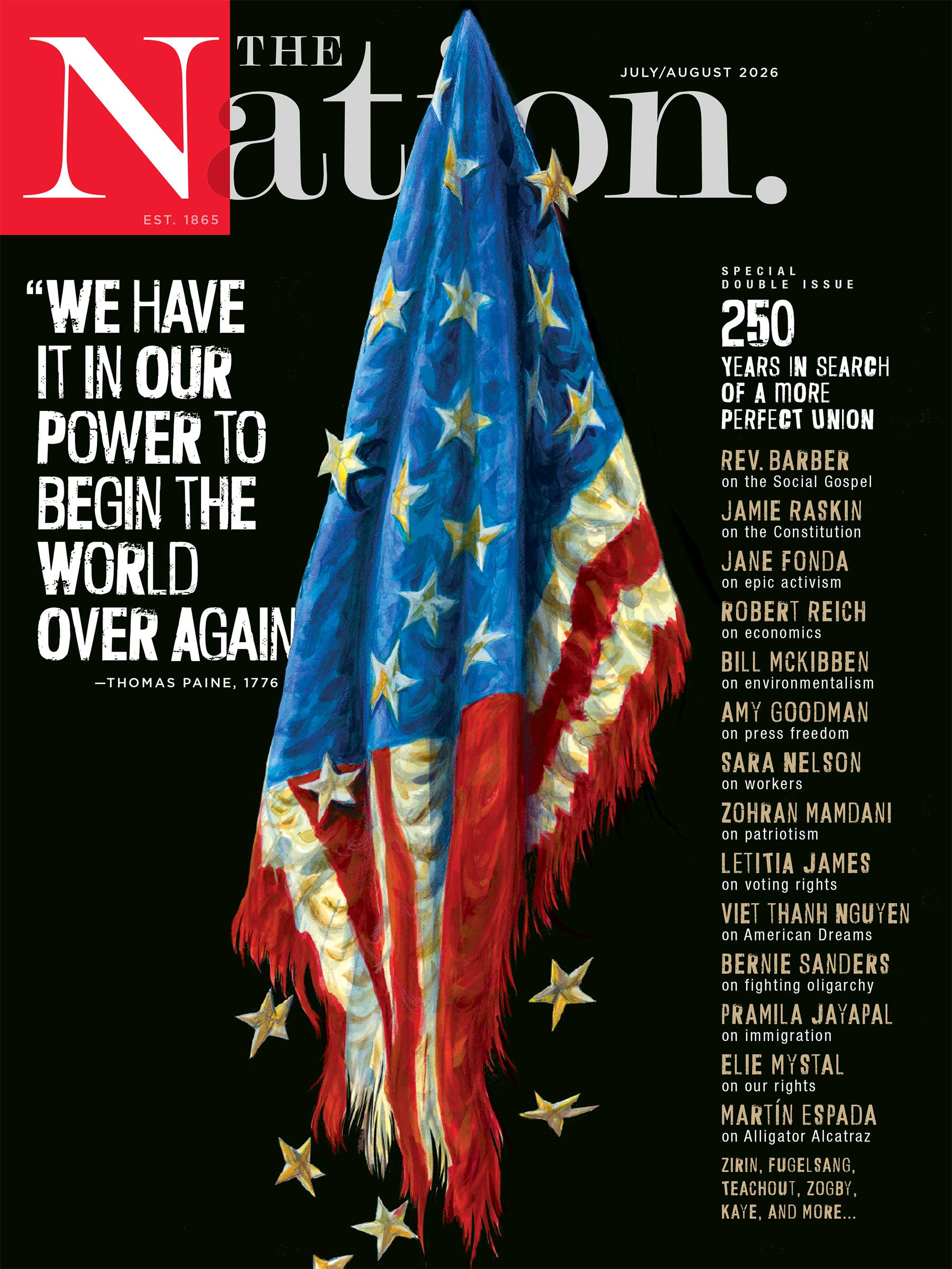
The year 2015 marks The Nation’s 150th anniversary (see here for a schedule of live events). This week, to celebrate the occasion, we’re publishing a very special anniversary issue, one of the longest in the magazine’s long history. This issue, which I co-edited with D.D. Guttenplan, our London correspondent, weaves together voices from The Nation’s rich history with contributors writing about the current cultural and political moment. In a rich series archival excerpts, we reprint some of the best that was thought and said in our pages—much of it inspiring and eerily prescient, some of it shocking. We have also included a few selections that turned out to be less than prophetic. Interspersed with the archival excerpts are three sections of new material. In the first, “The Nation and the Nation,” writers explore the magazine’s outsized influence on everything from poetry to feminism, radicalism to right-wing conservatism, Cuba to coverage of the arts. In “Fierce Urgencies,” contributors consider topics like the politics of fear, from anticommunism in the 1950s to Islamophobia today, and the relationship of the left to power—in movements, in electoral politics and in government. Finally, in “Radical Futures,” writers and activists map out new strategies for radicals, progressives and liberals seeking to expand the terms of our public discussion and look beyond the present moment. Change is inevitable, but the one constant in The Nation’s history has been faith—not in political parties or policies, but in what can happen when you tell people the truth. It is this notion that has sustained The Nation since its founding: that and the idea that there are always alternatives—in history, in politics, in life—that would make our country and the world a more humane, just and secure place. Our very first issue described “the conflict of the ages, the great strife between the few and the many, between privilege and equality, between law and power, between opinion and the sword.” This anniversary issue is a record of the last 150 years of that conflict—and as long as The Nation is around, that fight will go on. With your help, we’ll be fighting for another 150 years and beyond! —Katrina vanden Heuvel, Editor and Publisher Download a PDF of the full special issue. 150 Years of Telling the Truth, by Katrina vanden Heuvel The Founding Mission Statement of America’s Oldest Weekly Magazine A Message From President Barack Obama The Nation and the Nation: Radicals, rebels, poets, pioneers, feminists, fantasists and other voices from our hidden history. Fierce Urgencies: From the way we were then to the way we live now. Radical Futures: Harbingers of change, peeks over the horizon, maps of Utopia—and other strategies for keeping hope alive. Toward a Third Reconstruction: A Conversation with Eric Foner, Darryl Pinckney, Mychal Denzel Smith, Isabel Wilkerson and Patricia J. Williams. Why We Can’t Wait: Visions for a radical future, from StudentNation contributors and former interns. Excerpts from The Nation’s Archives, 1865–2015 The Nation: A Biography, Part I, Part II, Part III Columns A Wake-Up Call for US Liberals, by Eric Alterman Irresponsible Power, by Gary Younge Letters to the Editor Testimonials to The Nation Poems From the Archive Puzzle No. 3358 * * * The Nation and the Nation Radicals, rebels, poets, pioneers, feminists, fantasists and other voices from our hidden history. Eric Foner: Freedom’s Song Illustrated by Steve Brodner JoAnn Wypijewski: Night Thoughts Rick Perlstein: Going All the Way Illustrated by Eugène Mihaesco Elizabeth Pochoda: How to Lose Friends and Influence People Ange Mlinko: The Dream Life of Desire Betsy Reed and Katha Pollitt: Spreading Feminism Far and Wide Frances Jetter: Works on Paper Peter Kornbluh: Cuba Libre David Corn: How I Got That Story Calvin Trillin: Cruising to Port Maria Margaronis: Radical Hope Ariel Dorfman: Separated at Birth Illustrated by Yuko Shimizu * * * Fierce Urgencies From the way we were then to the way we live now. Marilynne Robinson: A Sense of Obligation Victor Navasky: The Roads Not Taken Victor Juhasz: His Master’s Voice Walden Bello: The Left in Power Kai Bird: Revisiting ‘Myths About the Middle East’: The Case for Disengagement Art Spiegelman: Drawing the Line Michael Tomasky: Lesser-Evilism We Can Believe In Robert L. Borosage: Occupy and Organize Michael Sorkin: Weird Bedfellows Helen Lewis: Game Not Over Tom Tomorrow: All the Right Enemies Moustafa Bayoumi: ‘Why Do They Hate Us?’ Michael Moore: Michael Moore for President * * * Radical Futures Harbingers of change, peeks over the horizon, maps of Utopia—and other strategies for keeping hope alive. Toni Morrison: No Place for Self-Pity, No Room for Fear Rebecca Solnit: Unpredictable Weather Illustrated by Eric Drooker Jack O’Dell: Beginning to See the Light Noam Chomsky: Killing the Commons Illustrated by Milton Glaser Stuart Klawans: Traces of Light Gene Seymour: Future Sounds Dave Zirin: A World of Sports Worth Fighting For E.L. Doctorow: Home Illustrated by Mirko Ilic Joel Rogers: Productive Democracy Kshama Sawant: Socialist Politics: The Heart of Rebuilding the Left Michael Massing: An Investigative Blueprint Illustrated by Marshall Arisman Michael Massing: Unburying the Lede David Cole: Privacy 2.0: Surveillance in the Digital Age John Nichols: Move to Amend Bhaskar Sunkara: A Red by Any Other Name Jon Wiener: It’s Time to End Tuition at Public Universities—and Abolish Student Debt Thomas Geoghegan: The Big Fix Amy Wilentz: The Future of a Failed State Mark Gevisser: Engendered * * * Excerpts from The Nation’s Archives, 1865–2015 Founded by abolitionists to finish the job of Emancipation, The Nation became a moribund defender of the status quo. But its firm anti-imperialism, and one crusading editor, brought it back to life. 1865–1875: When Corporations Became America’s Aristocracy Henry James: Mr. Walt Whitman Frederick Law Olmsted: Chicago in Distress 1875–1885: Custer’s Last Stand and the Power of Tammany Hall E.L. Godkin: The Sources of Communism 1885–1895: Anarchists Are Vagabonds and Ruffians and Threaten Everything We Most Value on Earth E.L. Godkin and Rochelle Gurstein: Clickbait Has Plagued Journalism for 125 Years The Editors: The New Football 1895–1905: When the American Empire Was Born Horace White and Elinor Langer: American Imperialism: This Is When It All Began 1905–1915: Henry James’s Obscurities Oswald Garrison Villard: What Would Lincoln Think of Race Relations on His 100th Birthday? Simeon Strunsky and Richard Kreitner: When the Constitution Becomes The Last Resort of Scoundrels From World War I to Vietnam, from the red scare to McCarthyism, The Nation stood firm for civil liberties and civil rights, even when that meant being banned—or standing alone. 1915–1925: Radicals in a Time of Hysteria Floyd Dell and Michelle Goldberg: Can Men and Women Be Friends? William MacDonald and Mayor Bill de Blasio: If We Repossessed Empty Homes, Homelessness Would Be Over 1925–1935: Is Art Possible in the United States? Langston Hughes and Touré: Loving Blackness in a Nation Ruled by White Supremacy Albert Einstein: Was Europe a Success? Emma Goldman and Vivian Gornick: When the World Became a Huge Penitentiary 1935–1945: The Establishment of a Warless World Must Be Our Goal John Dos Passos: Big Parade—1936 John Steinbeck: On the Violent Repression of the Fight for Migrant Workers’ Rights I.F. Stone: For the Jews—Life or Death? 1945–1955: We Face a Choice Between One World or None James Agee: The Salt of the Earth Hannah Arendt: French Existentialism Jean-Paul Sartre: Americans and Their Myths Bernard Fall and Frances FitzGerald: The Reporter Who Warned Us Not to Invade Vietnam 10 Years Before the Gulf of Tonkin Ray Bradbury: What Science Fiction Teaches Us About Reality 1955–1965: Down the Road of Folly W.E.B. Du Bois: I Won’t Vote Ralph Nader: The Safe Car You Can’t Buy Howard Zinn and Paula J. Giddings: When Respectability Was No Longer Respectable, and Virtue Required Acting Out, Not Leaning In Jessica Mitford: The Indignant Generation A forum for debate between radicals and liberals in an age of austerity, surveillance and endless war, The Nation has long had one foot inside the establishment and one outside it. 1965–1975: How To Tell The Rebels Have Won Wendell Berry and Wen Stephenson: The Gospel According to Wendell Berry Martin Luther King Jr.: The Last Steep Ascent Frances Fox Piven and Richard Cloward: The Weight of the Poor: A Strategy to End Poverty Hunter S. Thompson: The Motorcycle Gangs: Losers and Outsiders James Baldwin and Carrie Mae Weems : James Baldwin: A Report From Occupied Territory 1975–1985: Standing in Solidarity Against Jackbooted Oppressors William Appleman Williams and Greg Grandin: Is America Possible Without Empire? Gore Vidal: ‘Some’ Jews & ‘the’ Gays Barbara Ehrenreich: Can Women and Men Live Together Again? E.P. Thompson: East, West—Is There a Third Way? 1985–1995: The Radical Reformation of American Politics and Culture Christopher Hitchens: Terrorism and Its Discontents Alexander Cockburn: The Stars Were Their Alibi Alice Walker: What Can the White Man Say to the Black Woman? Edward Miliband: Maggie Stumbles Katha Pollitt: Are Women Morally Superior to Men? Tony Kushner: A Socialism of the Skin Adolph Reed Jr.: Adolph Reed Destroys ‘The Bell Curve’ 1995–2005: Our Enemies Cannot Defeat Us—Only We Can Edward Said: There Cannot Be Peace and Security Until the Cause of Palestinian Suffering Is Addressed Marshall Berman: What Does ‘The Communist Manifesto’ Have to Offer 150 Years After Its Publication? Mark Hertsgaard: A Global Green Deal 2005–2015: This All Seems Eerily Familiar * * * Poems From the Archives Robert Frost: The Bear Sylvia Plath: Two Views of a Cadaver Room Frank O’Hara: Present William Butler Yeats: Hound Voice W.H. Auden: The Fall of Rome Claude McKay: Home Song John Berryman: Dream Song Allen Ginsberg: Now and Forever Wallace Stevens: The Plain Sense of Things Adrienne Rich: Parting Anne Sexton: The Starry Night LeRoi Jones: Tight Rope Elizabeth Bishop: Varick Street Marianne Moore: The Mind Is an Enchanting Thing William Carlos Williams: The Injury Mahmoud Darwish: And We Love Life Magazine issue cover: art © Jasper Johns/Licensed by VAGA. New York, NY Jasper Johns (b. 1930). Three Flags, 1958. Encaustic on canvas, 30 5/8 x 45 1/2 x 4 5/8 in. (77 .8 x 115.6 x 11.7 cm). Whitney Museum of American Art, New York; purchased with funds from the Gilman Foundation Inc., the Lauder Foundation, A. Alfred Taubman, Laura Lee Whittier Woods, Howard Lipman and Ed Downe, in honor of the museum’s fiftieth anniversary 80.32 Digital lmage © Whitney Museum of American Art, NY
Mar 23, 2015 / The Nation
Drawing the Line Drawing the Line
Notes from a First Amendment fundamentalist.
Mar 23, 2015 / Art Spiegelman
The US’s ‘War on Drugs’ Has Spiraled Dangerously Out of Control The US’s ‘War on Drugs’ Has Spiraled Dangerously Out of Control
It didn’t work in Afghanistan, so let’s do it in Mexico.
Mar 23, 2015 / Rebecca Gordon
Works On Paper Works On Paper
This article is part of The Nation’s 150th Anniversary Special Issue. Download a free PDF of the issue, with articles by James Baldwin, Barbara Ehrenreich, Toni Morrison, Howard Zinn and many more, here.
Mar 23, 2015 / Frances Jetter
His Master’s Voice His Master’s Voice
This article is part of The Nation’s 150th Anniversary Special Issue. Download a free PDF of the issue, with articles by James Baldwin, Barbara Ehrenreich, Toni Morrison, Howard Zinn and many more, here.
Mar 23, 2015 / Victor Juhasz
Testimonials to ‘The Nation’ Testimonials to ‘The Nation’
Encomiums from Elizabeth Warren, Rev. Jesse Jackson, Bernie Sanders and many more.
Mar 23, 2015 / Feature
The Injury The Injury
June 22, 1946 From this hospital bed I can hear an engine breathing—somewhere in the night: —Soft coal, soft coal, soft coal! And I know it is men breathing shoveling, resting— —Go about it the slow way, if you can find any way— Christ! who’s a bastard? —quit and quit shoveling. A man beathing and it quiets and the puff of steady work begins slowly: Chug. Chug. Chug. Chug . . . fading off. Enough coal at least for this small job Soft! Soft! —enough for one small engine, enough for that. A man shoveling, working and not lying here in this hospital bed—powerless —with the white-throat calling in the poplars before dawn, his faint flute-call, triple tongued, piercing the shingled curtain of the new leaves; drowned out by car wheels singing now on the rails, taking the curve, slowly, a long wail, high pitched: rounding the curve— —the slow way because (if you can find any way) that is the only way left now for you. This article is part of The Nation’s 150th Anniversary Special Issue. Download a free PDF of the issue, with articles by James Baldwin, Barbara Ehrenreich, Toni Morrison, Howard Zinn and many more, here. William Carlos Williams (1883–1963) published several essays and poems in The Nation between 1937 and 1961; his work has been reviewed in these pages by Philip Rahv, Robert Lowell, Delmore Schwartz, Isaac Rosenfeld, Robert Creeley, Denise Levertov and James Longenbach.
Mar 23, 2015 / Books & the Arts / William Carlos Williams
Young ‘Nation’ Writers On Creating Our Radical Future Young ‘Nation’ Writers On Creating Our Radical Future
As The Nation looks forward to the next 150 years, we asked some contributors to StudentNation, the campus-oriented section of our site, and former Nation interns what a radical fu...
Mar 23, 2015 / Feature / The Nation