
The Ukraine Aid Package Heightens the Risk of Escalation
The passage by Congress of the latest aid package to Ukraine was met with cheers, but there is ample reason for caution.
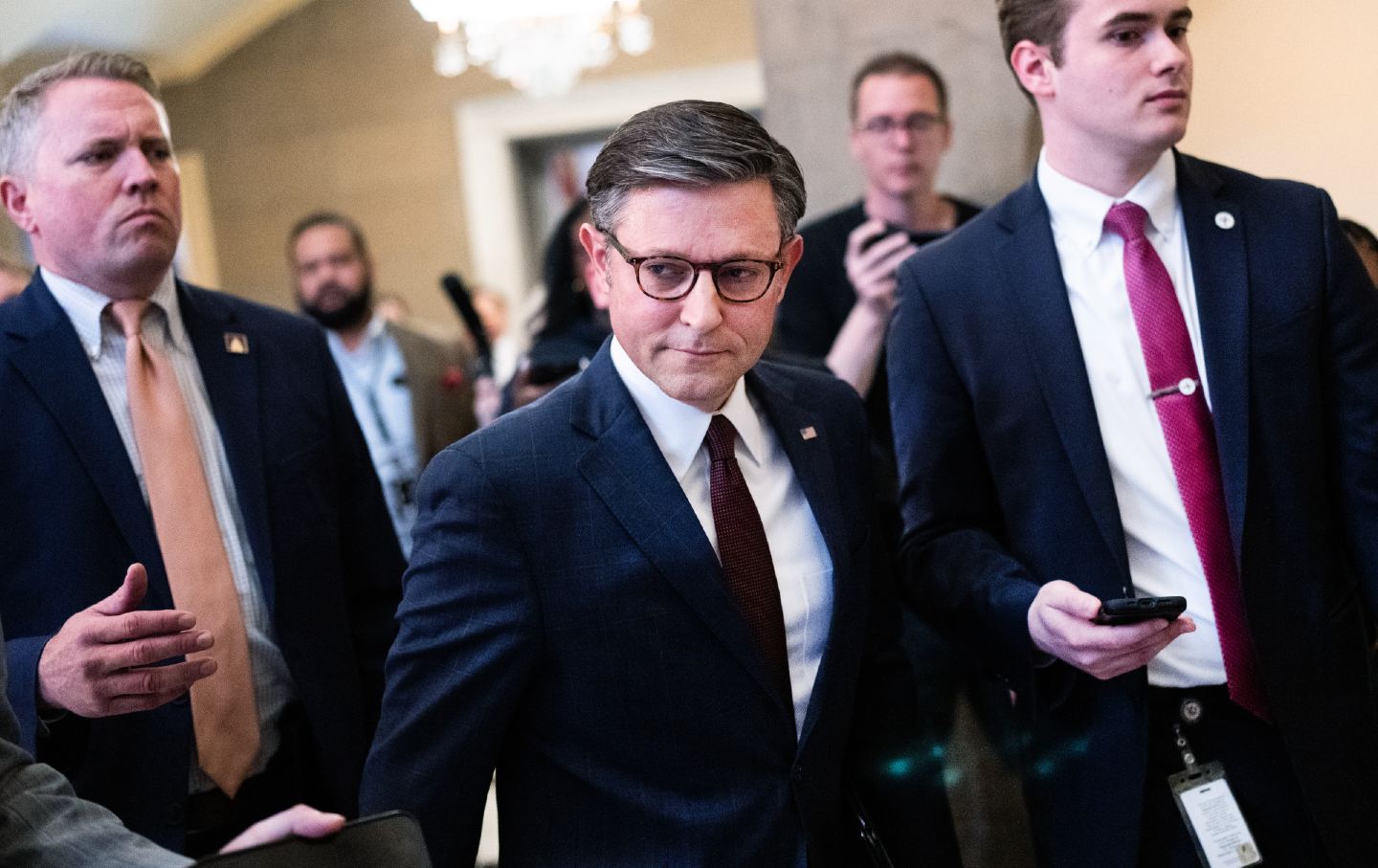
Last week’s passage of the Ukraine aid package by both the House and the Senate showed if nothing else that bipartisanship—at least on matters of foreign policy—remains alive and well in Washington, with leading Democratic progressives joining Republican hawks to pass the $61 billion package.
Mark Green, a former four-term Democratic congressman from Wisconsin, and current head of the Wilson Center, captured the current D.C. zeitgeist well, writing that “moments like the final passage of this assistance package show the world that, just as America never turns its back on key allies and important challenges, they should never fully count us out.”
Yet, despite the torrent of self-congratulation, concerning details surfaced soon after the House vote—not least what appears to be the Biden administration’s likely use of questionable, highly subjective intelligence to win over Republican Speaker Mike Johnson.
Multiple mainstream media outlets report that the Biden administration arranged several multiple “high-level” intelligence briefings for the speaker. According to Politico’s Jonathan Martin, “It only took a higher level of intelligence briefings, granted to congressional leaders, for [Johnson] to pick up that old Cold War hymnal.” Martin noticed that, after having received briefings by the US Intelligence Community, several members of Congress, including Johson, House majority leader Steve Scalise, House foreign affairs committee chair Michael McCaul, and Representative Brian Fitzpatrick were all using the phrase “axis of evil” to refer to Russia, Iran, and China. As McCaul put it, “They’re all related, man…. To abandon Ukraine will only invite more aggression from Putin but also Chairman Xi in Taiwan. The ayatollah has already reared his ugly head.”
Where did this language come from, asked Martin?
“Spend an hour in the SCIF getting briefed,” Fitzpatrick shot back, referring to the secure facility used for classified briefings. “These are not isolated problems.”
After the vote, Johnson told Bloomberg, “I really do believe the intel and the briefings that we got…. I think Vladimir Putin would continue to march through Europe if he were allowed.”
If the US IC is putting forward cherry-picked conjecture (“Putin will march through Europe”) as fact, then don’t we once again have to confront the specter of politicized intelligence?
More worrying still, reporting on the aid package shows that the president and his staff have been serially misleading the public about what exactly US forces have been up to in Ukraine. Politico reported last week that “the administration secretly sent long-range [ATACMS] missiles to Ukraine for the first time in the war—and Kyiv has already used them twice to strike far behind Russian lines.” If true, this would contradict the president’s public assurances that (a) his administration would not send ATACMS to Ukraine, and (b) the US would not, due to the risks, countenance direct attacks on Russia.
Meanwhile, The Washington Post’s Karen DeYoung indicates that “scores of images recently leaked online, many with classified US military and intelligence assessments, illustrate how deeply the United States is involved in virtually every aspect of the war, with the exception of US boots on the ground.”
All of which raises the question: What else are they not telling us?
One important consideration—but one that remains notable for its absence in the coverage of the war—involves the risks of escalation. Professor Lyle Goldstein, who for 20 years taught at the Naval War College, has written about what he calls the “nuclear paradox”—that is, “if the US and NATO increase their military spending and conventional forces in Europe, the weakness of Russian conventional military forces could prompt Moscow to rely more heavily on its nuclear forces.”
Ignoring such risks, supporters of the aid package have instead cited it as a boon to the US economy. Yet, besides being morally grotesque, lining the pockets of defense industry behemoths like Raytheon and Lockheed Martin at the cost of hundreds of thousands of dead Ukrainian and Russian soldiers will do little to further the president’s campaign pledge to “build back better.”
Still more, the animating idea behind the aid package— that it helps Ukraine live to fight another day—is deeply misguided. It would be hard to improve upon the formulation of George Beebe, former CIA head of Russia analysis and director of the Quincy Institute’s Grand Strategy Program, that, if Washington “were intentionally to design a formula for Ukraine’s destruction, it might look a lot like the aid package passed by Congress this week.” At this late date, better and more weapons and ordnance will not carry the day—and they will certainly not in the absence of a Ukrainian Army able to deploy them. Recent reporting by BBC Ukraine indicates that 650,000 military-age men have fled the country.
Popular
“swipe left below to view more authors”Swipe →Too often missing from the conversation is the humanitarian toll the war has taken on Ukraine. Estimates show that between 2021 and 2023, Ukraine’s GDP has shrunk by nearly 30 percent, with millions out of work. The Economist predicts that the country will need $37 billion in external financing in 2024. In short, there has to be a better way than prolonging the suffering in order to ward off the phantom of never-ending Russian expansion—after all, Putin’s military tried and failed to cross the Dnieper and take Kiev only two years ago. The idea that Ukraine is but a first step in Putin’s plans to retake Eastern Europe, while popular, simply overestimates Russian strength while ignoring the root cause of the current conflict. Wiser heads (if they indeed exist) in Washington might use the opportunity provided by the Ukraine Recovery Conference this June in Berlin to reassess our priorities.
The answer to war is not more war. A negotiated end to the cruel conflict will require hard choices and painful trade-offs. But the sooner it is done, the sooner Ukraine’s reconstruction, reconciliation, and entry into Europe can and should begin.
Support independent journalism that does not fall in line
Even before February 28, the reasons for Donald Trump’s imploding approval rating were abundantly clear: untrammeled corruption and personal enrichment to the tune of billions of dollars during an affordability crisis, a foreign policy guided only by his own derelict sense of morality, and the deployment of a murderous campaign of occupation, detention, and deportation on American streets.
Now an undeclared, unauthorized, unpopular, and unconstitutional war of aggression against Iran has spread like wildfire through the region and into Europe. A new “forever war”—with an ever-increasing likelihood of American troops on the ground—may very well be upon us.
As we’ve seen over and over, this administration uses lies, misdirection, and attempts to flood the zone to justify its abuses of power at home and abroad. Just as Trump, Marco Rubio, and Pete Hegseth offer erratic and contradictory rationales for the attacks on Iran, the administration is also spreading the lie that the upcoming midterm elections are under threat from noncitizens on voter rolls. When these lies go unchecked, they become the basis for further authoritarian encroachment and war.
In these dark times, independent journalism is uniquely able to uncover the falsehoods that threaten our republic—and civilians around the world—and shine a bright light on the truth.
The Nation’s experienced team of writers, editors, and fact-checkers understands the scale of what we’re up against and the urgency with which we have to act. That’s why we’re publishing critical reporting and analysis of the war on Iran, ICE violence at home, new forms of voter suppression emerging in the courts, and much more.
But this journalism is possible only with your support.
This March, The Nation needs to raise $50,000 to ensure that we have the resources for reporting and analysis that sets the record straight and empowers people of conscience to organize. Will you donate today?
More from The Nation
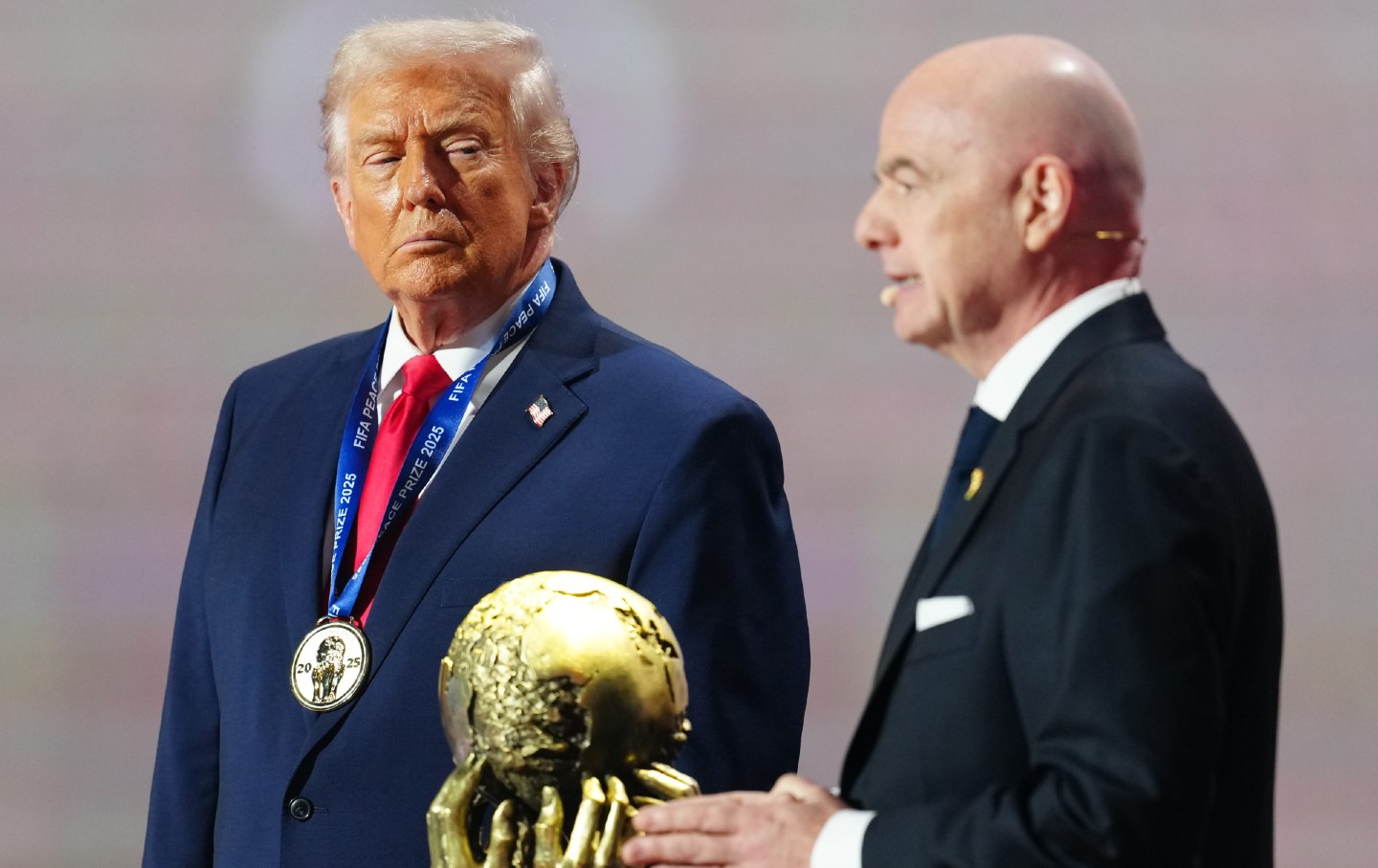
Trump and His Soulless Cronies Have Managed to Suck the Joy Out of the World Cup Trump and His Soulless Cronies Have Managed to Suck the Joy Out of the World Cup
Not even soccer is immune from Trump’s reverse Midas touch.
Garbage In, Carnage Out Garbage In, Carnage Out
The harrowing lessons of the Pentagon’s recently dissolved partnership with Anthropic.

The Iran War Could Be Catastrophic for the US-Israel Alliance. Good. The Iran War Could Be Catastrophic for the US-Israel Alliance. Good.
As Israel’s role in pushing the war with Iran comes into ever sharper focus, it’s up to us to turn outrage into change.

An Unlawful War An Unlawful War
The precedent being set by the US in launching this war of aggression against Iran will long live in infamy.
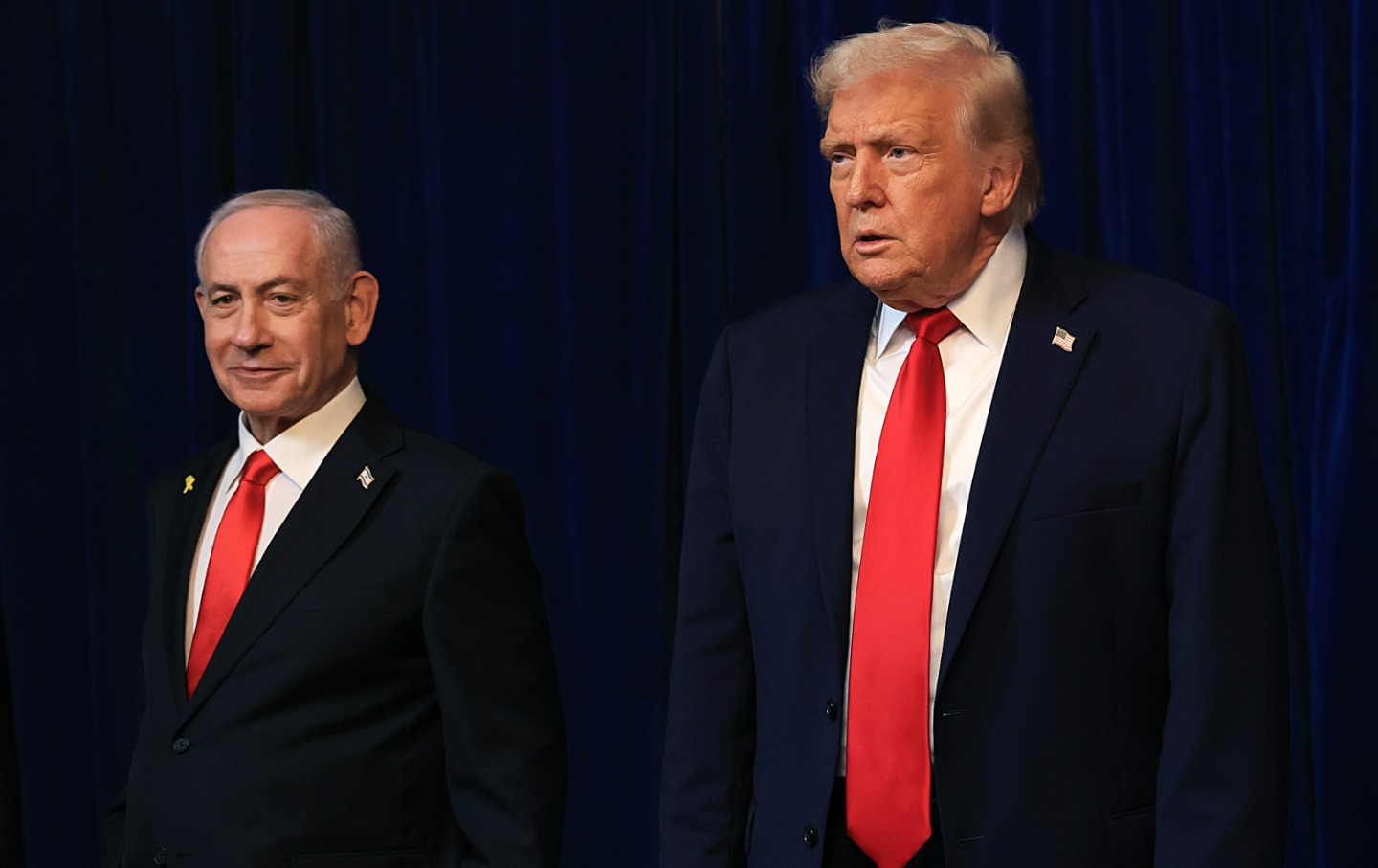
Trump and Netanyahu Want to Turn Iran Into a Failed State Trump and Netanyahu Want to Turn Iran Into a Failed State
This war looks designed to cause maximum chaos and instability. The world will pay a high price.

The War on Terror Paved the Way for Trump’s Rise—Now He’s Making It His Own The War on Terror Paved the Way for Trump’s Rise—Now He’s Making It His Own
Only the total abolition of the DHS can restore freedom.

