The Man Behind the Radical Walking Tours of New York City
Asad Dandia sued the NYPD after it spied on his family and community. Now he uses people’s history to reclaim the streets from the systems that surveilled him.
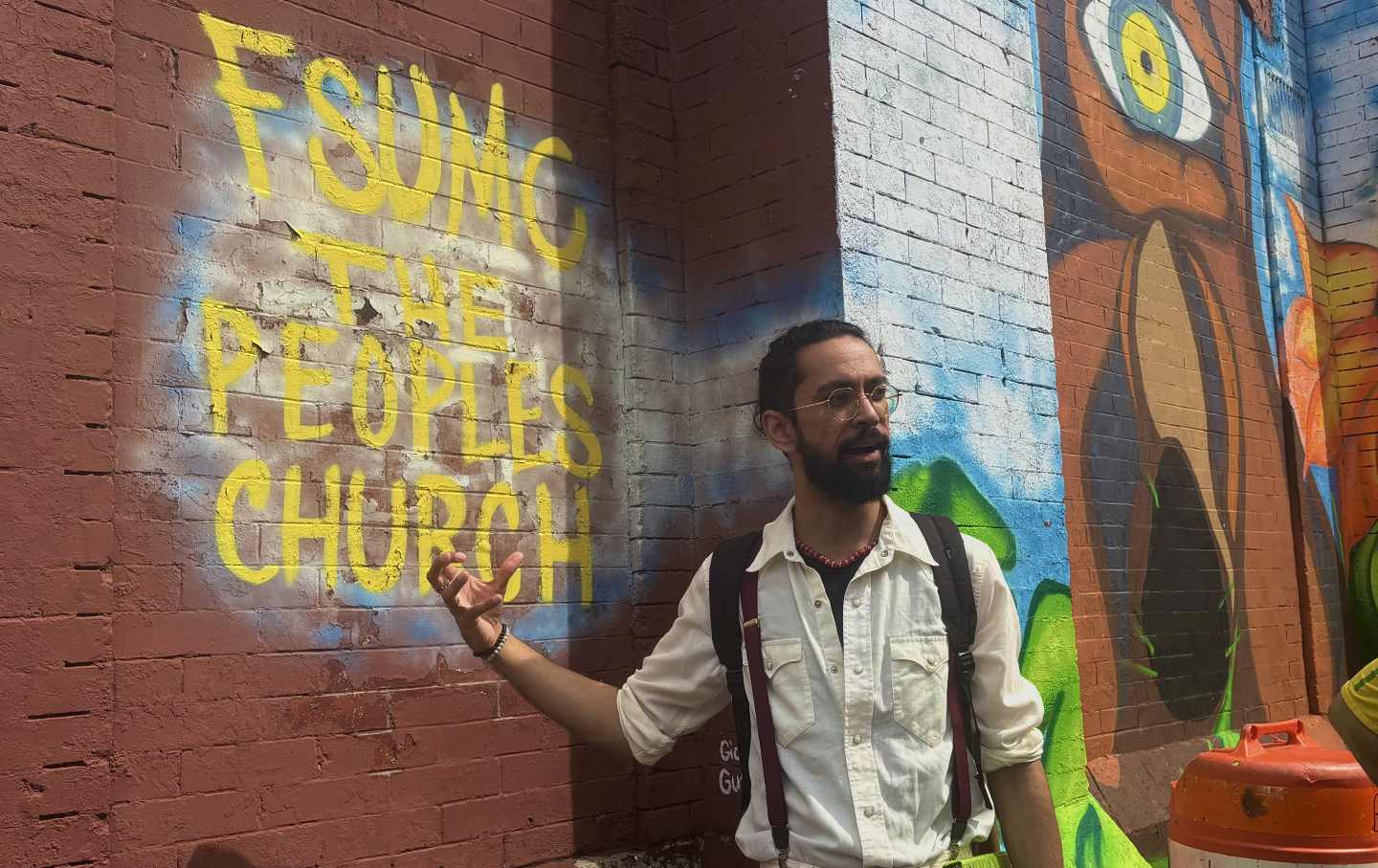
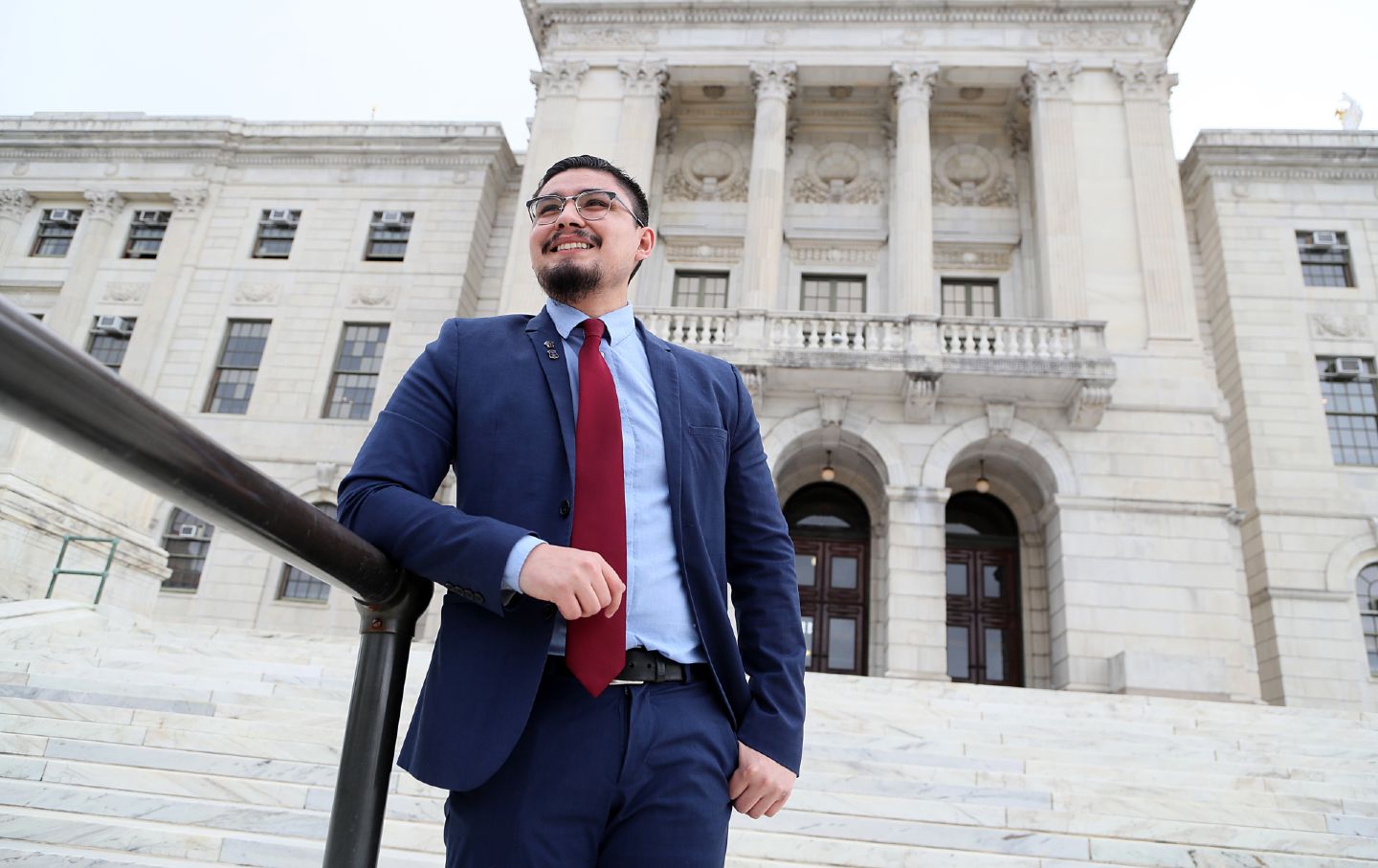
Asad Dandia.
(Lara-Nour Walton)
In winter 2012, Asad Dandia, 19, discovered that his friend who crashed at his house in Brighton Beach and dined at his family table was a New York Police Department plant. The department’s Intelligence Division was dispatching spies and plainclothes officers to compile dossiers on Muslim “hot spots.” They infiltrated local bookstores, restaurants, and mosques, eavesdropping on casual conversations and befriending unwitting community members.
The revelation devastated Dandia, a wiry Pakistani American university student. Not long after, the ACLU asked him to join a lawsuit challenging the NYPD, and, alongside five other plaintiffs, he watched a judge declare the surveillance program unconstitutional.
“That’s the story of how I changed New York City policy before I got my first full-time job after college,” he told a cluster of people one late-September afternoon, an antique map of New Amsterdam tucked under one arm.
Now 32, Dandia runs New York Narratives, which leads walking tours around the same city that put him under watch. He begins every outing like this—enumerating the many ways New York’s establishment failed him. Then, before you can absorb the gravity of the state violence he endured, he’s pivoted—gesturing toward East Harlem’s Islamic Cultural Center, launching into a spiel about how 46 Muslim countries helped fund its construction and how its oxidized copper dome evokes another New York icon: the Statue of Liberty.
It’s hard to imagine how the most powerful police department in the country came to see Dandia—gentle, with thin-rimmed glasses, a manbun, and a silken neckerchief—as a national security threat. Harder still to fathom how that paranoia ran so deep that the feds tried to deport one of Dandia’s undocumented friends for refusing to spy on him. Hardest of all to grasp how his love for New York survived its institutional cruelty.
Dandia is still trying to make sense of that betrayal himself. “But here’s what I settled on,” he told me. “If I allow my experience with the NYPD to make me hate New York, I’m giving them what they want. That’s me saying, ‘It’s your city and I’m just a guest.’”
Refusing that logic of alienation has become the essence of his walking-tour project. Folding his own accounts into a wider people’s history, Dandia takes New York back from the systems that surveilled him. In East Harlem, he chronicles the rise of Muslim Boricuas. In FiDi, he traces the forced displacement of Syrian émigrés. In upper Manhattan, he follows the specter of Malcolm X from Lenox Avenue to Frederick Douglass Boulevard.
“My goal is to enrich people’s understanding of the city, to help them see that they have a place in it too,” he said. “There’s a powerful social element to walking tours. We learn from each other, build meaningful bonds around the shared experience of walking, and generate new thoughts and ideas about what it means to be a New Yorker. So it’s not just the substance of the tour that is radical, it’s also the method.”
To that end, Dandia has mastered the tricky choreography of shepherding double-digit groups through busy streets—pausing before murals, housing projects, and taverns to deliver meticulously researched monologues. Sometimes reggaeton beats emanating from passing car stereos or subway tremors overpower him. But Dandia takes these interruptions in stride—leaning into the city’s noise and letting it become part of his performance.
“The reason why I put myself out there on these tours is because I don’t think you can separate the personal from the political,” he said. “I was spied on by the NYPD. It shaped the rest of my life forever. But, I fought back, and I want to use my story as a vehicle to show you that this is something that you can do too. You can reclaim the city for yourself.”
For Dandia, this means reframing New York City. The popular conception of his hometown, reflected in the sitcoms of the late 20th century and early aughts, has never felt quite right to him. Dandia was raised in Brighton Beach, a working-class corner of Brooklyn where street signs are in Cyrilic and “English is often spoken as a third language.” His tours, accordingly, focus on the lives of those in the city’s ethnic enclaves. He recovers the histories of Bangladeshi intermarriage into Harlem’s Puerto Rican and African American communities, Sephardic resettlement from formerly Dutch Brazil to New Amsterdam, and Robert Moses’s displacement of Washington Street’s tamarind-juice peddlers.
People usually find his tours novel for their ethnic scope, but what distinguishes Dandia’s walks is the way they filter the city’s past through the lens of labor, community, and collective struggle.
“The New York that we know today, the rights that we have, the benefits that we enjoy, the amenities that every single one of us value are a consequence of popular struggle,” Dandia said, readjusting his maroon suspenders, which he routinely wears on his tours. “I want people to understand that the city progressively unfolded through these struggles, and the best way to do that, I think, is to walk the streets and to see the sites of contestation,” he added. “The streets of New York bear witness to our labor.”
That progressive sensibility was born of Dandia’s early confrontations with the city’s institutions, and it evolved into political engagement. Since August 2024, he has been lending support to his friend Assemblyman Zohran Mamdani, who is engaged in what was once considered a long-shot mayoral campaign.
When Mamdani decided to run, he called up Dandia, whom he believed understood Muslim New York in ways few others could. Dandia has a bachelor’s degree in social work with a focus on community organizing from NYU and a master’s in Islamic studies from Columbia. But what really makes Dandia an expert is his relationship to the streets. In 2022, he earned an NYC tour-guide license and began leading walks everywhere from Arab Atlantic Avenue to the corridors of the Met’s Islamic art wing.
In summer 2024, the two men met at Greenwich Village’s Caffe Reggio, seeking uninterrupted conversation and near-anonymity in a tourist locale. Two weeks after strategizing over coffee, Mamdani requested that Dandia join what he called his “kitchen cabinet,” where he began offering unofficial advice to the mayoral hopeful. “Zohran is just like me,” Dandia said. “He’s South Asian, Muslim, American, millennial, democratic socialist, product of the city.” But most importantly, he’s “someone who very deeply loves and appreciates New York.”
Mamdani’s love for New York City is why, Dandia says, he is worth championing. “There are a lot of people with policy proposals, but you can tell they don’t love the city—they view it as a job opportunity,” he told me. “Whether you are a Palestinian in Gaza holding onto your land or a New Yorker fighting to keep your apartment, you do it because it’s your place and you can’t see yourself anywhere else. That’s why Zohran resonates with me so much. It’s because I can tell he’s really in love with New York City.”
For Dandia, that love is both politics and pedagogy—it powers every word he speaks on his tours. He is so ebullient and encyclopedic that passersby get drawn into his orbit, fastening themselves to tour groups until the very end. During his latest “Little Syria” excursion, he picked up—and held onto—six mostly unaffiliated strangers. One of them approached him at the terminus, the last-standing tenement on Washington Street, and asked him if he had ever done theater. “Just on the streets of New York, brother,” Dandia replied.

Popular
“swipe left below to view more authors”Swipe →Indeed, equipped with only a lime-green binder filled with land deeds and sepia-toned photos, Dandia builds scenes around a lost past. On his Little Syria tour, he stops at unremarkable junctures, like where a bridge over Interstate 478 meets the sidewalk, and begins orating: “Tenement life was not easy.” Suddenly, the freeway behind him dissolves, supplanted by a worn brick building with bedsheets clinging to its balconies. Flipping open his binder, Dandia pulls us inside, showing us pictures of a dinky hallway sink, black mold scaling decayed walls, and Syrian women bundled in winter clothes.
Then turning the binder toward himself and reading aloud from The Book of Khalid—a semi-autobiographical novel about Ottoman immigration to Manhattan—Dandia guides us into the minds of those who once occupied old Battery Park. One beleaguered man wonders if he made a grave mistake leaving home. Siphoning water from his flooded New York basement, he asks himself if “rolling our roofs in Baalbek,” was easier.
By drawing on primary sources and firsthand accounts of New York’s bygone days, Dandia becomes a vessel for the city’s layered history, resuscitating the memory of its forgotten generations. “I don’t want New York to be seen as just a collection of monuments and structures,” Dandia told me. “I want it to be understood as a collective of stories and people.” And because the people’s history of New York is inexhaustible, Dandia’s work knows no end. Underway are tours on James Baldwin in Greenwich Village, Bay Ridge’s Little Palestine, the Bengali Lower East Side, and the legacy of the Jewish labor bund in New York.
On his Muslim Harlem experience, Dandia stops where the epicenter of Latino-Muslim life, the organization Alianza Islámica, once stood. It is now a barbershop wedged between a Guatemalan grocer and waxing spa. Here, he recalled the words of Colson Whitehead: “You are a New Yorker when what was there before is more real and solid than what is here now.”
The line captures the city’s curious condition, where the past seems to push up against the present, sometimes more vivid and alive than its successor.
To really know New York is to remember what has been effaced. His tours oblige us to look past the high-rises and corporate Sweetgreen slop stations, to glimpse the people who once animated the spaces where they now stand. In that sense, Dandia makes New Yorkers of all who walk with him. By expanding our sense of what the city was, he invites us to lay claim to it—to see its history as our inheritance and to fight for what it might yet become.
Become a Sustaining Donor This September
Between the reemergence of right-wing red-baiting and Donald Trump’s use of the chilling National Security Presidential Memorandum–7 to criminalize left political organizing, we’re seeing McCarthyism reborn before our eyes.
This assault on democracy cannot be ignored or wished away. Resisting it requires bravery in the face of threats and repression, a steadfast commitment to the truth, and the unwavering belief that we can—and will—overcome this darkness.
We must have an independent media that sets the record straight, unearths corruption and abuses of power, and advances a politics of justice and dignity for all if we’re to win this fight.
That’s why I’m writing to you today. This September, The Nation needs to add 100 monthly donors to sustain our progressive journalism. Your contribution makes the next investigative report, the next truth-speaking column, and the next pathbreaking essay all possible.
I hope you’ll support our work with a recurring donation today. If you donate $10 or more a month, we’ll send you a brand new “Hands Off the Free Press!” sticker to recognise your commitment to our cause. Please, donate today.
Onward,
Katrina vanden Heuvel
Editor and Publisher, The Nation