
We Need to Stop the Nuclear Arms Race Before It Stops Us
There is a risk that the war of words between Moscow and DC could escalate.
Last week, President Trump reported that he had ordered nuclear-armed US submarines to move closer to Russia in response to veiled nuclear threats uttered by former Russian president Dimitri Medvedev.
The rhetorical combat between Trump and Medvedev underscored the risk that a war of words between Washington and Moscow could escalate into a real war—a war between nations with enough nuclear firepower to end life as we know it.
But upon closer scrutiny, Trump’s response to Medvedev was puzzling. As David Sanger of The New York Times pointed out, US ballistic firing submarines “don’t need to be repositioned. They can reach targets thousands of miles away. In fact, moving them can expose their position.”
Is it possible that our current commander in chief—the man with the authority to launch World War III—doesn’t understand how nuclear delivery systems work?
In response to Trump’s talk of repositioning the submarines, a Russian government spokesperson took the high road, telling a group of reporters “there can be no winner in a nuclear war. This is probably the key premise we rely on. We do not think there is talk of escalation.”
This soothing rhetoric contrasted sharply with Vladimir Putin’s threats to resort to the use of tactical nuclear weapons during the early stages of Russia’s invasion of Ukraine. The loose talk by both men underscores the danger of our current moment—a period of accelerated investment in nuclear weapons in the United States, Russia, and China at the same time that relations between Washington and both Beijing and Moscow are at a low ebb. To make matters worse, the last US-Russia arms accord—New START—is scheduled to expire next year.
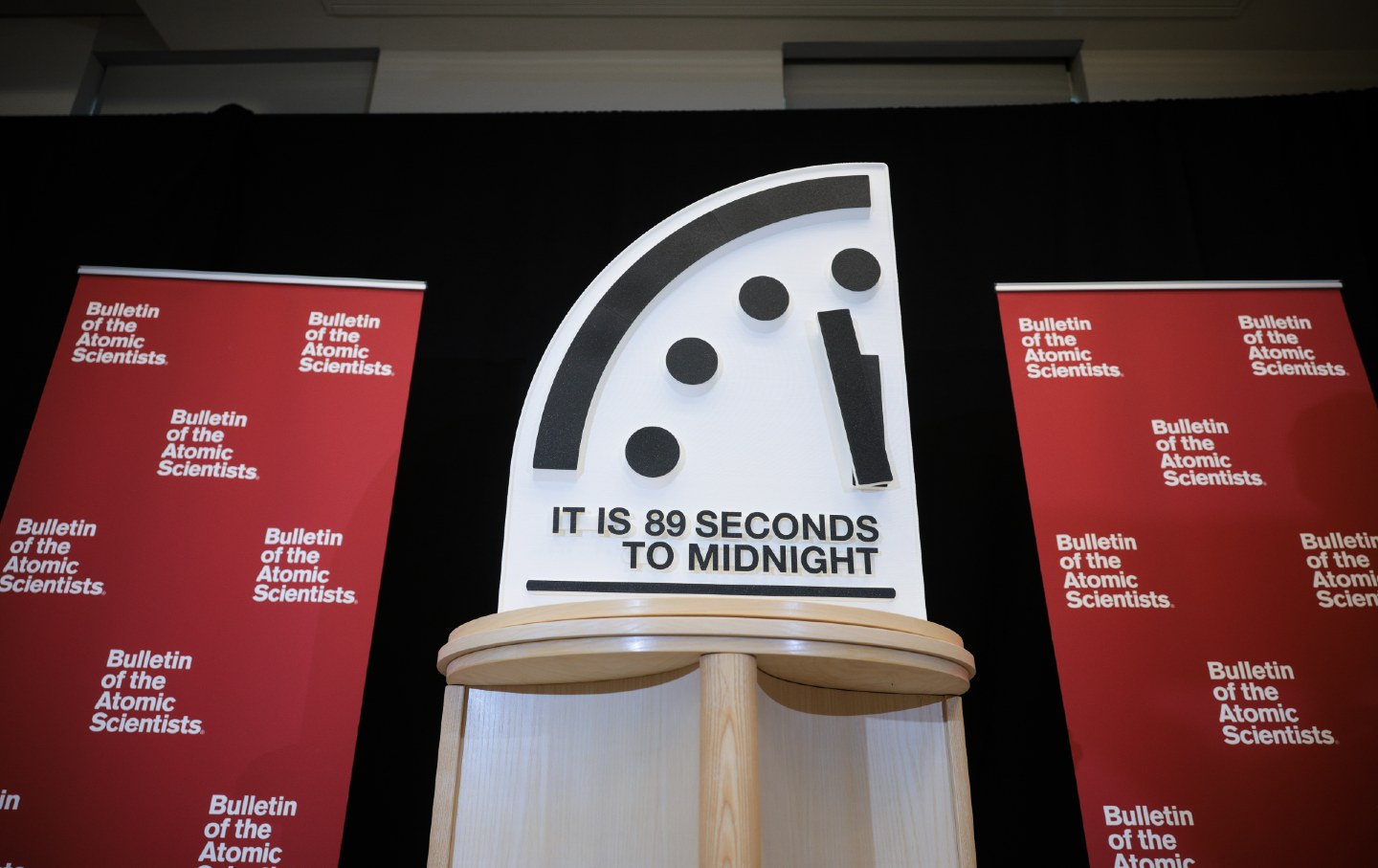
The distance between tough-guy posturing and the start of an actual conflict is too close for comfort. That’s why the Bulletin of the Atomic Scientists’ famous “Doomsday Clock” is now set at 89 seconds to midnight, the closest it has been to catastrophe since the beginning of the nuclear age.
And even as the great powers rush to build a new generation of nuclear weapons, there is no consistent dialogue among Russia, China, and the US about their nuclear postures or nuclear intentions. Meanwhile, nuclear weapons advocates in the US Congress and the conservative think tank world are aggressively pushing for a return to some of the riskiest practices of the Cold War era, from multi-warhead, long-range nuclear missiles to larger stockpiles of tactical nuclear weapons in Europe, to above ground nuclear testing. These measures risk dragging us back to the attitudes that prevailed in US national security circles before the peace movement of the 1980s transformed Ronald Reagan from the man who called the Soviet Union the “evil empire” and joked that the bombing would start in five minutes to the one who publicly acknowledged that “a nuclear war can never be won and must never be fought.”
Before public pressure soured Reagan’s opinion of the utility of nuclear weapons, there were some extraordinary statements made about nuclear war being “survivable.” For example, Colin Gray and Keith Payne teamed up for an infamous 1980 article in Foreign Policy titled “Victory Is Possible” in which they claimed that the United States could get through a nuclear war with Russia while losing “only” 20 million people. And Reagan civil defense official T.K. Jones famously told progressive journalist Robert Scheer that “with enough shovels” Americans could dig makeshift shelters—dirt holes with wooden planks on top—to ride out a nuclear conflict. Scheer’s 1982 book prompted by that conversation was a mainstay of antinuclear organizing and education as the peace movement grew in power during the 1980s.
As nuclear hawks push for a return to dangerous Cold War era practices and attitudes, the antinuclear movement is on its back heels, struggling to raise funds and generate attention amid the fusillade of horrific acts emanating from Moscow, Tel Aviv, Washington, and other global capitals. Genocide in Gaza, ongoing wars in Ukraine and Sudan, simmering trade wars, real-time ravages of climate change, rising authoritarianism, and growing global inequality are causing widespread devastation and trauma, leaving many people feeling powerless to push back in any meaningful fashion. In this political environment, with lives at risk on a daily basis, getting people to focus on the risk of a nuclear confrontation is a hard sell.
But from the ban-the-bomb movement of the 1950s and ’60s to the vibrant peace movement of the 1980s, people have risen to the occasion before, reining in the nuclear arms race and reducing global nuclear arsenals.
To be effective, a new antinuclear movement will have to be woven into the fabric of a society-wide drive for peace and social justice writ large, in which organizations concerned with specific threats to our common future make common cause, all the while respecting each other’s unique priorities and perspectives. We need to build a new community of advocates and organizers on a global scale that can survive the current assault on our lives and livelihoods while putting forth a robust vision of a more just, more tolerant, more joyful future. We need the patience to build relationships among people and organizations working on parallel tracks while being mindful of what Dr. Martin Luther King Jr. described as “the fierce urgency of now.”
As evidenced by the turnout at the “No Kings” demonstrations and the increase in courageous voices of resistance that refuse to be intimidated by neo-McCarthyite tactics, people are beginning to find their footing in the face of the relentless assault on basic rights and basic decency emanating from the current administration in Washington. The struggle for the future of America and the world is on, and no one can afford to sit on the sidelines.
Support independent journalism that does not fall in line
Even before February 28, the reasons for Donald Trump’s imploding approval rating were abundantly clear: untrammeled corruption and personal enrichment to the tune of billions of dollars during an affordability crisis, a foreign policy guided only by his own derelict sense of morality, and the deployment of a murderous campaign of occupation, detention, and deportation on American streets.
Now an undeclared, unauthorized, unpopular, and unconstitutional war of aggression against Iran has spread like wildfire through the region and into Europe. A new “forever war”—with an ever-increasing likelihood of American troops on the ground—may very well be upon us.
As we’ve seen over and over, this administration uses lies, misdirection, and attempts to flood the zone to justify its abuses of power at home and abroad. Just as Trump, Marco Rubio, and Pete Hegseth offer erratic and contradictory rationales for the attacks on Iran, the administration is also spreading the lie that the upcoming midterm elections are under threat from noncitizens on voter rolls. When these lies go unchecked, they become the basis for further authoritarian encroachment and war.
In these dark times, independent journalism is uniquely able to uncover the falsehoods that threaten our republic—and civilians around the world—and shine a bright light on the truth.
The Nation’s experienced team of writers, editors, and fact-checkers understands the scale of what we’re up against and the urgency with which we have to act. That’s why we’re publishing critical reporting and analysis of the war on Iran, ICE violence at home, new forms of voter suppression emerging in the courts, and much more.
But this journalism is possible only with your support.
This March, The Nation needs to raise $50,000 to ensure that we have the resources for reporting and analysis that sets the record straight and empowers people of conscience to organize. Will you donate today?
More from The Nation
Israel Is Using Its Genocidal Gaza Playbook on Iran Israel Is Using Its Genocidal Gaza Playbook on Iran
Just as in Palestine, the Israeli government is framing its latest conflict as a holy war of extermination.

Trump and His Soulless Cronies Have Managed to Suck the Joy Out of the World Cup Trump and His Soulless Cronies Have Managed to Suck the Joy Out of the World Cup
Not even soccer is immune from Trump’s reverse Midas touch.

Garbage In, Carnage Out Garbage In, Carnage Out
The harrowing lessons of the Pentagon’s recently dissolved partnership with Anthropic.
The Iran War Could Be Catastrophic for the US-Israel Alliance. Good. The Iran War Could Be Catastrophic for the US-Israel Alliance. Good.
As Israel’s role in pushing the war with Iran comes into ever sharper focus, it’s up to us to turn outrage into change.
An Unlawful War An Unlawful War
The precedent being set by the US in launching this war of aggression against Iran will long live in infamy.
Trump and Netanyahu Want to Turn Iran Into a Failed State Trump and Netanyahu Want to Turn Iran Into a Failed State
This war looks designed to cause maximum chaos and instability. The world will pay a high price.

