The View from Moscow
It’s complicated.
Moscow—Vladimir Putin’s alleged ability to manipulate US elections in favor of his secret soul brother Donald Trump has been an enduring meme in American media discourse for almost a decade. So, as one of the few correspondents for a US newspaper still based in Moscow, I was a bit surprised when absolutely no one called me up from North America in the wake of Trump’s big electoral victory to ask what the Russians are thinking about it. Are they dancing in the streets? Is Putin looking jubilant, and likely hatching schemes to exploit this new asset in the Kremlin’s service?
It’s complicated, would have been my cautious answer. There is no doubt that the Russians remain deeply fascinated with US politics, and the unusual, even disorderly spectacles of the past several months held the full attention, often laced with schadenfreude, of both the official press and the more freewheeling social media. The Kremlin clearly believes that the US is its main adversary in the world. Russian public opinion, once very pro-American, has turned surprisingly unfriendly.
A lot has changed since 2016, when the entire State Duma, Russia’s lower house of parliament, famously erupted in a spontaneous standing ovation at the news that Trump had defied the odds and defeated Hillary Clinton—who once described Putin as behaving “like Hitler.” Then, most of Russia’s foreign policy experts supposed that Trump would follow through on his vague pledges to “get along” with Putin and put an end to what they saw as an abnormal freeze in US-Russia relations that had followed the Ukrainian Maidan revolt and Russia’s subsequent annexation of Crimea.
The most important difference from those days is that the Russians have already endured one full White House term of Trump, which one Russian diplomat who deals with US relations told me was “the worst four years of our lives.” Moscow had hoped that Trump might discuss capping NATO’s eastward expansion, and perhaps nudge Kyiv to implement the Minsk Accords. That would have enabled Ukraine to peacefully reintegrate its territory [minus Crimea], and maintain its sovereignty, albeit as a neutral buffer zone between Russia and the West, something like Finland during the Cold War. Those, at least, were the Russian hopes.
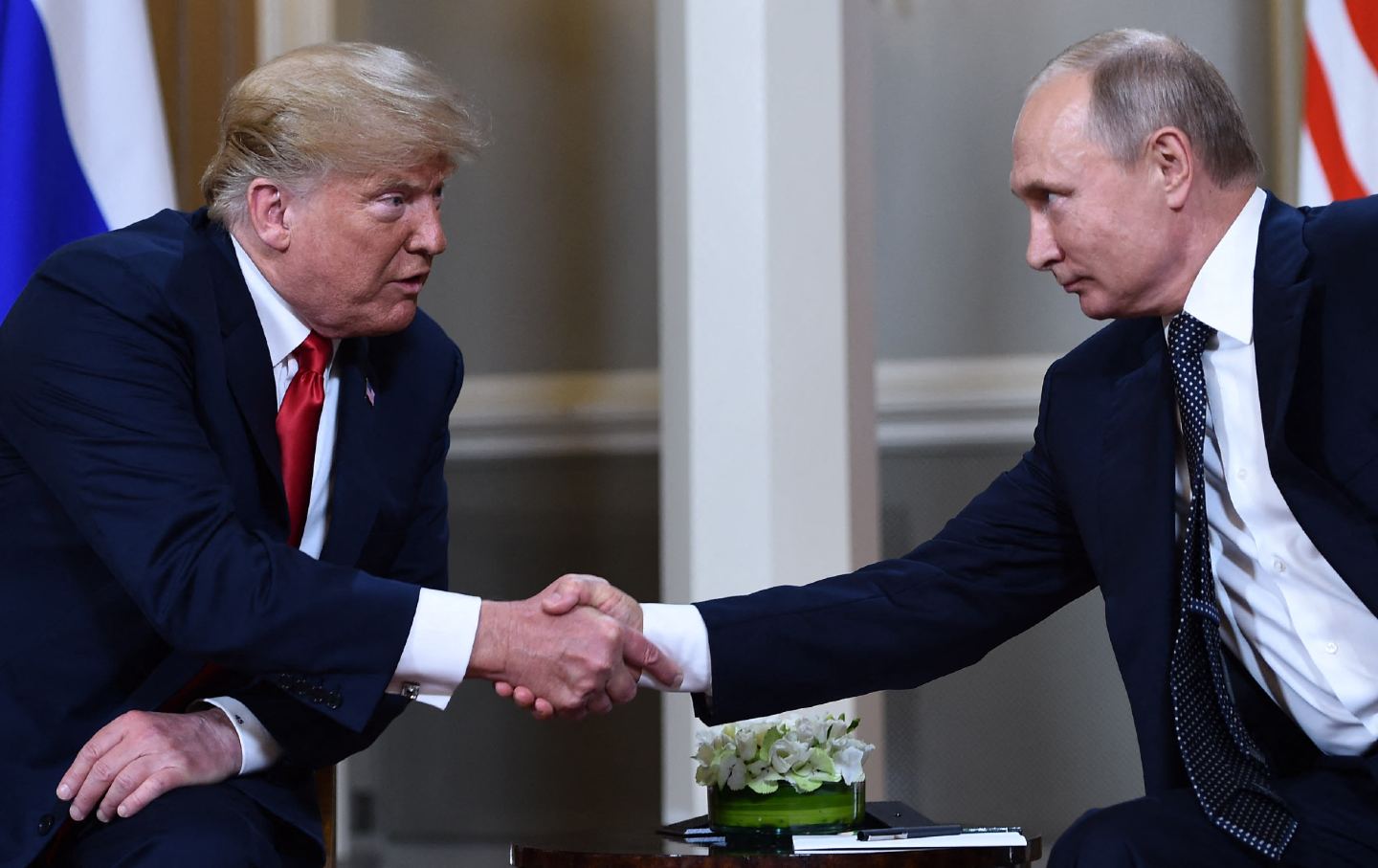
Instead, Trump ramped up sanctions on Russia and delivered lethal military aid to Ukraine. Russian foreign policy hands recall the 2018 Helsinki Summit with a shudder. The idea in Moscow was that the meeting might end the downward spiral in relations by reaching some broad understandings on tension-generating issues like arms control, Syria and Ukraine. Instead, the US media’s obsession with Trump’s apparent acceptance of Putin’s word that Russia hadn’t interfered in the US election, instead of his believing US intelligence agencies, became the only takeaway the summit is remembered for. Viewed through Moscow’s lens, Trump’s first term was a nonstop clown show that made everything so much worse than Clinton’s categorical and predictable hostility could possibly have done.
That goes far in explaining why official Moscow displayed little reaction to Trump’s stunning comeback. Putin took a couple days before offering congratulations, and he did so at the Valdai Conference, before an audience of international academics and journalists. As for holding talks, especially about Ukraine, Putin cautiously indicated that he was open to hearing what the man has to say. Russia’s foreign ministry issued a statement saying it has “no illusions” that Trump will change what it views as the wired-in anti-Russia stance of US foreign policy.
The other remarkable shift is that Russia has abandoned all previous hopes of repairing relations with the West, or at least with the United States. Russian diplomatic resources are now largely devoted to developing ties with what is referred to, without much exaggeration, as the “Global Majority.” The main vehicle for that is the BRICS+, an economically focused association that’s doubled in size in the past year, and has dozens of African, Latin American and Asian countries lining up to join. The group held a lavish summit in Kazan, Russia, in October. While most of its participants are not ready to sign on to the full anti-Western agenda favored by Russia and Iran, they are friendly to Russia, neutral on the Ukraine war, and eager to pursue the kind of economic ties that are already confounding US-led sanctions against Russia and others.
As for the war in Ukraine, it’s a very painful reality, and the Kremlin might indeed welcome a bit of outside help to solve it. Back in September, at a meeting of Far Eastern countries in Vladivostok, Putin appealed to powers like India, China, and Brazil, to step in and offer terms of mediation. Otherwise, the Russians seem grimly determined to win the war on the battlefield, and there’s nothing in current news reports to suggest they won’t eventually succeed. No one in Moscow appears to be waiting for Donald Trump’s intervention.
I recently asked Andrei Klimov, deputy chair of the international committee of Russia’s upper house of parliament, if he thought Trump’s victory would make any difference for Russia’s foreign policy calculations. He said it certainly would, because where Joe Biden was a “pro-Western” leader, Trump is a “pro-American” one. He left me to decipher that, but it didn’t sound like he believes anything will get easier.