The Hague Group Must Become a Global Initiative
The formation of The Hague Group is a critical step toward saving the international legal order. More states need to follow through to ensure the end of systemic impunity.
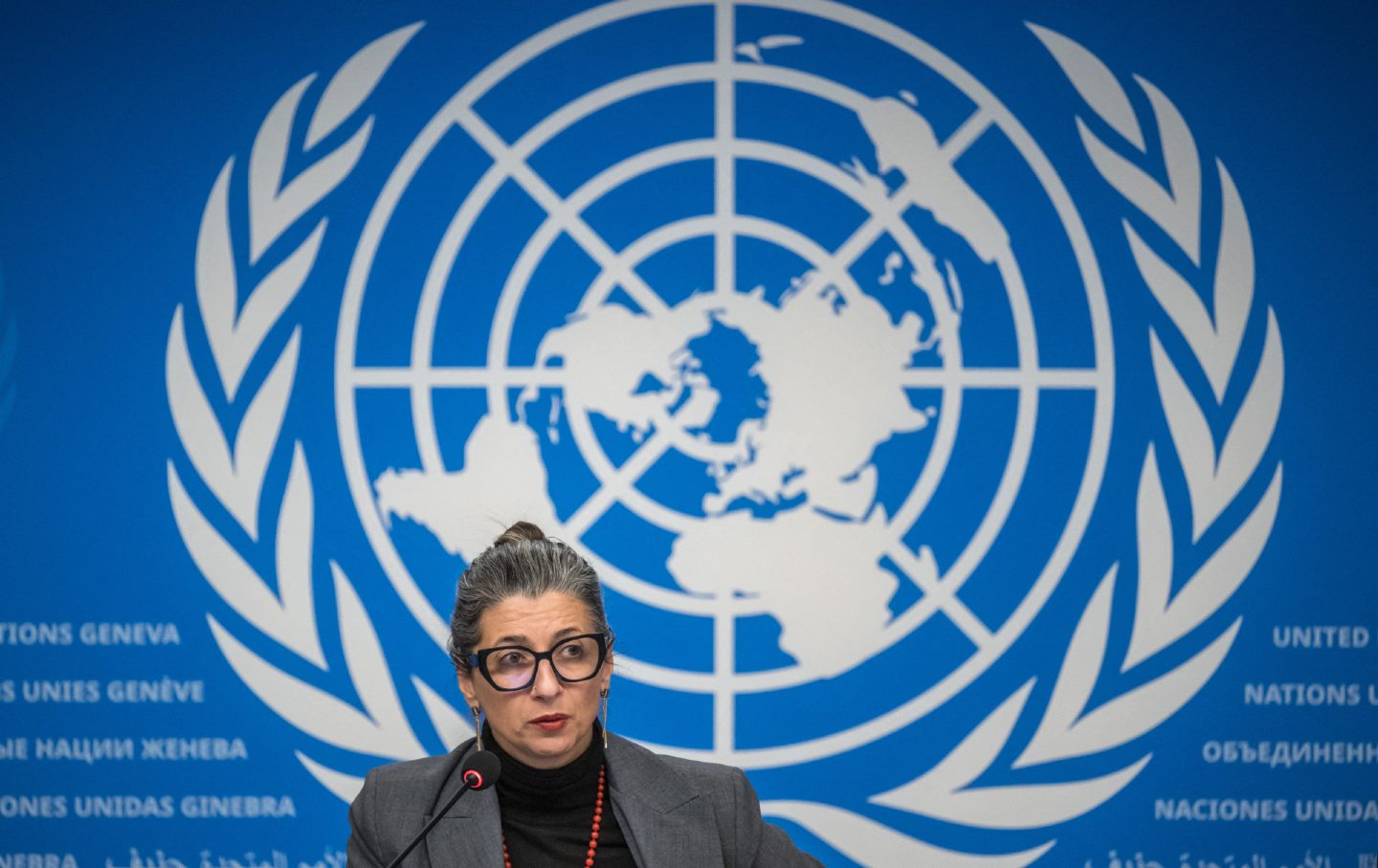
Francesca Albanese, United Nations Special Rapporteur on the occupied Palestinian territories, holds a press conference in Geneva on December 11, 2024.
(Fabrice Coffrini / AFP via Getty Images)
In Palestine, that abuses and violations of international law have become normalized is a fact. That impunity has been the rule, rather than the exception, over the course of the 76 years since Israel’s founding is another fact. And still, after 15 months of Israel’s brutal, revengeful assault on Gaza and its more than 2 million entrapped inhabitants, Palestine is at a climax. The catastrophic destruction of the entire landscape, the creation of conditions of life calculated to lead to the destruction of life, the attempted crushing of human dignity, have ushered in a new era: that of genocide, televised and livestreamed for the whole world to see.
Yet what we have seen in Gaza, and what we see now increasingly facing the West Bank, is not just a criminal assault against the Palestinians as a people—it is the erosion of the very protection function of international law and dangerous regression of the multilateral system, created to prevent conflict and protect civilian life. It is the creation of a world without civilians, where everyone and everything is either a target or collateral damage, and hence killable or destroyable.
Thus, after the Gaza genocide, international law stands at a precipice: If the laws that have been written as universal, to be applied equally to the strong and the weak, become systematically violated in defense of particular geopolitical interests, then the entire international legal system, premised upon the equality of all nations, is threatened—for all peoples.
In light of these developments, the tri-continental initiative launched in The Hague by nine states committed to holding Israel to account for its assault on Palestinian collective existence could not be more timely. The commitments that the group has set for this collective effort—upholding domestic legal mechanisms following the International Criminal Court’s arrest warrants, refusing harbor, and imposing an arms embargo—are part of the most fundamental obligations that all states have under international law in light of Israel’s long-standing crimes in the occupied Palestinian territory. These measures are an essential first step toward solving the question of Palestine, or “the Israel-Palestine conflict,” in line with international law.
Yet a solution will never be in reach until Israel’s sustained impunity comes to an end. Despite the efforts of the Palestinian people and some committed Israelis, the situation cannot be changed from inside Israel. International action is needed.
This is the task that confronts all states now. States have binding legal responsibilities in the face of protracted violations of international law, as is the case with Israel’s unlawful occupation and annexation of the occupied Palestinian territory, the apartheid regime it has imposed on the Palestinians, and, most recently, the genocide in Gaza. In light of the gravity of Israel’s actions, states are called upon to terminate all economic relationships, trade agreements, and academic relations with Israel. Such relationships would otherwise constitute aid and assistance for an internationally wrongful act. Under the law of state responsibility, states are required to cooperate to end through lawful means the breach in question—in practice, this means that all member states of the United Nations must cut all relations with Israel so long as it continues to oppress the Palestinian people. It is an obligation that is all the more urgent with the reprieve of a tenuously negotiated ceasefire.
In this crucial moment, The Hague Group sets an excellent example to other states as to how they can comply with their obligations under international law. The states that have signed on to the initiative—Belize, Bolivia, Colombia, Cuba, Honduras, Malaysia, Namibia, Senegal, and South Africa—are states with a history of consistent and principled commitment to the Palestinian question. These are also states that carry the wounds of a painful colonial past as well as the struggle for human rights that ensued. Their decision sets a powerful precedent, and I personally applaud these countries for their courage.
The states that have founded The Hague Group are leading the way in what must become a global push for collective action through international law—no arms for genocide, no aid for occupation, and no tolerance for apartheid.
I trust that more states will soon join this group. The purpose of The Hague Group is to end Israel’s exceptionalism and to make sure that what Israel has done in the past 15 months does not become the new normal for states for the years to come.
In the same fashion that states around the world united to end apartheid in Southern Africa, now the international community must come together to ensure the end of one of the most brutal apartheid regimes in history. If we are to salvage an international legal order in this current moment and move toward one in which imperialism and colonization do not continue to dictate its application, the international community, and the Palestinians most of all, must see this initiative grow.