After Imran Khan’s Arrest, Pakistan’s National Assembly Is Dissolved
The former prime minister was detained and convicted on Saturday. By Wednesday, the lower house of Parliament had been disbanded.
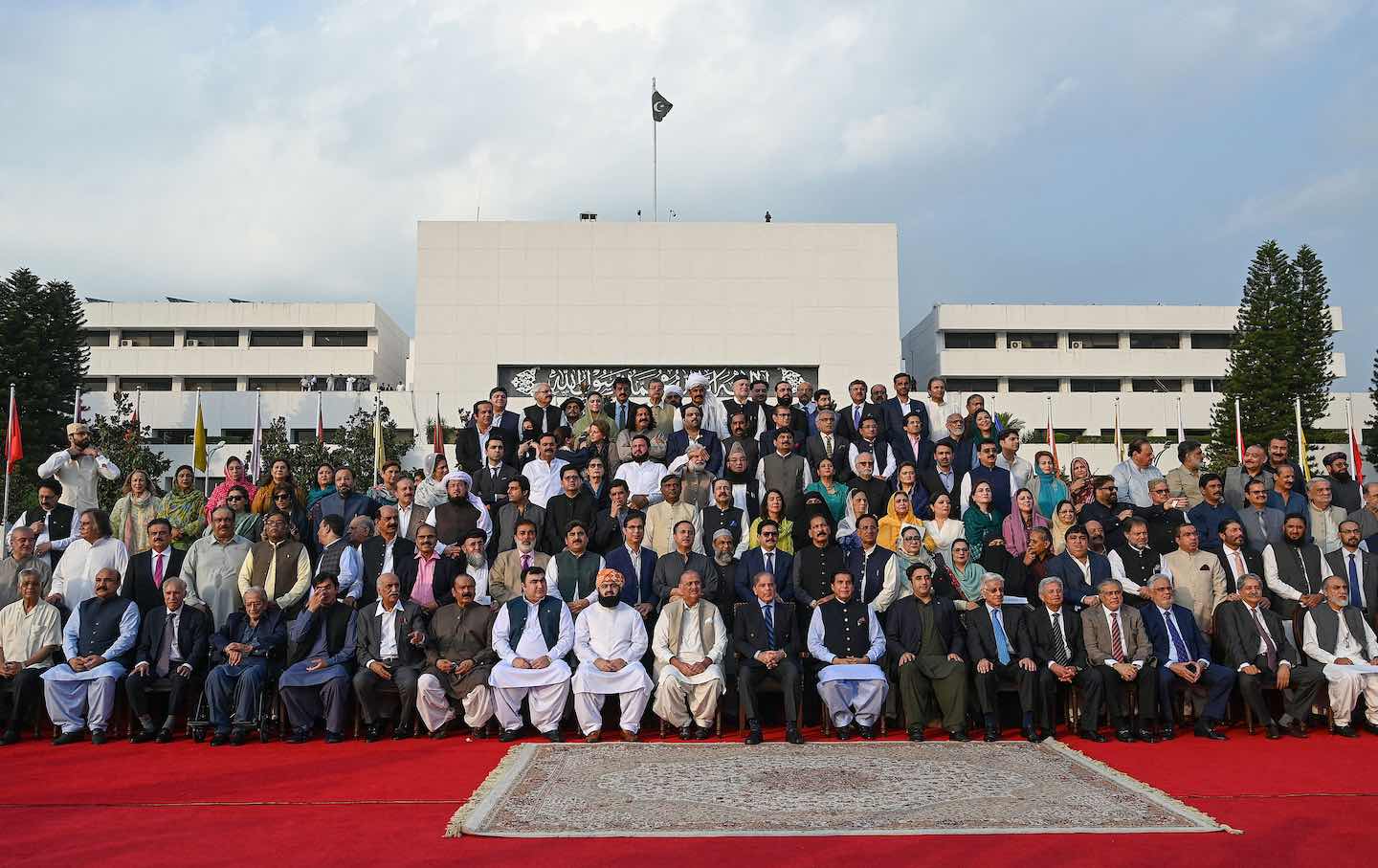
On Wednesday afternoon, in the anteroom of Islamabad’s Parliament house, Shahid Khaqan Abbasi expressed his shame at having been part of “the worst assembly” in Pakistan’s history. In the farewell session that followed before the assembly was finally dissolved, it was easy to see why the member of Parliament—and former prime minister himself—had reached this conclusion. More than a hundred seats remained vacant throughout the session, some 15 months after the then-recently ousted prime minister Imran Khan instructed members of his party to resign en masse in protest.
But it was a Parliament of empty seats long before their resignations. The election of Khan in the summer of 2018 had ushered in a period of “hybrid democracy,” when decisions were principally taken by the leadership of the Pakistan Army and defended by the civilian facade of the Khan-led government, which became increasingly reliant on governing through a series of ordinances. Human rights activists and civil society watched with horror as one member after another from the then-opposition, including Khan’s eventual successor, Shehbaz Sharif, were either thrown in jail or harassed by the National Accountability Bureau, an ostensibly anti-corruption agency that the military has used to coerce politicians. At the time, Khan was boastful of his involvement in their persecution. Five years later, he is the one who finds himself in jail on dubious charges, with his party crushed by the Pakistan army and his supporters cowed by the fear of persecution.
Hours after the lower house of Parliament was dissolved, The Intercept published the text of a diplomatic cable sent by the then–Pakistani ambassador to the United States, Asad Majeed Khan, detailing a meeting on March 7, 2022, with State Department official Donald Lu, in which the United States is alleged to have applied pressure for Khan’s removal. It will not come as a revelation to readers of The Nation that the US has had a long history of meddling in the affairs of other countries and of instituting regime change either by force or coercion. But it would be strange for the State Department, which has had a direct line to the Pakistan Army for more than half a century, to use diplomatic channels—in this case an ambassador who was certain to report the meeting to the prime minister—to apply this pressure if it were involved in a genuine conspiracy. What complicates this story even further is that the United States has become something of a base for Khan-supporting dissidents lobbying against the Pakistan Army and the coalition government it helped cobble together after toppling Khan’s government.
In an interview with The Nation at the end of June, Khan himself seemed to suggest that the US pressure had come as the result of a secret lobbying effort launched by Gen. Qamar Javed Bajwa, the chief of Pakistan’s powerful army when the cable was sent. What is certain is that relations between Khan and the top brass of the Pakistan army had broken down at least four months before his visit to Russia, which took place on the eve of the Ukraine invasion and was cited by Lu as the reason for Washington’s anger.
After the military helped remove Khan through a vote of no confidence in April 2022, it was hoped that Pakistan would experience something of a reset. Some commentators opined that the army had acknowledged its mistake in launching “Project Imran,” and that by removing its support for the former premier, had created the conditions for a return to the democratic norms of the decade before his victory. Instead, the coalition government headed by Prime Minister Sharif decided to forge a new consensus with the generals in Rawalpindi, and whatever democracy had been left at the end of the Khan premiership was trampled underfoot as a form of appeasement. In the last month of the assembly’s tenure, more than a hundred pieces of legislation, including amendments to the Official Secrets Act that seem designed to prosecute Khan, have been bulldozed through Parliament without debate or opposition.
Khan and his party have been accused of trying to foment a coup against the chief of army staff, Gen. Asim Munir, after thousands of Khan’s supporters laid siege to military installations in the aftermath of his arrest on May 9. Since then, the military establishment that brought Khan into power in 2018 has done everything it can to erase him from the political process. Virtually the entire top leadership of Khan’s party, the Pakistan Tehreek-e-Insaaf, has been forced to defect, with a rival party being created from scratch to absorb these politicians. Khan himself has been convicted of corruption in a case relating to his disposal of state gifts and the alleged concealment of his assets. Now that the National Assembly has been dissolved, the Constitution stipulates that general elections must be held by November, at the latest—but there is no one in Pakistan who expects this to happen. Rather, it is believed that a caretaker setup of technocrats will be allowed to govern for as long as it takes to purge the political system of Khan’s influence and to ensure that he will no longer be able to control what remains of his party.
That may yet be a very long time. The caretaker government in the Punjab, for instance, which came in after Khan dissolved the provincial assembly, has been in power for much longer than the Constitution permits. In that time, it has seen it fit to lease more than a million acres of state land to the army for corporate farming and has been criticized by the judiciary for exceeding its constitutional mandate. But then the Constitution, for the real decision makers in Pakistan, has always been seen as a mere piece of paper and democracy as a tiresome inconvenience.
At the end of this five-year term of the National Assembly, one wonders if the same might not be said about the country’s politicians.
Support independent journalism that does not fall in line
Even before February 28, the reasons for Donald Trump’s imploding approval rating were abundantly clear: untrammeled corruption and personal enrichment to the tune of billions of dollars during an affordability crisis, a foreign policy guided only by his own derelict sense of morality, and the deployment of a murderous campaign of occupation, detention, and deportation on American streets.
Now an undeclared, unauthorized, unpopular, and unconstitutional war of aggression against Iran has spread like wildfire through the region and into Europe. A new “forever war”—with an ever-increasing likelihood of American troops on the ground—may very well be upon us.
As we’ve seen over and over, this administration uses lies, misdirection, and attempts to flood the zone to justify its abuses of power at home and abroad. Just as Trump, Marco Rubio, and Pete Hegseth offer erratic and contradictory rationales for the attacks on Iran, the administration is also spreading the lie that the upcoming midterm elections are under threat from noncitizens on voter rolls. When these lies go unchecked, they become the basis for further authoritarian encroachment and war.
In these dark times, independent journalism is uniquely able to uncover the falsehoods that threaten our republic—and civilians around the world—and shine a bright light on the truth.
The Nation’s experienced team of writers, editors, and fact-checkers understands the scale of what we’re up against and the urgency with which we have to act. That’s why we’re publishing critical reporting and analysis of the war on Iran, ICE violence at home, new forms of voter suppression emerging in the courts, and much more.
But this journalism is possible only with your support.
This March, The Nation needs to raise $50,000 to ensure that we have the resources for reporting and analysis that sets the record straight and empowers people of conscience to organize. Will you donate today?