Narendra Modi Learns That Not Even Trump Respects a Bootlicker
The Indian prime minister discovers that the world’s biggest bully sees fawning as weakness.
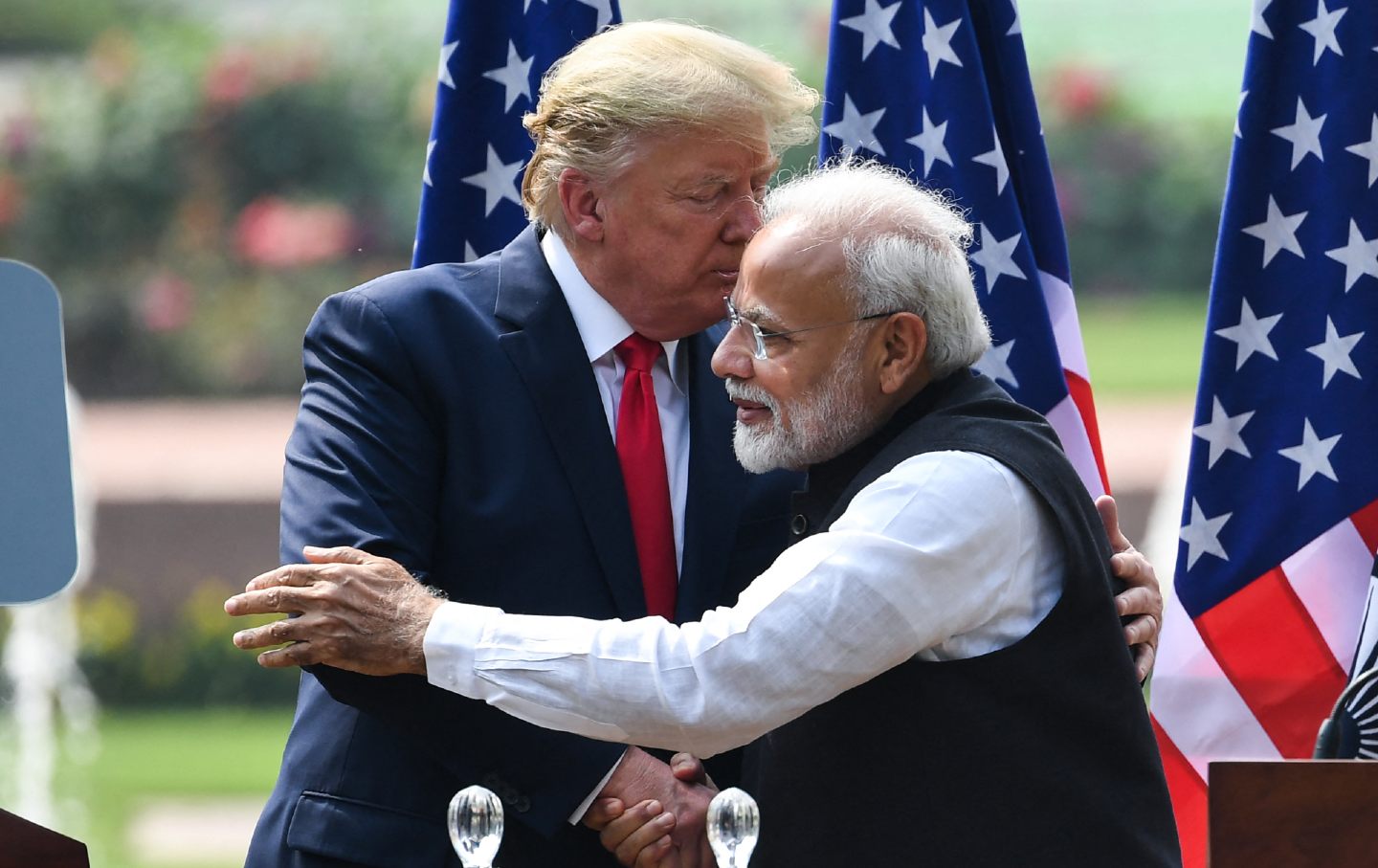
President Donald Trump shakes hands with Indian Prime Minister Narendra Modi during a joint press conference in New Delhi on February 25, 2020.
(Prakash Singh / AFP via Getty Images)Donald Trump has created a new golden age of sycophancy. The White House now resembles Versailles under the absolutist monarchs or Beijing’s Forbidden City under the emperors. CEOs and foreign leaders are lining up to butter up the US president. On Thursday, Tim Cook, the CEO of Apple, presented Trump with exactly the sort of shiny object that tickles his fancy: a glass plaque on a 24-karat gold stand, which Cook described as “a unique unit of one.” While the plaque was no doubt an expensive gift, it was a small price to pay for keeping the special tariff exemptions that Trump has been giving to Apple. Thanks to Congress’s abdicating its constitutional duty, Trump essentially has unilateral power to set tariffs, and he uses this authority to threaten companies and nations. To stave off the president’s ire, they offer simpering compliments and baubles.
Few world leaders have played the game of toadying to Trump as assiduously as Indian Prime Minister Narendra Modi. In 2019, Trump and the Indian leader met in Houston for the massive “Howdy Modi” rally, which attracted more than 50,000 attendees. The meeting was both a campaign event (designed to help Trump win the fast-rising Indian American vote) and a chance to cement the ties between the two countries. At that rally, Modi called Trump his “true friend in the White House.” The following year, Trump visited India for an even larger event called “Namaste Trump,” which drew at least 100,000 people. These events were designed to forge ties that were both personal and ideological. Modi is often described as India’s counterpart to Trump. Both men are authoritarian populists who have built their coalitions by attacking migrants and minority groups. In governing style, both men are wheeler-dealers, with a strong faith in their ability to make personal connections that can overcome diplomatic disputes. In February, Modi was one of the first foreign leaders to visit the White House and spoke passionately about his “great friendship” with Trump. At that meeting, Trump and Modi promised to double trade between the two countries.
On Wednesday, Modi and the Indian government learned how little friendship with Trump is worth when the president took to social media to announce his intention to impose steep tariffs of 50 percent on India. Time points out that these are “among the steepest U.S. levies of any nation.” This injury was combined with an insult that is especially likely to sting in India, an emerging power with an elite that is self-conscious about how they are perceived by the larger world. The immediate pretext for the tariffs was that India was buying Russian oil. With passive-aggressive spite, Trump wrote on Truth Social, “I don’t care what India does with Russia. They can take their dead economies down together, for all I care.”
The Indian government responded that this criticism is selectively and capriciously applied. It’s true that the country buys Russian oil, but that’s something it was encouraged to do by the United States as recently as last year because it would help stabilize the global energy market. Further, the European Union continues to do more trade with Russia than India does.
The Indian government is on solid ground in arguing that it is being picked on by Trump administration as an easy target. Trump has been under pressure from NATO allies to do more to help Ukraine, and India, as a midlevel power, makes a convenient punching bag.
In going after India, Trump is subverting decades of efforts to build closer ties between the world’s two largest democracies. During the Cold War, India and the United States had chilly relationships because the US supported Pakistan as a bulwark against communism while the subcontinent pursued a policy of independency and neutrality. But starting in the 1990s, the United States adopted a bipartisan policy of moving closer to India, now seen as a potential Asian counterpart to a rising China.
Trump’s turn against India has less to do with Russia than with the personal pique of a president who is easy to take offense when he feels his insatiable amour propre has been insulted. India and Pakistan had a brief military clash in May. After the two countries reached a ceasefire, Trump tried to claim credit as the broker of the peace. This is in keeping with his habit of wanting to be seen as an indispensable global leader, but India viewed it as an insult to its national sovereignty. Modi and Trump had a lengthy phone conversation on the matter on June 17, which Bloomberg describes as “tense.”
Bloomberg further reports:
Although the US never made a direct request for Modi to acknowledge Trump’s role in the ceasefire, India saw a shift in tone from the White House after that phone call, according to the officials in New Delhi. Once Trump began publicly attacking India, they added, it was clear the episode marked a turning point in the broader relationship.
Trump’s mercurial, personality-based diplomacy is likely to lead to a long-term chilling of the relationship with India. Some in India are contrasting Trump’s instability with the much calmer relationship India has enjoyed with Russia over many years. The New York Times notes that Modi domestically has “faced a storm of criticism over the Trump administration’s treatment of India.” Navdeep Suri, who had served as India’s high commissioner to Australia, told Bloomberg, “The Russia relationship is old, time-tested. All those days when the US was letting New Delhi down, including at the United Nations, Moscow stood behind India like a rock. Oil is a small part of the current story. India won’t like to be seen as capitulating under pressure.”
One consequence of Trump’s slap in the face is that the Indian government is stepping up its efforts to improve ties with China, despite having fought a border clash with this neighboring country as recently as 2020. Significantly, Xu Feihong, China’s ambassador to India, used Trump’s latest tariff hike to draw a lesson by tweeting, “Give the bully an inch, he will take a mile.”
Xu’s comments get to the heart of the matter. Trump is a bully. His tariff policy, although dressed in rhetoric about reshoring and national security, has little or no strategic basis. It is designed only to feed Trump’s never-satisfied ego. While flattering Trump has become a preferred strategy of many nations, there is little evidence that it works. In fact, like many bullies, Trump is more respectful of those who fight back. China, which has taken a firm line in defense of its national interests, is doing better at trade negotiations with the United States than India is.
For a middle power like India, the best way to deal with Trump is not flattery or fake bonhomie. Trump has no real friends, only abject cronies. A better path is to work out trade deals with other large economies such as China, Brazil, or South Africa. Such a policy would hark back to India’s Cold War strategy of building a nonaligned bloc. For that matter, even nominal US allies such as Canada, Mexico, and European Union should think about creating such a bloc. The only way to beat the bully is to create a counter power that can push back. In the age of Trump, flattery will get you nowhere.
Disobey authoritarians, support The Nation
Over the past year you’ve read Nation writers like Elie Mystal, Kaveh Akbar, John Nichols, Joan Walsh, Bryce Covert, Dave Zirin, Jeet Heer, Michael T. Klare, Katha Pollitt, Amy Littlefield, Gregg Gonsalves, and Sasha Abramsky take on the Trump family’s corruption, set the record straight about Robert F. Kennedy Jr.’s catastrophic Make America Healthy Again movement, survey the fallout and human cost of the DOGE wrecking ball, anticipate the Supreme Court’s dangerous antidemocratic rulings, and amplify successful tactics of resistance on the streets and in Congress.
We publish these stories because when members of our communities are being abducted, household debt is climbing, and AI data centers are causing water and electricity shortages, we have a duty as journalists to do all we can to inform the public.
In 2026, our aim is to do more than ever before—but we need your support to make that happen.
Through December 31, a generous donor will match all donations up to $75,000. That means that your contribution will be doubled, dollar for dollar. If we hit the full match, we’ll be starting 2026 with $150,000 to invest in the stories that impact real people’s lives—the kinds of stories that billionaire-owned, corporate-backed outlets aren’t covering.
With your support, our team will publish major stories that the president and his allies won’t want you to read. We’ll cover the emerging military-tech industrial complex and matters of war, peace, and surveillance, as well as the affordability crisis, hunger, housing, healthcare, the environment, attacks on reproductive rights, and much more. At the same time, we’ll imagine alternatives to Trumpian rule and uplift efforts to create a better world, here and now.
While your gift has twice the impact, I’m asking you to support The Nation with a donation today. You’ll empower the journalists, editors, and fact-checkers best equipped to hold this authoritarian administration to account.
I hope you won’t miss this moment—donate to The Nation today.
Onward,
Katrina vanden Heuvel
Editor and publisher, The Nation