
A State Crackdown in Pakistan Threatens Continuing Unrest
Protesters in support of Imran Khan’s PTI party were met with obstruction and violence, leading to mounting public outrage.
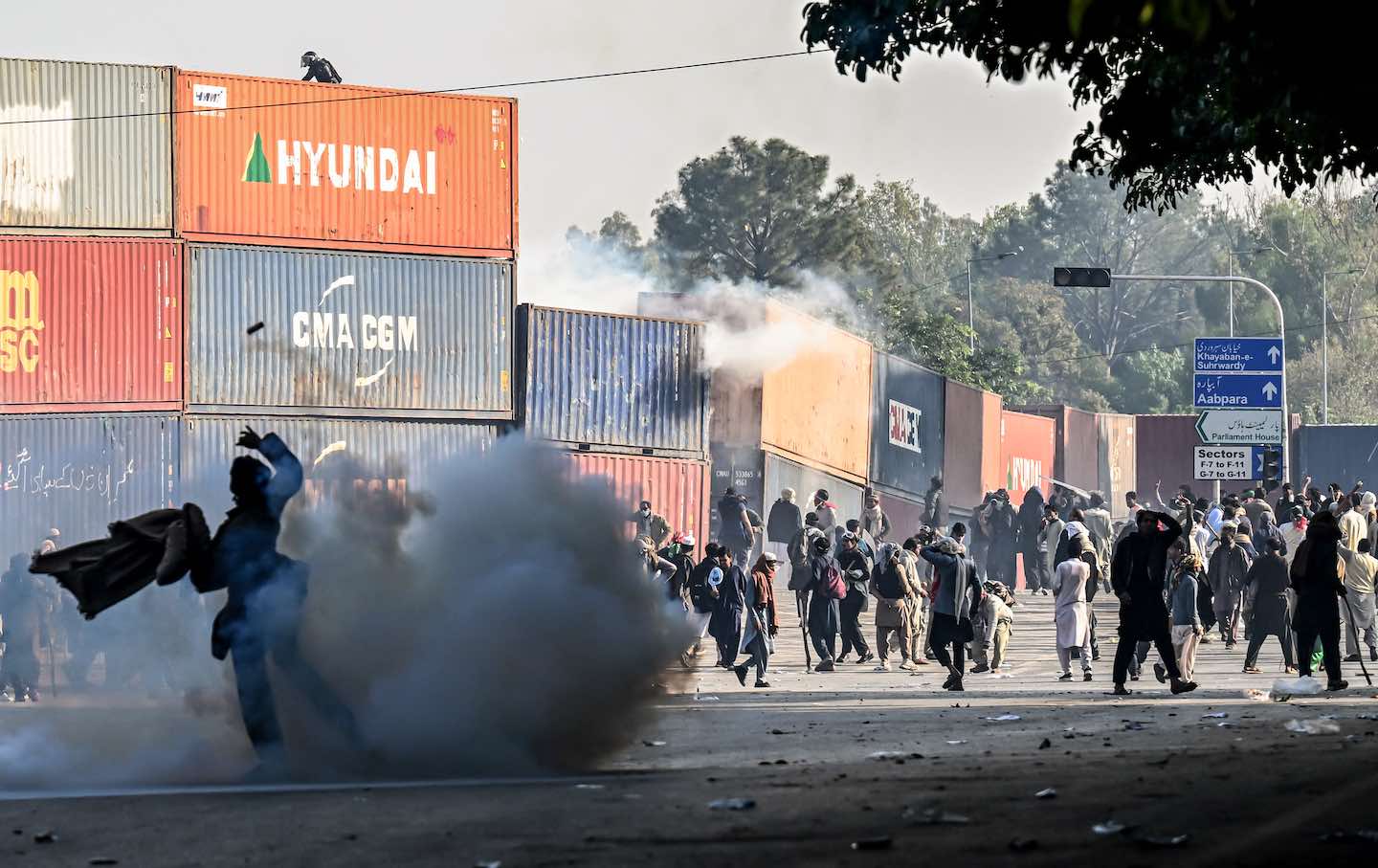
Policemen fire tear gas shells to disperse supporters of the Pakistan Tehreek-e-Insaf party during a protest demanding the release of former prime minister Imran Khan, at the Red Zone area in Islamabad on November 26, 2024.
(Aamir Qureshi / AFP)
Islamabad—On the afternoon of Tuesday, November 26, supporters of Pakistan’s incarcerated former prime minister, Imran Khan, appeared to have won a decisive victory. Mobilized by Khan’s wife, a mysterious faith healer by the name of Bushra, thousands of political workers from the Pakistan Tehreek-e-Insaaf (PTI) marched on the capital to demand his release. Their objective was to reach D-Chowk, a roundabout in the government district of Islamabad that has been likened to Egypt’s Tahrir Square, where they were planning to stage a sit-in and pressure the government. Against all odds, they reached their destination.
In the run-up to the protest, dubbed “the final call” by PTI officials, the government had implemented a number of obstacles to deter the protesters. The twin cities of Rawalpindi and Islamabad were put in a state of lockdown, with shipping containers placed on all the major roads. The motorways linking Islamabad with the rest of the country were also shut down to limit the number of protesters entering the capital. Schools and colleges were closed, and Section 144, a colonial-era law that prohibits public gatherings, was duly imposed.
The “final call” demonstration was the latest in a series of clashes between the PTI and the state after the former cricketer turned politician was removed in a military-sponsored vote of no confidence in April 2022. Though not the first politician to fall afoul of his military benefactors, Khan’s ability to keep his vote bank intact while he’s locked up in a jail cell has caused his political rivals and the military a great deal of embarrassment—not least in February, when candidates affiliated with the PTI won a series of stunning victories in the election.
On Tuesday, having cleared every obstacle in their path, Khan’s supporters were in a jubilant mood. But sometime between 9 and 10 pm, the streetlights in the area were turned off and law enforcement agencies commenced a clear-out operation. Much of what happened next remains a mystery. According to the PTI, snipers deployed on the rooftops of high-rise buildings in the area began to shoot at protesters, leading to the deaths of more than 270 people. The government, however, maintains that not a single round of live ammunition was fired, and that the crowd dispersed when law enforcement began to make arrests.
“PTI was trying to look for bodies here and there,” Information Minister Attaullah Tarar said in an official press conference. “They are in the habit of visiting morgues, for that matter, and in the past we’ve seen that they’ve owned the funerals of ordinary citizens.”
What is certain is that within a couple of hours of the lights going out, the area was cleared and the demonstration put down. Bushra herself fled the scene in haste and has yet to reappear in public. Meanwhile, the police have arrested more than 4,000 people, a number that is expected to rise even further as the crackdown against the PTI continues.
Despite the government‘s claims, it is also clear that some people were shot dead at the scene. Though the numbers are impossible to verify at this stage, a doctor who spoke to the BBC on the condition of anonymity claimed that he had never done so many surgeries for gunshot wounds in a single night. “Some of the injured came in such critical condition that we had to start surgery right away instead of waiting for anesthesia,” he said.
Meanwhile, family members of those killed or injured by the shooting have come forward and given vivid accounts of state brutality. Such is the weight of the anecdotal evidence that even some of Khan’s opponents have agreed that firearms were used. Former prime minister Shahid Khaqan Abbasi, a fervent critic of Imran Khan and the PTI, has claimed that at least two people from his own constituency were murdered at the protest. “How can you justify shooting at protesters?” he said on local television. “And on top of that the government has the brazenness to claim that no one has died. Let the hospitals release their records.”
There has been a heavy police presence at the hospitals nearest the scene, amid accusations of record-tampering and intimidation. On Thursday, November 28, intelligence operatives abducted the renowned investigative journalist Matiullah Jan from the parking lot of the Pakistan Institute of Medical Sciences, the hospital nearest to the PTI protest, where he had gone to find out the number of fatalities in the crackdown.
Hours after Jan’s abduction, he was charged with possession of 246 grams of crystal methamphetamine and sent to jail. The ridiculousness of the charge, along with the fact that Jan was picked up while he was trying to document the number of protesters shot during the operation, has convinced many that the government is being dishonest.
There is also an ironic dimension to this entire episode. Matiullah Jan is the same journalist who in July 2020 was abducted for his reporting, midway through Imran Khan’s controversial premiership. Back then, several members of the current PMLN government, then in opposition, used his case to decry the authoritarianism of the PTI regime. Today, barely any are willing to speak up for him, even though one assumes that they remember what it was like to be on the receiving end of state persecution. Even the false narcotics charge is not without precedent: In July 2019, a similarly bogus case was registered against Rana Sanaullah Khan, a leading politician from the PMLN, who was charged with trafficking 15 kilograms of heroin to Lahore.
Amid the dizzying churn of Pakistani politics, where political parties take turns doing the military’s bidding and journalists are terrorized for holding them to account, there is a sense that the country has never been so broken. There have been crackdowns in the past, but Islamabad has never witnessed anything so brutal.
In addition to the deaths of PTI activists, at least four security officials were also killed.
More from The Nation

Progressives Are Backing Puerto Rican Independence. It’s About Time. Progressives Are Backing Puerto Rican Independence. It’s About Time.
More and more leftists are concluding that statehood for the island is not enough.
The Saudi Phase of the Iran War Signals More Chaos to Come The Saudi Phase of the Iran War Signals More Chaos to Come
The conflict that Donald Trump has repeatedly proclaimed an unequivocal American victory keeps spiraling out of control.
Andy Burnham’s Speech to the Labour Party Conference Could Be the Start of a Positive Social-Democratic Politics Andy Burnham’s Speech to the Labour Party Conference Could Be the Start of a Positive Social-Democratic Politics
But the autumn budget to be released at the end of October will offer needed details.
Why Navi Pillay’s Receiving the Nobel Peace Prize Is So Important Why Navi Pillay’s Receiving the Nobel Peace Prize Is So Important
She believes that human rights and international law are universal principles that must be enforced regardless of violator’s ideology, ethnicity, or geostrategic alignment.
Writing About War as Bombs Fall Writing About War as Bombs Fall
While the Israeli government launched a well-orchestrated offensive of disinformation and hyperbole that would make the illegal permissible in the war on Gaza.

