
The Memo of Understanding That No One Understands
The massive ambiguities in the framework for an Iran peace agreement all leave Tehran with the upper hand.
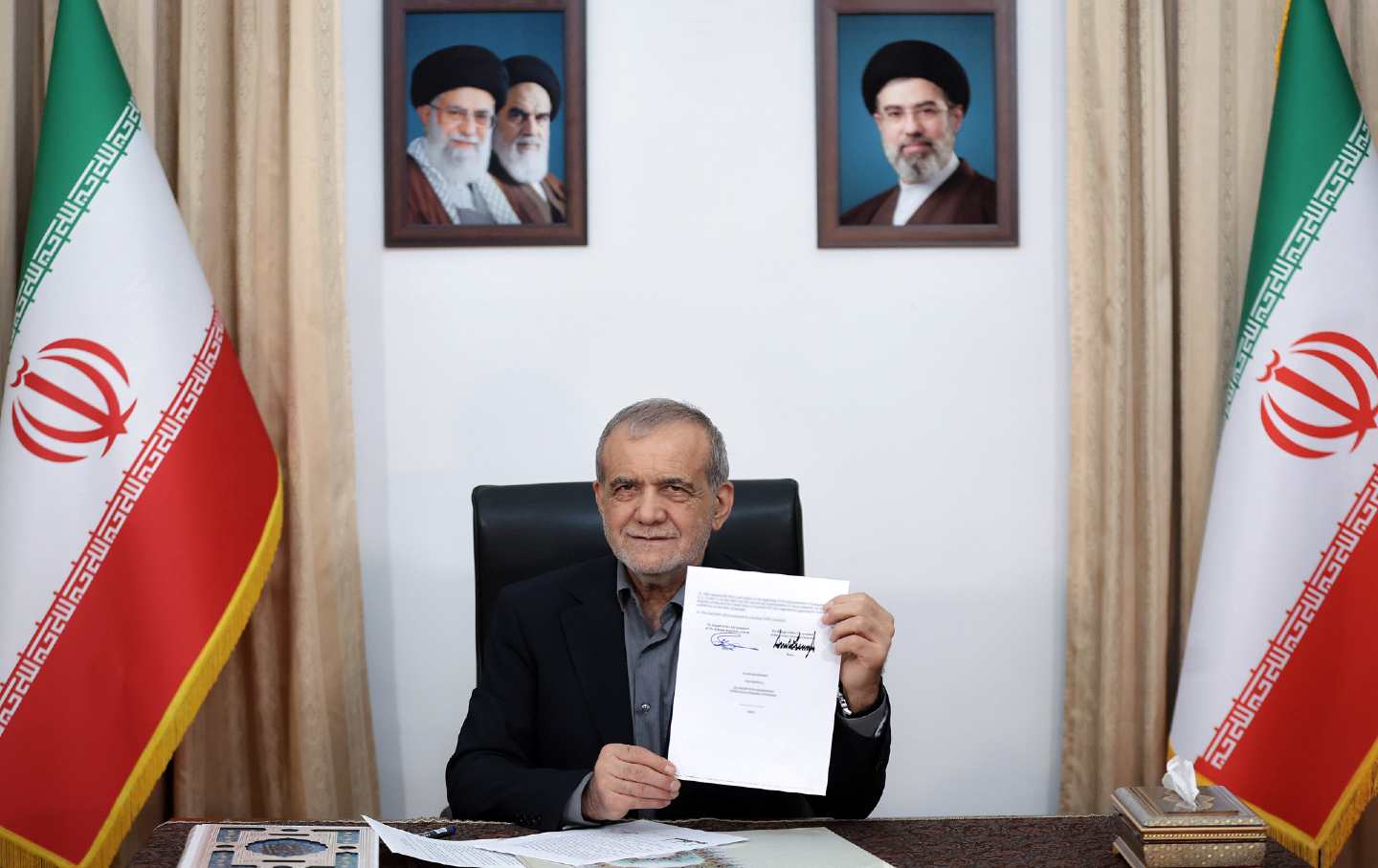
Iranian President Masoud Pezeshkian displays his signed copy of the memorandum of understanding establishing a framework to end the US war with Iran
(Iranian Presidency / Anadolu via Getty Images)Just two weeks after it was signed, the memorandum of understanding between Iran and the United States to wind down Donald Trump’s feckless war is in such serious trouble that diplomats are now gathered in Qatar trying to contain the damage. This, like all the other follies associated with this purblind imperial errand, was an entirely foreseeable development: the agreement-in-process seeks to secure the reopening of the Strait of Hormuz in exchange for near-total American capitulation on decades of policy red lines for the United States, from the empowerment of regional proxies for Iran to the continued development of ballistic missiles and ongoing nuclear-enrichment initiatives.
Still, underneath the daily violence, turmoil, and confusion in and around the Strait, the outline of a settlement remains legible. But it can only be realized if the Trump administration is willing to accept what amounts to a stinging strategic defeat: namely, by transforming the deliberately ambiguous memorandum from a mostly empty piece of Trumpian diplomatic theater into a real, binding document capable of delivering lasting calm.
Given the significant stress that the months-long Hormuz closure placed on international commerce and growth—as well as its role in engineering President Trump’s acute humiliation at hands of bunkered theocrats he had quite recently threatened to eradicate—the stakes are as high as they were when the memorandum won US approval two weeks ago. Yet even though representatives of Iran and the United States spent months putting the agreement together, no one seems to agree on exactly what’s in it. The Americans clearly believe they agreed to lift punishing sanctions on Iran and authorized a release of frozen Iranian assets to the tune of $12 billion in exchange for Iranian forces’ to open the Strait for 60 days. Meanwhile, the Iranians interpret the broad language of the memorandum as granting them the right to dictate shipping routes and attack ships that operate outside of them. To cite an Internet meme from a more innocent time, America sees a white-and-gold dress, and Iran sees a blue-and-black one.
Together with the simmering Lebanon-Israeli conflict, which Iranian negotiators succeeded in formally linking to the memorandum, the precise shape of the Hormuz reopening is emerging as the biggest threat to the framework for an end to the Iran war. This, in turn, presents a major obstacle for Trump and his MAGA allies in the Republican Party, who well understand that they have little choice but to bring the Iran crisis to an end before the US midterm elections in November in order to continue holding power in Congress.
Any fair reading of the actual terms in the memorandum confirms that they lend themselves to these harsh outcomes for American negotiators for one simple reason: the US team got played by their more motivated, clever, and emboldened counterparts. If the memorandum is to lead to a durable settlement, it will be on terms that Tehran could only have dreamed of when the American and Israeli bombing started in February. The only relevant question going forward is whether Trump can accept that his little misadventure failed.
Last weekend’s tit-for-tat violence, which the Trump administration seemingly timed to unfold while markets were closed for the weekend, was caused by Iranian attacks on commercial ships using a US-backed route on the Omani side of the Strait. Iran is insisting that commercial ships wanting to pass through the Strait obtain a permit and then use a route taking them through Iranian territorial waters. This is obviously a violation of international maritime law—yet it also appears to be fully consistent with the document that a cornered President Trump signed in Versailles. Iran’s actions in the Strait are an unmistakable signal that the country intends not just to impose a tolling system on the waterway but also to ensure that ships steer as close to Iran’s shores as possible, in order to secure maximum ongoing leverage. Indeed, exactly such a plan, which Iran created with Oman, was leaked to reporters on Tuesday.
The United States can act surprised and outraged over this post-memorandum maneuvering, but it’s all right there in the document. Point 5 states that “the Islamic Republic of Iran will make arrangements using its best efforts for the safe passage of commercial vessels with no charge for 60 days.” It does not say that Iran must allow ships to take whatever route they pleas—and in fact very clearly gives Iran the right to determine what constitutes “safe passage.” Point 5 also doesn’t specify just what constitutes a “best effort”—a loophole roughly equivalent to an anguished parent’s discovery that there’s no effective way to define what “two more bites” means to a toddler. Meanwhile, the extremely open-ended regime that would almost certainly fall under Iran’s authority after 60-day expiration date on passage without charge would be a source of unmistakable economic pain to ships operating in the region.
The memorandum also called for the “immediate and permanent termination of military operations on all fronts, including in Lebanon.” That sounds eminently reasonable–were it not for the inconvenient consideration that the actual combatants are not party to the understanding. Under great duress from Trump, Israeli Prime Minister Benjamin Netanyahu agreed last week to a flimsy “framework agreement” that the Lebanese government threw together chiefly to give Trump the space to open the Strait of Hormuz, bring down gas prices, and stop inflation from getting any worse. Because the framework conditions an Israeli withdrawal from Lebanon on the successful disarmament of Hezbollah by the shell government in Beirut—a gargantuan task it clearly lacks the capacity to carry out—it will lead to nothing but future conflict.
This is why the “trilateral framework” for an agreement to end the invasion in Lebanon is likely to take its place in the pantheon of Trump’s fake diplomatic achievements, alongside milestones such as the 2018 document that committed North Korea to the “complete denuclearization of the Korean Peninsula” but failed to provide even the outline of a process to achieve such a lofty goal.
Like most of the “deals” and “frameworks” and “breakthroughs” that President Trump has bragged about over the years, the Iran memorandum is heavy on vapors and vibes and very light on the kind of precise terms that can keep the peace. These are documents whose fundamental purpose is stage management and narrative-building rather than conflict resolution. They are the diplomatic equivalent of shoving clutter under the bed instead of cleaning the room.
Consider, for example, that virtually nothing of substance has happened since the “deal” to end Israel’s genocide in Gaza while more than a million Palestinians remain displaced, immiserated, and without any sense of when their suffering might end. I would encourage you to return to the text of the “agreement” and marvel at all the things that are supposed to be, but very much are not, happening. That would include, just for starters, the establishment of a “temporary transitional governance of a technocratic, apolitical Palestinian committee,” as well as a “Trump economic development plan” that involves “convening a panel of experts who have helped birth some of the thriving modern miracle cities in the Middle East.” Other feel-good and distinctly content-challenged word formations here are the creation of a “special economic zone” with “preferred tariff and access rates to be negotiated with participating countries” and the founding of an “interfaith dialogue process” that will “try and change mindsets and narratives of Palestinians and Israelis.”
Similar to the Trumpian showcase of gobbledygook that solved nothing in Gaza, the Iran memorandum also promises that an “executive mechanism will be established to monitor the successful implementation of this MoU.” If any such mechanism has been established or even conceptualized, it has escaped everyone’s notice; yet the larger quandary here for Trump’s bumbling team of negotiators is that there’s never going to be a final deal at all if the fragile peace falls apart.
And it is pretty clearly already at risk, in large part because Trump keeps sending the few remaining brainless loyalists in his ever-narrower orbit to conduct negotiations that under any sane president would be entrusted to diplomatic professionals capable of creating an actionable document.
Popular
“swipe left below to view more authors”Swipe →Yet, even in spite of such feckless buffoonery, the memorandum could still lead to a more durable arrangement. Iran understandably now seems to care more about institutionalizing its control over the Strait of Hormuz than racing toward a nuclear weapon—especially since the former instrument of global clout now serves the strategic purpose of the latter at significantly lower cost. An arrangement that traded some nuclear enrichment capacity for a Hormuz tolling regime as well as recognized Iranian control over the waterway would allow Iran to get what it has always wanted—regime security, robust deterrence, and an end to the country’s international economic isolation— on terms that were not available before the war.
But to get there, Trump’s overmatched negotiators are going to need to formally agree to the very, very painful concessions that they have so far refused to acknowledge. That, in turn, will require the president himself to sign a document that will be broadly and correctly viewed as a catastrophe for the United States. And unlike the Gaza “agreement,” it will actually need to be put into practice.
For its part, Iran may have to decide whether it’s willing to abandon the massive strategic breakthrough it appears on the verge of achieving for the sake of registering its disapproval with Israeli actions in Lebanon—or maintaining a greatly diminished nuclear program that now feels unnecessary. There is some risk for Tehran that keeping the conflict on simmer will allow the United States to demonstrate its capacity to restore shipping in Hormuz to some workable fraction of prewar levels without giving in to Iranian demands. Still, every vaguely worded provision in the memorandum of understanding clearly gives Iran the upper hand—and a strong incentive simply to wait out Trump and his lackeys at the negotiating table.
In his videotaped speech on February 28, a baseball cap–wearing President Trump told the Iranians, “For many years, you have asked for America’s help, but you never got it. No president was willing to do what I am willing to do tonight.”
He was right about one thing: No American president has ever delivered such a glorious bounty of help to Iran’s autocrats. Tehran’s representatives in Qatar can only marvel in gratitude—and suppress fits of howling laughter.
Become a Sustaining Donor This September
Between the reemergence of right-wing red-baiting and Donald Trump’s use of the chilling National Security Presidential Memorandum–7 to criminalize left political organizing, we’re seeing McCarthyism reborn before our eyes.
This assault on democracy cannot be ignored or wished away. Resisting it requires bravery in the face of threats and repression, a steadfast commitment to the truth, and the unwavering belief that we can—and will—overcome this darkness.
We must have an independent media that sets the record straight, unearths corruption and abuses of power, and advances a politics of justice and dignity for all if we’re to win this fight.
That’s why I’m writing to you today. This September, The Nation needs to add 100 monthly donors to sustain our progressive journalism. Your contribution makes the next investigative report, the next truth-speaking column, and the next pathbreaking essay all possible.
I hope you’ll support our work with a recurring donation today. If you donate $10 or more a month, we’ll send you a brand new “Hands Off the Free Press!” sticker to recognise your commitment to our cause. Please, donate today.
Onward,
Katrina vanden Heuvel
Editor and Publisher, The Nation
More from The Nation

Japan’s Far Right Is Courting Young Voters Japan’s Far Right Is Courting Young Voters
Sanseitō has attracted young voters through a robust social-media strategy, Charlie Kirk–like public speaking events, and anti-establishment messaging.
This AI Panic Is Nothing New This AI Panic Is Nothing New
In the 1940s, The Nation asked questions about the atomic bomb we’re asking of artificial intelligence today.
The Decades-Old Roots of Trump’s War on Iran The Decades-Old Roots of Trump’s War on Iran
An interview with historian Behrooz Ghamari-Tabrizi about the generations of US presidents who have tried to destroy the Iranian regime.
Emmanuel Macron’s Turbulent Exit Emmanuel Macron’s Turbulent Exit
Between a budget crisis and a cost-of-living squeeze, Macron is leaving a country feeling more insecure than ever—and ready to take to the streets.
Israel’s Election Can’t Fix What Netanyahu Broke Israel’s Election Can’t Fix What Netanyahu Broke
The fundamental problem is not the name of the prime minister, but rather the actions of the Israeli government and the urgent issues that need to be addressed.
The AfD’s Rise Isn’t Just About East Germany The AfD’s Rise Isn’t Just About East Germany
The Alternative für Deutschland has a stable national poll lead, including in the former West Germany. Its rise owes to much more than Eastern grievances.

