
Adjuncting Until the End of Time
Universities now have more adjuncts than tenured and tenure-track professors combined. The conditions are unsustainable—for professors and students alike.
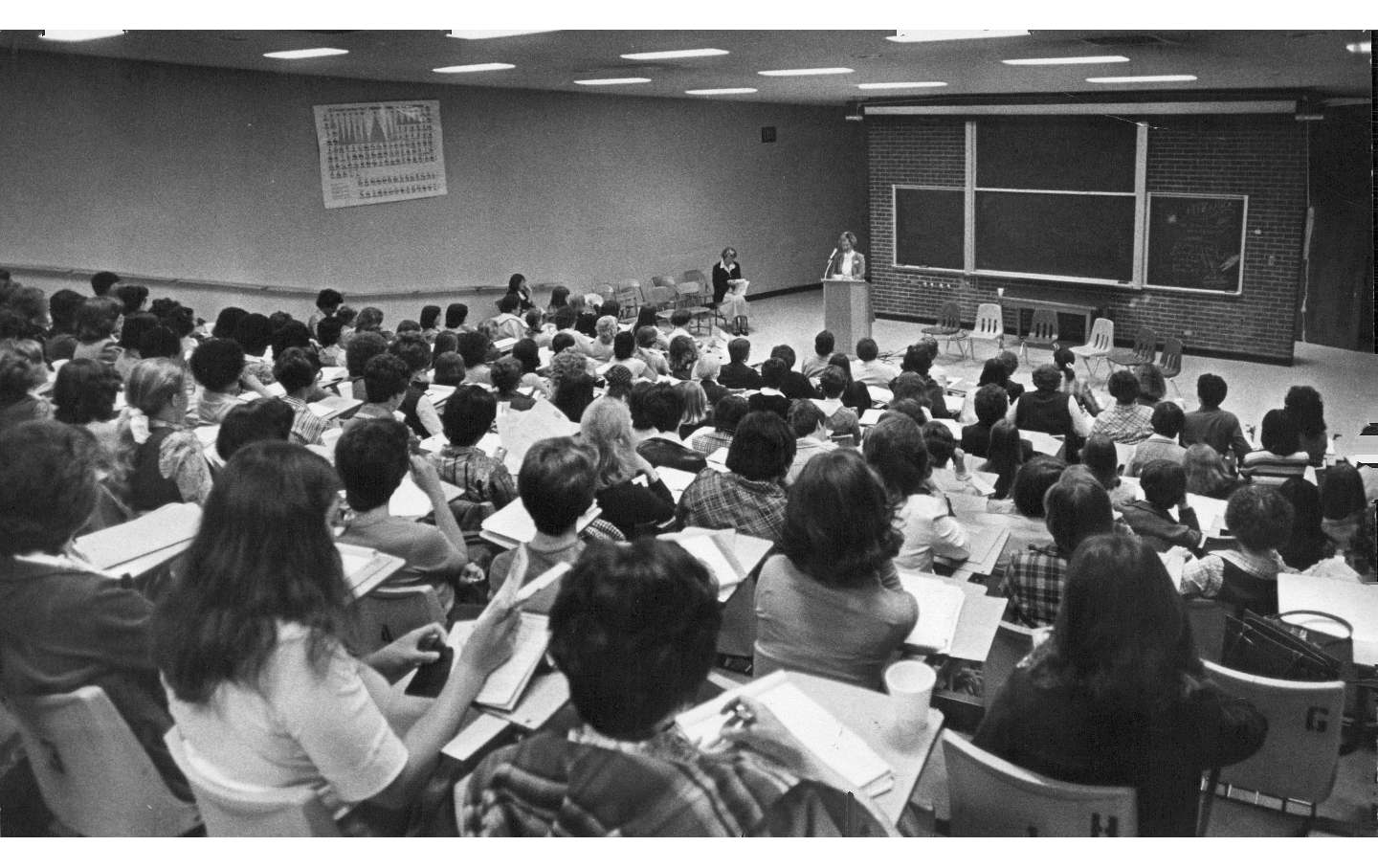
Lecture at Regis College, 1978.
(John Prieto / The Denver Post / Getty Images)One night many years ago, my partner came home from work, hobbled on his crutches across the living room, and nearly collapsed onto the couch. He was still recovering from major surgery but was unable to take time off from work, as his income was dependent on a patchwork of adjunct teaching jobs without benefits under short-term contracts at three different colleges.
A massive bolus of keys, several for each place he worked, was clipped to his belt and jangled comically, metaphorically, off the edge of the couch. “Are we living in a sitcom?” I asked. We both started laughing. As with many issues in this era, the tragedy of reality had somehow crossed the line into satire. Still, I mentally pocketed the scene. Years later, I wrote it into my novel The Adjunct—then I wrote it out, for being too absurd.
Now the news is teeming with stories about higher education—not only about Trump’s attacks on universities, but about the recent college grads who are facing the toughest job market since the pandemic. For those who do manage to find employment, over 40 percent are working jobs that don’t usually require a college degree.
In the midst of these crises, it’s easy to miss a longer-term problem in academia: the deterioration of working conditions for faculty. Because there are jobs for college instructors. They do require degrees. But the pay and the benefits are abysmal. Universities now have more adjuncts than tenured and tenure-track professors combined. Many adjuncts make around $4,000 a course, and a quarter of adjuncts make less than $25,000 a year. In no city in the United States is this enough money to live off comfortably.
Tell people that your partner is a professor, and they don’t imagine an adjunct. The job conjures the image of an idyllic campus dotted with rusticated stone buildings, of a messy office packed with books, and of a job so cushy, all that’s left to worry about is existential dread. The academy of campus novels, from The Secret History to Wonder Boys, and TV shows like The Chair or HBO’s new comedy The Rooster offer a mythology as quaint these days as the western.
Adjunct professors are the gig-economy workers of higher ed. They often have multiple jobs, partly because of the low pay, partly because courses can be canceled at the last minute, and partly because some universities limit the number of classes that an adjunct can teach (possibly to avoid health-insurance obligations).
Adjuncts were originally used in small numbers, as a way to bring industry professionals into the classroom. Now they’re a cost-saving measure, with positions often filled by academics vying for a decreasing number of tenure-track jobs. This is the case even as universities continue to spend big in other areas, such as to cover the costs of their increasingly large administrations or to construct new buildings designed to garner prestige and lure students.
Adjuncts typically receive no benefits: no employer-sponsored healthcare plan, no retirement plan, no sick leave, no disability, and, of course, no support for research and writing. This isn’t just bad for adjuncts as workers; it’s bad for everyone, affecting the quality of education, our ideals of equity, and our ability to create a society rich with new art, stories, and ideas.
Adjunct labor disproportionately affects women and Black people and, ironically, is most often used in the liberal arts and humanities, disciplines that often position themselves as centers of freedom and diversity. (Most of the adjuncts I know are in fields like English, political theory, and philosophy.) Some universities have been cowed into dropping their diversity, equity, and inclusion programs by the Trump administration, but how deeply dedicated these institutions ever were to equity is unclear, given that they run on the backs of highly skilled, low-paid, precarious labor—a system that only serves to reinforce class and social hierarchies.
There is no indication that adjuncts are less capable than their tenured peers, only that they haven’t won the lottery of professorship. Despite their compromised positions, adjuncts still win teaching awards, publish books, and contribute widely to scholarship, literature, and the arts. And they do this even though their academic research and writing—meant to be supported by a tenured position—has been relegated to unpaid labor.
Adjuncting is also a bad deal for students, who seem largely unaware of the problem. (I recently heard about a student who was shocked to discover, upon dropping food off at a local pantry, that their instructor was the one picking it up.)
As the cost of tuition rapidly increases, and as the proliferation of AI compromises the college experience, students should know that universities are ensuring that their instructors don’t have the time to dedicate to creating new classes or modules or to fully contend with how AI is changing the classroom. Adjuncts also don’t have a chance to be a part of any one university community, which would allow them to become mentors to students as well as to connect with and learn from peer scholars, then bring that knowledge back into the classroom.
I used to think of academia as a modern patronage system that shaped our thought and culture in important ways. Through tenure, thinkers, writers, and artists were offered financial stability, and with it the time and freedom to research and create outside of the market. In exchange, they passed their knowledge on to students.
Popular
“swipe left below to view more authors”Swipe →But academia no longer fulfills this promise. In the 10 years since my partner’s surgery, he has worked at eight institutions in three different countries, in a series of precarious academic positions—and all this while applying for the next round of jobs, writing articles for leading journals, and publishing a book with a major university press. There’s a strange, depressing dissonance to leveling up in a career—achieving, essentially, all the milestones of tenure—yet never having the opportunity to advance, never mind having the dignity of stability.
I stood by helplessly watching my partner’s plight. In it, I saw reflected my own struggle to sustain a creative-writing career with a hodgepodge of freelance work, and I saw the struggle of many workers whose livelihoods have been relegated to the gig economy. All I could think to do was write.
I joke that I rage-wrote The Adjunct, but it’s only partly a joke. I wrote the book from a maddening, cornered place that felt both unsustainable and unchangeable. The Adjunct is nothing like a classic academic novel. It sprawls beyond the enclosed space of a single campus. It is not about a professor wracked by ennui or existential dread. It’s not even, really, a novel of ideas. Instead, it’s about an adjunct barely making ends meet, teaching a class about the campus novel—the very genre she’s been alienated from.
Whether you think of it as satire or reportage mostly depends on how much you know about the plight of the adjunct yourself.
Become a Sustaining Donor This September
Between the reemergence of right-wing red-baiting and Donald Trump’s use of the chilling National Security Presidential Memorandum–7 to criminalize left political organizing, we’re seeing McCarthyism reborn before our eyes.
This assault on democracy cannot be ignored or wished away. Resisting it requires bravery in the face of threats and repression, a steadfast commitment to the truth, and the unwavering belief that we can—and will—overcome this darkness.
We must have an independent media that sets the record straight, unearths corruption and abuses of power, and advances a politics of justice and dignity for all if we’re to win this fight.
That’s why I’m writing to you today. This September, The Nation needs to add 100 monthly donors to sustain our progressive journalism. Your contribution makes the next investigative report, the next truth-speaking column, and the next pathbreaking essay all possible.
I hope you’ll support our work with a recurring donation today. If you donate $10 or more a month, we’ll send you a brand new “Hands Off the Free Press!” sticker to recognise your commitment to our cause. Please, donate today.
Onward,
Katrina vanden Heuvel
Editor and Publisher, The Nation
More from The Nation
As Cornell’s Rape Case Draws National Attention, Students Want Accountability. As Cornell’s Rape Case Draws National Attention, Students Want Accountability.
A new lawsuit alleging that a former student was drugged and gang-raped by Chi Phi fraternity members is sparking outrage in the Cornell community.

Irish Goalkeeper Gavin Bazunu’s Refusal to Play Against Israel Puts Him on the Right Side of History Irish Goalkeeper Gavin Bazunu’s Refusal to Play Against Israel Puts Him on the Right Side of History
Bazunu’s decision raises the perennial question: Why is a country that is currently committing a genocide allowed to compete in the first place?
The Promises and Compromises of the University of California The Promises and Compromises of the University of California
I grew up in a neighborhood manufactured by the University of California, Irvine. It felt like a utopia for academics—until the university forsook its mission of serving the publi...

Is Platonic Co-Parenting the Future of the Family? Is Platonic Co-Parenting the Future of the Family?
Disillusioned with the nuclear family and apprehensive of tethering their reproductive futures to the bleak hellscape of modern love, young people are seeking a different way.
Treat Spotify Like a Public Utility Treat Spotify Like a Public Utility
Music streaming platforms have way too much control over musicians and music lovers. It’s time to rein them in.

