
The Iran War Is a Disaster for Gaza
How the crisis leaves Gaza’s 2 million people more friendless, isolated, and vulnerable than ever before.
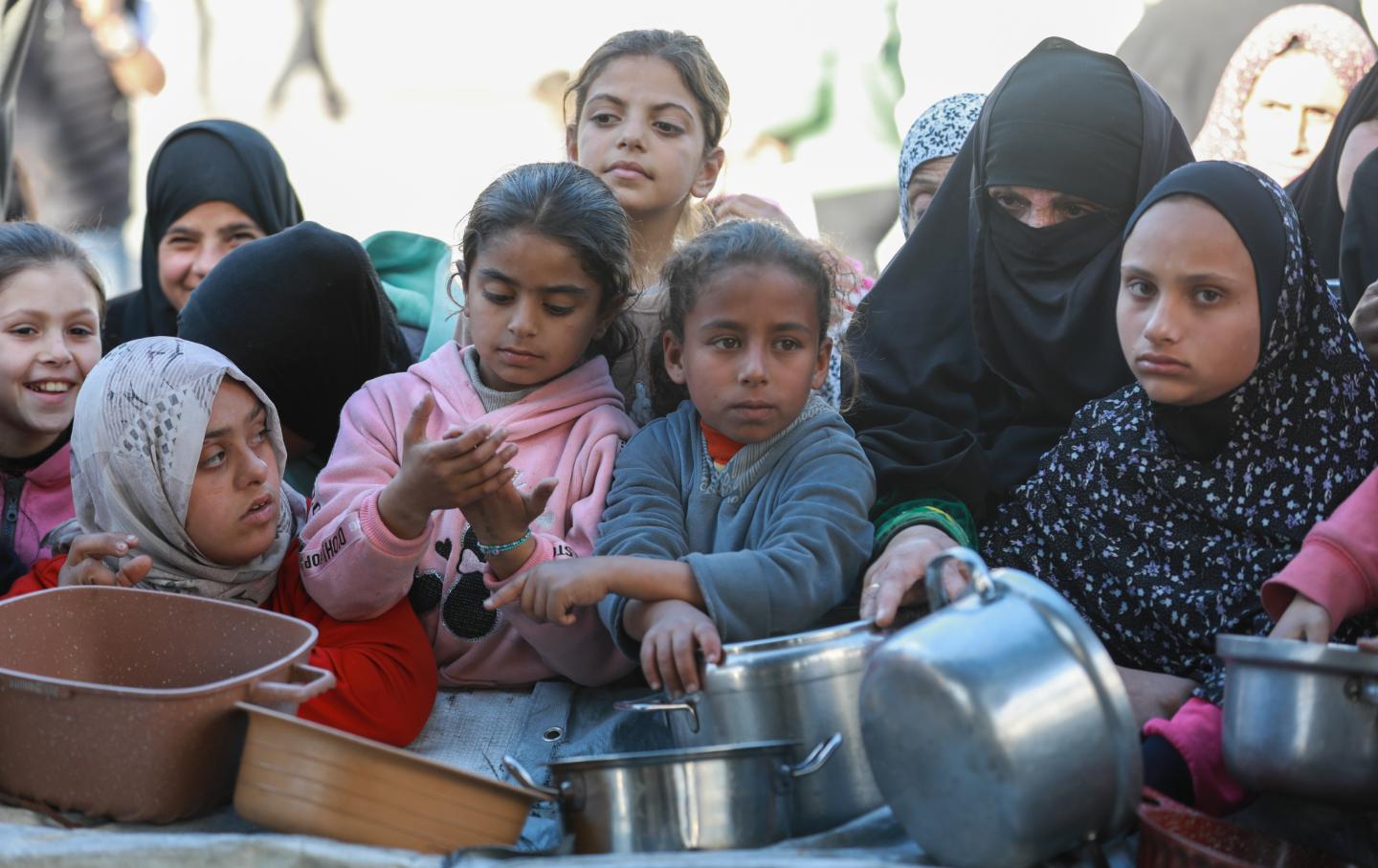
A charity organization distributes meals to displaced Palestinians during the holy month of Ramadan, as food shortages continue amid Israeli attacks and ongoing restrictions on the entry of aid, in Beit Lahia, Gaza, on March 8, 2026.
(Abdalhkem Abu Riash / Anadolu via Getty Images)The widening US-Israeli war with Iran is already reshaping the political and military contours of the Middle East. Much of the focus has been on the risk of regional escalation and the implications for Gulf security. But the war’s impact may be just as immediate and consequential for Gaza, where 2 million people are already living under conditions that leave no room to absorb new pressures. The crisis is complicating an already volatile situation for a place with no functioning governance, no open borders, no powerful supporters, and a humanitarian infrastructure that was already failing before the strikes on Tehran.
The killing of Iranian Supreme Leader Ali Khamenei removed the last remaining Middle East actor who, however cynically, saw Gaza as core to his agenda. For years, Iran helped arm and fund Hamas, not out of absolute alignment with the movement or out of solidarity with Palestinians, but because maintaining that front gave Tehran leverage in the wider region. As long as Iran had both the capacity and willingness to escalate—whether directly against Israel or through allied groups—Israel had to factor in the risk of a broader, multifront confrontation, a calculation that, until 2023, imposed at least some constraints on its actions in Gaza.
Those constraints are now gone. The Iranian leadership has been significantly degraded. The country’s missile and air defense infrastructure, which underpinned its regional deterrence, has been badly damaged. And with Khamenei dead and his successor, his relatively unknown son Motjaba, taking charge amid such turmoil, Iran’s political house will be consumed for the foreseeable future by an internal power struggle between the Islamic Revolutionary Guard Corps, the clerical establishment, and whatever remains of civilian governance. Amid so many domestic crises, it seems highly unlikely that Gaza will be much of a priority, at least not in the foreseeable future.
Hamas is already dealing with the consequences of the assault on Iran. For years, Iran has been a financial backer and a logistical and strategic anchor for Hamas through the wider “axis of resistance,” providing funding, weapons, and a broader deterrent environment in which escalation against Gaza carried the risk of retaliation elsewhere in the region.
With Iran’s military infrastructure degraded and its leadership preoccupied with internal succession, that support network is effectively frozen for the time being. Any money or arms that Iran had been supplying will be cut off for now, and Israel has no reason to fear Iranian reprisal if it escalates in Gaza. The news that the Houthis will resume attacks on the United States and Israel in the Red Sea does not substantially change this calculation. Those attacks redirect Israeli and American military attention toward maritime security and the northern theater, which means Gaza recedes further both from the operational map and from the attention of the outside world.
It is difficult to see the timing of the initial US-Israeli strikes as incidental—or as unconnected from the situation in Gaza. For months, Israeli and US officials had signaled that an attack on Iran would depend on a particular alignment of political and military conditions in the Middle East, suggesting the operation was shaped by broader strategic calculations beyond its stated objectives. Gaza provided both the cover and the justification for these moves.
The Gaza war created a political environment in which large-scale Israeli military operations were already normalized, and where actions framed under the rubric of existential self-defense faced far less international resistance than they would have before October 2023. That rhetoric had been tested to its limits and held. Striking Iran’s nuclear and military infrastructure under that same framework was not a sudden escalation but the continuation of a doctrine whose permissible radius has steadily expanded since 2023.
The regional architecture right now was, from Israel’s perspective, as favorable as it will ever be. Hezbollah, which is in open war with Israel as of this writing, has been significantly degraded after multiple campaigns since 2024. Hamas is militarily weakened and politically isolated. The Houthis, while still active, have been absorbed into a separate American military front. In sum, Iran’s “axis of resistance” had been dismantled piece by piece, leaving Tehran more exposed and less able to threaten meaningful retaliation through intermediaries than at any point in the past two decades.
Though Israeli Prime Minister Benjamin Netanyahu has advocated confrontation with Iran for decades, the timing is also useful in domestic political terms. Escalation shifts Israel back into a wartime political environment, where security considerations dominate public debate and internal political disputes tend to recede. For a government that has struggled with coalition instability, faced ongoing corruption proceedings against the prime minister, and absorbed criticism over its handling of the Gaza ceasefire, the return to a heightened security posture can provide Netanyahu a degree of political consolidation that is often harder to sustain in peacetime.
For Washington, the calculus was different but compatible. The Trump administration had signaled from its first weeks that it viewed Iran’s nuclear program as a red line issue requiring resolution (despite the absence of publicly verified and conclusive evidence that there even was an active Iranian nuclear weapons program). The latest war allowed the US to act on that position while the regional landscape—with Arab Gulf states already aligned through the Abraham Accords framework—minimized the diplomatic cost, presenting the strikes as a strategic decision made in a window that both governments judged would not remain open indefinitely.
The price for that decision is now being paid by the people of Gaza.
The US-Israeli operation required the acquiescence of Arab Gulf states, built over years through diplomatic ties formed on the implicit premise that Palestinian rights could be deferred in exchange for security guarantees and normalization with Israel. Gaza had no representation in that arrangement—and the arrangement worked precisely because no one with power required it to.
Iran’s retaliation against a string of these US allies has now removed even the residual political pressure that Arab governments occasionally applied around the future of Gaza. Saudi Arabia, Qatar, and Bahrain—all struck by Iranian retaliatory missiles, which have targeted both US military and civilian infrastructure—are not available for Palestinian advocacy in the near term. At the moment, they are conducting damage assessments, securing their own airspace, and managing the domestic and diplomatic consequences of being targeted by a neighbor they had not formally declared an enemy. The political bandwidth required to pressure Israel on Gaza crossing closures or ceasefire violations simply does not exist right now. Israel has also expanded its attack on Lebanon, the last active front capable of imposing any military cost on Israeli conduct in Gaza. As a result, Gaza is more exposed to Israeli escalation than at any point since October 2023.
It’s impossible to know the full consequences of this war. But it will inevitably cause significant changes in the political and military architecture of the Middle East. The Gulf states that absorbed Iranian strikes will likely deepen and expand their security dependence on the United States and, by extension, their operational coordination with Israel. That process was already underway through the Abraham Accords and through the gradual integration of regional air-defense systems linking the United States, Israel, and several Gulf states. During the current war, that alignment has become operationally visible, when Iranian retaliatory missile and drone attacks have been intercepted in part through American early-warning systems and air-defense assets operating from Gulf states and US bases in the region.
A little more than a week into the ongoing war, this relationship has been accelerated by years. Soon, there will be a tighter military and economic bloc, built around containing whatever government reconstitutes itself in Tehran, and held together by exactly the kind of US-Gulf-Israeli security integration that has historically treated Palestinian rights as a negotiating variable rather than a baseline condition.
Gaza will be subsumed by this alignment. As Gulf states deepen their security dependence on Washington and expand economic and technological ties with Israel under the normalization frameworks that emerged over the past decade, their strategic incentives increasingly lie in maintaining those arrangements rather than disrupting them over Gaza. In that configuration, the Palestinian question becomes something to defer rather than confront. The political pressure that Arab governments once applied on Gaza, however inconsistently, was always contingent on their own strategic autonomy and their ability to balance relations with multiple regional actors. That autonomy is now being traded—voluntarily and with urgency—for security guarantees in the face of Iran’s retaliation. Gaza is what gets left off the table when that trade is made.
Equally important is who and what fills that vacuum. The Trump administration’s peace plan for Gaza—which conditions any political process on Hamas’s disarmament, contains no defined sovereignty path, and was designed as a set of preconditions rather than a framework open to negotiation—is now the only framework on the future of the Strip with active US support. The international actors who might have pushed back—European governments, UN agencies, Arab states—are either impacted by the regional crisis, institutionally sidelined, complicit in Gaza’s destruction, or all of the above. One of the most consequential political effects of the Iran War is the closure of the diplomatic space around Gaza at exactly the moment when Gaza’s physical situation is deteriorating fastest.
On the ground, the Israeli office that coordinates the movement of goods and humanitarian aid into Gaza, known as the Coordinator of Government Activities in the Territories, has closed all crossings in and out of Gaza, including Rafah, until further notice. On March 1, Israel’s ban on 37 humanitarian organizations—central to whatever aid distribution capacity still existed in the Strip—took formal effect. World Central Kitchen, which said it had been providing 1 million meals a day to Gaza’s population, announced that it is suspending operations, citing the impossibility of moving personnel or supplies across closed crossings. Gaza requires between 500 and 600 trucks of aid daily to meet basic needs. There is currently no mechanism to replace what has just been removed.
Gaza does not have a warehousing and distribution infrastructure capable of moving existing supplies to the people who need them. Before this week, just 19 of the 37 hospitals in Gaza were functioning, most only partially. Israeli troops across northern and eastern Gaza restrict the movement of both people and goods. The organizations that have been doing the actual distribution—the NGOs, the UN agencies, the independent relief groups—are the same organizations Israel announced it will bar from operating in Gaza, for refusing to hand over confidential staff lists. The Gulf logistics infrastructure through which regional humanitarian operations are funded and staged has been disrupted.
Each of these developments would constitute a significant deterioration individually. For them to arrive simultaneously on a population already stretched to the very limits of human suffering is of a different order entirely—one that will become measurably more visible with each passing day as the war rages on.
But the humanitarian crisis is only half the picture. The other half concerns the so-called Gaza ceasefire, a fragile arrangement resting on conditions that have now largely ceased to exist. The agreement always depended on a specific set of political and military pressures operating in the background: Hezbollah’s intact deterrence posture along the northern front, Iran’s residual capacity to threaten escalation costs, and a regional diplomatic architecture—anchored in Qatar and Egypt, and staged through Gulf capitals—capable of maintaining back-channel pressure on all parties. This body has now been fractured along every axis simultaneously. The ceasefire has not formally collapsed. But the conditions that made it survivable—regionally, militarily, diplomatically—have been stripped away faster than any governance body could adapt to.
Popular
“swipe left below to view more authors”Swipe →In much the same way, this war exposes the limits of Trump’s Board of Peace, an institution whose members include many of the same actors driving the conflicts it purports to resolve. Established with a two-year UN Security Council mandate, the board was conceived when the ceasefire in Gaza appeared to be holding and it seemed the International Stabilization Force might be deployed in the near future. The board was also expected to expand its portfolio to encompass the rest of the world’s active conflicts, even as several of those conflicts involve the same governments that now sit on the body tasked with addressing them. But the board has no operational authority. It hasn’t opened the Gaza crossings. It can neither restore the deterrence environment nor reconstitute the NGO presence it failed to protect. It only has diplomatic standing and a mandate whose own charter offers no binding timelines and mechanisms for holding parties to ceasefire terms when the political conditions that produced those terms have dissolved. A few weeks after its establishment, the board is already facing its second challenge, before it has resolved, or even stabilized, its first. All of those assumptions have been invalidated in a matter of days.
Every other party to this conflict retains institutional recourse. Iran, even with Khamenei and significant parts of its military infrastructure destroyed, retains a state, a territory, a successor government of some form, and international legal standing. Its internal succession crisis—however volatile—will be resolved within existing state structures, or it will produce a new structure. Either way, the country will not cease to exist as a political entity. The Gulf states currently absorbing Iranian missiles have governments, defense alliances, sovereign wealth funds, and the full machinery of international diplomacy available to them. Israel holds the region’s most powerful military, its only nuclear weapons, an unconditional security guarantee from the United States, and functional government institutions. Hamas, even in its diminished state, remains a political and military organization capable of negotiating and maneuvering.
But the people of Gaza themselves have none of these instruments. Gaza may not be a side to this war in any traditional sense, but it sits at its most exposed surface. The coming days will be dominated, legitimately, by questions of Iranian succession, Gulf security architecture, US military posture, and the risk of further escalation. But the decisions being made within that frame are already producing consequences in Gaza that will not wait for the wider war to resolve.
The gap between the speed of those consequences and the pace of international attention to them is itself becoming a central problem. Naming it clearly is the minimum the moment requires.
Support independent journalism that does not fall in line
Even before February 28, the reasons for Donald Trump’s imploding approval rating were abundantly clear: untrammeled corruption and personal enrichment to the tune of billions of dollars during an affordability crisis, a foreign policy guided only by his own derelict sense of morality, and the deployment of a murderous campaign of occupation, detention, and deportation on American streets.
Now an undeclared, unauthorized, unpopular, and unconstitutional war of aggression against Iran has spread like wildfire through the region and into Europe. A new “forever war”—with an ever-increasing likelihood of American troops on the ground—may very well be upon us.
As we’ve seen over and over, this administration uses lies, misdirection, and attempts to flood the zone to justify its abuses of power at home and abroad. Just as Trump, Marco Rubio, and Pete Hegseth offer erratic and contradictory rationales for the attacks on Iran, the administration is also spreading the lie that the upcoming midterm elections are under threat from noncitizens on voter rolls. When these lies go unchecked, they become the basis for further authoritarian encroachment and war.
In these dark times, independent journalism is uniquely able to uncover the falsehoods that threaten our republic—and civilians around the world—and shine a bright light on the truth.
The Nation’s experienced team of writers, editors, and fact-checkers understands the scale of what we’re up against and the urgency with which we have to act. That’s why we’re publishing critical reporting and analysis of the war on Iran, ICE violence at home, new forms of voter suppression emerging in the courts, and much more.
But this journalism is possible only with your support.
This March, The Nation needs to raise $50,000 to ensure that we have the resources for reporting and analysis that sets the record straight and empowers people of conscience to organize. Will you donate today?
More from The Nation
Israel Is Using Its Genocidal Gaza Playbook on Iran Israel Is Using Its Genocidal Gaza Playbook on Iran
Just as in Palestine, the Israeli government is framing its latest conflict as a holy war of extermination.
Trump and His Soulless Cronies Have Managed to Suck the Joy Out of the World Cup Trump and His Soulless Cronies Have Managed to Suck the Joy Out of the World Cup
Not even soccer is immune from Trump’s reverse Midas touch.
Garbage In, Carnage Out Garbage In, Carnage Out
The harrowing lessons of the Pentagon’s recently dissolved partnership with Anthropic.
The Iran War Could Be Catastrophic for the US-Israel Alliance. Good. The Iran War Could Be Catastrophic for the US-Israel Alliance. Good.
As Israel’s role in pushing the war with Iran comes into ever sharper focus, it’s up to us to turn outrage into change.
An Unlawful War An Unlawful War
The precedent being set by the US in launching this war of aggression against Iran will long live in infamy.
Trump and Netanyahu Want to Turn Iran Into a Failed State Trump and Netanyahu Want to Turn Iran Into a Failed State
This war looks designed to cause maximum chaos and instability. The world will pay a high price.

