61 Years After Bloody Sunday, We Are Entering a New Era of Voter Suppression
Two efforts underway threaten to erode the promise secured by the foot soldiers of Selma in 1965.
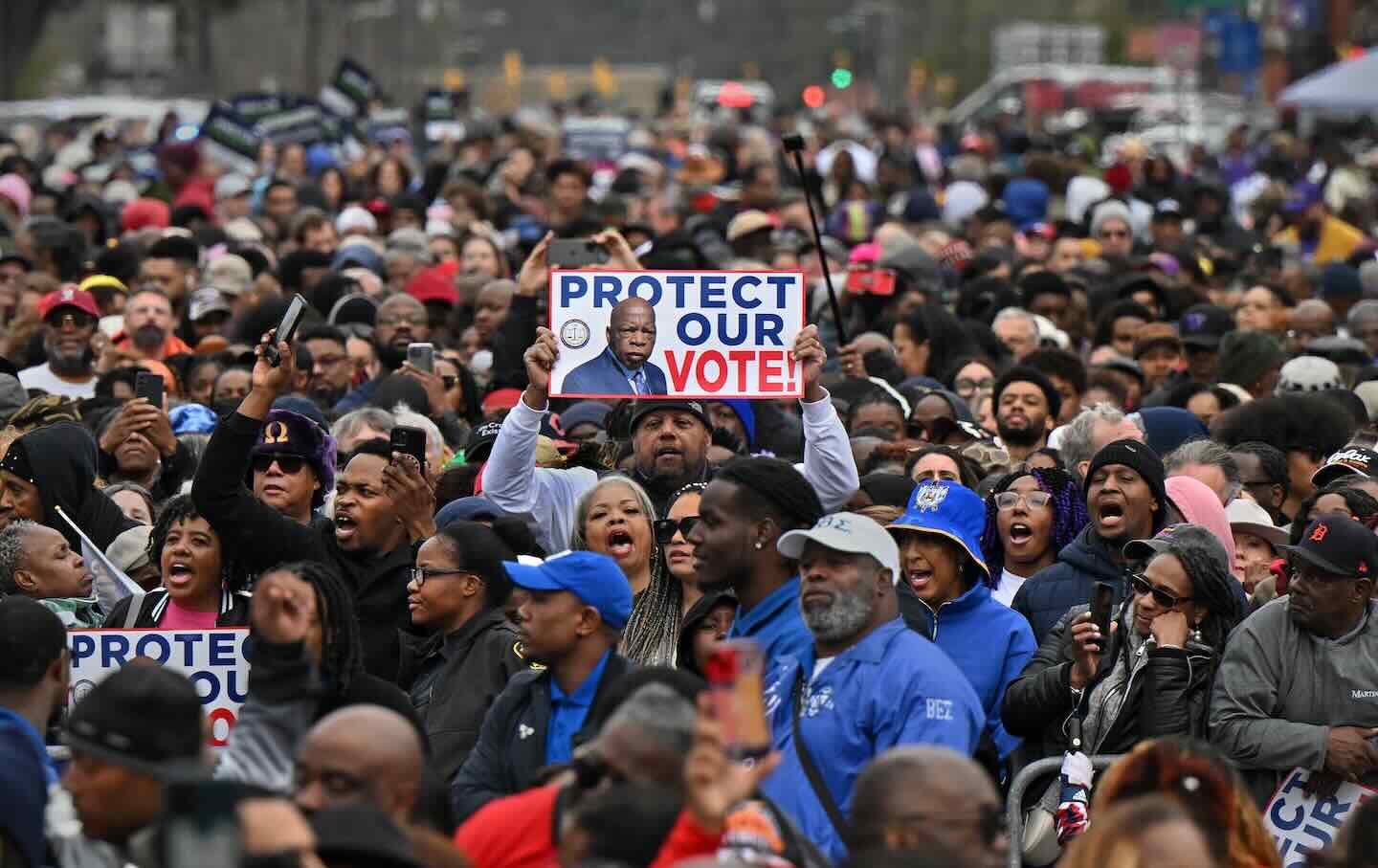
Thousands are backed up and waiting to cross the Edmund Pettus Bridge to commemorate the 60th anniversary of the Bridge Crossing Jubilee and “Bloody Sunday” in Selma, Alabama, in 1965.
(Michael S. Williamson / The Washington Post via Getty Images)As the writer Zora Neale Hurston eloquently observed, “There are years that ask questions, and there are years that answer.”
Nineteen sixty-five was one of those years that answered. And 2026 is shaping up to be its heir.
In 1965, a group of ordinary citizens stood on the doorstep of history. On one side, the brutal reality they had lived since the final days of Reconstruction, one of white hoods and open caskets, strange fruit and sundown towns. On the other was the promise of true equality, which had eluded them for so long.
They didn’t know it then, but their fearless actions on a bridge in Selma would set in motion a series of events that would dramatically alter the course of history, dividing the struggle for civil rights into two eras: before Selma and after. The Voting Rights Act, signed into law five months later, codified what the Constitution had promised Black Americans for nearly a century.
As we mark 61 years since that fateful march, we find ourselves at another inflection point—standing on another doorstep. But behind this door is not progress; it’s regression.
Two consequential voting rights developments greet us this year: a seemingly innocuous change to Postal Service procedure that actually has massive ramifications for mail-in voting, and an imminent congressional vote on the so-called “SAVE America Act,” which passed the House last month and now heads to the Senate. Together, they threaten to erode the promise secured by the foot soldiers of Selma.
Despite its misleading name, the SAVE America Act is not about saving our elections. It’s about sabotaging them. The measure would require American citizens to show documents like a passport or birth certificate to register to vote. The problem: Nearly half of Americans don’t have a passport, and 69 million women could not use their birth certificate to prove their citizenship status because it doesn’t match their current legal name.
What the SAVE America Act conveniently overlooks is that we already have a strong voter verification system in place. Every state in this country verifies the identity of voters. Every single one. When you register to vote, your information is cross-checked against state databases—your driver’s license number, the last four digits of your Social Security number, your address.
And this system works. Because when states have gone looking for the voter fraud the SAVE America Act claims to be solving, they find virtually nothing. The Bipartisan Policy Center tracked noncitizen voting over 24 years and found 77 confirmed cases.
Seventy-seven. Across a quarter century.
The SAVE America Act replaces this system, which works, with one that creates a hurdle that tens of millions of American citizens cannot clear.
We know what happens when governments do this because Kansas tried it, beginning in 2013. Its legislature passed a law nearly identical to the one being proposed now. The result: Roughly 31,000 eligible citizens—12 percent of all applicants—were unfairly blocked from registering to vote. The law was eventually ruled unconstitutional.
And then there’s what’s happening to the US Postal Service. This shift is so technical, you’d be forgiven for missing it, but it has far-reaching implications for voting.
The day before Christmas, the USPS quietly updated its rulebook to clarify something it says has always been true: A postmark is not, and has never been, a record of when a piece of mail was deposited. It’s a record of when the mail was processed.
For decades, this distinction didn’t matter much, because the old postal network was structured in a way that made the two dates align almost automatically; mail dropped off at a Post Office was typically processed and postmarked that same evening at a nearby facility. The postmark became, in practice, a reliable timestamp for when a piece of mail—for instance, a ballot—was deposited with the USPS.
Popular
“swipe left below to view more authors”Swipe →But now that’s changing. Under the Postal Services’ massive overhaul, mail processing has been consolidated from nearly 200 local facilities to just 60 regional hubs. Post offices of more than 50 miles from a regional center have been reduced to a single morning pickup. Mail deposited in the afternoon waits until the next day to even begin moving toward processing. The gap between the date a ballot is mailed and the date it receives a postmark—a gap for years was virtually nonexistent—is now a day or more for millions of Americans, especially those in rural areas.
Sixteen states and the District of Columbia allow ballots to be counted after Election Day if they are postmarked by Election Day, treating that postmark as legal proof a voter acted in time. But when a ballot deposited on Election Day routinely isn’t processed until the following day, that proof may never materialize, even for voters who did everything right.
Taken together, these two issues form an interlocking system. The SAVE America Act prevents millions from registering in the first place. The Postal Service changes mean that even those who do register and vote can have their ballots disqualified. The tactics may look different. One is dressed in the language of election security, the other in the language of operational efficiency. But the result is the same: a smaller electorate, and outcomes shaped before a single vote is counted.
The Postal Service’s modernization efforts should not come at the cost of mail-in voters, particularly those in rural communities who depend most on the mail to make their voices heard. The Senate must recognize the SAVE America Act for what it is—a modern poll tax dressed in the language of election security—and reject it accordingly. And all of us should honor Selma by actively defending the inclusive, multiracial democracy it made possible.
Make no mistake, 2026 will be a year that answers. The question is whether that answer will honor the sacrifice of those who crossed the bridge at Selma—or betray it.
Become a Sustaining Donor This September
Between the reemergence of right-wing red-baiting and Donald Trump’s use of the chilling National Security Presidential Memorandum–7 to criminalize left political organizing, we’re seeing McCarthyism reborn before our eyes.
This assault on democracy cannot be ignored or wished away. Resisting it requires bravery in the face of threats and repression, a steadfast commitment to the truth, and the unwavering belief that we can—and will—overcome this darkness.
We must have an independent media that sets the record straight, unearths corruption and abuses of power, and advances a politics of justice and dignity for all if we’re to win this fight.
That’s why I’m writing to you today. This September, The Nation needs to add 100 monthly donors to sustain our progressive journalism. Your contribution makes the next investigative report, the next truth-speaking column, and the next pathbreaking essay all possible.
I hope you’ll support our work with a recurring donation today. If you donate $10 or more a month, we’ll send you a brand new “Hands Off the Free Press!” sticker to recognise your commitment to our cause. Please, donate today.
Onward,
Katrina vanden Heuvel
Editor and Publisher, The Nation