
Boris Kagarlitsky on Hungary’s Election
Reflections on right-wing populism’s dead end and the window of opportunity for the left.
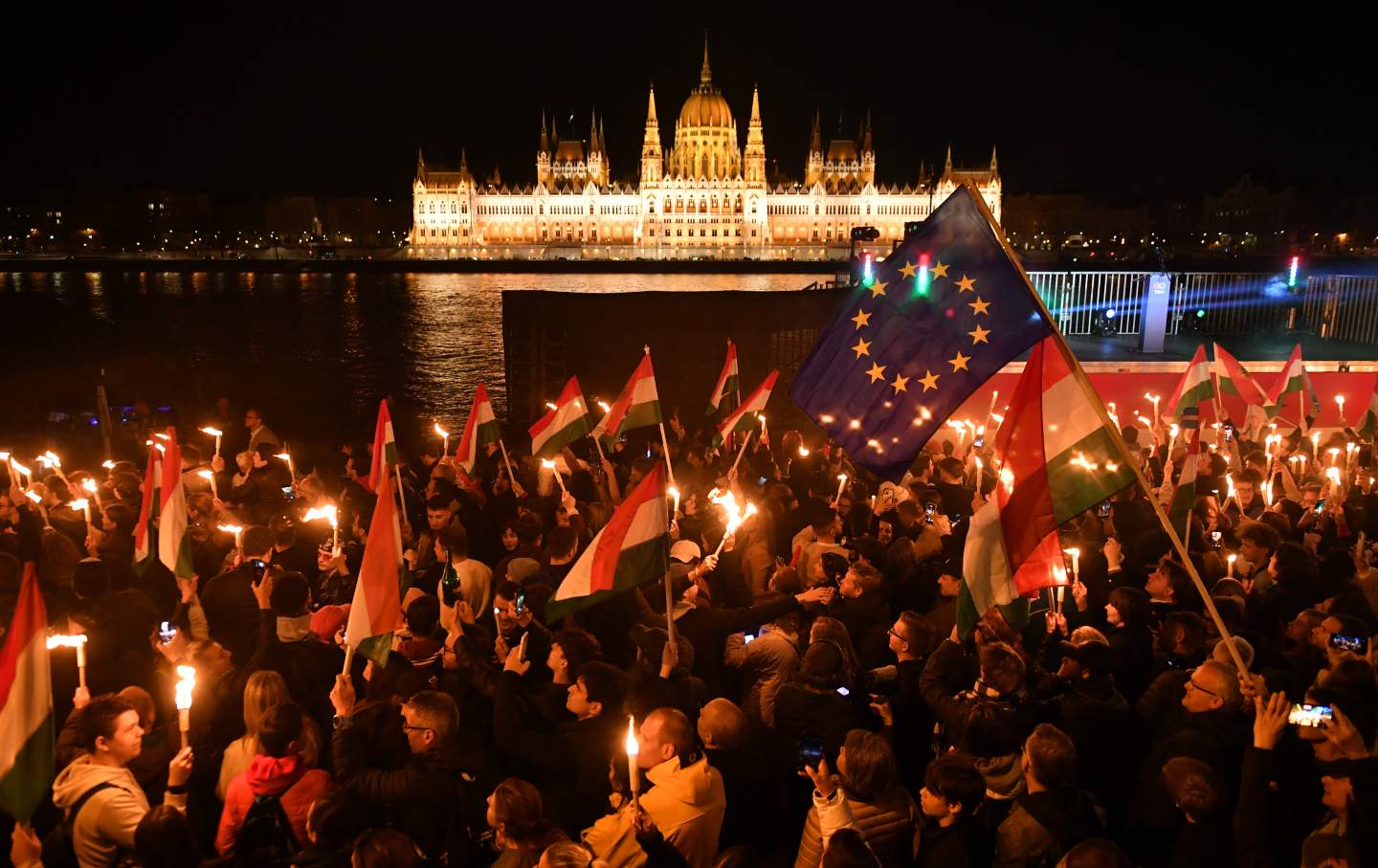
Boris Kagarlitsky, Russia’s most prominent leftist intellectual and Marxist critic of both Western imperialism and Putin’s domestic authoritarianism, is two years and two months into a five-year prison sentence for his outspoken opposition to the war in Ukraine and the Putin regime. He is confined to Penal Colony No. 4—yet he is anything but idle. From his cell he maintains an extensive correspondence, produces essays and articles on current political questions, and is at work on larger projects: a rethinking of imperialist conflicts and the crisis of the left, a major essay on the significance of 1968–73 as a moment of missed revolutionary opportunities, and sketches of a book about his time in prison.
His mood is good and he remains fully engaged with the world. He has no access to the Internet—his sole source of news is the official Russian television channel, plus letters from friernds and colleagues. That makes his political analysis all the more striking, given the conditions under which it was written. His articles reach us in portions, sent out across multiple letters—and are sometimes lost in transit, forcing him to rewrite everything two or three times over.
We are pleased to publish his latest piece: a reflection prompted by the Hungarian elections, in which Kagarlitsky examines the dead end of right-wing populism and the window of opportunity it may yet open for the left. Boris argues that right-wing populists succeeded by absorbing the redistributive language of the left while abandoning any structural challenge to property relations. That speaks directly to political dilemmas far beyond Hungary. Kagarlitsky concludes that the left has yet to fill the vacuum it left behind, and that we still must pass through what he calls “the desert of political uncertainty.”
The defeat of Viktor Orbán in the Hungarian parliamentary elections was unanimously assessed by all commentators as bad news for the Kremlin, which has lost its main ally in Europe. At the same time, Orbán’s failure was also a blow to Donald Trump’s prestige, as the American president publicly expressed support for the Hungarian prime minister, and Vice President Vance actually campaigned on his behalf. It made no difference: Hungarians rejected the ruling party at the polls.
And yet, when Hungarian citizens went to the polls, geopolitics was probably not their primary concern. For many years, while Orbán kept a firm grip on the country, he had maintained considerable support—which suddenly seemed to evaporate. What happened? To understand this, we need to think carefully about the socio-political nature of national-populist movements, of which Orbán was a typical representative.
In the early years of this century, left-wing movements virtually disappeared as a political force across Eastern Europe. This corresponds to the general trend of left decline observable almost everywhere, but in Eastern and Central Europe the process reached a scale that led to a complete redrawing of the entire political landscape.. The vacuum created by the collapse of left-wing parties was filled by right-wing populism and nationalism.
In fact, the ideological legacy of the left was divided between right-wing populists and liberals. The liberals took from the left agenda its concern for women’s rights and the interests of national minorities, while the right-wing populists declared themselves the defenders of the lower strata of society, the voice of the ordinary person In essence, both liberals and national-populists were betting on the redistribution of social resources. But the difference lay not only in the fact that redistributive measures were conceived and carried out in the interests of different groups—it also lay in the fact that, unlike the agenda of the classical left, neither side envisaged any structural reforms, any change in relations of production, and least of all in property relations.
The advantage of the right consisted not in more aggressive demagoguery, as the respectable intelligentsia tended to assume, but in the fact that their project appealed to broader strata of society. Both the right and the liberals were, in essence, betting on market protectionism—only the right’s version was directed inward rather than outward. Their clientele was far larger, and moreover their dependence on state support was much stronger. This approach predetermined the political successes of the right, but it also created a heap of problems that accumulated gradually but relentlessly after they took power.
Since redistributive policy was not grounded in structural economic change, it quickly exhausted itself. Put simply, the money needed to sustain the clientele ran out all the faster the wider the government’s social base. In such a situation it was entirely natural to seek external sponsors who might directly or indirectly prop up the flagging project.
Viktor Orbán found such support in the Kremlin—though under different circumstances other options might have been available. But the trouble is that as events develop, dependence on an external patron inevitably grows, and by tightening his ties with Moscow, Orbán made himself powerful enemies in Western Europe and became a hostage to his own earlier decisions.
Meanwhile, over four-plus years of the Ukrainian conflict, the situation changed. Ukraine became a kind of unifying project for Europe—a common cause helping to overcome the crisis of European integration that had been visible since the 2010s.
The neoliberal project of uniting the continent on the basis of a single market, a single currency, and the interests of big capital had been running up against a whole bouquet of contradictions. The countries of the new Europe, formerly belonging to the Soviet bloc, stood in opposition to the richer and more developed old—Western—Europe. Britain was competing with Germany, defending the remnants of its financial centre’s influence; Northern Europe was trying to preserve what remained of the welfare state, even as it was being gradually dismantled. But above all, no government could identify either a common interest or a common cause intelligible to its own citizens, let alone to one another.
The peak of the crisis came with Brexit in 2016, and it was entirely clear that Britain’s departure from the EU might be followed by further crises. (The Brussels bureaucracy, for its part, was quietly working to break up the United Kingdom by gently encouraging Scottish separatism.) Regional contradictions were layered on top of national ones, and Thomas Hobbes’s famous “war of all against all” threatened to engulf the continent, derailing the process of European integration. And here the “special military operation” in Ukraine came into play.
Popular
“swipe left below to view more authors”Swipe →In all likelihood, the long-term consequences of the Ukrainian war were not initially understood—not in Moscow, not in Brussels, not in Kyiv. And certainly not in Budapest. Nor was the war itself planned as a long-term affair. But as the conflict dragged on, it became a structural factor of politics in its own right. Old Europe united with new Europe in the face of a common threat; Britain drew closer to the continental states to such a degree that I would not be surprised if it eventually returned to the European Union. And the arrival of Donald Trump in the White House accelerated the process still further, once it became clear that Europeans would have to rely on their own resources—greetings from North Korea!—and resist a new aggressive American policy as well. In short: defense on all azimuths, as Charles de Gaulle once prescribed. In such a situation, Viktor Orbán’s little pranks became a very big problem—for not only the Eurocrats in Brussels but also the overwhelming majority of Hungarian society, which does not imagine itself in isolation from the rest of Europe. Which is, incidentally, entirely rational: The economy of a small country like Hungary cannot survive without interaction with its neighbors.
Today, taking stock of what has happened, the Kremlin has most likely begun to grasp how reckless it was to place such a bet on Trump, and still more reckless to try to push the Europeans out of the Ukrainian settlement process. Whether any conclusions will be drawn from this is another matter—if it is not already too late.
But returning to the original theme: The political question that the Hungarian election results have posed to society does not reduce to geopolitics. The defeat of the national-populists and the success of the liberals does not at all mean a return to the good old days before the rise of Orbán and his like. The right has failed to replace the left—but a left alternative has not yet taken shape either. We still have to pass through the desert of political uncertainty.
Become a Sustaining Donor This September
Between the reemergence of right-wing red-baiting and Donald Trump’s use of the chilling National Security Presidential Memorandum–7 to criminalize left political organizing, we’re seeing McCarthyism reborn before our eyes.
This assault on democracy cannot be ignored or wished away. Resisting it requires bravery in the face of threats and repression, a steadfast commitment to the truth, and the unwavering belief that we can—and will—overcome this darkness.
We must have an independent media that sets the record straight, unearths corruption and abuses of power, and advances a politics of justice and dignity for all if we’re to win this fight.
That’s why I’m writing to you today. This September, The Nation needs to add 100 monthly donors to sustain our progressive journalism. Your contribution makes the next investigative report, the next truth-speaking column, and the next pathbreaking essay all possible.
I hope you’ll support our work with a recurring donation today. If you donate $10 or more a month, we’ll send you a brand new “Hands Off the Free Press!” sticker to recognise your commitment to our cause. Please, donate today.
Onward,
Katrina vanden Heuvel
Editor and Publisher, The Nation
More from The Nation
This AI Panic Is Nothing New This AI Panic Is Nothing New
In the 1940s, The Nation asked questions about the atomic bomb we’re asking of artificial intelligence today.
The Decades-Old Roots of Trump’s War on Iran The Decades-Old Roots of Trump’s War on Iran
An interview with historian Behrooz Ghamari-Tabrizi about the generations of US presidents who have tried to destroy the Iranian regime.
Emmanuel Macron’s Turbulent Exit Emmanuel Macron’s Turbulent Exit
Between a budget crisis and a cost-of-living squeeze, Macron is leaving a country feeling more insecure than ever—and ready to take to the streets.
Israel’s Election Can’t Fix What Netanyahu Broke Israel’s Election Can’t Fix What Netanyahu Broke
The fundamental problem is not the name of the prime minister, but rather the actions of the Israeli government and the urgent issues that need to be addressed.
The AfD’s Rise Isn’t Just About East Germany The AfD’s Rise Isn’t Just About East Germany
The Alternative für Deutschland has a stable national poll lead, including in the former West Germany. Its rise owes to much more than Eastern grievances.
Chinese Development Is the Betrayal Washington Cannot Forgive Chinese Development Is the Betrayal Washington Cannot Forgive
The prospects for Xi Jinping’s visit are dim because American leaders are blaming China for the failures of globalization.

