
Can BRICS Rise in a World Threatened by War?
The group’s appeal is only growing since its recent expansion, but it must now deal with a world on the brink.
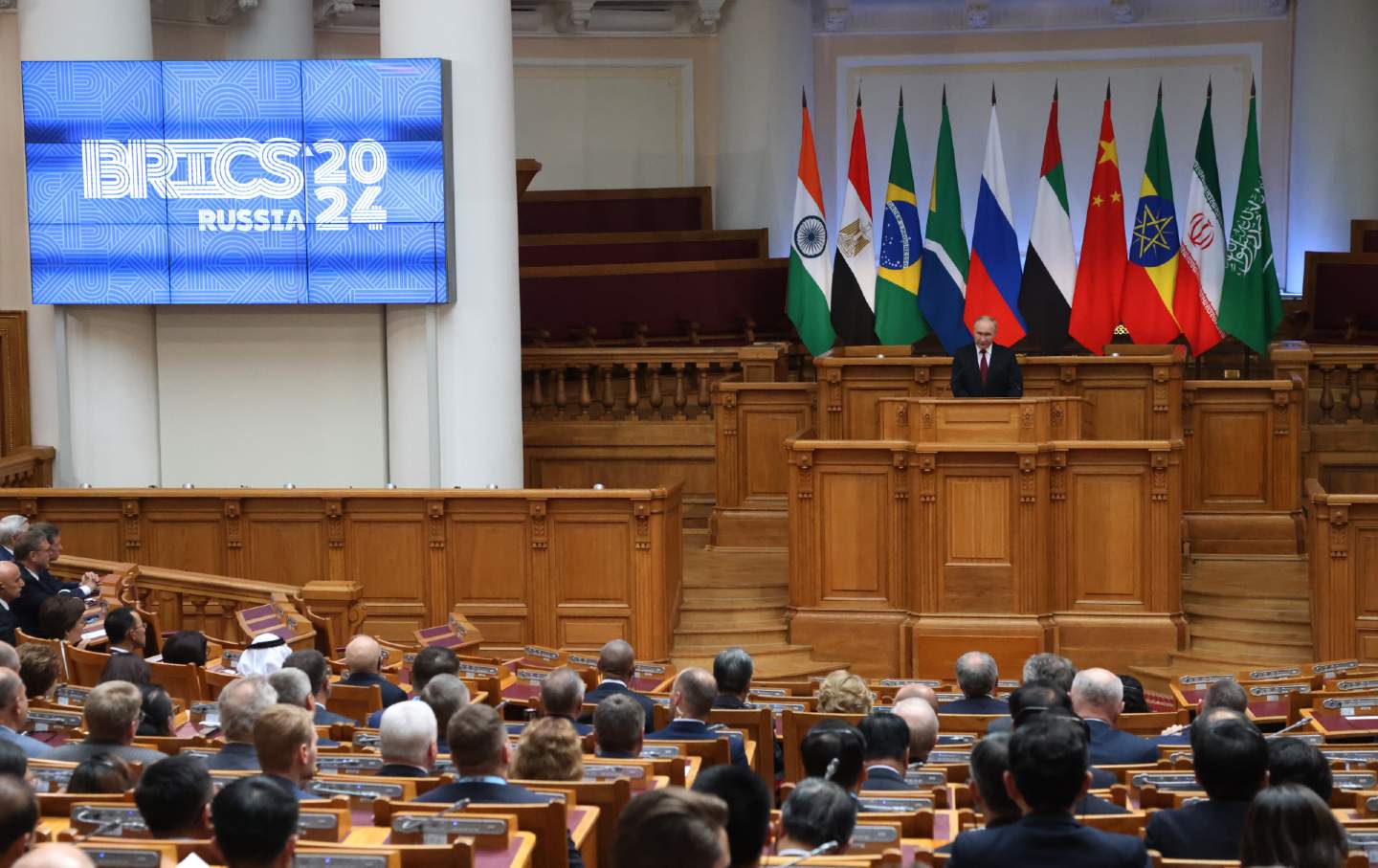
After being long ignored by the West, BRICS—the intergovernmental organization uniting Brazil, Russia, India, China, South Africa, Iran, Egypt, Ethiopia, and the United Arab Emirates—generated enormous interest during its summit last year in Johannesburg, South Africa. That summit marked BRICS’s biggest expansion to date, with invitations sent to Egypt, Ethiopia, Iran, the United Arab Emirates, Argentina, and Saudi Arabia. (Argentina later declined and Saudi Arabia is still undecided.) But Johannesburg’s deeper message was the renewed assertion of the Global South.
BRICS leaders will soon meet again in Kazan, Russia, for their 16th summit. Writing here last year on the eve of Johannesburg, I had characterized BRICS as a coalition between the “Global East” (comprised of China and Russia) and the Global South, with its expansion a strong signal of the developing world’s deep dissatisfaction with the failures of the US-led order. A year later, BRICS is becoming even more attractive across the Global South, even as the world is increasingly at risk of major-power war.
Continuing the Enlargement
BRICS holds promise on two fronts. The first is its expansion itself, which speaks to the organization’s dynamism and wide appeal. The second is its attempt at problem-solving—chiefly on development finance and alternative currencies.
The induction of new members set in motion in Johannesburg has unfolded rather smoothly: Egypt, Ethiopia, Iran, and the UAE joined on schedule at the beginning of this year. BRICS’s newly inducted members come with many potential benefits. The energy-rich UAE brings finance, deep pockets, and a dynamic start-up culture. Egypt occupies a special and prominent place among Arab states. Ethiopia and Egypt are also, respectively Africa’s second- and third-most-populous countries. Iran, though sanctioned and currently in conflict with Israel, is another energy-rich regional power.
The past year has shown that the rush to join BRICS is only growing across the Global South. Thailand and Malaysia’s push for membership marks the future entry of Southeast Asia, a region that has demonstrated major success in economic growth and integration. At the other end of Asia, Turkey and the Eurasian state of Azerbaijan have also applied. President Erdoğan will be present in Kazan along with at least 24 other leaders. Several other states are in the membership pipeline.
Will BRICS add new members in Kazan? The grouping is now dealing with a challenge common to all organizations seen as desirable for membership—balancing growth with efficacy. A public setback on cohesion emerged last month when a BRICS foreign ministers’ meeting failed to issue a joint statement. Differences on the Middle East and who should represent Africa in a reformed UN Security Council got in the way.
Additions to core membership are possible, but unlikely at Kazan. However, a new category of “partner” countries will likely be inaugurated, representing a tier below full membership. This would mark the fulfillment of a goal in the group’s summit declaration in Johannesburg (paragraph 92).
Much has been made of BRICS’s “anti-Western” nature due to China and Russia’s outsized heft. But BRICS’s expansion across the Global South can only dilute the influence of Moscow and Beijing in the longer run. The Global South may not necessarily be an ally of the West, but nor is it an adversary. It seeks not containment but “hedge-mony”—the practice of multi-alignment in a world in which “US relative power is slowly eroding and the future of the global order is highly uncertain.”
Delivering on Public Goods
BRICS’s most significant on-the-ground impact has been through its development institution, the Shanghai-headquartered New Development Bank (NDB). The bank enjoys the second-highest rating level of AA+ from Standard & Poor’s. The NDB has maintained a high rating, despite having to navigate Western sanctions against Russia, one of its top shareholders. It has done so by suspending its projects in Russia.
The NDB’s dominant shareholders are the five core members of BRICS, each with an equal share. But it is also open to all UN member states, and recently approved Algeria’s membership. Bangladesh, Egypt, UAE, and Uruguay are the other non-core NDB members. The NDB’s loan disbursements amount to about $4 billion annually, much smaller than the World Bank’s more than $100 billion.
But the NDB has some unique characteristics not seen in other Multilateral Development Banks (MDBs)—no single dominant shareholder, a rotating presidency between the five core BRICS members, and a serious effort on offering loans in local currencies with a goal of a 30 percent share of the total. These have presented no barriers to its collaboration with traditional MDBs. The emergence and maturing of a professionally managed development bank on the world stage without the West’s or Japan’s participation is a qualitatively new and underappreciated phenomenon.
The threat of crippling Western sanctions is a common vulnerability for all states outside the US core alliance system, thanks to the global hegemony of the mighty US dollar. Bilateral local currency arrangements are growing to achieve greater financial autonomy—most prominently between Russia and China, India and Russia, and within ASEAN. Thus far, these have only made a dent in the dollar’s reign.
Though BRICS is loath to call it “de-dollarization,” the push continues to build up BRICS Pay, a platform aimed to circumvent the US dollar taking advantage of digital and decentralized technologies. Heavily sanctioned Russia is particularly keen to make progress in this area. However, there are indications of mixed support within BRICS for any rapid progress. Even as many states continue to slowly build up local currency pathways on their own, progress on a BRICS-driven platform for such arrangements will make only incremental progress at Kazan.
Navigating a World at War
As the “great-power competition” took off in 2018, BRICS has had to confront a world in which trade and investment became weaponized. The illegal Russian invasion of Ukraine marked another descent—outright flirtation with great-power war. Since the Johannesburg summit, Washington’s unconscionable arming and shielding of the current Israeli government, which is prosecuting an assault on Palestine and Lebanon in wake of Hamas’s October 7, 2023, terror attack, has brought us to the threshold of a regional conflagration. Meanwhile, a vast belt in Africa, stretching from the Sahel to Somalia, is in the throes of increasing violence and state failure. Far too much of the world is now at war or on the brink of one.
BRICS has so far deftly managed the pressures from the Russia-Ukraine war. The Middle East presents a more serious challenge. An Israel-Iran war with US participation could threaten the stability and prosperity of the UAE and put Egypt under further pressure to act more strongly against Israel. Meanwhile, tensions between Egypt and Ethiopia show no sign of ebbing. These are precisely the four new members of BRICS.
Popular
“swipe left below to view more authors”Swipe →BRICS has a generally strong record at not letting bilateral tensions affect its functioning—the best example being China and India’s competing responsibly within the grouping. In fact, there is the potential for BRICS to emerge as a venue for adversaries to reduce their bilateral tensions as they engage and socialize.
The continuing expansion of BRICS comes at a time when forces of fragmentation are ascendant, and formal structures of multilateralism seem to be dying a slow death. This has made informal groupings central to problem-solving.
For all its flaws and checkered actors, the growing BRICS is among the many necessary correctives to an out-of-balance world. It cannot replace a flailing UN system. But the persistence and growth of BRICS demonstrates that, while fragmentation may dominate today’s headlines, the impulse for collective action, however uneven and fitful, remains very much alive.
Become a Sustaining Donor This September
Between the reemergence of right-wing red-baiting and Donald Trump’s use of the chilling National Security Presidential Memorandum–7 to criminalize left political organizing, we’re seeing McCarthyism reborn before our eyes.
This assault on democracy cannot be ignored or wished away. Resisting it requires bravery in the face of threats and repression, a steadfast commitment to the truth, and the unwavering belief that we can—and will—overcome this darkness.
We must have an independent media that sets the record straight, unearths corruption and abuses of power, and advances a politics of justice and dignity for all if we’re to win this fight.
That’s why I’m writing to you today. This September, The Nation needs to add 100 monthly donors to sustain our progressive journalism. Your contribution makes the next investigative report, the next truth-speaking column, and the next pathbreaking essay all possible.
I hope you’ll support our work with a recurring donation today. If you donate $10 or more a month, we’ll send you a brand new “Hands Off the Free Press!” sticker to recognise your commitment to our cause. Please, donate today.
Onward,
Katrina vanden Heuvel
Editor and Publisher, The Nation
More from The Nation

Pinochet: The Verdict of History in the Letelier-Moffitt Case Pinochet: The Verdict of History in the Letelier-Moffitt Case
An act of international terrorism on the streets of Washington, DC, still reverberates 50 years later.
How to Arrest Benjamin Netanyahu How to Arrest Benjamin Netanyahu
Make no mistake: The United States can seize Netanyahu for crimes under US law and prosecute him in US courts when he is in New York City this week.
In the Age of AI, Nuclear Weapons Abolition Is a Renewed Imperative In the Age of AI, Nuclear Weapons Abolition Is a Renewed Imperative
As long as we have nuclear weapons, the job of ending humanity will continue to be as easy as the push of a button—or an AI agent hacking into a nuclear command-and-control system...
These Students Are Shaping UN Human Rights Policy These Students Are Shaping UN Human Rights Policy
Princeton undergraduates are helping the organization develop standards for post-mortem digital privacy and death in custody.
The Peril of Trump’s Final Act: Would He Use a Tactical Nuclear Weapon in Iran? The Peril of Trump’s Final Act: Would He Use a Tactical Nuclear Weapon in Iran?
Trump is trapped in a war that has already been lost, a reality that he will never allow himself to admit.
A Spreading War Rattles Global Energy Markets A Spreading War Rattles Global Energy Markets
Analysts say the consequences for energy prices and the world economy may be more serious in this later phase of a war that many had expected to be largely over by now.

