We Can’t Afford to Ignore This Threat to the People of Gaza
The very air that Gazans breathe could put their health in danger for many years to come.
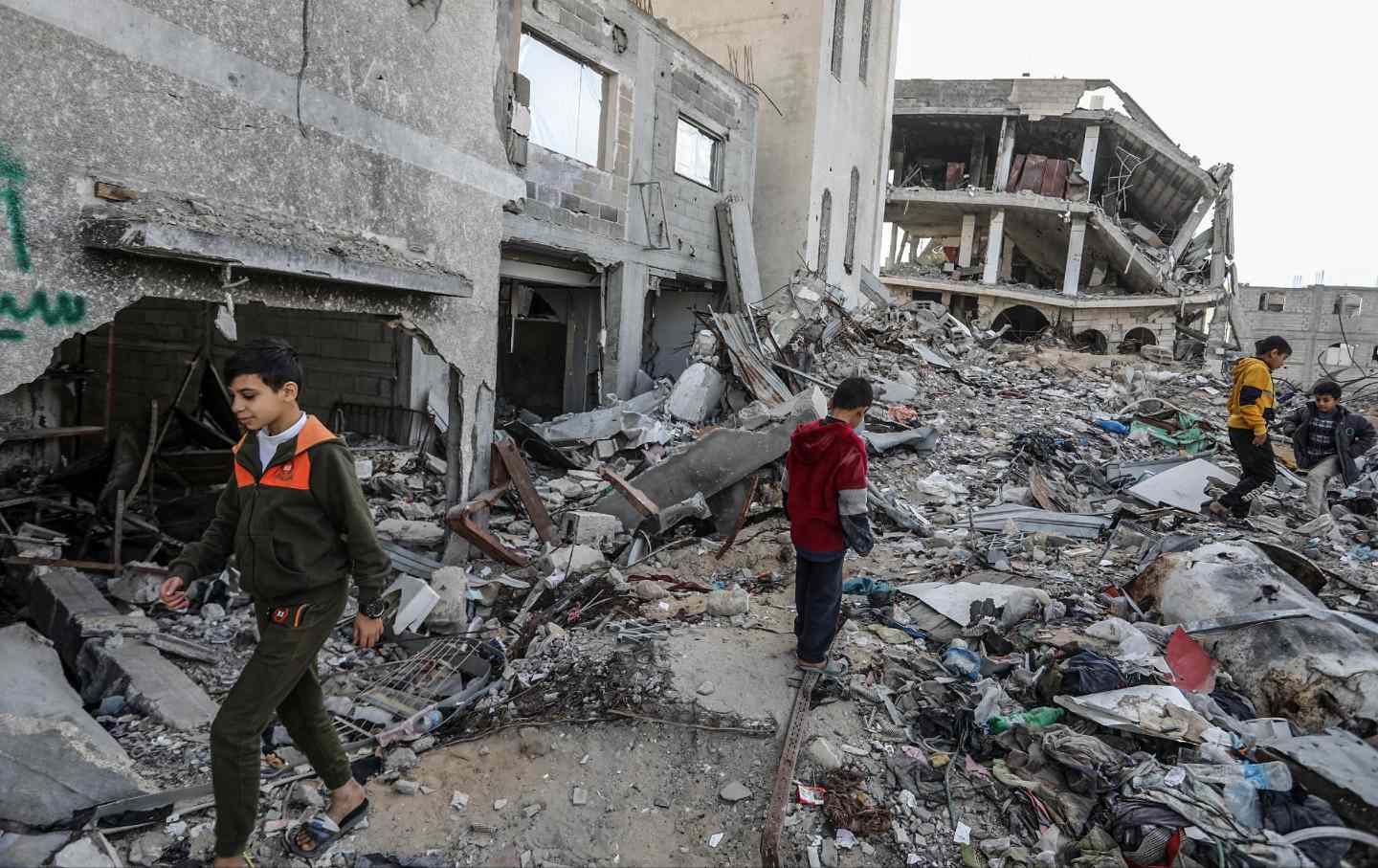
Debris in Khan Yunis, Gaza on December 10, 2024.
(Abed Rahim Khatib / Anadolu via Getty Images)Gaza is no longer recognizable. Since Israel’s genocide began last year, more than 60% of its buildings have been destroyed or damaged – leading to more than 42 million tons of rubble. Satellite images taken before and after October 2023 show the impressions of buildings and homes in one image and a landscape awash in brown dust in the other. The sheer amount of dust is the most defining feature of these pictures – they are notably more sepia tone in color. What was once part of a free-standing structure became pulverized, aerosolized, and inhaled before settling on the ground.
The genocide has caused countless threats to the health of people in Gaza. But this dust—the particles emanating from the rubble that now blankets every part of the region—is a threat we don’t talk about that much. We should start talking about it more because it will imperil public health in Gaza for many years to come.
When we think of airstrikes, we imagine traumatic injuries – limbs torn to pieces; bones broken, the streets filled with blood. But the impacts of an airstrike go far beyond the initial damage it causes. Survivors are exposed to toxic building material, smoke and chemicals – all of which can be absorbed by the body in different ways. Considering that some people remain trapped under the rubble for hours or days, there is a prolonged period in which they remain directly exposed to these materials. Some people in Gaza continue to live in the collapsed shells of their homes, while others live in tents likely within meters of the destruction.
What do these health impacts look like specifically on civilians? Last year, researchers at the University of Maryland reviewed several studies to find an answer. They discovered that the vast majority of research on toxic chemical exposures in war was focused broadly on the impacts on military personnel (such as the impacts of burn pits) or on the impact on those who were either in or around the World Trade Center site during and after 9/11. There is comparatively little research on the impacts of war-related chemical exposure on civilians – even though there is extensive documentation of, for instance, the effects of Agent Orange in Vietnam or the birth defects being experienced by babies in Fallujah.
The research that was produced after 9/11 can give us a clue as to what people in Gaza may be dealing with. When the towers collapsed, materials like polycyclic aromatic hydrocarbons, asbestos, metals, and glass were released into the air. In the aftermath, many people developed respiratory symptoms – what was soon called “World Trade Center Cough Syndrome”. Research shows that there were increases in cancer amongst both rescue workers and civilians who were exposed to the 9/11 attacks. Cancers can take a long time to develop, which is why researchers call for continued surveillance as the relationship between exposure and cancer development may become more clear. But, enough of a link has been established that Congress has allocated funds for 9/11 responders through the James Zadroga 9/11 Health and Compensation Act.
If the collapse of the World Trade Center caused such wide-ranging and long-lasting harm, one can only imagine what a year of ongoing bombardment in an area considerably more densely packed than Manhattan can do to people; specifically, people who also have limited (if any) access to basic healthcare and find themselves deprived of food and clean water. As an October report from Reuters highlighted, the presence of asbestos in building materials is of particular concern. Asbestos can be easily inhaled and cause mesothelioma and lung cancer.
The UN Environment Programme has also raised concerns about heavy metals and lead leaking into the groundwater in Gaza; caused specifically by the destruction of solar panels. With Israel virtually obliterating Gaza’s sanitation infrastructure, people are likely drinking water contaminated with these and other pollutants. As we know, lead exposure, even in small amounts is highly detrimental to childhood development. Lead has also been tied to lower birth weights when there is prenatal exposure.
It isn’t difficult to conclude that there is a generational health crisis in the Gaza Strip. Even after the ongoing genocide comes to an end, sooner than later we hope, the people of Gaza will be left with lifelong impacts to their health. As US and Israeli officials discuss plans for a “post-war Gaza,” there is little attention devoted to the actual health and welfare of the Palestinians who live there.
Drs. Almashat & McDiarmid of the University of Maryland have called for more attention and study on the impacts of toxic chemical exposures on civilians in armed conflicts. Without such research, the victims of conflict are rendered more invisible and those who partake in genocide denial are further empowered. Neglecting to document these impacts gives us a false impression of how many people have been killed and impacted – which denies them the right to be treated and just as importantly, the opportunity for justice.
These people need to be represented in the literature and public health advocates everywhere must step up to the plate to help document what has occurred. But this cannot be done as Palestinian health workers continue to be targeted and killed, and as researchers like Dr. Khaled Asler and doctors like Dr. Hussam Abu Safiya, director of the Kamal Adwan Hospital, are kidnapped by Israeli forces. Dr. Asler was later released after an international outcry, but Dr. Abu Safiya continues to be held by Israeli forces with his whereabouts unknown. Data cannot be collected in the midst of mass death; this must stop now.