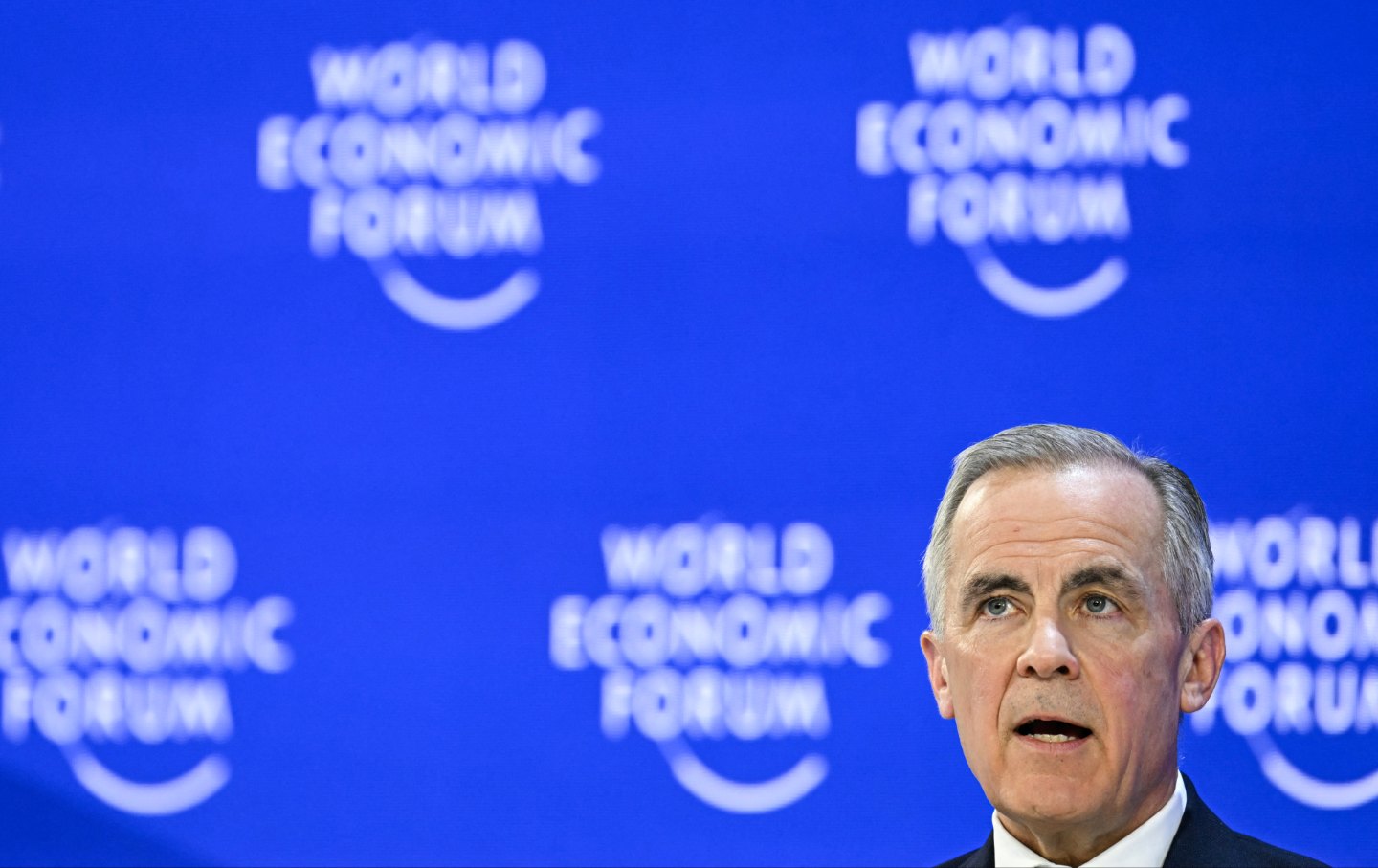
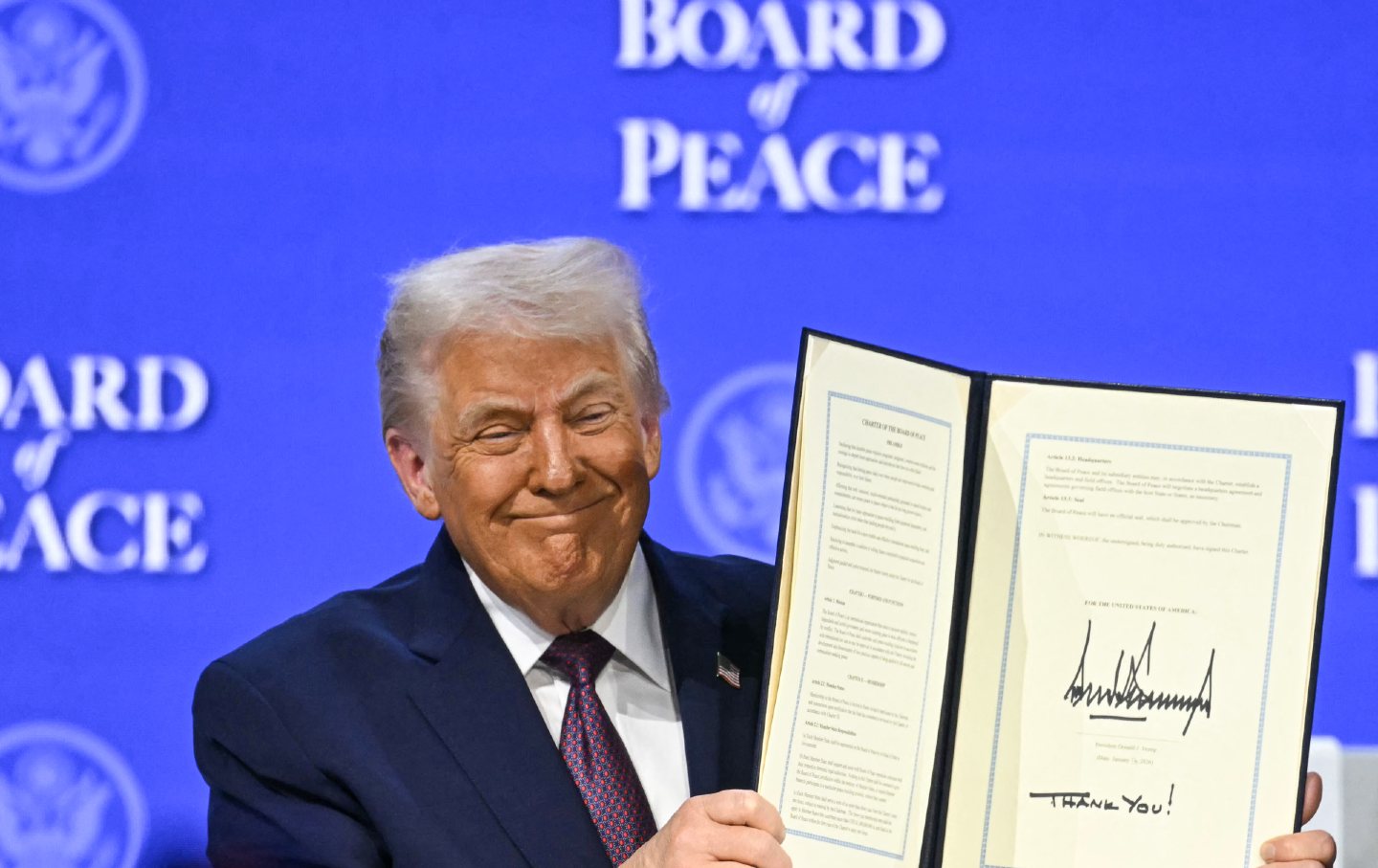
Donald Trump holds a signed founding charter for the “Board of Peace” during the World Economic Forum annual meeting in Davos.
(Fabrice Coffrini / AFP via Getty Images)
For those of us who have mourned the loss of countless loved ones killed by the Israeli military over the past 27 months and watched our family homes reduced to rubble, the “New Gaza” vision unveiled by President Donald Trump and Jared Kushner in Davos is an outrageous moral affront. To see AI-generated renderings of luxury high-rises and “coastal tourism zones” atop the literal ruins of our lives is not a vision of peace. It is a blueprint for erasure.
The plan presented by Kushner—who has deep family ties to Benjamin Netanyahu and a history of funding illegal Israeli settlements on occupied Palestinian land in the West Bank—imagines a “New Gaza.” This Gaza is portrayed as a futuristic dreamscape of gleaming apartment blocks, data centers, and luxury towers lining the Mediterranean shore in place of the cities and towns Israel has systematically destroyed—and in fact continues to destroy despite the supposed ceasefire. During his presentation, Kushner praised the value of Gaza’s “waterfront property,” and spoke of planning for “catastrophic success,” effectively recasting mass killing and genocide into an investment opportunity.
This plan will not achieve peace. It is designed to perpetuate and further entrench a system of Israeli apartheid that has oppressed Palestinians for eight decades, which is the root cause of all the violence between Israelis and Palestinians.
Even in a best-case scenario, this plan will likely make Gaza unaffordable for most Palestinians and separate them into “technocratic” camps under the oversight of an “Executive Board” of foreign CEOs run by Trump. Of even greater concern, by prioritizing “industrial zones” and “tech-driven governance” while ignoring Palestinian human rights and Israel’s ongoing campaign to make Gaza unlivable—such that Palestinians have no choice but to leave—this vision amounts to soft ethnic cleansing. Indeed, just a day before revealing this plan, news reports revealed that the Israeli government had been discussing a proposal to reopen the Rafah crossing only on the condition that outbound traffic is prioritized over entry, setting a ratio to ensure more Palestinians leave the Strip than are allowed to return. This plan is designed to replace our indigenous people and society with a capitalist dystopia where we are merely a cheap labor force behind militarized walls.
Trump and Kushner speak of a “New Gaza” without ever reckoning with Israel’s destruction of the old one. Under this administration’s direction, Gaza is being treated as a distressed asset or a failed startup awaiting new management, rather than a homeland and the site of a crime scene, with thousands of bodies still missing underneath the rubble.
I owned a home on Gaza’s beach. Israel flattened it last year, as it did tens of thousands of others, damaging or destroying more than 90% of all homes in Gaza. No Trump-backed panel of CEOs, autocrats, and leaders of governments complicit in Israel’s genocidal campaign can restore what was stolen by force. Yet from a conference stage in Davos, they claim the authority to decide what comes next for a people they refuse to even look in the eye.
If the United States and the international community are serious about moving toward a true and lasting peace, they must abandon these neocolonial plans and pivot toward a solution rooted in freedom, justice, and Palestinian agency.
For starters, the process must be rooted in Palestinian self-determination; the governance of Gaza must be led by Palestinians, for Palestinians, under a unified national framework—not a “management contract” overseen by foreign trustees. Second, instead of attempting to replace the United Nations system with “free market principles,” the U.S. must fully restore funding to UNRWA, ensure unobstructed aid through all crossings, and compel Israel to reverse its ongoing attempts to ban UNRWA and other aid groups from carrying out their critical work. Third, there must be absolute accountability for reconstruction: it must be treated as a legal right and a remedy for the destruction leveled by Israel with U.S.-made weapons, not an ATM for well-connected investors. Finally, there must be a firm political horizon for when the international community recognizes a sovereign, viable Palestinian state within the 1967 borders. Without a clear path to ending Israel’s brutal occupation, any “investment” is simply a way to fund a more comfortable cage.
But before any of this can happen, Israel must be compelled to finally end its campaign of genocide in Gaza, which, as noted by Amnesty International and others, is ongoing despite the supposed ceasefire announced in October. To achieve this, the international community must move beyond rhetoric and fulfill its legal obligations under the Genocide Convention to prevent further atrocities. This requires the immediate imposition of a comprehensive arms embargo and targeted sanctions on Israel—measures that are not merely political choices but legal imperatives for every signatory committed to halting the destruction of a people.
While Israel’s government was consulted in the drafting of Trump’s plan, the Palestinian people—the very subjects of these grand designs—have been deliberately shut out. Decisions about our land, governance, and lives are being finalized in a perversely named “Board of Peace” run by Trump.
True peace and rebuilding acknowledge responsibility for the destruction of our homes and lives, and prioritize Palestinian agency. We do not need a “Master Plan” imposed on us by people who do not have our rights or well-being at heart. We need our homeland preserved, rebuilt, and our rights and aspirations centered.