
Mark Carney Knows the Old World Is Dying. But His New World Isn’t Good Enough.
The Canadian prime minister offered a radical analysis of the collapse of the liberal world order. His response to that collapse is unacceptably conservative.
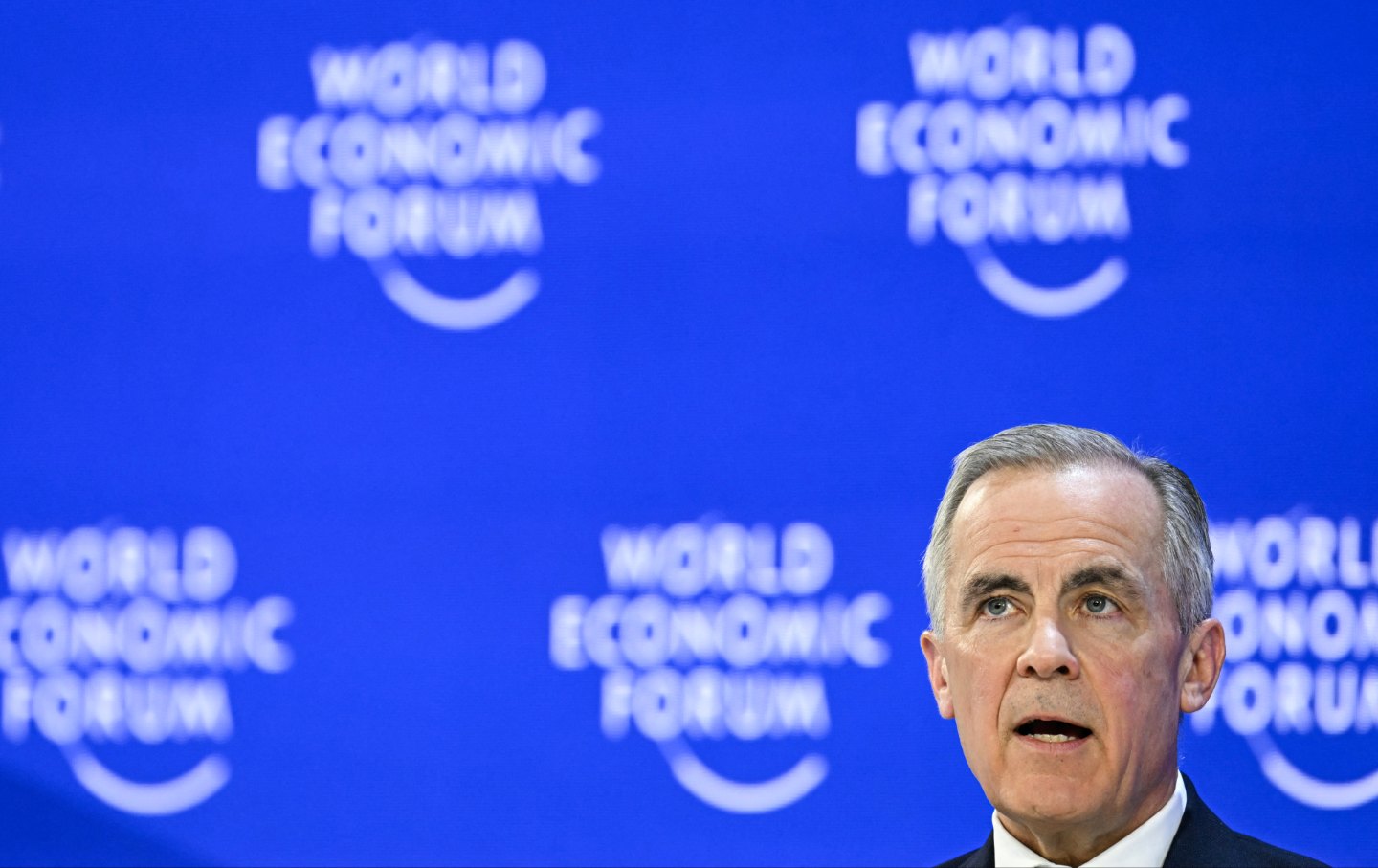
Canadian Prime Minister Mark Carney delivers a speech during the World Economic Forum (WEF) annual meeting in Davos on January 20, 2026.
(Fabrice Coffrini / AFP via Getty Images)Nobody would ever call Canadian Prime Minister Mark Carney a charismatic speaker. A former central banker and hedge fund manager, Carney can be as dry as an insurance salesman explaining an actuarial life table. Inexplicably, he has difficulty with both of Canada’s official languages. When speaking French, he drones in an affectless monotone that can charitably be described as a brave effort by a remedial student. But even in his native English, he stammers when reading from a teleprompter. By contrast, Justin Trudeau, Carney’s immediate predecessor as prime minister and former Liberal Party leader, was a natural politician. Trudeau has star power comparable to John F. Kennedy’s or Barack Obama’s: He is handsome, bilingual, photogenic, and unfailingly charming in his interactions with voters. Trudeau speaks with an effortless fluidity and grace, perhaps acquired during his previous career as a drama teacher. It’s entirely fitting that he is currently dating the singer Katy Perry.
Yet, for all his celebrity aura, Trudeau never gave a speech that made any kind of lasting impact during his near-decade in power. His stolid successor, however, has done just that after less than a year in office. In an address at the World Economic Forum in Davos on Tuesday, Carney delivered a stark warning about the crisis of the liberal world order that earned a standing ovation and global attention.
Carney’s speech was a product of an existential crisis for the country he leads. Donald Trump’s second term in office has created anxiety among many US allies, but perhaps none more than Canada, whose economy and national security are unusually tightly integrated with its southern neighbor. The US is far and away Canada’s biggest trading partner, making up 62.2 percent of trade. (The next largest trading partner, China, makes up less than 8 percent.) And since World War II, Canada’s entire national security umbrella has been intertwined with US-led institutions such as NATO and NORAD.
Canada and the United States have had their differences over the past 80 years, but none of them fundamentally undermined this status quo. Enter Trump. Now Canada has seen its most important ally turn into an open predator. Trump has repeatedly expressed a desire to make Canada the 51st US state—part of a larger project of hemispheric domination that also includes kidnapping the president of Venezuela and his wife, bombing boats in the Caribbean and Pacific Ocean under the pretext of waging war on drugs, threatening to annex Greenland, and pushing for regime change in Cuba—and slapped tariffs on some of Canada’s most important industries.
Neither Carney nor the Canadian public has been willing to write off Trump’s comments about a 51st state as mere trolling. Mainstream Canadian newspapers such as The Globe and Mail have speculated that the US could use the Alberta separatist movement as a pretext for a military intervention along the lines of Russia’s invasion of Ukraine. The Canadian military is even reportedly preparing contingency plans for a long, drawn-out guerrilla war in response to an American invasion.
All of this tension was in the air when Carney gave his Davos speech. Carney didn’t mention Trump by name, but the US president was clearly the target of an extended analysis of the dangers of a new world of great-power competition. Carney alluded to a famous aphorism from the Greek historian Thucydides, “It seems that every day we’re reminded that we live in an era of great-power rivalry, that the rules-based order is fading, that the strong can do what they can, and the weak must suffer what they must.”
The best response to this new world, Carney suggested, is honesty about the changes happening, including candor about the hypocrisy of the liberal world order.
Carney’s bluntness on this last point was particularly striking, given his background as a pillar of the neoliberal establishment. At times, he sounded less like a product of the corporate world than a protégé of Noam Chomsky or Greg Grandin in acknowledging the predation of that system:
For decades, countries like Canada prospered under what we called the rules-based international order. We joined its institutions, we praised its principles, we benefited from its predictability. And because of that, we could pursue values-based foreign policies under its protection.
We knew the story of the international rules-based order was partially false that the strongest would exempt themselves when convenient, that trade rules were enforced asymmetrically. And we knew that international law applied with varying rigour depending on the identity of the accused or the victim….
Over the past two decades, a series of crises in finance, health, energy and geopolitics have laid bare the risks of extreme global integration. But more recently, great powers have begun using economic integration as weapons, tariffs as leverage, financial infrastructure as coercion, supply chains as vulnerabilities to be exploited.
These are welcome words, and brave ones, because Canada is vulnerable to US pressure. Trump certainly caught the gist of them and responded at Davos by saying, “Canada lives because of the United States. Remember that, Mark, the next time you make your statements.” Previously, Trump had invited Carney to join the Board of Peace, a harebrained scheme to supersede the United Nations with an organization of cronies. One of the functions of the Board of Peace would be to govern over Gaza as imperial overlord. On Thursday, Trump posted on Truth Social: “Please let this Letter serve to represent that the Board of Peace is withdrawing its invitation to you regarding Canada’s joining, what will be, the most prestigious Board of Leaders ever assembled, at any time.”
Carney is better off not being on the Board of Peace, but this bit of Trumpian nonsense highlights the limits of Carney’s stance as an opponent of Trumpism. Canada and its European allies are threatened by US neo-imperialism, but the people of Gaza are actively suffering under an ongoing genocide. If Carney really wanted to change a global system where the strong prey on the weak, he could join nations in the Global South, such as South Africa, and the outliers in Europe, such as Ireland and Spain, in condemning the United States and Israel. He has not done so, instead sticking to circumspect banalities
Lloyd Axworthy, who had served as minister of foreign affairs from 1996 to 200 under Liberal Prime Minister Jean Chretien, has rebuked Carney for his repeated subservience to Trump on a broad range of issues. According to Axworthy, Carney “went silent when Trump attacked a Canadian judge at the International Criminal Court, refused to comment on his breach of international law in Venezuela, declined to outright condemn his threats against Greenland, paid scant attention to the tragedy in Sudan, and backed away from climate commitments—to name just a few examples.”
As an alternative to Trump’s neo-imperialism, Carney at Davos recommended a new alliance of middle powers that could promote trade and security. This program is fine as far as it goes, but the nations Carney seems interested in engaging most are either the wealthy countries of Europe or the emerging great power of China. Nowhere did he address the need to revitalize the United Nations or build stronger ties to the Global South.
Moreover, the seeming radicalism of Carney’s analysis is at odds with the conservatism of his actual policy agenda, as journalist Luke Savage highlighted in a Substack post:
Practically-speaking, this has meant new trade agreements with the likes of China and Qatar in service of the domestic agenda to which Carney alluded around the speech’s midpoint—a program…of publicly-subsidized but privately-led economic development facilitated through the rolling back of environmental and regulatory safeguards, a lavish round of tax cuts, an austerian approach to public spending, and an embrace of military Keynesianism.
Popular
“swipe left below to view more authors”Swipe →Some of Carney’s conservative policies are strategic. As US expansionists such as former Trump adviser Steve Bannon seek to exploit the Alberta separatist movement, there is a logic in Carney’s move to defuse tension in the western province by appeasing the right. He is, in effect, trying to run a government of national unity. But these decisions are also in keeping with Carney’s fundamentally conservative worldview. This is a man who has spent his entire adult life in corporate boardrooms or running central banks.
In any case, Carney’s combination of centrist policies with strengthening alliances with European powers amounts to a politics of retrenchment rather than an attempt to forge novel policies. The great Marxist Antonio Gramsci famously wrote (in a loose translation): “The old world is dying, and the new world struggles to be born: Now is the time of monsters.” To his credit, Carney knows the old world is dying. But the new world he is trying to create is just a refurbished version of that old world. It will not help us in defeating the monsters.
More from The Nation
Democrats Can Contain the Donroe Doctrine Democrats Can Contain the Donroe Doctrine
Democrats have the tools to challenge Trump’s military interventions and electoral interference in Latin America—if they’re willing to use them.

Israeli Elections: Fanatics, Generals, and the Question of Palestine Israeli Elections: Fanatics, Generals, and the Question of Palestine
The central question is whether defeating Netanyahu would change Israel’s policies or simply change the people managing them.
“LULA!” Progressives Hail Brazil’s Stunning Election Result “LULA!” Progressives Hail Brazil’s Stunning Election Result
“The people united will never be defeated!” declares Zohran Mamdani.
Israel’s Extremist Election Israel’s Extremist Election
The run-up to the vote on Tuesday is exposing the façade of Israeli democracy—and the fealty of the country's so-called opposition when it comes to matters of Jewish supremacy.

“NAZA” and Israel’s History of Automated Warfare “NAZA” and Israel’s History of Automated Warfare
As violent technologies like spyware, predictive targeting algorithms, and 2,000-pound warheads become ordinary instruments of military rule, once-abhorred practices become routin...
Brazil’s Workers’ Party Is Not Stopping Brazil’s Workers’ Party Is Not Stopping
With just a few days remaining before the runoff election, supporters of Lula’s party are doing everything possible to rally support behind the president.

