A Call Is Rising for Nations to Boycott the Trump World Cup
As marauding state agents fill US streets, a leading German soccer official says countries should consider what was once unthinkable: skipping the 2026 World Cup.
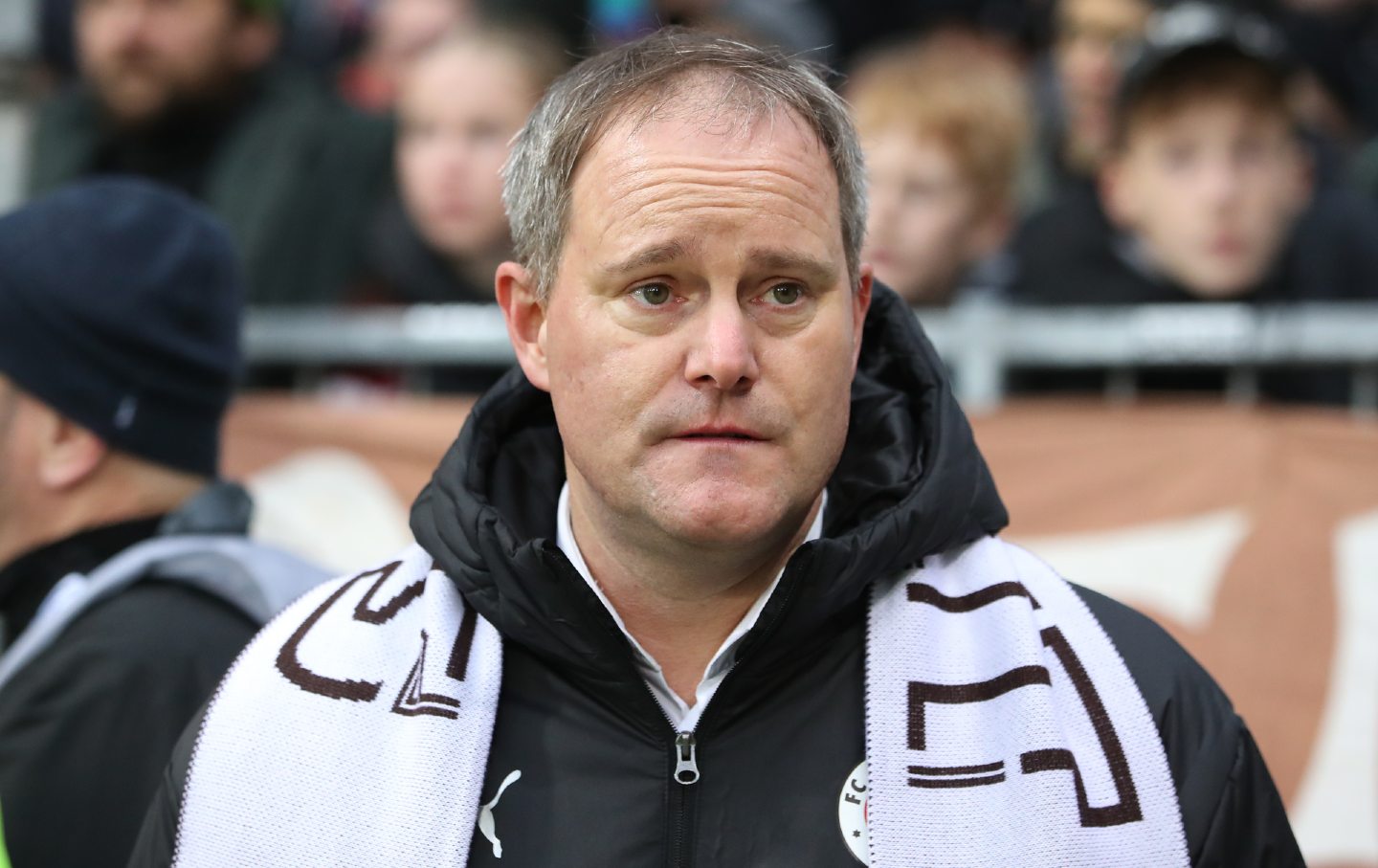
Oke Göttlich, the president of FC St. Pauli, looks on before the Bundesliga match between FC St. Pauli 1910 and FC Bayern München at Millerntor Stadium on November 9, 2024, in Hamburg, Germany.
(Sebastian El-Saqqa / firo sportphoto via Getty Images)This week, a leading German soccer official, Oke Göttlich, said that the time has come to consider the unthinkable: a boycott of the World Cup to protest Donald J. Trump’s United States. The most watched sporting event on earth is due to be played this year in the United States, Canada, and Mexico, and Göttlich said in a Friday interview, before a federal agent murdered Minneapolis VA nurse Alex Pretti, that “the time has come” to “seriously consider and discuss this.” Göttlich was responding not only to state agents marauding US streets but also to Trump’s military threats against Greenland and the people of Europe, which have shattered old alliances. However specious these alliances may have been, the alternative that Trump is advancing is a new world order of unchecked US aggression, where the ghoulish Stephen Miller feels free to call for occupation and bloodshed.
Göttlich is no lightweight. He is one of the German federation’s 10 vice presidents and the president of the Bundesliga club St. Pauli. Folks may know St. Pauli as a proudly left-wing, openly anti-fascist team whose fans generally align with what Göttlich is putting forward, although calling for a boycott goes beyond what any European soccer power broker has done. It moves the “Overton window” as to where this discussion could go. Göttlich was pressed by a reporter about the St. Pauli players on the German national team and whether he felt like he was undercutting their personal and national ambitions. Göttlich replied, “The life of a professional player is not worth more than the lives of countless people in various regions who are being directly or indirectly attacked or threatened by the World Cup host. What were the justifications for the boycotts of the Olympic Games in the 1980s? By my reckoning the potential threat is greater now than it was then. We need to have this discussion.”
It is actually past time to have this discussion. Ten long months ago, I wrote a piece with Jules Boykoff titled, “With ICE Out of Control, How Can the US Cohost the 2026 World Cup?” It was a call for countries outside of the United States to boycott. We did not know at the time that the US would threaten war on European soil, abduct world leaders, blow fisher-folk out of the ocean, kidnap 5-year-olds, and execute US citizens in the streets. And yet even 10 months ago, in the aftermath of the ICE kidnappings of Mahmoud Khalil and Rumeysa Ozturk and the revelations that the US was sending people to labor camps in El Salvador, it was clear that the direction of this country would be toward fascist violence.
Our argument was that countries were being deeply irresponsible by not warning their citizens that traveling to the United States would be perilous and not just for them: players, coaches, and their families would all be at risk. Now even FIFA former chief, that monument to corruption Sepp Blatter, is saying that it could be dangerous for fans to travel to the United States. But Göttlich is taking it to the next level by challenging nations to stay home. FIFA, the world governing body for soccer, has witnessed its chief, Gianni Infantino, affect a weak and bent posture when in Trump’s presence. During Trump’s second term, Infantino has visited the White House more than any foreign leader and presented Trump with that tacky FIFA Peace Prize. Infantino might feel like a world leader when paraded around by Trump like a hairless poodle, but his subservience to Trump has created an opportunity for Göttlich to be a real leader.
“As organizations and society, we’re forgetting how to set taboos and boundaries, and how to defend values,” Göttlich said. “Taboos are an essential part of our stance. Is a taboo crossed when someone threatens? Is a taboo crossed when someone attacks? When people die? I would like to know from Donald Trump when he has reached his taboo, and I would like to know from [German soccer chief] Bernd Neuendorf and Gianni Infantino.”
While Göttlich cited the 1980 Olympic boycott of Moscow following their invasion of Afghanistan, a far better historical comparison comes from his own backyard: the 1936 Berlin Olympics. Hitler used these games to normalize his Nazi regime and project himself as a leader among world leaders. We can, of course, look back at that Olympics and revel in classic sports moments like Jesse Owens winning four gold medals and ruining Hitler’s dreams of Aryan supremacy.
More on the politics of soccer:
But the deeper story of those games is the shameful decision of countries to travel to Berlin to play for the entertainment of their fascist hosts in the first place. This is not hindsight. There were explosive debates across the globe, particularly the United States, about competing in a Germany already imprisoning dissidents and Jews, burning books, and building a military arsenal for territorial expansion. Organizations like the NAACP agitated for a US boycott. The Amateur Athletic Union, by a sliver of a vote, ignored their pleas as well as the arguments of others and sent US athletes to compete. These decisions now look obscene. Göttlich is offering countries a way to avoid being depicted as cowards, quislings, or villains in the eyes of history. Countries should boycott the World Cup games scheduled to be played in the United States. Ten months ago, they needed to do it for the safety of their own fans. Now they must act for the safety of the rest of us.
One last note: I went to college in the Twin Cities. I still have many friends in the area. My anger at watching Trump send killers to fill the streets of Minneapolis is personal, but the people there have bravely shown that such state violence will be met with a response. Minnesotans aren’t Gianni Infantino. Their backs are not bent, and if you ask them to kiss Trump’s ring, they will bite that finger to the bone.