If the World Can’t Stop the Genocide Against Us, Let It at Least Carry Our Stories
A journalist in Gaza debates whether to leave before his entire family is killed or stay so his people’s story is told.
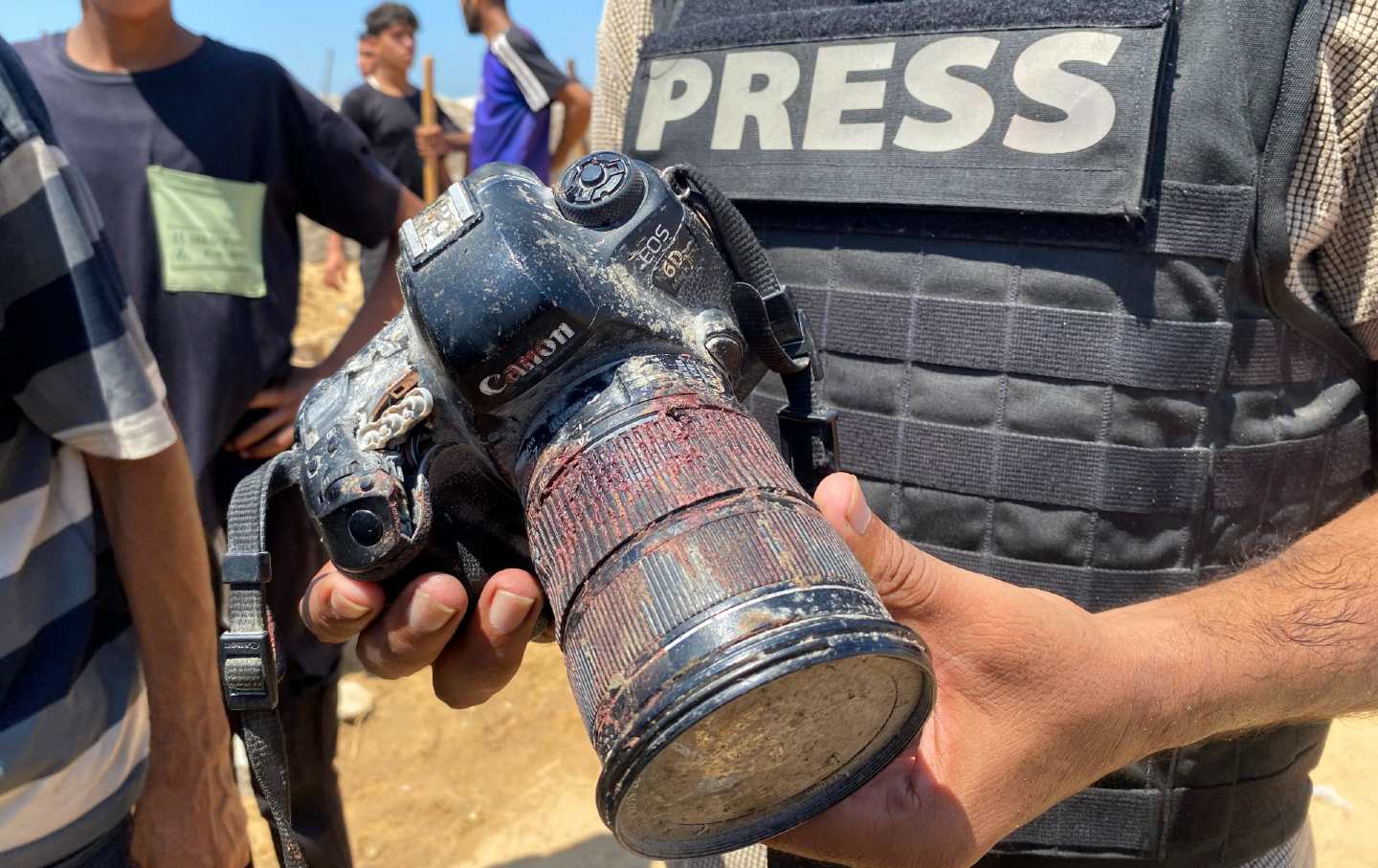
A journalist holds the blood-covered camera belonging to Palestinian photojournalist Mariam Dagga, who was killed in an Israeli strike on Nasser hospital in Khan Yunis in the southern Gaza Strip, during her funeral on August 25, 2025.
(AFP via Getty Images)It is midnight in Gaza City. The drones never leave the sky—we call them zannana—for the way their zzzzzz drills into our heads. Explosions roll from the next neighborhood with every airstrike on homes, or when a remotely operated ground vehicle—an unmanned robot packed with explosives—is steered between buildings and detonated.
On the street below my window, a truck waits under the cones of flashlights, stacked with what remains of my neighbors’ lives: mattresses, blankets, and wooden furniture pried apart for firewood—the only fuel left after nearly two years without gas or diesel. They are leaving again—for the eighth time in nearly two years of war.
I sit in an unfinished apartment, its walls still pitted with holes from helicopter gunships and drone fire. I rented it after being displaced from the east of the city. Now it shelters three families from my relatives. Together we debate whether to join the convoys heading south. I am certain every family in Gaza is having the same conversation.
This is the rhythm of life here: displacement after displacement, death after death, with no time for mourning—only desperate attempts to save whoever is left.
I have lost more than 65 relatives in this war: my mother and father, four siblings, and their children. Two of my brothers were journalists: One worked with an international news agency; the other was a filmmaker I collaborated with. I myself have been wounded twice. Journalism here is no longer a profession. It is a deadly gamble. In nearly two years, Israel has killed about 250 of our colleagues—journalists, filmmakers, and media workers—in Gaza.
At dawn on September 20, 2025, before I could finish writing these words, our neighbors from the Jammala family were killed. I have known them since I was 13, when they raised their building beside ours. They lived by selling meat and running a small grill restaurant; their kebab was famous, and they were generous, sharing food with the poor.
For the past two years, their restaurant had been closed, as meat and most basic foods were barred. The only time we tasted meat or eggs was during the brief two‑month ceasefire at the start of 2025, when limited supplies were briefly allowed in before being choked off again.
I remember Mahmoud—who died with his children in the bombing—telling me he had never imagined his kids would grow up craving the grilled meat their family once made for everyone.
Their building was flattened. Most of the dead were children. One woman lost her husband, Mahmoud, and their three children; if she survives, she will live with one leg. His younger brother, Khaled, lost his wife and all his children and will live alone. Their only “crime,” as it is, was refusing to flee again. Their home stood beside mine, which was destroyed 22 months earlier, when most of my family were killed in the same way—because they stayed. That night I had been sleeping beside my parents when they were torn apart. The blast threw me several meters. My relatives found me by following the sound of my moaning under the rubble.
Journalists and filmmakers also have families. Many have begun fleeing south in search of a safety that does not exist. I fear no one will remain to document what happens, and we will die in silence—as the perpetrators intend. Every day we wrestle with the same question: Do we stay, cameras open, and accept the risk of death? Or do we flee with our families, knowing there is no safe place even in the south?
Popular
“swipe left below to view more authors”Swipe →Israel has barred foreign journalists and filmmakers from entering Gaza, ensuring that little besides its version of events can reach the outside world. Here, the camera itself is treated as a target. Neighbors sometimes fear hosting us, worried they will be bombed simply for sheltering a journalist. Yet this danger only deepens our sense of duty: If we are silent, only the voice of the oppressor will remain. Our responsibility is to record, to insist that people here are not numbers but human beings, with lives and stories that deserve to be told.
Daily survival collides with this duty. We line up with our children to fill water jugs—our ration for the day—sometimes urging them forward because they are small enough to slip through the crowd before the truck’s tank runs dry. I never imagined my children would live like this: in constant fear of death, collecting water, chopping wood, lighting fires to cook, charging phones, searching markets for whatever food might be found. This is the war of daily details.
Meanwhile, I rush to document a bombed home, a displaced family, or a child who lost both parents. I search for an Internet signal to upload raw footage or to connect with my colleague Salah, who managed to escape Gaza with his family at the start of the war, so we can edit a film together. We have lived without electricity for nearly two years, our offices destroyed; new equipment, spare parts, and even basics that keep us working—batteries, lenses, and the like—are barred. Still, we record. We keep footage raw and make only light edits. Here, stories tell themselves; a little editing is enough.
Some of our films have reached international festivals and won awards. While audiences abroad watch them, we run between bombings, hunt for bread amid deliberate starvation, bury loved ones, and fight off despair. I often wonder how we are still enduring.
Our films can cross borders and break the siege, while we remain trapped, running from one air strike to the next or buried under the rubble. I often tell my colleagues: If the world cannot stop the genocide against us, then at least let it carry our stories. We may not be able to protect our lives, but we can fight to ensure that our story is told. And if we are killed, then those who survive must hold on to life so they can carry our story forward.
Gaza is not only “breaking news,” not only ruins, not only hunger. It is voices, souls, and human dignity demanding recognition. If those who kill intend to silence, our obligation is the opposite: to record. We may not be able to save our bodies. But we can protect the record of our lives—and refuse to vanish without a witness.