
War Has Forced Gaza’s Children to Grow Up Far Too Soon
“Instead of playing and jumping, he is thinking of how to help us survive,” one father says.
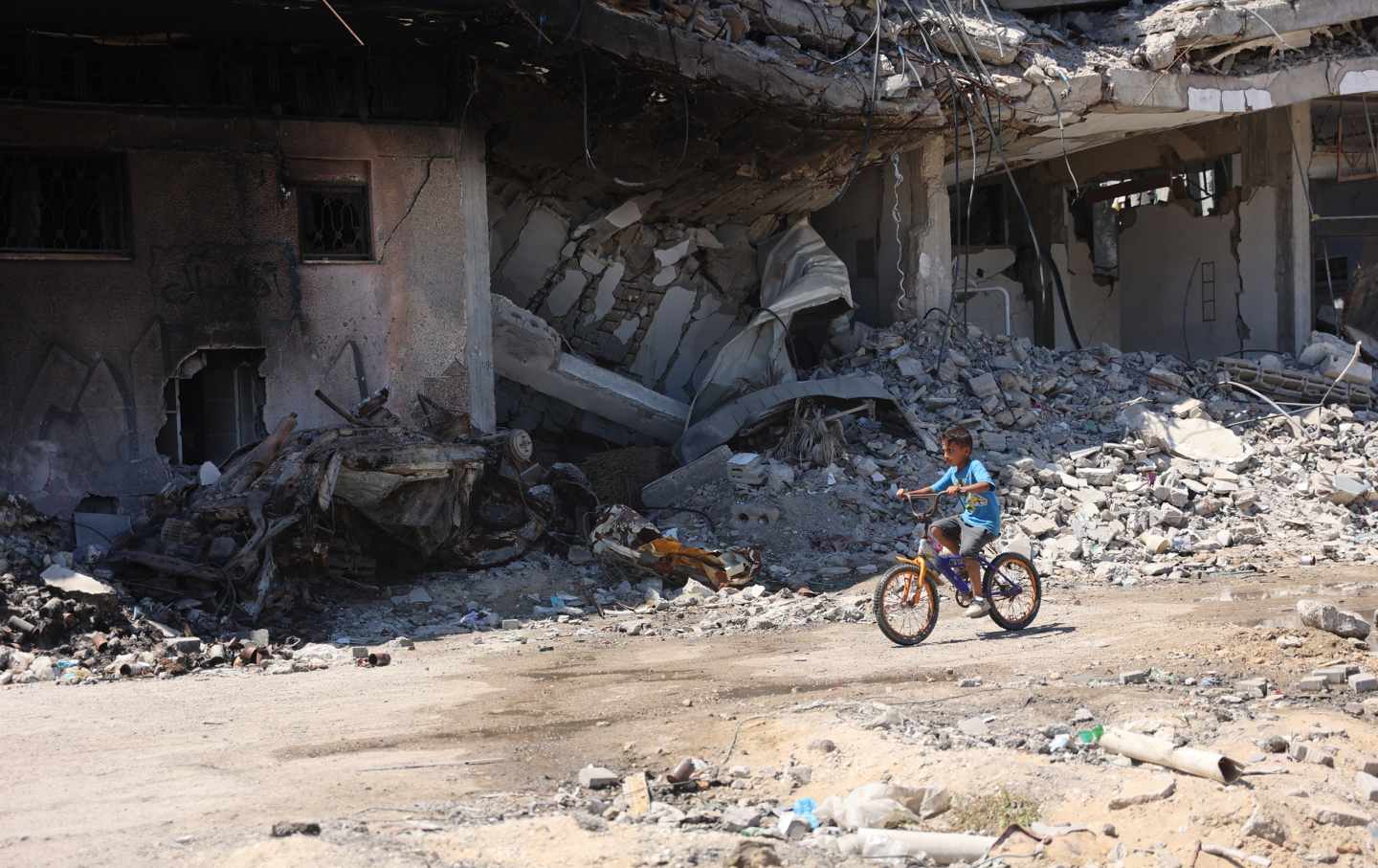
A Palestinian boy cycles past buildings destroyed in previous Israeli bombardment, in the Sheikh Radwan neighborhood north of Gaza City on July 3, 2024.
(Omar Al-Qattaa / AFP via Getty Images)Mohammed is 8 years old. He once dreamed of becoming an engineer like his father. However, the ongoing struggle that has ravaged Gaza since October 2023 has significantly altered the innocent mentality of Mohammed, his siblings, and countless other children.
Mohammed, his parents, and his three siblings fled their home in the Al-Jalaa neighborhood of Gaza City on October 13. They first sought refuge in Khan Younis, then in Rafah, before finally ending up in a tent in Al-Mawasi, an area extending from western Rafah to western Khan Younis, and one classified by Israel as a safe haven.
The constant threat of Israeli air strikes and the harrowing displacement have taken a significant toll on Mohammed and his family. But nothing has been quite as painful for his parents as seeing their kids lose their innocence and turn into old souls in young bodies.
Mohammed, once an active and smart boy who loved to play football and assist his grandfather with his commercial activities, has now been forced to mature far too young. The war has transformed him into a child who knows more about survival than playing games. “Mohammed has become an expert in lighting fires for cooking, filling water gallons, and planting and watering seeds before the tent,” his father said.
“Before leaving Rafah, Mohammed and I were walking through the city’s streets. As I stopped for a while to have a short conversation with my friend, I looked around to see Mohammed going a little bit farther away to collect wood from a destroyed house, even though I didn’t ask him to do so,” Abu Mohammed, his father, recounted. “I asked him why he was collecting wood, and he told me that we don’t need to buy wood.”
“That moment just broke my heart,” the father expressed. “Instead of playing and jumping, Mohammed is thinking of how to be economical and how to help us survive.”
Before this war started, Umm Mohammed’s first priority was her children’s education. She was dedicated to encouraging her kids, pushing them to study harder, and following up with their lessons to help them excel in their classes.
“I was overjoyed every time my children got full marks and never felt satisfied if they ever missed more than two marks,” she said. “I always wanted them to be superior above all.”
But the children have been away from school for about eight months. Umm Mohammed sometimes tries to push Lama, the oldest, and her siblings to write some sentences or do some mathematical calculations. “Lama often succeeds, yet Mohammed usually fails, and Rima could never make it,” she said.
Lama is 11 years old. She is a smart and quiet girl who loves to draw and make accessories. She also used to be the first in her class. Now, she spends her time either helping her mother cook food on a wood fire or washing clothes. “Lama looks like she grew up eight years, not eight months, in this war,” her mother said.
However, Lama remains a little bit luckier than her younger sister, Rima. She at least had the opportunity to pass four grades at school, while Rima did not. At this moment, Rima should have been celebrating her graduation from the first grade. She does not have enough skills in reading and writing, having managed to attend school for only a month before Israel launched its war on Gaza. Financial issues had also prevented her from attending kindergarten, yet her mother was keen on educating her. Umm Mohammed used to teach Rima letters and numbers at home, waiting for the first grade to start so Rima could sign up for school for free.
Since October 2023, approximately 300,000 students have been denied the right to complete their education as a result of the merciless war on the Gaza Strip. For over seven months, they have been experiencing diverse forms of death, displacement, fear, and starvation.
Umm Mohammed sometimes tries to push her children to recite the Qur’an, but even this usually seems difficult. Living in a tent basically feels like living in the open. “It is hard to keep the children focused, as the environment is chaotic and noisy all the time. Everyone around hears you, and you hear everyone in return,” she said.
Yet, amid the despair, hope still exists. “We hold onto the hope that one day, our children can return to their schools, to their books, and to their dreams,” said Abu Mohammed.
Popular
“swipe left below to view more authors”Swipe →Support independent journalism that does not fall in line
Even before February 28, the reasons for Donald Trump’s imploding approval rating were abundantly clear: untrammeled corruption and personal enrichment to the tune of billions of dollars during an affordability crisis, a foreign policy guided only by his own derelict sense of morality, and the deployment of a murderous campaign of occupation, detention, and deportation on American streets.
Now an undeclared, unauthorized, unpopular, and unconstitutional war of aggression against Iran has spread like wildfire through the region and into Europe. A new “forever war”—with an ever-increasing likelihood of American troops on the ground—may very well be upon us.
As we’ve seen over and over, this administration uses lies, misdirection, and attempts to flood the zone to justify its abuses of power at home and abroad. Just as Trump, Marco Rubio, and Pete Hegseth offer erratic and contradictory rationales for the attacks on Iran, the administration is also spreading the lie that the upcoming midterm elections are under threat from noncitizens on voter rolls. When these lies go unchecked, they become the basis for further authoritarian encroachment and war.
In these dark times, independent journalism is uniquely able to uncover the falsehoods that threaten our republic—and civilians around the world—and shine a bright light on the truth.
The Nation’s experienced team of writers, editors, and fact-checkers understands the scale of what we’re up against and the urgency with which we have to act. That’s why we’re publishing critical reporting and analysis of the war on Iran, ICE violence at home, new forms of voter suppression emerging in the courts, and much more.
But this journalism is possible only with your support.
This March, The Nation needs to raise $50,000 to ensure that we have the resources for reporting and analysis that sets the record straight and empowers people of conscience to organize. Will you donate today?
More from The Nation

Trump and His Soulless Cronies Have Managed to Suck the Joy Out of the World Cup Trump and His Soulless Cronies Have Managed to Suck the Joy Out of the World Cup
Not even soccer is immune from Trump’s reverse Midas touch.

Garbage In, Carnage Out Garbage In, Carnage Out
The harrowing lessons of the Pentagon’s recently dissolved partnership with Anthropic.

The Iran War Could Be Catastrophic for the US-Israel Alliance. Good. The Iran War Could Be Catastrophic for the US-Israel Alliance. Good.
As Israel’s role in pushing the war with Iran comes into ever sharper focus, it’s up to us to turn outrage into change.

An Unlawful War An Unlawful War
The precedent being set by the US in launching this war of aggression against Iran will long live in infamy.
Trump and Netanyahu Want to Turn Iran Into a Failed State Trump and Netanyahu Want to Turn Iran Into a Failed State
This war looks designed to cause maximum chaos and instability. The world will pay a high price.

The War on Terror Paved the Way for Trump’s Rise—Now He’s Making It His Own The War on Terror Paved the Way for Trump’s Rise—Now He’s Making It His Own
Only the total abolition of the DHS can restore freedom.

