
We Are Failing Children Around the World With Our War-Making
What today’s conflicts are doing to the children trapped by them.
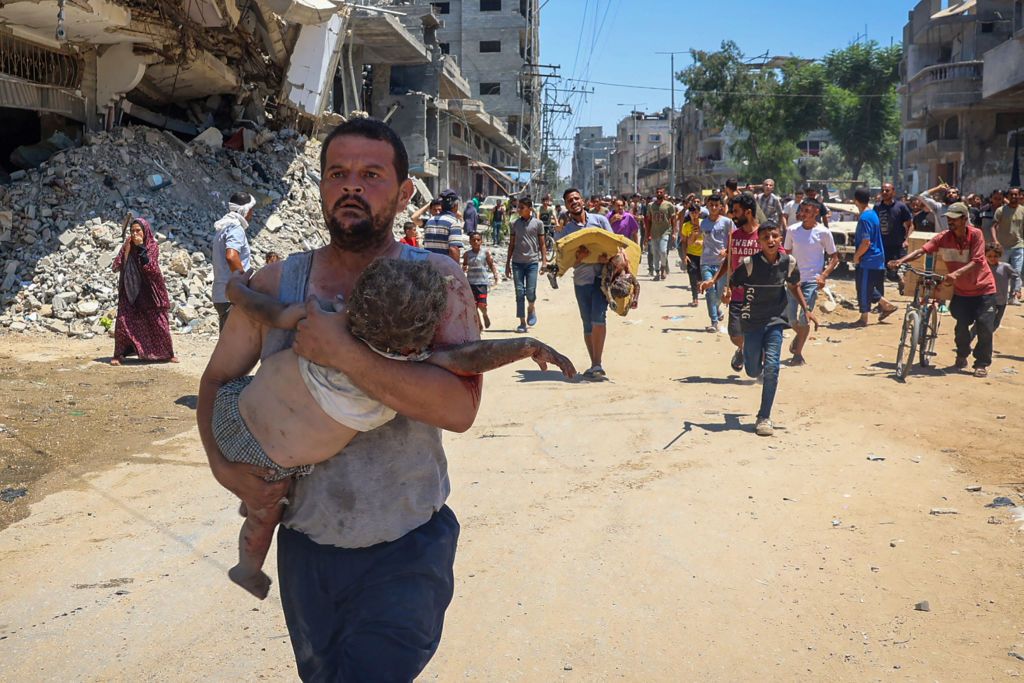
People carry children injured during Israeli bombardment as they flee in al-Bureij refugee camp in the central Gaza Strip on July 23.
(Eyad Baba / Getty Images)
This article originally appeared at TomDispatch.com. To stay on top of important articles like these, sign up to receive the latest updates from TomDispatch.com.
“War is not healthy for children and other living things,” reads a poster titled “Primer” created by the late artist Lorraine Schneider for an art show at New York’s Pratt Institute in 1965. Printed in childlike lowercase letters, the words interspersed between the leaves of a simply rendered sunflower, it was an early response to America’s war in Vietnam. “She just wanted to make something that nobody could argue with,” recalled Schneider’s youngest daughter, Elisa Kleven, in an article published earlier this year. Six decades later, Schneider’s hypothesis has consistently been borne out.
According to Save the Children, about 468 million children—about one of every six young people on this planet—live in areas affected by armed conflict. Verified attacks on children have tripled since 2010. Last year, global conflicts killed three times as many children as in 2022. “Killings and injuries of civilians have become a daily occurrence,” UN human rights chief Volker Türk commented in June when he announced the 2023 figures. “Children shot at. Hospitals bombed. Heavy artillery launched on entire communities.”
It took four decades for the United Nations Security Council to catch up to Schneider. In 2005, that global body identified—and condemned—six grave violations against children in times of war: killing or maiming; recruitment into or use by armed forces and armed groups; attacks on schools or hospitals; rape or other grave acts of sexual violence; abduction; and the denial of humanitarian access to them. Naming and shaming, however, has its limits. Between 2005 and 2023, more than 347,000 grave violations against youngsters were verified across more than 30 conflict zones in Africa, Asia, the Middle East, and Latin America, according to UNICEF, the UN agency for children. The actual number is undoubtedly far higher.
From the extreme damage explosive weapons do to tiny bodies to the lasting effects of acute deprivation on developing brains, children are particularly vulnerable in times of conflict. And once subjected to war, they carry its scars, physical and mental, for a lifetime. A recent study by Italian researchers emphasized what Schneider intuitively knew—that “war inflicts severe violations on the fundamental human rights of children.” The complex trauma of war, they found, “poses a grave threat to the emotional and cognitive development of children, increasing the risk of physical and mental illnesses, disabilities, social problems, and intergenerational consequences.”
Despite such knowledge, the world continues to fail children in times of conflict. The United States was, for instance, one of the members of the UN Security Council that condemned those six grave wartime violations against children. Yet the Biden administration has greenlit tens of billions of dollars in weapons sales to Israel, while US munitions have repeatedly been used in attacks on schools, that have become shelters, predominantly for women and children, in the Gaza Strip. “Make no mistake, the United States is fully, fully, fully supportive of Israel,” President Joe Biden said recently, even though his administration acknowledged the likelihood that Israel had used American weaponry in Gaza in violation of international law.
And Gaza is just one conflict zone where, at this very moment, children are suffering mightily. Let TomDispatch offer you a hellscape tour of this planet, a few stops in a world of war to glimpse just what today’s conflicts are doing to the children trapped by them.
Gaza
The Gaza Strip is the most dangerous place on Earth to be a child, according to UNICEF. Israel has killed around 17,000 children there since the current Gaza War began in October 2023, according to local authorities. And almost as horrific, about 26,000 kids have reportedly lost one or both parents. At least 19,000 of them are now orphans or are otherwise without a caregiver. One million children in Gaza have also been displaced from their homes since October 2023.
In addition, Israel is committing “scholasticide,” the deliberate and systematic destruction of the Palestinian education system in Gaza, according to a recent report by the Al Mezan Center for Human Rights, a Palestinian advocacy group. More than 659,000 children there have been out of school since the beginning of the war. The conflict in Gaza will set children’s education back by years and risks creating a generation of permanently traumatized Palestinians, according to a new study by the University of Cambridge, the Centre for Lebanese Studies, and the United Nations Relief and Works Agency for Palestinian Refugees in the Near East.
Even before the current war, an estimated 800,000 children in Gaza—about 75 percent of the kids there—were in need of mental health and psychosocial support. Now, UNICEF estimates that more than 1 million of them—in effect, every kid in the Gaza Strip—needs such services. In short, you can no longer be a healthy child there.
Lebanon
Over four days in late September, as Israel ramped up its war in Lebanon, about 140,000 children in that Mediterranean nation were displaced. Many arrived at shelters showing signs of deep distress, according to Save the Children staff. “Children are telling us that it feels like danger is everywhere, and they can never be safe. Every loud sound makes them jump now,” said Jennifer Moorehead, Save the Children’s country director in Lebanon. “Many children’s lives, rights, and futures have already been turned upside down and now their capacity to cope with this escalating crisis has been eroded.”
All schools in that country have been closed, adversely affecting every one of its 1.5 million children. More than 890 children have also been injured in Israeli strikes over the last year, the vast majority—more than 690—since August 20, according to the Lebanese Ministry of Public Health. Given that Israel has recently extended attacks from the south of the country to the Lebanese capital, Beirut, they will undoubtedly be joined by all too many others.
Sudan
Children have suffered mightily since heavy fighting erupted in Khartoum, Sudan’s capital, in April 2023 between the Sudanese Armed Forces and the paramilitary Rapid Support Forces. More than 18,000 people have reportedly been killed and close to 10 million have been forced to flee their homes since the civil war there began. Almost half of the displaced Sudanese are—yes!—children, more than 4.6 million of them, making the conflict there the largest child displacement crisis in the world.
More than 16 million Sudanese children are also facing severe food shortages. In the small town of Tawila in that country’s North Darfur state, at least 10 children die of hunger every day, according to a report last month in The Guardian. The population of the town has ballooned as tens of thousands fled El Fasher, North Darfur’s besieged capital. “We anticipate that the exact number of children dying of hunger is much higher,” Aisha Hussien Yagoub, the head of the health authority for the local government in Tawila told The Guardian. “Many of those displaced from El Fasher are living far from our clinic and are unable to reach it.”
More than 10 million Sudanese children, or 50 percent of that country’s kids, have been within about three miles of the front lines of the conflict at some point over the past year. According to Save the Children, this marks the highest rate of exposure in the world. In addition, last year, there was a fivefold increase in grave violations of Sudanese children’s rights compared to 2022.
Syria
More than 30,200 children have been killed since the Syrian Civil War began in 2011, according to the Syrian Network for Human Rights. Another 5,200 children were forcibly disappeared or are under arrest.
However little noticed, Syria’s remains the world’s largest refugee crisis. More than 14 million Syrians have been forced from their homes. More than 7.2 million of them are now estimated to be internally displaced in a country where nine in 10 people exist below the poverty line. An entire generation of children has lived under the constant threat of violence and emotional trauma since 2011. It’s been the only life they’ve ever known.
Popular
“swipe left below to view more authors”Swipe →“Services have already collapsed after 14 years of conflict,” Rasha Muhrez, Save the Children’s response director in Syria, said last month. “The humanitarian crisis in Syria is at a record level.” More than two-thirds of the population of Syria, including about 7.5 million children, require humanitarian assistance. Nearly half of the 5.5 million school-aged children—2.4 million between the ages of 5 and 17—remain out of school, according to UNICEF. About 7,000 schools have been destroyed or damaged.
Recently, Human Rights Watch sounded the alarm about the recruitment of children, “apparently for eventual transfer to armed groups,” by a youth organization affiliated with the Kurdish-led Autonomous Administration for North and East Syria and the US-backed Kurdish-led Syrian Democratic Forces, its military wing.
Ukraine
Child casualties in Ukraine jumped nearly 40 percent in the first half of this year, bringing the total number of children killed or injured in nearly 900 days of war there to about 2,200, according to Save the Children. “This year, violence has escalated with a new intensity, with missiles, drones, and bombs causing an alarming rise in children being injured or killed in daylight blasts,” said Stephane Moissaing, deputy country director for Save the Children in Ukraine. “The suffering for families will not stop as long as explosive weapons are sweeping through populated towns and villages across Ukraine.”
There are already 2.9 million Ukrainian children in need of assistance—and the situation is poised to grow worse in the months ahead. Repeated Russian attacks on the country’s infrastructure could result in power outages of up to 18 hours a day this winter, leaving many of Ukraine’s children freezing and without access to critical services. “The lack of power and all its knock-on effects this winter could have a devastating impact not only on children’s physical health but on their mental well-being and education,” said Munir Mammadzade, UNICEF representative to Ukraine. “Children’s lives are consumed by thoughts of survival, not childhood.”
Ukraine also estimates that Russian authorities have forcibly removed almost 20,000 children from occupied territories there since the February 2022 invasion. A Financial Times investigation found that Ukrainian children who were abducted and taken to Russia early in the war were put up for adoption on a Russian government-linked website. One of them was shown with a false Russian identity. Another was listed using a Russian version of their Ukrainian name. There was no mention of the children’s Ukrainian backgrounds.
West and Central Africa
Conflicts have been raging in the Democratic Republic of Congo (DRC) for decades. World Vision has called the long-running violence there “one of the worst child protection crises in the world.” A 2023 UN report on children and armed conflict documented 3,377 grave violations against children in the DRC. Of these, 46 percent involved the recruitment of children—some as young as five—by armed groups.
Violence and intercommunity tensions in the DRC have forced 1,457 schools to close this year alone, affecting more than 500,000 children. And sadly, that country is no anomaly. In May, the United Nations Office for the Coordination of Humanitarian Affairs reported that more than 5,700 schools in Burkina Faso had been closed due to insecurity, depriving more than 800,000 children of their educations. And by mid-2024, conflicts had shuttered more than 14,300 schools in 24 African countries, according to the Norwegian Refugee Council. That marks an increase of 1,100 closures compared to 2023. The 2024 closures were clustered in West and Central Africa, mainly in Burkina Faso, the DRC, Cameroon, Chad, Nigeria, and Niger. They have affected an estimated 2.8 million children.
“Education is under siege in West and Central Africa. The deliberate targeting of schools and the systemic denial of education because of conflict is nothing short of a catastrophe. Every day that a child is kept out of school is a day stolen from their future and from the future of their communities,” said Hassane Hamadou, the Norwegian Refugee Council’s regional director for West and Central Africa. “We urgently call on all parties to conflict to cease attacks on and occupation of schools and ensure that education is protected and prioritized.”
Feet of Clay
It’s been six decades since Lorraine Schneider unveiled her poster and her commonsense wisdom to the world. She’s been proven right at every turn, in every conflict across the entire planet. Everywhere that children (not to mention other living things) have been exposed to war, they have suffered. Children have been killed and maimed. They have been physically, psychologically, and educationally stunted, as well as emotionally wounded. They have been harmed, assaulted, and deprived. Their bodies have been torn apart. Their minds—the literal architecture of their brains—have been warped by war.
In the conflict zones mentioned above and so many others—from Myanmar to Yemen—the world is failing its children. What they have lost can never be “found” again. Survivors can go on, but there is no going back.
Schneider’s mother, Eva Art, was a self-taught sculptor who escaped pogroms in Ukraine by joining relatives in the United States as a child. She lost touch with her family during World War II, according to her daughter Kleven, and later discovered that her relatives had been killed, their entire shtetl (or small Jewish town) wiped out. To cope with her grief, Art made clay figurines of the dead of her hometown: a boy and his dog, an elderly woman knitting, a mother cradling a baby. And today, the better part of 100 years after the young Art was forced from her home by violence, children continue to suffer in the very same ways—and continue to turn to clay for solace.
Israa Al-Qahwaji, a mental health and psychosocial support coordinator for Save the Children in Gaza, shared the story of a young boy who survived an air strike that resulted in the amputation of one of his hands, while also killing his father and destroying his home. In shock and emotionally withdrawn, the boy was unable to talk about the trauma. However, various therapeutic techniques allowed him to begin to open up, according to Al-Qahwaji. The child began to talk about games he could no longer play and how losing his hand had changed his relationship with his friends. In one therapy session, he was asked to mold something out of clay to represent a wish. With his remaining hand, he carefully shaped a house. After finishing the exercise, he turned to the counselor with a question that left Al-Qahwaji emotionally overwhelmed. “Now,” the boy asked, “will you bring my dad and give me my hand back?”
Support independent journalism that does not fall in line
Even before February 28, the reasons for Donald Trump’s imploding approval rating were abundantly clear: untrammeled corruption and personal enrichment to the tune of billions of dollars during an affordability crisis, a foreign policy guided only by his own derelict sense of morality, and the deployment of a murderous campaign of occupation, detention, and deportation on American streets.
Now an undeclared, unauthorized, unpopular, and unconstitutional war of aggression against Iran has spread like wildfire through the region and into Europe. A new “forever war”—with an ever-increasing likelihood of American troops on the ground—may very well be upon us.
As we’ve seen over and over, this administration uses lies, misdirection, and attempts to flood the zone to justify its abuses of power at home and abroad. Just as Trump, Marco Rubio, and Pete Hegseth offer erratic and contradictory rationales for the attacks on Iran, the administration is also spreading the lie that the upcoming midterm elections are under threat from noncitizens on voter rolls. When these lies go unchecked, they become the basis for further authoritarian encroachment and war.
In these dark times, independent journalism is uniquely able to uncover the falsehoods that threaten our republic—and civilians around the world—and shine a bright light on the truth.
The Nation’s experienced team of writers, editors, and fact-checkers understands the scale of what we’re up against and the urgency with which we have to act. That’s why we’re publishing critical reporting and analysis of the war on Iran, ICE violence at home, new forms of voter suppression emerging in the courts, and much more.
But this journalism is possible only with your support.
This March, The Nation needs to raise $50,000 to ensure that we have the resources for reporting and analysis that sets the record straight and empowers people of conscience to organize. Will you donate today?
More from The Nation

Trump and His Soulless Cronies Have Managed to Suck the Joy Out of the World Cup Trump and His Soulless Cronies Have Managed to Suck the Joy Out of the World Cup
Not even soccer is immune from Trump’s reverse Midas touch.
Garbage In, Carnage Out Garbage In, Carnage Out
The harrowing lessons of the Pentagon’s recently dissolved partnership with Anthropic.
The Iran War Could Be Catastrophic for the US-Israel Alliance. Good. The Iran War Could Be Catastrophic for the US-Israel Alliance. Good.
As Israel’s role in pushing the war with Iran comes into ever sharper focus, it’s up to us to turn outrage into change.

An Unlawful War An Unlawful War
The precedent being set by the US in launching this war of aggression against Iran will long live in infamy.
Trump and Netanyahu Want to Turn Iran Into a Failed State Trump and Netanyahu Want to Turn Iran Into a Failed State
This war looks designed to cause maximum chaos and instability. The world will pay a high price.

The War on Terror Paved the Way for Trump’s Rise—Now He’s Making It His Own The War on Terror Paved the Way for Trump’s Rise—Now He’s Making It His Own
Only the total abolition of the DHS can restore freedom.

